Thank you for visiting SNEWPapers!
Sign up free
Editorial
March 26, 1891
Southern Christian Advocate
Charleston, Charleston County, South Carolina
What is this article about?
This editorial compiles arguments and news items advocating for temperance, criticizing saloon licensing, brewers' practices, and alcohol's societal costs, while highlighting supportive quotes, enforcement successes in Vermont and Kansas, and statistics on arrests in Chicago.
Clipping
OCR Quality
98%
Excellent
Full Text
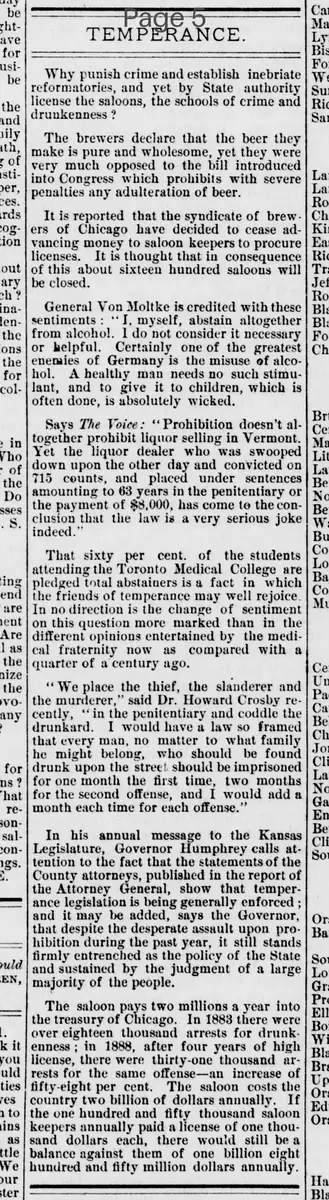
TEMPERANCE
Why punish crime and establish inebriate reformatories, and yet by State authority license the saloons, the schools of crime and drunkenness?
The brewers declare that the beer they make is pure and wholesome, yet they were very much opposed to the bill introduced into Congress which prohibits with severe penalties any adulteration of beer.
It is reported that the syndicate of brewers of Chicago have decided to cease advancing money to saloon keepers to procure licenses. It is thought that in consequence of this about sixteen hundred saloons will be closed.
General Von Moltke is credited with these sentiments: I, myself, abstain altogether from alcohol. I do not consider it necessary or helpful. Certainly one of the greatest enemies of Germany is the misuse of alcohol. A healthy man needs no such stimulant, and to give it to children, which is often done, is absolutely wicked.
Says The Voice: "Prohibition doesn't altogether prohibit liquor selling in Vermont. Yet the liquor dealer who was swooped down upon the other day and convicted on 715 counts, and placed under sentences amounting to 63 years in the penitentiary or the payment of $8,000, has come to the conclusion that the law is a very serious joke indeed."
That sixty per cent. of the students attending the Toronto Medical College are pledged total abstainers is a fact in which the friends of temperance may well rejoice. In no direction is the change of sentiment on this question more marked than in the different opinions entertained by the medical fraternity now as compared with a quarter of a century ago.
"We place the thief, the slanderer and the murderer," said Dr. Howard Crosby recently, "in the penitentiary and coddle the drunkard. I would have a law so framed that every man, no matter to what family he might belong, who should be found drunk upon the street should be imprisoned for one month the first time, two months for the second offense, and I would add a month each time for each offense."
In his annual message to the Kansas Legislature, Governor Humphrey calls attention to the fact that the statements of the County attorneys, published in the report of the Attorney General, show that temperance legislation is being generally enforced and it may be added, says the Governor, that despite the desperate assault upon prohibition during the past year, it still stands firmly entrenched as the policy of the State and sustained by the judgment of a large majority of the people.
The saloon pays two millions a year into the treasury of Chicago. In 1883 there were over eighteen thousand arrests for drunkenness; in 1888, after four years of high license, there were thirty-one thousand arrests for the same offense-an increase of fifty-eight per cent. The saloon costs the country two billion of dollars annually. If the one hundred and fifty thousand saloon keepers annually paid a license of one thousand dollars each, there would still be a balance against them of one billion eight hundred and fifty million dollars annually.
Why punish crime and establish inebriate reformatories, and yet by State authority license the saloons, the schools of crime and drunkenness?
The brewers declare that the beer they make is pure and wholesome, yet they were very much opposed to the bill introduced into Congress which prohibits with severe penalties any adulteration of beer.
It is reported that the syndicate of brewers of Chicago have decided to cease advancing money to saloon keepers to procure licenses. It is thought that in consequence of this about sixteen hundred saloons will be closed.
General Von Moltke is credited with these sentiments: I, myself, abstain altogether from alcohol. I do not consider it necessary or helpful. Certainly one of the greatest enemies of Germany is the misuse of alcohol. A healthy man needs no such stimulant, and to give it to children, which is often done, is absolutely wicked.
Says The Voice: "Prohibition doesn't altogether prohibit liquor selling in Vermont. Yet the liquor dealer who was swooped down upon the other day and convicted on 715 counts, and placed under sentences amounting to 63 years in the penitentiary or the payment of $8,000, has come to the conclusion that the law is a very serious joke indeed."
That sixty per cent. of the students attending the Toronto Medical College are pledged total abstainers is a fact in which the friends of temperance may well rejoice. In no direction is the change of sentiment on this question more marked than in the different opinions entertained by the medical fraternity now as compared with a quarter of a century ago.
"We place the thief, the slanderer and the murderer," said Dr. Howard Crosby recently, "in the penitentiary and coddle the drunkard. I would have a law so framed that every man, no matter to what family he might belong, who should be found drunk upon the street should be imprisoned for one month the first time, two months for the second offense, and I would add a month each time for each offense."
In his annual message to the Kansas Legislature, Governor Humphrey calls attention to the fact that the statements of the County attorneys, published in the report of the Attorney General, show that temperance legislation is being generally enforced and it may be added, says the Governor, that despite the desperate assault upon prohibition during the past year, it still stands firmly entrenched as the policy of the State and sustained by the judgment of a large majority of the people.
The saloon pays two millions a year into the treasury of Chicago. In 1883 there were over eighteen thousand arrests for drunkenness; in 1888, after four years of high license, there were thirty-one thousand arrests for the same offense-an increase of fifty-eight per cent. The saloon costs the country two billion of dollars annually. If the one hundred and fifty thousand saloon keepers annually paid a license of one thousand dollars each, there would still be a balance against them of one billion eight hundred and fifty million dollars annually.
What sub-type of article is it?
Temperance
What keywords are associated?
Temperance
Prohibition
Saloons
Drunkenness
Brewers
Arrests
Medical Students
Alcohol Costs
What entities or persons were involved?
General Von Moltke
Dr. Howard Crosby
Governor Humphrey
Chicago Brewers Syndicate
Toronto Medical College Students
Editorial Details
Primary Topic
Advocacy For Temperance And Criticism Of Saloons And Alcohol
Stance / Tone
Strongly Pro Temperance And Anti Alcohol
Key Figures
General Von Moltke
Dr. Howard Crosby
Governor Humphrey
Chicago Brewers Syndicate
Toronto Medical College Students
Key Arguments
Licensing Saloons Contradicts Punishing Crime And Establishing Reformatories.
Brewers Oppose Anti Adulteration Bills Despite Claiming Beer Purity.
Chicago Brewers Ceasing Loans May Close 1600 Saloons.
Alcohol Misuse Harms Germany; Unnecessary For Healthy People.
Vermont Prohibition Enforces Severe Penalties On Liquor Dealers.
60% Of Toronto Medical Students Are Total Abstainers, Showing Shifting Medical Opinion.
Drunkards Should Face Escalating Prison Terms Like Other Criminals.
Kansas Prohibition Is Enforced And Supported By Majority.
Chicago Saloons Increase Drunkenness Arrests Despite Revenue; Overall Societal Cost Exceeds Potential License Fees.