Thank you for visiting SNEWPapers!
Sign up free
The Indian Leader
Lawrence, Douglas County, Kansas
What is this article about?
Report on Quinaielt Reservation in Washington, detailing its origins from 1855-1856 treaties, land allotments, schools with total capacity of 865 pupils, economy based on salmon fishing yielding over $75,000 annually, challenges in agriculture due to climate, and plans for local Indian government to prepare for citizenship.
Merged-components note: Merged Taholah Indian School report across pages 7-8, including image and dateline. Relabeled domestic_news to story. Note: initial parsing included ending of prior Gila report in this component's text.
Clippings
1 of 2
OCR Quality
Full Text
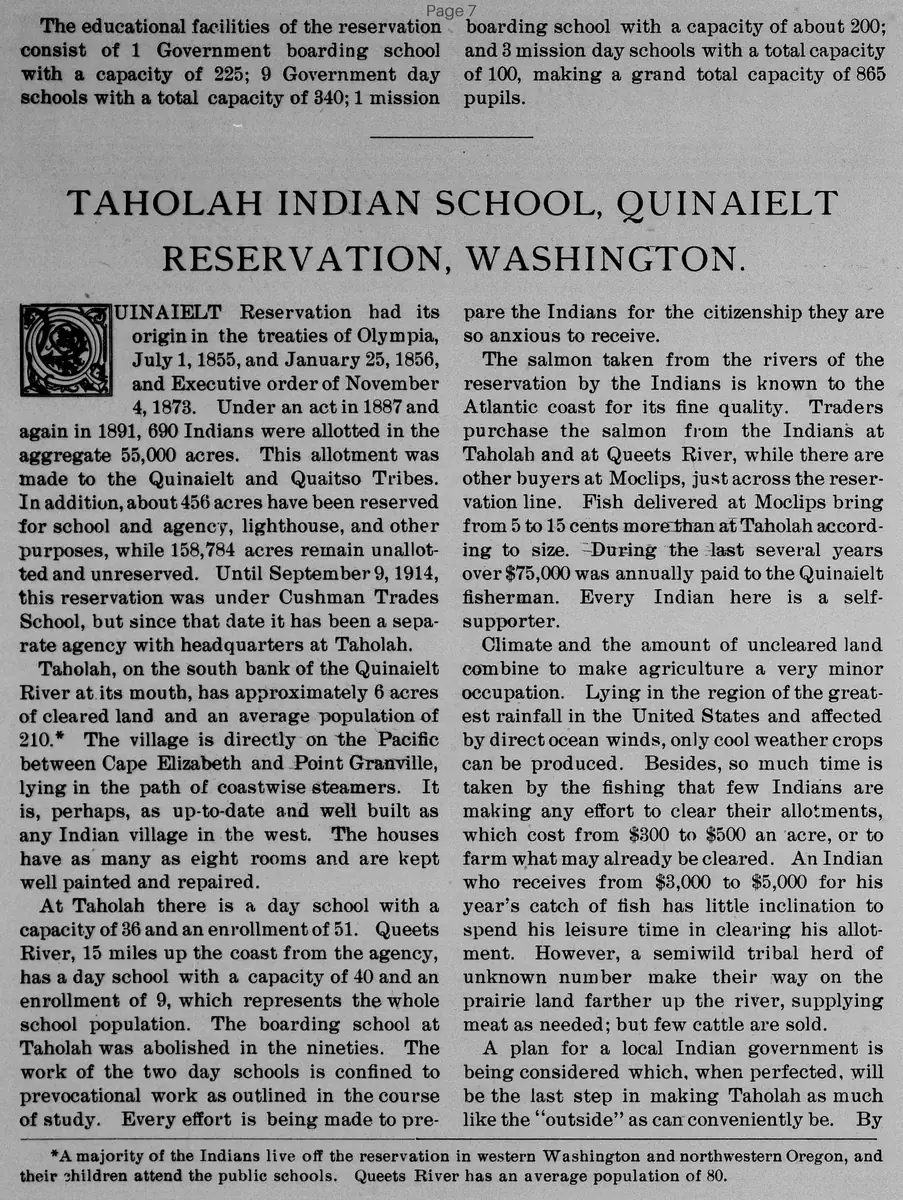
TAHOLAH INDIAN SCHOOL, QUINAIELT RESERVATION, WASHINGTON.
QUINAIELT Reservation had its origin in the treaties of Olympia, July 1, 1855, and January 25, 1856, and Executive order of November 4, 1873. Under an act in 1887 and again in 1891, 690 Indians were allotted in the aggregate 55,000 acres. This allotment was made to the Quinaielt and Quaitso Tribes. In addition, about 456 acres have been reserved for school and agency, lighthouse, and other purposes, while 158,784 acres remain unallotted and unreserved. Until September 9, 1914, this reservation was under Cushman Trades School, but since that date it has been a separate agency with headquarters at Taholah. Taholah, on the south bank of the Quinaielt River at its mouth, has approximately 6 acres of cleared land and an average population of 210.* The village is directly on the Pacific between Cape Elizabeth and Point Granville, lying in the path of coastwise steamers. It is, perhaps, as up-to-date and well built as any Indian village in the west. The houses have as many as eight rooms and are kept well painted and repaired.
At Taholah there is a day school with a capacity of 36 and an enrollment of 51. Queets River, 15 miles up the coast from the agency, has a day school with a capacity of 40 and an enrollment of 9, which represents the whole school population. The boarding school at Taholah was abolished in the nineties. The work of the two day schools is confined to prevocational work as outlined in the course of study. Every effort is being made to prepare the Indians for the citizenship they are so anxious to receive.
The salmon taken from the rivers of the reservation by the Indians is known to the Atlantic coast for its fine quality. Traders purchase the salmon from the Indians at Taholah and at Queets River, while there are other buyers at Moclips, just across the reservation line. Fish delivered at Moclips bring from 5 to 15 cents more than at Taholah according to size. During the last several years over $75,000 was annually paid to the Quinaielt fisherman. Every Indian here is a self-supporter.
Climate and the amount of uncleared land combine to make agriculture a very minor occupation. Lying in the region of the greatest rainfall in the United States and affected by direct ocean winds, only cool weather crops can be produced. Besides, so much time is taken by the fishing that few Indians are making any effort to clear their allotments, which cost from $300 to $500 an acre, or to farm what may already be cleared. An Indian who receives from $3,000 to $5,000 for his year's catch of fish has little inclination to spend his leisure time in clearing his allotment. However, a semi-wild tribal herd of unknown number make their way on the prairie land farther up the river, supplying meat as needed; but few cattle are sold.
A plan for a local Indian government is being considered which, when perfected, will be the last step in making Taholah as much like the "outside" as can conveniently be. By
*A majority of the Indians live off the reservation in western Washington and northwestern Oregon, and their children attend the public schools. Queets River has an average population of 80.
this plan, the Indians will be given an opportunity to become acquainted with State and county affairs before being called on to take a hand in the actual duties thereof.
TAHOLAH.
What sub-type of article is it?
What themes does it cover?
What keywords are associated?
What entities or persons were involved?
Where did it happen?
Story Details
Key Persons
Location
Quinaielt Reservation, Washington; Taholah; Queets River
Event Date
1855 1914
Story Details
The Quinaielt Reservation originated from 1855-1856 treaties and 1873 executive order; 690 Indians allotted 55,000 acres in 1887-1891; educational facilities total 865 pupils capacity; economy relies on salmon fishing earning over $75,000 annually; agriculture limited by climate; plans for local government to aid citizenship preparation.