Thank you for visiting SNEWPapers!
Sign up free
Shepherdstown Register
Shepherdstown, Jefferson County, West Virginia
What is this article about?
Prof. Taylor of the Department of Agriculture confirms the horse disease is contagious via microscopic spores, causing nasal symptoms upon inhalation. He recommends binding flannel around the horse's forehead for early treatment, claiming high success rate.
Clipping
OCR Quality
Full Text
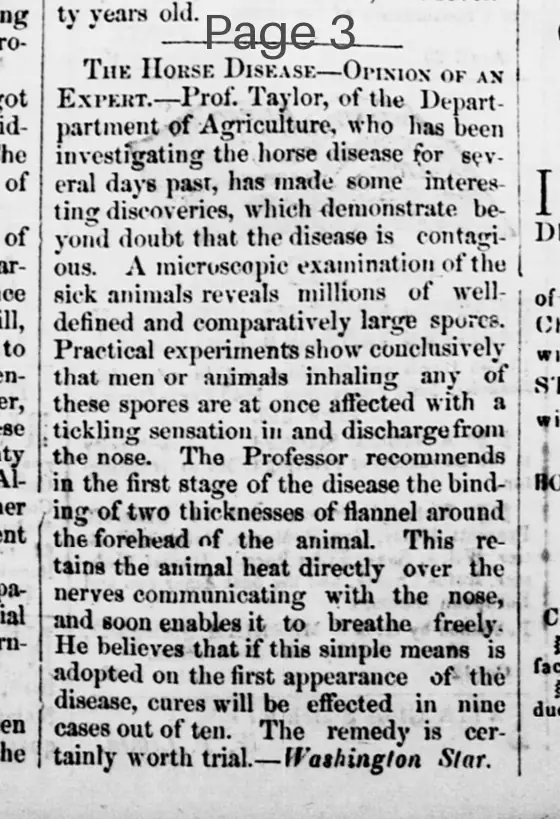
Prof. Taylor, of the Department of Agriculture, who has been investigating the horse disease for several days past, has made some interesting discoveries, which demonstrate beyond doubt that the disease is contagious. A microscopic examination of the sick animals reveals millions of well-defined and comparatively large spores. Practical experiments show conclusively that men or animals inhaling any of these spores are at once affected with a tickling sensation in and discharge from the nose. The Professor recommends in the first stage of the disease the binding of two thicknesses of flannel around the forehead of the animal. This retains the animal heat directly over the nerves communicating with the nose, and soon enables it to breathe freely. He believes that if this simple means is adopted on the first appearance of the disease, cures will be effected in nine cases out of ten. The remedy is certainly worth trial.—Washington Star.
What sub-type of article is it?
What keywords are associated?
What entities or persons were involved?
Where did it happen?
Domestic News Details
Primary Location
Washington
Key Persons
Outcome
cures expected in nine out of ten cases with early flannel treatment; disease causes nasal tickling and discharge.
Event Details
Prof. Taylor investigated the horse disease, finding it contagious through microscopic spores inhaled by men or animals, leading to nasal symptoms. He recommends binding two thicknesses of flannel around the animal's forehead in the first stage to retain heat over nasal nerves for freer breathing.