Thank you for visiting SNEWPapers!
Sign up free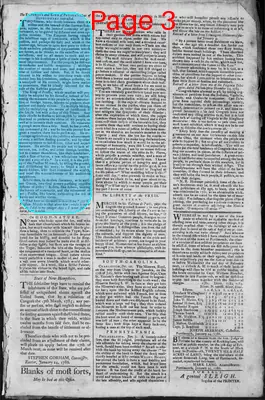
Fowle's New Hampshire Gazette And General Advertiser
Portsmouth, Rockingham County, New Hampshire
What is this article about?
Contrast between the Emperor's promotion of commerce, trade, and luxury in Austria versus the King of Prussia's focus on agriculture, parsimony, and hardy virtues to build a strong military in Prussia, within the German Empire.
Clipping
OCR Quality
Full Text
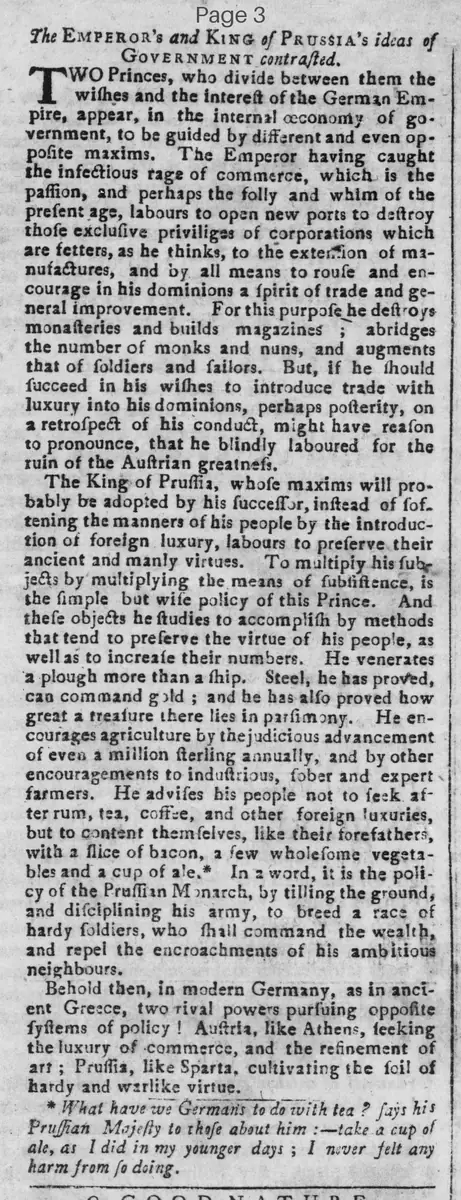
TWO Princes, who divide between them the wishes and the interest of the German Empire, appear, in the internal oeconomy of government, to be guided by different and even opposite maxims. The Emperor having caught the infectious rage of commerce, which is the passion, and perhaps the folly and whim of the present age, labours to open new ports to destroy those exclusive privileges of corporations which are fetters, as he thinks, to the extension of manufactures, and by all means to rouze and encourage in his dominions a spirit of trade and general improvement. For this purpose he destroys monasteries and builds magazines; abridges the number of monks and nuns, and augments that of soldiers and sailors. But, if he should succeed in his wishes to introduce trade with luxury into his dominions, perhaps posterity, on a retrospect of his conduct, might have reason to pronounce, that he blindly laboured for the ruin of the Austrian greatness.
The King of Prussia, whose maxims will probably be adopted by his successor, instead of softening the manners of his people by the introduction of foreign luxury, labours to preserve their ancient and manly virtues. To multiply his subjects by multiplying the means of subsistence, is the simple but wise policy of this Prince. And these objects he studies to accomplish by methods that tend to preserve the virtue of his people, as well as to increase their numbers. He venerates a plough more than a ship. Steel, he has proved, can command gold; and he has also proved how great a treasure there lies in parsimony. He encourages agriculture by the judicious advancement of even a million sterling annually, and by other encouragements to industrious, sober and expert farmers. He advises his people not to seek after rum, tea, coffee, and other foreign luxuries, but to content themselves, like their forefathers, with a slice of bacon, a few wholesome vegetables and a cup of ale. In a word, it is the policy of the Prussian Monarch, by tilling the ground, and disciplining his army, to breed a race of hardy soldiers, who shall command the wealth, and repel the encroachments of his ambitious neighbours.
Behold then, in modern Germany, as in ancient Greece, two rival powers pursuing opposite systems of policy! Austria, like Athens, seeking the luxury of commerce, and the refinement of art; Prussia, like Sparta, cultivating the soil of hardy and warlike virtue.
* What have we Germans to do with tea? says his Prussian Majesty to those about him: -- take a cup of ale, as I did in my younger days; I never felt any harm from so doing.
What sub-type of article is it?
What keywords are associated?
What entities or persons were involved?
Where did it happen?
Foreign News Details
Primary Location
German Empire
Key Persons
Outcome
potential ruin of austrian greatness from introducing trade and luxury; prussian policy to increase subjects, preserve virtues, and build hardy soldiers to command wealth and repel neighbors.
Event Details
The Emperor promotes commerce by opening ports, destroying corporate privileges, encouraging trade, destroying monasteries to build magazines, reducing monks and nuns while increasing soldiers and sailors. The King of Prussia preserves manly virtues, multiplies subjects through subsistence means, encourages agriculture with annual advancements and supports industrious farmers, advises against foreign luxuries in favor of simple fare, and focuses on tilling ground and disciplining army to breed hardy soldiers.