Thank you for visiting SNEWPapers!
Sign up free
Story
April 22, 1863
The Potter Journal
Coudersport, Potter County, Pennsylvania
What is this article about?
In a tale of redemption, young Willie M- sneaks into a saloon to join his struggling father, whose innocent plea inspires the man to swear off drink, restoring family harmony amid poverty.
Merged-components note: Continuation of the story 'Papa Goes There.' across sequential reading orders and adjacent bboxes.
Clipping
OCR Quality
98%
Excellent
Full Text
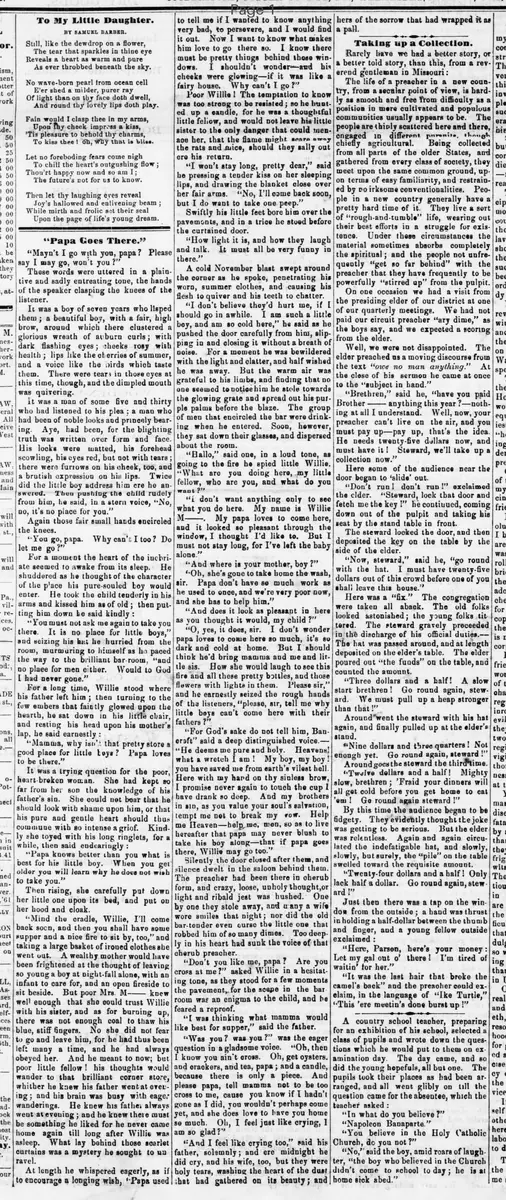
"Papa Goes There."
"Mayn't I go with you, papa? Please say I may go, won't you?"
These words were uttered in a plaintive and sadly entreating tone, the hands of the speaker clasping the knees of the listener.
It was a boy of seven years who lisped them; a beautiful boy, with a fair, high brow, around which there clustered a glorious wreath of auburn curls; with dark flashing eyes; cheeks rosy with health; lips like the cherries of summer, and a voice like the birds which taste them. There were tears in those eyes at this time, though, and the dimpled mouth was quivering.
It was a man of some five and thirty who had listened to his plea: a man who had been of noble looks and princely bearing. Aye, had been, for the blighting truth was written over form and face. His locks were matted, his forehead scowling, his eyes red, but not with tears: there were furrows on his cheek, too, and a brutish expression on his lips. Twice did the little boy address him ere he answered. Then pushing the child rudely from him, he said, in a stern voice, "No, no, it's no place for you."
Again those fair small hands encircled the knees.
"You go, papa. Why can't I too? Do let me go?"
For a moment the heart of the inebriate seemed to awake from its sleep. He shuddered as he thought of the character of the place his pure-souled boy would enter.
He took the child tenderly in his arms and kissed him as of old; then putting him down he said kindly:
"You must not ask me again to take you there. It is no place for little boys,"
and seizing his hat he hurried from the room, murmuring to himself as he paced the way to the brilliant bar-room, "and no place for men either. Would to God I had never gone."
For a long time, Willie stood where his father left him; then turning to the few embers that faintly glowed upon the hearth, he sat down in his little chair, and resting his head upon his mother's lap, he said earnestly:
"Mamma, why isn't that pretty store a good place for little boys? Papa loves to be there."
It was a trying question for the poor, heart-broken woman. She had kept so far from her son the knowledge of his father's sin. She could not bear that he should look with shame upon him, or that his pure and gentle heart should thus commune with so intense a grief. Kindly she toyed with his long ringlets, for a while, then said endearingly:
"Papa knows better than you what is best for his little boy. When you get older you will learn why he does not wish to take you."
Then rising, she carefully put down her little one upon its bed, and put on her hood and cloak.
"Mind the cradle, Willie, I'll come back soon, and then you shall have some supper and a nice fire to sit by, too," and taking a large basket of ironed clothes she went out. A wealthy mother would have been frightened at the thought of leaving so young a boy at night-fall alone, with an infant to care for, and an open fireside to sit beside. But poor Mrs. M- knew well enough that she could trust Willie with his sister, and as for burning up, there was not enough coal to thaw his blue, stiff fingers. No she did not fear to go and leave him, for he had thus been left many a time, and he had always obeyed her. And he meant to now; but poor little fellow! his thoughts would wander to that brilliant corner store, whither he knew his father went at evening; and his brain was busy with eager wanderings. He knew his father always went at evening; and he knew there must be something he liked for he never came home again till long after Willie was asleep. What lay behind those scarlet curtains was a mystery he sought to unravel.
At length he whispered eagerly, as if to encourage a longing wish, "Papa used
to tell me if I wanted to know anything very bad, to persevere, and I would find it out. Now I want to know what makes him love to go there so. I know there must be pretty things behind those windows. I shouldn't wonder-and his cheeks were glowing-if it was like a fairy house. Why can't I go?"
Poor Willie! The temptation to know was too strong to be resisted; so he hunted up a candle, for he was a thoughtful little fellow, and would not leave his little sister to the only danger that could menace her, that the flame might scare away the rats and mice, should they sally out ere his return.
"I won't stay long, pretty dear," said he pressing a tender kiss on her sleeping lips, and drawing the blanket close over her fair arms.
"No, I'll come back soon, but I do want to take one peep."
Swiftly his little feet bore him over the pavements, and in a trice he stood before the curtained door.
"How light it is, and how they laugh and talk. It must all be very funny in there."
A cold November blast swept around the corner as he spoke, penetrating his worn, summer clothes, and causing his flesh to quiver and his teeth to chatter.
"I don't believe they'd hurt me, if I should go in awhile. I am such a little boy, and am so cold here," he said as he pushed the door carefully from him, slipping in and closing it without a breath of noise. For a moment he was bewildered with the light and clatter, and half wished he was away. But the warm air was grateful to his limbs, and finding that no one seemed to notice him he stole towards the glowing grate and spread out his purple palms before the blaze. The group of men that encircled the bar were drinking when he entered. Soon, however, they sat down their glasses, and dispersed about the room.
"Hallo," said one, in a loud tone, as going to the fire he spied little Willie.
"What are you doing here, my little fellow, who are you, and what do you want?"
"I don't want anything only to see what you do here. My name is Willie M- My papa loves to come here, and it looked so pleasant through the window, I thought I'd like to. But I must not stay long, for I've left the baby alone."
"And where is your mother, boy?"
"Oh, she's gone to take home the wash, sir. Papa don't have so much work as he used to once, and we're very poor now, and she has to help him."
"And does it look as pleasant in here as you thought it would, my child?"
"O, yes, it does, sir. I don't wonder papa loves to come here so much, it's so dark and cold at home. But I should think he'd bring mamma and me and little sis. How she would laugh to see this fire and all these pretty bottles, and those flowers with lights in them. Please sir."
and he earnestly seized the rough hands of the listeners, "please, sir, tell me why little boys can't come here with their fathers?"
"For God's sake do not tell him, Bancroft," said a deep distinguished voice.-
"He deems us pure and holy. Heavens! what a wretch I am! My boy, my boy! you have saved me from earth's vilest hell. Here with my hand on thy sinless brow, I promise never again to touch the cup I have drank so deep. And my brothers in sin, as you value your soul's salvation, tempt me not to break my vow. Help me Heaven-help me, men, so as to live hereafter that papa may never blush to take his boy along-that if papa goes there, Willie may go too."
Silently the door closed after them, and silence dwelt in the saloon behind them. The preacher had been there in cherub form, and crazy, loose, unholy thought, or light and ribald jest was hushed. One by one they stole away, and many a wife wore smiles that night; nor did the old bar-tender even curse the little one that robbed him of so many dimes. Too deeply in his heart had sunk the voice of that cherub preacher.
"Don't you like me, papa? Are you cross at me?" asked Willie in a hesitating tone, as they stood for a few moments on the pavement, for the scene in the bar room was an enigma to the child, and he feared a reproof.
"I was thinking what mamma would like best for supper," said the father.
"Was you? was you?" was the eager question in a gladsome voice. "Oh, then I know you ain't cross. Oh, get oysters and crackers, and tea, papa; and a candle, because there is only a piece. And please papa, tell mamma not to be too cross to me, cause you know if I hadn't gone as I did, you wouldn't perhaps come yet, and she does love to have you home so much. Oh, I feel just like crying, I am so glad?"
"And I feel like crying too," said his father, solemnly; and ere midnight he did cry, and his wife, too, but they were holy tears, washing the heart of the dust that had gathered on its beauty; and members of the sorrow that had wrapped it as a pall.
"Mayn't I go with you, papa? Please say I may go, won't you?"
These words were uttered in a plaintive and sadly entreating tone, the hands of the speaker clasping the knees of the listener.
It was a boy of seven years who lisped them; a beautiful boy, with a fair, high brow, around which there clustered a glorious wreath of auburn curls; with dark flashing eyes; cheeks rosy with health; lips like the cherries of summer, and a voice like the birds which taste them. There were tears in those eyes at this time, though, and the dimpled mouth was quivering.
It was a man of some five and thirty who had listened to his plea: a man who had been of noble looks and princely bearing. Aye, had been, for the blighting truth was written over form and face. His locks were matted, his forehead scowling, his eyes red, but not with tears: there were furrows on his cheek, too, and a brutish expression on his lips. Twice did the little boy address him ere he answered. Then pushing the child rudely from him, he said, in a stern voice, "No, no, it's no place for you."
Again those fair small hands encircled the knees.
"You go, papa. Why can't I too? Do let me go?"
For a moment the heart of the inebriate seemed to awake from its sleep. He shuddered as he thought of the character of the place his pure-souled boy would enter.
He took the child tenderly in his arms and kissed him as of old; then putting him down he said kindly:
"You must not ask me again to take you there. It is no place for little boys,"
and seizing his hat he hurried from the room, murmuring to himself as he paced the way to the brilliant bar-room, "and no place for men either. Would to God I had never gone."
For a long time, Willie stood where his father left him; then turning to the few embers that faintly glowed upon the hearth, he sat down in his little chair, and resting his head upon his mother's lap, he said earnestly:
"Mamma, why isn't that pretty store a good place for little boys? Papa loves to be there."
It was a trying question for the poor, heart-broken woman. She had kept so far from her son the knowledge of his father's sin. She could not bear that he should look with shame upon him, or that his pure and gentle heart should thus commune with so intense a grief. Kindly she toyed with his long ringlets, for a while, then said endearingly:
"Papa knows better than you what is best for his little boy. When you get older you will learn why he does not wish to take you."
Then rising, she carefully put down her little one upon its bed, and put on her hood and cloak.
"Mind the cradle, Willie, I'll come back soon, and then you shall have some supper and a nice fire to sit by, too," and taking a large basket of ironed clothes she went out. A wealthy mother would have been frightened at the thought of leaving so young a boy at night-fall alone, with an infant to care for, and an open fireside to sit beside. But poor Mrs. M- knew well enough that she could trust Willie with his sister, and as for burning up, there was not enough coal to thaw his blue, stiff fingers. No she did not fear to go and leave him, for he had thus been left many a time, and he had always obeyed her. And he meant to now; but poor little fellow! his thoughts would wander to that brilliant corner store, whither he knew his father went at evening; and his brain was busy with eager wanderings. He knew his father always went at evening; and he knew there must be something he liked for he never came home again till long after Willie was asleep. What lay behind those scarlet curtains was a mystery he sought to unravel.
At length he whispered eagerly, as if to encourage a longing wish, "Papa used
to tell me if I wanted to know anything very bad, to persevere, and I would find it out. Now I want to know what makes him love to go there so. I know there must be pretty things behind those windows. I shouldn't wonder-and his cheeks were glowing-if it was like a fairy house. Why can't I go?"
Poor Willie! The temptation to know was too strong to be resisted; so he hunted up a candle, for he was a thoughtful little fellow, and would not leave his little sister to the only danger that could menace her, that the flame might scare away the rats and mice, should they sally out ere his return.
"I won't stay long, pretty dear," said he pressing a tender kiss on her sleeping lips, and drawing the blanket close over her fair arms.
"No, I'll come back soon, but I do want to take one peep."
Swiftly his little feet bore him over the pavements, and in a trice he stood before the curtained door.
"How light it is, and how they laugh and talk. It must all be very funny in there."
A cold November blast swept around the corner as he spoke, penetrating his worn, summer clothes, and causing his flesh to quiver and his teeth to chatter.
"I don't believe they'd hurt me, if I should go in awhile. I am such a little boy, and am so cold here," he said as he pushed the door carefully from him, slipping in and closing it without a breath of noise. For a moment he was bewildered with the light and clatter, and half wished he was away. But the warm air was grateful to his limbs, and finding that no one seemed to notice him he stole towards the glowing grate and spread out his purple palms before the blaze. The group of men that encircled the bar were drinking when he entered. Soon, however, they sat down their glasses, and dispersed about the room.
"Hallo," said one, in a loud tone, as going to the fire he spied little Willie.
"What are you doing here, my little fellow, who are you, and what do you want?"
"I don't want anything only to see what you do here. My name is Willie M- My papa loves to come here, and it looked so pleasant through the window, I thought I'd like to. But I must not stay long, for I've left the baby alone."
"And where is your mother, boy?"
"Oh, she's gone to take home the wash, sir. Papa don't have so much work as he used to once, and we're very poor now, and she has to help him."
"And does it look as pleasant in here as you thought it would, my child?"
"O, yes, it does, sir. I don't wonder papa loves to come here so much, it's so dark and cold at home. But I should think he'd bring mamma and me and little sis. How she would laugh to see this fire and all these pretty bottles, and those flowers with lights in them. Please sir."
and he earnestly seized the rough hands of the listeners, "please, sir, tell me why little boys can't come here with their fathers?"
"For God's sake do not tell him, Bancroft," said a deep distinguished voice.-
"He deems us pure and holy. Heavens! what a wretch I am! My boy, my boy! you have saved me from earth's vilest hell. Here with my hand on thy sinless brow, I promise never again to touch the cup I have drank so deep. And my brothers in sin, as you value your soul's salvation, tempt me not to break my vow. Help me Heaven-help me, men, so as to live hereafter that papa may never blush to take his boy along-that if papa goes there, Willie may go too."
Silently the door closed after them, and silence dwelt in the saloon behind them. The preacher had been there in cherub form, and crazy, loose, unholy thought, or light and ribald jest was hushed. One by one they stole away, and many a wife wore smiles that night; nor did the old bar-tender even curse the little one that robbed him of so many dimes. Too deeply in his heart had sunk the voice of that cherub preacher.
"Don't you like me, papa? Are you cross at me?" asked Willie in a hesitating tone, as they stood for a few moments on the pavement, for the scene in the bar room was an enigma to the child, and he feared a reproof.
"I was thinking what mamma would like best for supper," said the father.
"Was you? was you?" was the eager question in a gladsome voice. "Oh, then I know you ain't cross. Oh, get oysters and crackers, and tea, papa; and a candle, because there is only a piece. And please papa, tell mamma not to be too cross to me, cause you know if I hadn't gone as I did, you wouldn't perhaps come yet, and she does love to have you home so much. Oh, I feel just like crying, I am so glad?"
"And I feel like crying too," said his father, solemnly; and ere midnight he did cry, and his wife, too, but they were holy tears, washing the heart of the dust that had gathered on its beauty; and members of the sorrow that had wrapped it as a pall.
What sub-type of article is it?
Family Drama
Personal Triumph
What themes does it cover?
Family
Moral Virtue
Triumph
What keywords are associated?
Temperance Story
Alcohol Reform
Family Redemption
Child Innocence
Saloon Temptation
What entities or persons were involved?
Willie M
Papa (Mr. M )
Mrs. M
Little Sister
Where did it happen?
Home And Bar Room Saloon
Story Details
Key Persons
Willie M
Papa (Mr. M )
Mrs. M
Little Sister
Location
Home And Bar Room Saloon
Story Details
A poor boy, Willie, begs to accompany his alcoholic father to a bar but is refused. Curious, he sneaks in alone, innocently questions the men, prompting his father to vow sobriety and reform, reuniting the family with hope.