Thank you for visiting SNEWPapers!
Sign up free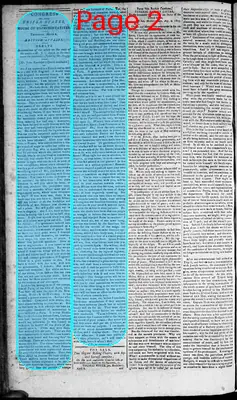
Alexandria Daily Advertiser
Alexandria, Virginia
What is this article about?
In the U.S. House of Representatives on Thursday, March 6, during a committee of the whole debate on British affairs, John Randolph concluded his speech opposing war with Britain or France, advocating for negotiation and criticizing past U.S. treaty handling and conduct toward Spain.
Clipping
OCR Quality
Full Text
OF THE
UNITED STATES.
HOUSE OF REPRESENTATIVES.
Thursday March 6.
BRITISH AFFAIRS.
DEBATE
In committee of the whole on the state of the union--Mr. F. G. Smith, in the chair--on the resolution offered by Mr. Gregg.
[Mr. John Randolph's Speech concluded.]
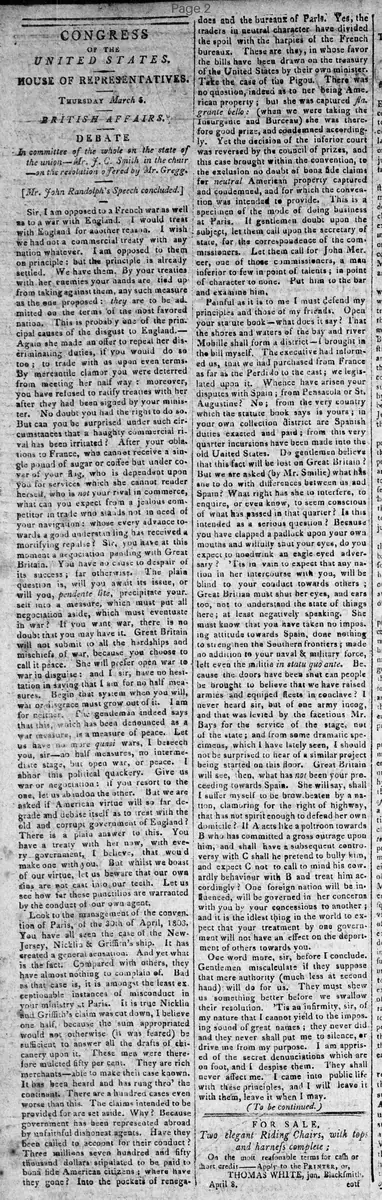
Sir, I am opposed to a French war as well as to a war with England. I would treat with England for another reason. I wish we had not a commercial treaty with any nation whatever. I am opposed to them on principle: but the principle is already settled. We have them. By your treaties with her enemies your hands are tied up from taking against them, any such measure as the one proposed: they are to be admitted on the terms of the most favored nation. This is probably one of the principal causes of the disgust to England.--Again she made an offer to repeal her discriminating duties, if you would do so too; to trade with us upon even terms. By mercantile clamor you were deterred from meeting her half way: moreover, you have refused to ratify treaties with her after they had been signed by your minister. No doubt you had the right to do so. But can you be surprised under such circumstances that a haughty commercial rival has been irritated? After your obligations to France, who cannot receive a single pound of sugar or coffee but under cover of your flag, who is dependent upon you for services which she cannot render herself, who is not your rival in commerce, what can you expect from a jealous competitor in trade who stands not in need of your navigation: whose every advance towards a good understanding has received a mortifying repulse? Sir, you have at this moment a negotiation pending with Great Britain. You have no cause to despair of its success; far otherwise. The plain question is, will you await its issue, or will you, pendente lite, precipitate yourself into a measure, which must put all negotiation aside, which must eventuate in war? If you want war, there is no doubt that you may have it. Great Britain will not submit to all the hardships and mischiefs of war, because you choose to call it peace. She will prefer open war to war in disguise: and I sir, have no hesitation in saying that I am for no half measures. Begin that system when you will, war or disgrace must grow out of it. I am for neither. A gentleman indeed says that this, which has been denounced as a war measure, is a measure of peace. Let us have no more quasi wars, I beseech you, sir--no half measures, no intermediate stage, but open war, or peace. I abhor this political quackery. Give us war or negotiation: if you resort to the one, let us abandon the other. But we are asked if American virtue will so far degrade and debase itself as to treat with the old and corrupt government of England? There is a plain answer to this. You have a treaty with her now, with every government, I believe, that would make one with you. But whilst we boast of our virtue, let us beware that our own sins are not cast into our teeth. Let us see how far these punctilios are warranted by the conduct of our own agent. Look to the management of the convention of Paris, of the 30th of April, 1803. You have all seen the case of the New-Jersey, Nicklin & Griffith's ship. It has created a general sensation: And yet what is the fact. Compared with others, they have almost nothing to complain of. Bad as that case is, it is amongst the least exceptionable instances of misconduct in your ministry at Paris. It is true Nicklin and Griffith's claim was cut down, I believe one half, because the sum appropriated would not otherwise (it was feared) be sufficient to answer all the drafts of chicanery upon it. These men were therefore mulcted fifty per cent. They are rich merchants-able to make their case known. It has been heard and has rung through the continent. There are a hundred cases even worse than this. The claims intended to be provided for are set aside. Why? Because government has been represented abroad by unfaithful dishonest agents. Have they been called to account for their conduct? Three millions seven hundred and fifty thousand dollars stipulated to be paid to bona fide American citizens; where have they gone? Into the pockets of renegades and the bureaux of Paris. Yes, the traders in neutral character have divided the spoil with the harpies of the French bureaux. These are they, in whose favor the bills have been drawn on the treasury of the United States by their own minister. Take the case of the Pigou. There was no question, indeed as to her being American property; but she was captured flagrante bello: (when we were taking the Insurgente and La Vengeance) she was therefore good prize, and condemned accordingly. Yet the decision of the inferior court was reversed by the council of prizes, and this case brought within the convention, to the exclusion no doubt of bona fide claims for neutral American property captured and condemned, and for which the convention was intended to provide. This is a specimen of the mode of doing business at Paris. If gentlemen doubt upon the subject, let them call upon the secretary of state, for the correspondence of the commissioners. Let them call for John Mercer, one of those commissioners, a man inferior to few in point of talents; in point of character to none. Put him to the bar and examine him. Painful as it is to me I must defend my principles and those of my friends. Open your statute book--what does it say? That the shores and waters of the bay and river Mobile shall form a district--I brought in the bill myself. The executive had informed us, that we had purchased from France as far as the Perdido to the east; we legislated upon it. Whence have arisen your disputes with Spain; from Pensacola or St. Augustine? No; from the very country which the statute book says is yours; in your own collection district are Spanish duties exacted and paid; from this very quarter incursions have been made into the old United States. Do gentlemen believe that this fact will be lost on Great Britain? But we are asked (by Mr. Smilie) what has she to do with differences between us and Spain? What right has she to interfere, to enquire, or even know, to seem conscious of what has passed in that quarter? Is this intended as a serious question? Because you have clapped a padlock upon your own mouths and wilfully shut your eyes, do you expect to hoodwink an eagle eyed adversary? 'Tis in vain to expect that any nation in her intercourse with you, will be blind to your conduct towards others; Great Britain must shut her eyes, and ears too, not to understand the state of things here; at least negatively speaking. She must know that you have taken no imposing attitude towards Spain, done nothing to strengthen the Southern frontiers; made no addition to your naval & military force, left even the militia in statu quo ante. Because the doors have been shut can people be brought to believe that we have raised armies and equipped fleets in conclave? I never heard sir, but of one army incog, and that was levied by the facetious Mr. Bayes for the service of the stage, not of the state; and from some dramatic specimens, which I have lately seen, I should not be surprised to hear of a similar project being started on this floor. Great Britain will see, then, what has not been your proceeding towards Spain. She will say, shall I suffer myself to be brow-beaten by a nation, clamoring for the right of highway, that has not spirit enough to defend her own domicile?--If A acts like a poltroon towards B who has committed a gross outrage upon him, and shall have a subsequent controversy with C shall he pretend to bully him, and expect C not to call to mind his cowardly behaviour with B and treat him accordingly? One foreign nation will be influenced, will be governed in her concerns with you by your concessions to another; and it is the idlest thing in the world to expect that your treatment by one government will not have an effect on the deportment of others towards you. One word more, sir, before I conclude. Gentlemen miscalculate if they suppose that mere authority (much less at second hand) will do for us. They must show us something better before we swallow their resolution. Tis an infirmity, sir, of my nature that I cannot yield to the imposing sound of great names; they never did, and they never shall put me to silence, or drive me from my purpose. I am apprised of the secret denunciations which are on foot, and I despise them. They shall never affect me. I came into public life with these principles, and I will leave it with them, leave it when I may.
(To be continued.)
What sub-type of article is it?
What keywords are associated?
What entities or persons were involved?
Where did it happen?
Domestic News Details
Primary Location
United States House Of Representatives
Event Date
Thursday March 6.
Key Persons
Event Details
In committee of the whole on the state of the union, chaired by Mr. F. G. Smith, debate on the resolution offered by Mr. Gregg regarding British affairs. Mr. John Randolph concluded his speech opposing war with France or England, advocating for negotiation with Britain, criticizing U.S. treaty obligations, past refusals to ratify treaties, misconduct in the Paris convention of April 30, 1803, including cases like Nicklin & Griffith's ship and the Pigou, and U.S. handling of disputes with Spain.