Thank you for visiting SNEWPapers!
Sign up free
Camden Journal
Camden, Kershaw County, South Carolina
What is this article about?
Daniel Webster shares eloquent thoughts on a recent sermon about Christianity's evidences, arguing the Gospel is true history, not fraud, based on Christ's pure life, teachings, and emphasis on individual accountability to God.
Merged-components note: These two sequential components form a single continuous story on Webster's remarks on Christianity, with the second picking up directly from the garbled end of the first.
Clipping
OCR Quality
Full Text
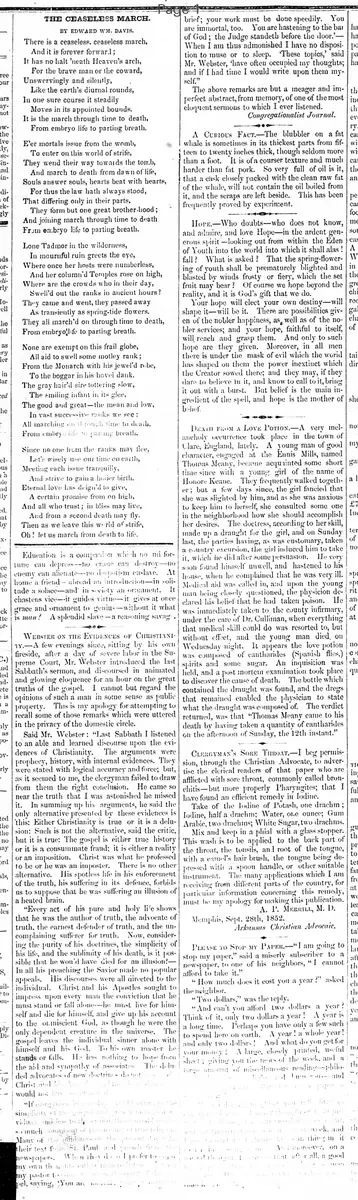
Said Mr. Webster: "Last Sabbath I listened to an able and learned discourse upon the evidences of Christianity. The arguments were prophecy, history, with internal evidences. They were stated with logical accuracy and force; but, as it seemed to me, the clergyman failed to draw from them the right conclusion. He came so near the truth that I was astonished he missed it. In summing up his arguments, he said the only alternative presented by these evidences is this: Either Christianity is true or it is a delusion: Such is not the alternative, said the critic, but it is true: The gospel is either true history or it is a consummate fraud; it is either a reality or an imposition. Christ was what he professed to be or he was an imposter. There is no other alternative. His spotless life in his enforcement of the truth, his suffering in its defence, forbids us to suppose that he was suffering an illusion of a heated brain.
"Every act of his pure and holy life shows that he was the author of truth, the advocate of truth, the earnest defender of truth, and the un-complaining sufferer for truth. Now, considering the purity of his doctrines, the simplicity of his life, and the sublimity of his death, is it possible that he would have died for an illusion?— In all his preaching the Savior made no popular appeals. His discourses were all directed to the individual. Christ and his Apostles sought to impress upon every man the conviction that he must stand or fall alone—he must live for himself and die for himself, and give up his account to the omniscient God, as though he were the only dependent creature in the universe. The gospel leaves the individual sinner alone with himself and his God. To his own master he stands or falls. He has nothing to hope from the aid and sympathy of associates. The deluded advocates of new doctrines do not Christ will foecon simpliety vilnak nd lsto somuchoigut Many of heir test fom S. Paul ah newspaers. Wn thydIy. forto my own th. my pastor t... bel, saving. You ar brief; your work must be done speedily. You are immortal, too. You are hastening to the bar of God; the Judge standeth before the door.'— When I am thus admonished I have no disposition to muse or to sleep. 'These topics,' said Mr. Webster, 'have often occupied my thoughts; and if I had time I would write upon them myself.'"
The above remarks are but a meager and imperfect abstract, from memory, of one of the most eloquent sermons to which I ever listened.
Congregationalist Journal.
What sub-type of article is it?
What themes does it cover?
What keywords are associated?
What entities or persons were involved?
Where did it happen?
Story Details
Key Persons
Location
Mr. Webster's Fireside
Story Details
Mr. Webster critiques and expands on a sermon about Christianity's evidences, asserting the Gospel's truth through Christ's life, death, and teachings on individual responsibility to God.