Thank you for visiting SNEWPapers!
Sign up free
Editorial
April 24, 1935
The Daily Alaska Empire
Juneau, Juneau County, Alaska
What is this article about?
The New York Times editorial discusses the defeat of the Townsend old-age pension plan in a House test vote, portraying it as a reassuring setback for radical economic schemes. It critiques the plan's financial impossibility and notes growing skepticism among reformers like Upton Sinclair.
Clipping
OCR Quality
98%
Excellent
Full Text
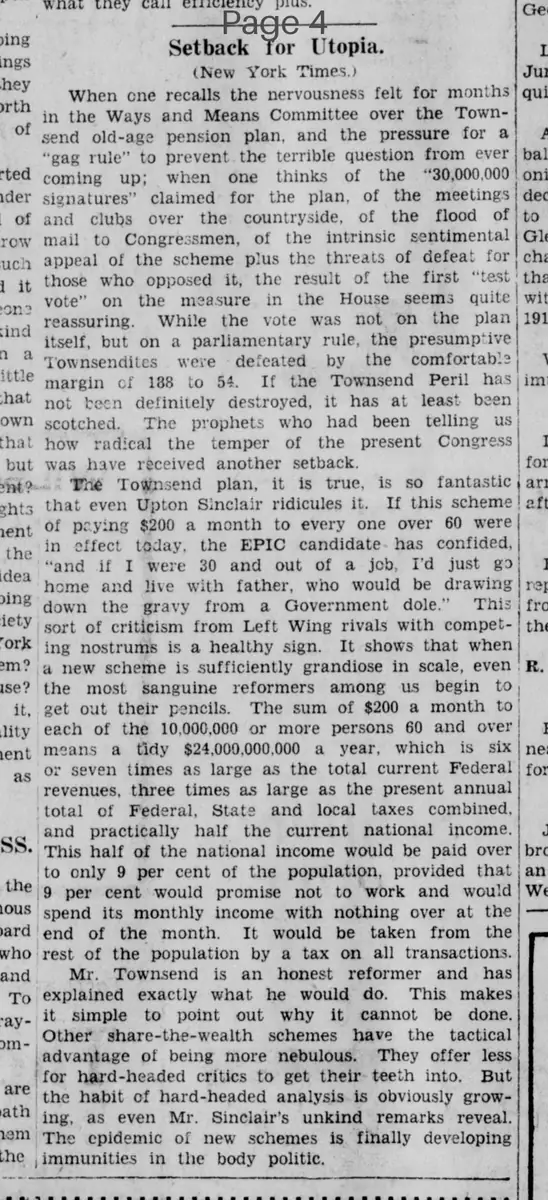
Setback for Utopia.
(New York Times.)
When one recalls the nervousness felt for months in the Ways and Means Committee over the Townsend old-age pension plan, and the pressure for a "gag rule" to prevent the terrible question from ever coming up; when one thinks of the "30,000,000 signatures" claimed for the plan, of the meetings and clubs over the countryside, of the flood of mail to Congressmen, of the intrinsic sentimental appeal of the scheme plus the threats of defeat for those who opposed it, the result of the first "test vote" on the measure in the House seems quite reassuring. While the vote was not on the plan itself, but on a parliamentary rule, the presumptive Townsendites were defeated by the comfortable margin of 188 to 54. If the Townsend Peril has not been definitely destroyed, it has at least been scotched. The prophets who had been telling us how radical the temper of the present Congress was have received another setback.
The Townsend plan, it is true, is so fantastic that even Upton Sinclair ridicules it. If this scheme of paying $200 a month to every one over 60 were in effect today, the EPIC candidate has confided, "and if I were 30 and out of a job, I'd just go home and live with father, who would be drawing down the gravy from a Government dole." This sort of criticism from Left Wing rivals with competing nostrums is a healthy sign. It shows that when a new scheme is sufficiently grandiose in scale, even the most sanguine reformers among us begin to get out their pencils. The sum of $200 a month to each of the 10,000,000 or more persons 60 and over means a tidy $24,000,000,000 a year, which is six or seven times as large as the total current Federal revenues, three times as large as the present annual total of Federal, State and local taxes combined, and practically half the current national income.
This half of the national income would be paid over to only 9 per cent of the population, provided that 9 per cent would promise not to work and would spend its monthly income with nothing over at the end of the month. It would be taken from the rest of the population by a tax on all transactions.
Mr. Townsend is an honest reformer and has explained exactly what he would do. This makes it simple to point out why it cannot be done. Other share-the-wealth schemes have the tactical advantage of being more nebulous. They offer less for hard-headed critics to get their teeth into. But the habit of hard-headed analysis is obviously growing, as even Mr. Sinclair's unkind remarks reveal.
The epidemic of new schemes is finally developing immunities in the body politic.
(New York Times.)
When one recalls the nervousness felt for months in the Ways and Means Committee over the Townsend old-age pension plan, and the pressure for a "gag rule" to prevent the terrible question from ever coming up; when one thinks of the "30,000,000 signatures" claimed for the plan, of the meetings and clubs over the countryside, of the flood of mail to Congressmen, of the intrinsic sentimental appeal of the scheme plus the threats of defeat for those who opposed it, the result of the first "test vote" on the measure in the House seems quite reassuring. While the vote was not on the plan itself, but on a parliamentary rule, the presumptive Townsendites were defeated by the comfortable margin of 188 to 54. If the Townsend Peril has not been definitely destroyed, it has at least been scotched. The prophets who had been telling us how radical the temper of the present Congress was have received another setback.
The Townsend plan, it is true, is so fantastic that even Upton Sinclair ridicules it. If this scheme of paying $200 a month to every one over 60 were in effect today, the EPIC candidate has confided, "and if I were 30 and out of a job, I'd just go home and live with father, who would be drawing down the gravy from a Government dole." This sort of criticism from Left Wing rivals with competing nostrums is a healthy sign. It shows that when a new scheme is sufficiently grandiose in scale, even the most sanguine reformers among us begin to get out their pencils. The sum of $200 a month to each of the 10,000,000 or more persons 60 and over means a tidy $24,000,000,000 a year, which is six or seven times as large as the total current Federal revenues, three times as large as the present annual total of Federal, State and local taxes combined, and practically half the current national income.
This half of the national income would be paid over to only 9 per cent of the population, provided that 9 per cent would promise not to work and would spend its monthly income with nothing over at the end of the month. It would be taken from the rest of the population by a tax on all transactions.
Mr. Townsend is an honest reformer and has explained exactly what he would do. This makes it simple to point out why it cannot be done. Other share-the-wealth schemes have the tactical advantage of being more nebulous. They offer less for hard-headed critics to get their teeth into. But the habit of hard-headed analysis is obviously growing, as even Mr. Sinclair's unkind remarks reveal.
The epidemic of new schemes is finally developing immunities in the body politic.
What sub-type of article is it?
Economic Policy
Social Reform
What keywords are associated?
Townsend Plan
Old Age Pension
Congress Vote
Economic Reform
Share The Wealth
Upton Sinclair
What entities or persons were involved?
Townsend
Upton Sinclair
Ways And Means Committee
Congress
Editorial Details
Primary Topic
Critique Of Townsend Old Age Pension Plan
Stance / Tone
Reassuring Critique Of Radical Scheme
Key Figures
Townsend
Upton Sinclair
Ways And Means Committee
Congress
Key Arguments
Townsend Plan Defeated 188 54 In House Test Vote On Parliamentary Rule
Plan's $200 Monthly Pension For Over 60s Would Cost $24 Billion Annually, Exceeding Federal Revenues
Scheme Requires Recipients Not To Work And Spend All Income Monthly
Funded By Transaction Tax On Rest Of Population
Even Upton Sinclair Ridicules It As Financially Impossible
Growing Skepticism And Analysis Against Grandiose Reform Schemes