Thank you for visiting SNEWPapers!
Sign up free
The Daily Herald
New Haven, New Haven County, Connecticut
What is this article about?
Observers at Yale College documented the annual November meteoric shower on the night of November 12-13, 1837, noting 226 meteors radiating from the constellation Leo, despite full moonlight. The event was less intense than previous years but confirmed the pattern.
Merged-components note: Dateline 'Yale College, Nov. 14' belongs to the preceding meteoric shower article.
Clipping
OCR Quality
Full Text
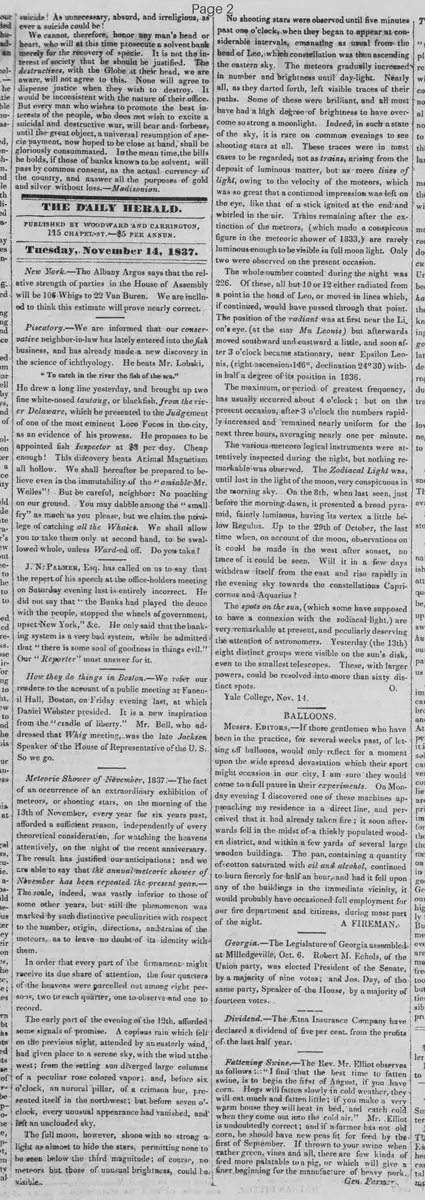
The scale, indeed, was vastly inferior to those of some other years, but still the phenomenon was marked by such distinctive peculiarities with respect to the number, origin, directions, and trains of the meteors, as to leave no doubt of its identity with them.
In order that every part of the firmament might receive its due share of attention, the four quarters of the heavens were parcelled out among eight persons, two to each quarter, one to observe and one to record.
The early part of the evening of the 12th afforded some signals of promise. A copious rain which fell on the previous night, attended by an easterly wind, had given place to a serene sky, with the wind at the west; from the setting sun diverged large columns of a peculiar rose colored vapor; and, before six o'clock, an auroral pillar, of a crimson hue, presented itself in the northwest; but before seven o'clock, every unusual appearance had vanished, and left an unclouded sky.
The full moon, however, shone with so strong a light as almost to hide the stars, permitting none to be seen below the third magnitude; of course, no meteors but those of unusual brightness, could be visible.
No shooting stars were observed until five minutes past one o'clock, when they began to appear at considerable intervals, emanating as usual from the head of Leo, which constellation was then ascending the eastern sky. The meteors gradually increased in number and brightness until day-light. Nearly all, as they darted forth, left visible traces of their paths. Some of these were brilliant, and all must have had a high degree of brightness to have overcome so strong a moonlight. Indeed, in such a state of the sky, it is rare on common evenings to see shooting stars at all. These traces were in most cases to be regarded, not as trains, arising from the deposit of luminous matter, but as mere lines of light, owing to the velocity of the meteors, which was so great that a continued impression was made on the eye, like that of a stick ignited at the end and whirled in the air. Trains remaining after the extinction of the meteors, (which made a conspicuous figure in the meteoric shower of 1833,) are rarely luminous enough to be visible in full moon light. Only two were observed on the present occasion.
The whole number counted during the night was 226. Of these, all but 10 or 12 either radiated from a point in the head of Leo, or moved in lines which, if continued, would have passed through that point. The position of the radiant was at first near the Lion's eye, (at the star Mu Leonis) but afterwards moved southward and eastward a little, and soon after 3 o'clock became stationary, near Epsilon Leonis, (right ascension 146°, declination 24° 30') within half a degree of its position in 1836.
The maximum, or period of greatest frequency, has usually occurred about 4 o'clock; but on the present occasion, after 3 o'clock the numbers rapidly increased and remained nearly uniform for the next three hours, averaging nearly one per minute.
The various meteorological instruments were attentively inspected during the night, but nothing remarkable was observed. The Zodiacal Light was, until lost in the light of the moon, very conspicuous in the morning sky. On the 8th, when last seen, just before the morning dawn, it presented a broad pyramid, faintly luminous, having its vertex a little below Regulus. Up to the 29th of October, the last time when, on account of the moon, observations on it could be made in the west after sunset, no trace of it could be seen. Will it in a few days withdraw itself from the east and rise rapidly in the evening sky towards the constellations Capricornus and Aquarius?
The spots on the sun, (which some have supposed to have a connexion with the zodiacal light,) are very remarkable at present, and peculiarly deserving the attention of astronomers. Yesterday (the 13th) eight distinct groups were visible on the sun's disk, even to the smallest telescopes. These, with larger powers, could be resolved into more than sixty distinct spots.
Yale College, Nov. 14.
What sub-type of article is it?
What keywords are associated?
Where did it happen?
Domestic News Details
Primary Location
Yale College
Event Date
November 13, 1837
Outcome
226 meteors observed, radiating from leo; less intense than prior years but confirmed annual pattern; no casualties.
Event Details
Eight observers at Yale College watched the night sky, divided into quarters, and counted 226 shooting stars from 1:05 AM until daylight, mostly from the head of Leo. Meteors left bright traces despite full moon; maximum frequency after 3 AM, averaging one per minute. Additional notes on aurora, zodiacal light, and sunspots.