Thank you for visiting SNEWPapers!
Sign up free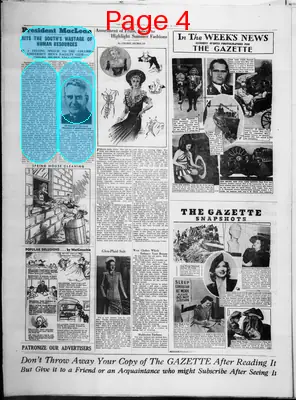
The Gazette
Cleveland, Cuyahoga County, Ohio
What is this article about?
Dr. Malcolm S. MacLean, Hampton Institute president, speaks at Columbia University on the wastage of human resources in the South's handling of Negro higher education, calling it a violation of democracy and urging educational reforms like faculty exchanges.
Merged-components note: Image overlaps with story bounding box.
Clipping
OCR Quality
Full Text
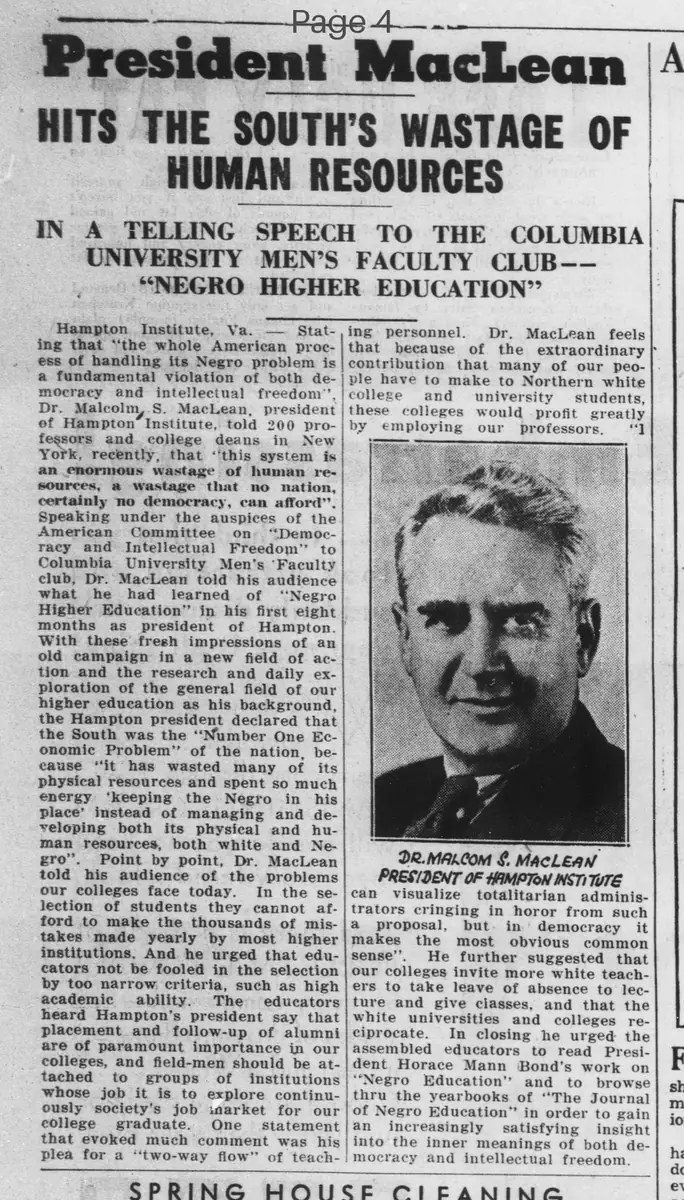
HITS THE SOUTH'S WASTAGE OF HUMAN RESOURCES
IN A TELLING SPEECH TO THE COLUMBIA UNIVERSITY MEN'S FACULTY CLUB--
"NEGRO HIGHER EDUCATION"
Hampton Institute, Va.--Stating that "the whole American process of handling its Negro problem is a fundamental violation of both democracy and intellectual freedom,"
Dr. Malcolm S. MacLean, president of Hampton Institute, told 200 professors and college deans in New York, recently, that this system is an enormous wastage of human resources, a wastage that no nation, certainly no democracy, can afford.
Speaking under the auspices of the American Committee on "Democracy and Intellectual Freedom" to Columbia University Men's Faculty Club, Dr. MacLean told his audience what he had learned of "Negro Higher Education" in his first eight months as president of Hampton.
With these fresh impressions of an old campaign in a new field of action and the research and daily exploration of the general field of our higher education as his background, the Hampton president declared that the South was the "Number One Economic Problem" of the nation, because "it has wasted many of its physical resources and spent so much energy 'keeping the Negro in his place' instead of managing and developing both its physical and human resources, both white and Negro."
Point by point, Dr. MacLean told his audience of the problems our colleges face today. In the selection of students they cannot afford to make the thousands of mistakes made yearly by most higher institutions. And he urged that educators not be fooled in the selection by too narrow criteria, such as high academic ability. The educators heard Hampton's president say that placement and follow-up of alumni are of paramount importance in our colleges, and field-men should be attached to groups of institutions whose job it is to explore continuously society's job market for our college graduate. One statement that evoked much comment was his plea for a "two-way flow" of teaching personnel.
Dr. MacLean feels that because of the extraordinary contribution that many of our people have to make to Northern white college and university students, these colleges would profit greatly by employing our professors.
"I can visualize totalitarian administrators cringing in horror from such a proposal, but in democracy it makes the most obvious common sense." He further suggested that our colleges invite more white teachers to take leave of absence to lecture and give classes, and that the white universities and colleges reciprocate. In closing he urged the assembled educators to read President Horace Mann Bond's work on "Negro Education" and to browse thru the yearbooks of "The Journal of Negro Education" in order to gain an increasingly satisfying insight into the inner meanings of both democracy and intellectual freedom.
What sub-type of article is it?
What themes does it cover?
What keywords are associated?
What entities or persons were involved?
Where did it happen?
Story Details
Key Persons
Location
Columbia University Men's Faculty Club, New York
Event Date
Recently
Story Details
Dr. Malcolm S. MacLean, president of Hampton Institute, delivers a speech criticizing the American handling of the Negro problem as a violation of democracy and intellectual freedom, highlighting the South's wastage of human resources and urging improvements in higher education, including better student selection, alumni placement, and exchange of teaching personnel between institutions.