Thank you for visiting SNEWPapers!
Sign up free
The Key West Citizen
Key West, Monroe County, Florida
What is this article about?
Army engineers in Jacksonville face challenges regulating Lake Okeechobee's water levels after Christmas deluge causes unprecedented 0.9-foot rise to 15.5 feet, requiring gradual discharge to prevent floods while preserving water for agriculture, amid tensions over outlets to Caloosahatchee River and St. Lucie Canal.
Clipping
OCR Quality
Full Text
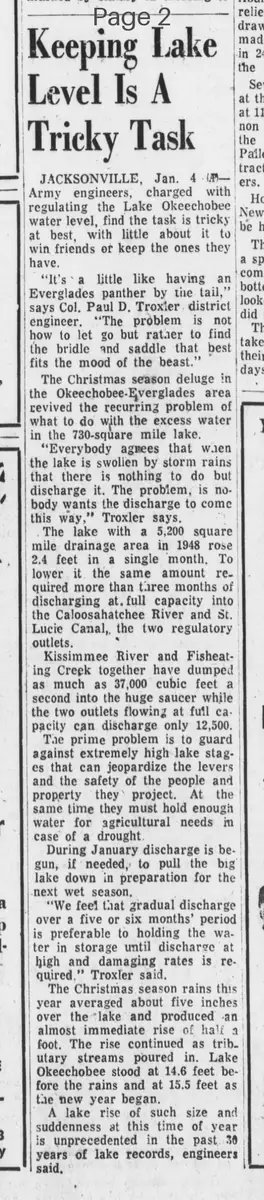
JACKSONVILLE, Jan. 4 (A)— Army engineers, charged with regulating the Lake Okeechobee water level, find the task is tricky at best, with little about it to win friends or keep the ones they have.
"It's a little like having an Everglades panther by the tail," says Col. Paul D. Troxler district engineer.
"The problem is not how to let go but rather to find the bridle and saddle that best fits the mood of the beast."
The Christmas season deluge in the Okeechobee-Everglades area revived the recurring problem of what to do with the excess water in the 730-square mile lake.
"Everybody agrees that when the lake is swollen by storm rains that there is nothing to do but discharge it. The problem is nobody wants the discharge to come this way," Troxler says.
The lake with a 5,200 square mile drainage area in 1948 rose 2.4 feet in a single month. To lower it the same amount required more than three months of discharging at full capacity into the Caloosahatchee River and St. Lucie Canal, the two regulatory outlets.
Kissimmee River and Fisheating Creek together have dumped as much as 37,000 cubic feet a second into the huge saucer while the two outlets flowing at full capacity can discharge only 12,500.
The prime problem is to guard against extremely high lake stages that can jeopardize the levees and the safety of the people and property they protect. At the same time they must hold enough water for agricultural needs in case of a drought.
During January discharge is begun, if needed, to pull the big lake down in preparation for the next wet season.
"We feel that gradual discharge over a five or six months' period is preferable to holding the water in storage until discharge at high and damaging rates is required," Troxler said.
The Christmas season rains this year averaged about five inches over the lake and produced an almost immediate rise of half a foot. The rise continued as tributary streams poured in. Lake Okeechobee stood at 14.6 feet before the rains and at 15.5 feet as the new year began.
A lake rise of such size and suddenness at this time of year is unprecedented in the past 30 years of lake records, engineers said.
What sub-type of article is it?
What themes does it cover?
What keywords are associated?
What entities or persons were involved?
Where did it happen?
Story Details
Key Persons
Location
Lake Okeechobee, Everglades Area, Jacksonville
Event Date
Jan. 4, Following Christmas Season Rains
Story Details
Army engineers struggle to regulate Lake Okeechobee's water levels after heavy Christmas rains cause an unprecedented rise, balancing flood risks with agricultural needs by discharging water gradually through outlets like Caloosahatchee River and St. Lucie Canal, despite opposition from downstream areas.