Thank you for visiting SNEWPapers!
Sign up free
The Enquirer
Richmond, Henrico County, Virginia
What is this article about?
During a sultry thunderstorm in Richmond on Tuesday the 10th inst., lightning struck trees on Shockoe Hill, shocking passersby including a young gentleman who was stunned, marked by burns, and revived via cold water affusion, friction, and bleeding, with noted temporary amnesia; medical theories discussed.
Merged-components note: The letter provides direct analysis and commentary on the electricity incident and lightning strike described in the preceding story, forming a single coherent component on the topic.
Clipping
OCR Quality
Full Text
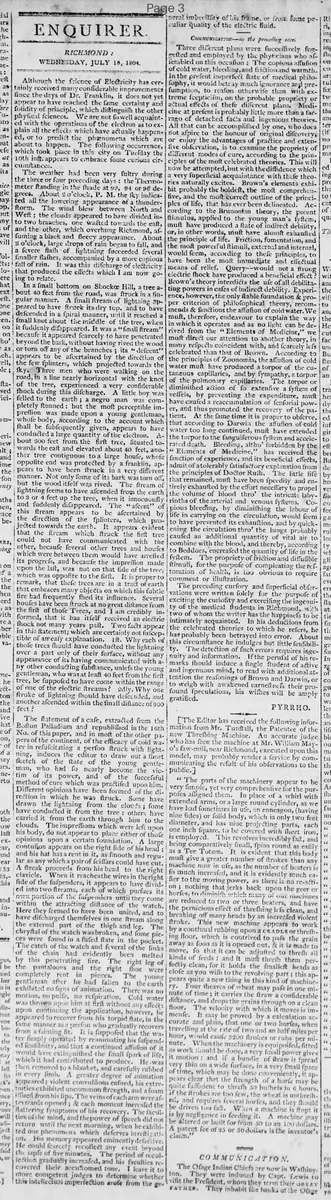
The weather had been very sultry during the three or four preceding days: the Thermometer standing in the shade at 92, 94 or 96 degrees. About 2 o'clock, P. M. the sky indicated all the lowering appearance of a thunderstorm. The wind blew between North and West; the clouds appeared to have divided into two branches, one wafted towards the east, and the other, which overhung Richmond, assuming a black and fleecy appearance. About 5 o'clock, large drops of rain began to fall, and a severe flash of lightning succeeded several smaller flashes, accompanied by a more copious fall of rain. It was this discharge of electricity that produced the effects which I am now going to relate.
In a small bottom on Shockoe Hill, a tree about 40 feet from the road, was struck in a singular manner. A small stream of lightning appeared to have struck its dry top, and to have descended in a spiral manner, until it reached a small knot about the middle of the tree, when it suddenly disappeared. It was a "small stream" because it appeared scarcely to have penetrated beyond the bark, without having rived the wood or torn off any of the branches; its "descent" appears to be ascertained by the direction of the few splinters, which projected towards the sky. Three men who were walking on the road, in a line nearly horizontal with the knot of the tree, experienced a very considerable shock during this discharge. A little boy was felled to the earth; a negro man was completely stunned: but the most perceptible impression was made upon a young gentleman, whose body, according to the account which shall be subsequently given, appears to have conducted a large quantity of the electron. About 500 feet from the first tree, situated towards the east and elevated about 40 feet, another tree contiguous to a large house, whose opposite end was protected by a franklin, appears to have been struck in a very different manner. Not only some of its bark was torn off, but the wood itself was rived. The stream of lightning seems to have ascended from the earth to 3 or 4 feet up the tree, when it innocuously and suddenly disappeared. The "ascent" of this stream appears to be ascertained by the direction of the splinters, which projected towards the earth. It appears evident that the stream which struck the first tree could not have communicated with the other, because several other trees and houses which were between them would have arrested its progress, and because the impression made upon the last, was not on that side of the tree: which was opposite to the first. It is proper to remark, that these trees are in a tract of earth that embraces many objects on which this subtle fire had frequently shed its influence. Several houses have been struck at no great distance from the first of those Trees, and I am credibly informed, that it has itself received an electric shock not many years past. Two facts appear in this statement; which are certainly not susceptible of an easy explanation. 1st. Why each of those trees should have conducted the lightning over a part only of their surface, without any appearance of its having communicated with any other conducting substance, unless the young gentleman, who was at least 40 feet from the first tree, be supposed to have come within the range of one of the electric streams? 2dly. Why one stroke of lightning should have descended, and another ascended within the small distance of 500 feet?
The statement of a case, extracted from the Boston Palladium and republished in the 16th No. of this paper, and in most of the other papers of the continent, of the efficacy of cold water in resuscitating a person struck with lightning, induces the editor to draw out a short sketch of the state of the young gentleman, who had so nearly become the victim of its power, and of the successful method of cure which was practised upon him. Different opinions have been formed of the direction in which he was struck. Some have drawn the lightning from the clouds; some have conducted it from the tree: others have carried it from the earth through him to the clouds. The impressions which were left upon his body, do not appear to place either of those opinions upon a certain foundation. A large contusion appears on the right side of his head; and his hat has a rent in it, as smooth and regular as any which a pair of scissors could have cut. A streak proceeds from his head to the right clavicle. When it reaches the wires in the right side of the suspenders, it appears to have divided into two streams, each of which pursues its own portion of the suspenders until they come within the attracting distance of the watch. Here they seemed to have been united, and to have discharged themselves in one stream along the external part of the thigh and leg. The crystal of the watch was broken, and some pieces were found in a fused state in the pocket. The catch of the watch and several of the links of the chain had evidently been melted by this penetrating fire. The right leg of the pantaloons and the right shoe were completely rent in pieces. The young gentleman after he had fallen to the earth exhibited no signs of animation. There was no motion, no pulse, no respiration. Cold water was thrown upon him at first without any effect: upon continuing the application, however, he appeared to recover from his torpid state, in the same manner as a person who gradually recovers from a fainting fit. It is supposed that the water simply operated by reanimating his suspended sensibility, and that a continued affusion of it would have extinguished the small spark of life, which it had contributed to produce. He was then removed to a blanket, and carefully rubbed in every limb. A greater degree of animation appeared; violent convulsions ensued, his extremities exhibited uncommon strength, and a foam issued from his lips. The veins of each arm were afterwards opened; & each moment increased the alarming symptoms of his recovery. The faculties of the mind, and the power of speech did not return until the next morning, when he exhibited one phenomena which deserves investigation. His memory appeared eminently defective. He could scarcely recollect any event beyond the lapse of five minutes. The period of recollection gradually increased, and his faculties recovered their accustomed tone. I leave it to more competent judges to determine whether this intellectual imperfection arose from the general imbecility of his frame, or from some peculiar quality of the electric fluid.
Communication--on the preceding case:
Three different plans were successively suggested and employed by the physicians who assembled on this occasion: The copious affusion of cold water, bleeding, and friction and warmth. In the present imperfect state of medical philosophy, it would betray much ignorance and presumption, to reason otherwise than with extreme scepticism, on the probable propriety or actual effects of these different plans. Medicine at present is probably little more than a farrago of detached facts and ingenious theories. All that can be accomplished by one, who does not aspire to the honour of original discovery, or enjoy the advantages of practice and extensive observation, is to examine the propriety of different modes of cure, according to the principles of the most celebrated theories. This will now be attempted, but with the diffidence which a very superficial acquaintance with these theories naturally excites. Brown's elements exhibit probably the boldest, the most comprehensive, and the most correct outline of the principles of life, that has ever been delineated. According to the Brunonian theory, the potent stimulus, applied to the young man's system, must have produced a state of indirect debility, or, in other words, must have almost exhausted the principle of life. Friction, fomentation, and the most powerful stimuli, external and internal, would seem, according to these principles, to have been the most immediate and effectual means of relief. Query--would not a strong electric shock have produced a beneficial effect? Brown's theory interdicts the use of all debilitating powers in cases of indirect debility. Experience, however, the only stable foundation & proper criterion of philosophical theory, recommends & sanctions the affusion of cold water. We must, therefore, endeavour to explain the way in which it operates and as no light can be derived from the "Elements of Medicine," we must direct our attention to another theory, in many respects coincident with, and scarcely less celebrated than that of Brown. According to the principles of Zoonomia, the affusion of cold water must have produced a torpor of the cutaneous capillaries, and by sympathy, a torpor of the pulmonary capillaries. The torpor or diminished action of so extensive a system of vessels, by preventing the expenditure, must have caused a reaccumulation of sensorial power, and thus promoted the recovery of the patient. At the same time it is proper to observe, that according to Darwin the affusion of cold water too long continued, must have extended the torpor to the sanguiferous system and accelerated death. Bleeding, although forbidden by the "Elements of Medicine," has received the sanction of experience, and its beneficial effects, admit of a tolerably satisfactory explanation from the principles of Doctor Rush. The little life that remained, must have been speedily and entirely exhausted by the effort necessary to propel the volume of blood through the intricate labyrinths of the arterial and venous systems. Copious bleeding, by diminishing the labour of life in carrying on the circulation, would seem to have prevented its exhaustion, and by quickening the circulation through the lungs probably caused an additional quantity of vital air to combine with the blood, and thereby, according to Beddoes, increased the quantity of life in the system. The propriety of friction and diffusible stimuli, for the purpose of completing the restoration of health, is too obvious to require comment or illustration.
The preceding cursory and superficial observations were written solely for the purpose of exciting the curiosity and exercising the ingenuity of the medical students in Richmond, with two of whom the writer has the happiness to be intimately acquainted. In his deductions from the celebrated theories to which he refers, he has probably been betrayed into error. About this circumstance he indulges but little sensibility. The detection of such errors requires ingenuity and information. If the perusal of his remarks should induce a single student of active and ingenuous mind, to read with additional attention the reasonings of Brown and Darwin, or to weigh with awakened earnestness their profound speculations, his wishes will be amply gratified.
PYRRHO.
What sub-type of article is it?
What themes does it cover?
What keywords are associated?
What entities or persons were involved?
Where did it happen?
Story Details
Key Persons
Location
Richmond, Shockoe Hill
Event Date
Tuesday The 10th Inst.
Story Details
Lightning struck two trees on Shockoe Hill during a thunderstorm, shocking three men and a boy nearby; a young gentleman was severely affected, showing marks from head to leg, rendered unconscious, and revived with cold water, friction, and bleeding, with temporary memory loss.