Thank you for visiting SNEWPapers!
Sign up free
The National Intelligencer And Washington Advertiser
Washington, District Of Columbia
What is this article about?
In 1802, Secretary of the Treasury Albert Gallatin responds to a congressional committee's inquiries about treasury operations, detailing how public monies are drawn, expended, and accounted for, highlighting issues in appropriations and accountability, and proposing reforms to improve efficiency and prevent abuse.
Merged-components note: This is a continuation of the treasury department report across pages, indicated by the text flow and '(To be Continued.)'. The original label for the second part was 'editorial', but the content is a formal government financial report, better classified as 'domestic_news'.
Clippings
1 of 2
OCR Quality
Full Text
January 1, 1802.
Sir,
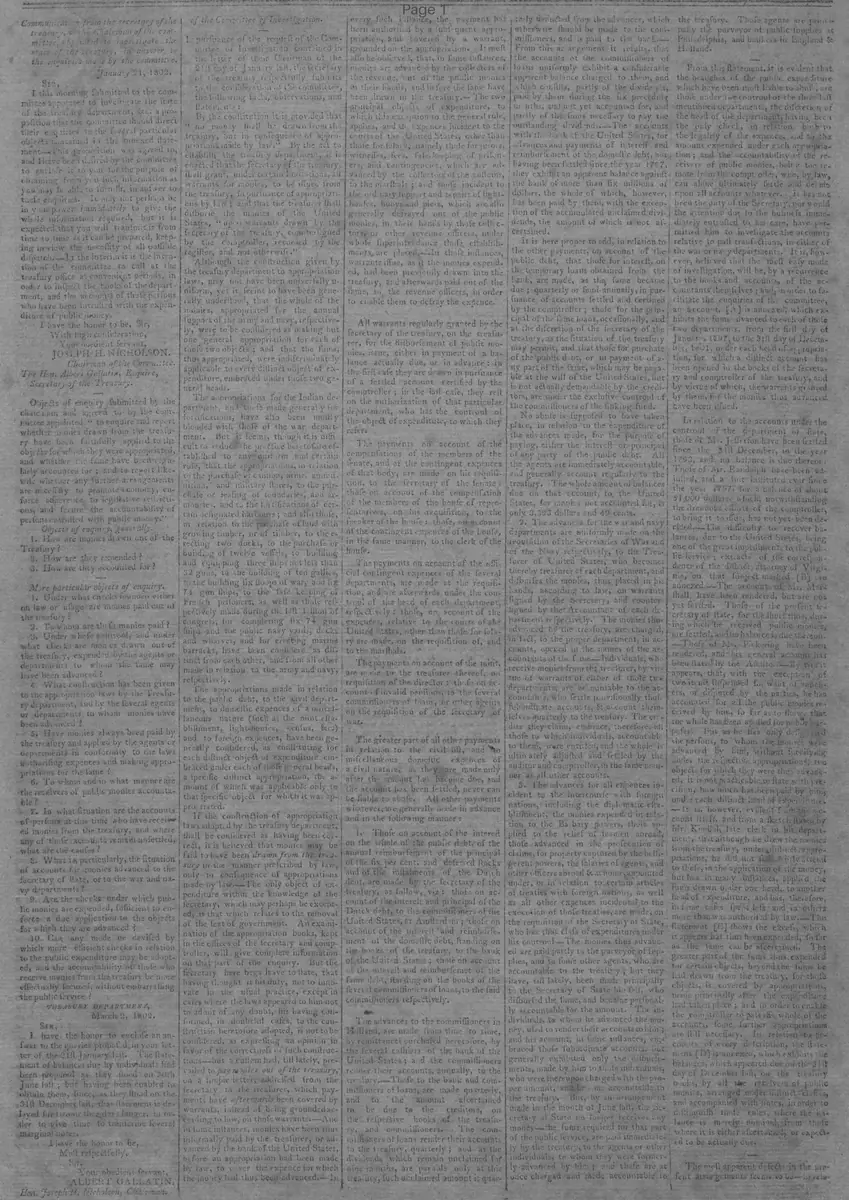
I this morning submitted to the committee appointed to investigate the state of the treasury department, &c. a proposition that the committee should direct their enquiries to the several particular objects contained in the annexed statement—this proposition was agreed to, and I have been desired by the committee to enclose it to you for the purpose of obtaining from you such information as you may be able to furnish, in answer to these enquiries. It may not perhaps be in your power immediately to give the whole information required, but it is expected that you will transmit it from time to time as it can be prepared, keeping in view the necessity of all possible dispatch.—In the interim it is the intention of the committee to call at the treasury office at convenient periods, in order to inspect the books of the department, and the accounts of those persons who have been intrusted with the expenditure of public money.
I have the honor to be, Sir,
With high consideration,
Your obedient servant,
JOSEPH H. NICHOLSON.
Chairman of the Committee.
The Hon. Albert Gallatin, Esquire,
Secretary of the Treasury.
Objects of enquiry submitted by the chairman, and agreed to by the committee appointed "to enquire and report whether monies drawn from the treasury have been faithfully applied to the objects for which they were appropriated, and whether the same have been regularly accounted for; and to report likewise whether any further arrangements are necessary to promote economy, enforce adherence to legislative restrictions, and secure the accountability of persons intrusted with public money."
Objects of enquiry, generally.
1. How are monies drawn out of the Treasury?
2. How are they expended?
3. How are they accounted for?
More particular objects of enquiry.
1. Under what checks founded either on law or usage are monies paid out of the treasury?
2. To whom are the monies paid?
3. Under whose control, and under what checks are notes drawn out of the treasury, expended by the agents or departments to whom the same may have been advanced?
4. What construction has been given to the appropriation laws by the Treasury department, and by the several agents or departments to whom monies have been advanced?
5. Have monies always been paid by the treasury and applied by the agents or departments in conformity to the laws authorizing expenses and making appropriations for the same?
6. To whom and in what manner are the receivers of public monies accountable?
7. In what situation are the accounts of persons at this time who have received monies from the treasury, and where any of those accounts remain unsettled, what are the causes?
8. What is particularly, the situation of accounts for monies advanced to the secretary of state, or to the war and navy departments?
9. Are the checks under which public monies are expended, sufficient to enforce a due application to the objects for which they are advanced?
10. Can any mode be devised by which more efficient checks in relation to the public expenditure may be adopted, and the accountability of those who receive monies from the treasury be more effectually secured, without embarrassing the public service?
TREASURY DEPARTMENT,
March 2, 1802.
SIR,
I have the honor to enclose an answer to the queries proposed in your letter of the 1st January last. The statement of balances due by individuals had been prepared as they stood on 30th June last; but having been enabled to obtain them, since, as they stood on the 31st December last, that statement is delayed for two or three days longer, in order to give time to transcribe several marginal notes.
I have the honor to be
Most respectfully,
Your obedient servant,
ALBERT GALLATIN
In pursuance of the request of the Committee of Investigation contained in the letter of their Chairman of the 21st day of January last, the Secretary of the treasury respectfully submits to the consideration of the committee, the following facts, observations, and statements:
By the constitution it is provided that "no money shall be drawn from the treasury, but in consequence of appropriations made by law." By the act to establish the treasury department, it is enacted that the secretary of the treasury shall grant, under certain limitations, all warrants for monies, to be issued from the treasury, in pursuance of appropriations by law; and that the treasurer shall disburse the monies of the United States, "upon warrants drawn by the secretary of the treasury, countersigned by the comptroller, recorded by the register, and not otherwise."
Although the construction given by the treasury department to appropriation laws, may not have been universally uniform, yet it seems to have been generally understood, that the whole of the monies, appropriated for the annual support of the army and navy, respectively, were to be considered as making but one general appropriation for each of those two objects; and that the sums, thus appropriated, were indiscriminately applicable to every distinct object of expenditure, embraced under those two general heads.
The appropriations for the Indian department, and those made generally for fortifications, have also been mostly included with those of the war department. But it seems, though it is difficult to reduce the practice heretofore established to any uniform and certain rule, that the appropriations, in relation to the purchase of cannon, arms, ammunition, and military stores, to the purchase or leasing of boundaries, and armouries, and to the fortifications of certain designated harbours; and also those in relation to the purchase of land with growing timber, or of timber, to the erecting two docks, to the purchase or building of twelve vessels, to building and equipping three ships not less than 32 guns, to the building of ten galleys, the building six sloops of war, and six 74 gun ships, to the safe keeping of French prisoners, as well as those respectively made during the last session of congress, for completing six 74 gun ships and the public navy yards, docks and wharves, and for erecting marine barracks, have been considered as distinct from each other, and from all other made in relation to the army and navy, respectively.
The appropriations made in relation to the public debt, to the civil department, to domestic expenses of a miscellaneous nature (such as the mint establishment, light-houses, census, &c.) and to foreign expenses, have been generally considered, as constituting for each distinct object of expenditure embraced under each of those general heads, a specific distinct appropriation, the amount of which was applicable only to that specific object for which it was appropriated.
If the construction of appropriation laws adopted by the treasury department, shall be considered as having been correct, it is believed that monies may be said to have been drawn from the treasury in the manner prescribed by law, only in consequence of appropriations made by law.--The only object of expenditure within the knowledge of the secretary, which may perhaps be excepted, is that which relates to the removal of the seat of government. An examination of the appropriation books, kept in the offices of the secretary and comptroller, will give complete information on that part of the enquiry. But the secretary here begs leave to state, that having thought it his duty, not to innovate in the usual practice, except in cases where the laws appeared to him not to admit of any doubt, his having conformed, in doubtful cases, to the construction heretofore adopted, is not to be considered, as expressing an opinion in favor of the correctness of such constructions---but a custom had, till lately, prevailed to pay monies out of the treasury, on a simple letter, addressed from the secretary to the treasurer, which payments have afterwards been covered by warrants, instead of being grounded according to law, on those warrants.--And in some instances, monies have been thus informally paid by the treasurer, or advanced by the bank of the United States, before an appropriation had been made by law, to cover the expense for which the money had thus been advanced.--In every such instance, the payment has been authorized by a subsequent appropriation, and covered by a warrant, grounded on the appropriation. It must also be observed, that, in some instances, monies are advanced by the collectors of the revenue, out of the public monies in their hands, and before the same have been drawn into the treasury.-- The two principal objects of expenditure, to which this exception to the general rule applies, and the expenses incident to the courts of the United States, other than those for salary, namely those for jurors, witnesses, fees, safe-keeping of prisoners, and contingencies, which are advanced by the collectors of the customs, to the marshals; and those incident to the ordinary support and repairs of light-houses, buoys and piers, which are also generally defrayed out of the public monies, in their hands by those collectors. or other revenue officers, under whose superintendence those establishments. are placed,o-In those instances. warrants issue, as if the monies expended. had been previously drawn into the treasury, and afterwards paid out of the same, to the revenue officers, in order to enable them to defray the expense.
All warrants regularly granted by the secretary of the treasury, on the treasurer. for the disbursement of public monies, issue, either in payment of a balance actually due, or in advance: in the first case they are drawn in pursuance of a settled account certified by the comptroller; in the last case, they rest on the authorization of that particular department, who has the control of the object of expenditure, to which they refer.
The payments on account of the compensations of the members of the senate, and of the contingent expenses of that body, are made on his requisition, to the secretary of the senate: those on account of the compensation of the members of the house of representatives, on his requisition, to the speaker of the house: those, on account of the contingent expenses of the house, in the same manner, to the clerk of the house.
The payments on account of the official contingent expenses of the several departments, are made at the requisition, and are afterwards under the control of the head of each department, respectively: those, on account of the expenses, relative to the courts of the United States, other than those for salary are made. on the requisition of, and to the marshals.
The payments on account of the mint. are made to the treasurer thereof, on requisition of the director: those of account invalid pensions. to the several commissioners of loans, or other agents on the requisition of the secretary of war
The greater part of all other? payments in relation to the civil list, and to miscellaneous domestic expenses of a civil nature, as they are made only after the amount has become due, and the account has been settled, never can be liable to abuse. All other payments whatever, are generally made in advance and in the following manner:
1. Those on account of the interest on the whole of the public debt, of the annual reimbursement of the principal of the six per cent. and deferred stocks and of the installments of the Dutch debt, are made by the secretary of the treasury, as follows, viz: those on account of the interest and principal of the Dutch debt, to the commissioners of the United States, at Amsterdam; those on account of the interest and reimbursement ol the domestic debt, standing on the books of the treasury, to the bank of the United States; those on account of the interest and reimbursement of the same debt, standing on the books of the several commissioners of loans, to the said commissioners respectively.
The advances to the commissioners in Holland, are made from time to time, by remittances purchased heretofore, by the several cashiers of the bank of the United States: and the commissioners render their accounts, annually, to the treasury.--Those to the bank and commissioners of loans, are made quarterly, and to the amount ascertained to be due to the creditors, on the respective books of the treasury, and commissioners. The commissioners of loans render their accounts to the treasury, quarterly; and as the dividends which remain unclaimed for nine months, are payable only at this treasury, such unclaimed amount is quarterly deducted from the advances, which otherwise should be made to the commissioners, and is paid to the bank--.
From this arrangement it results, that the accounts of the commissioners of loans uniformly exhibit a considerable apparent balance charged to them, and which consists, partly of the dividends, paid by them during the six preceding months, and not yet accounted for, and partly of the sums necessary to pay the outstanding dividends.- The accounts with the bank of the United States, for advances and payments of interest and reimbursement of the domestic debt, not having been settled since the year 1797, they exhibit an apparent balance against the bank of more than six millions of dollars, the whole of which, however, has been paid by them, with the exception of the accumulated unclaimed dividends, the amount of which is not ascertained.
It is here proper to add, in relation to the other payments, on account of the public debt, that those for interest, on the temporary loans obtained from the bank, are made, as the same became due; quarterly or semi-annually, in pursuance of accounts settled and certified by the comptroller; those for the principal of the same loans, occasionally, and at the discretion of the secretary of the treasury, as the situation of the treasury may permit, and that those for purchase of the public debt, or in payment of any part of the same, which may be payable at the will of the United States, but is not actually demandable by the creditors, are under the exclusive control of the commissioners of the sinking fund.
No abuse is supposed to have taken place, in relation to the expenditure of the advances made, for the purpose of paying, either the interest or principal of any part of the public debt. All the agents are immediately accountable, and generally account regularly to the treasury. The whole amount of balances due on that account, to the United States, for monies not accounted for, is only 3,393 dollars and 49 cents.
2. The advances for the war and navy departments are uniformly made on the requisition of the Secretaries of War and of the Navy respectively, to the Treasurer of United States, who becomes thereby treasurer of each department, and disburses the monies, thus placed in his hands, according to law, on warrants signed by the Secretary, and countersigned by the Accountant of each department respectively. The monies thus advanced to the treasury, are charged. in fact, to the proper department, in accounts, opened in the names of the accountants of the same-- individuals, who receive monies from the treasurer, by virtue of warrants of either of those two departments, are accountable to the accountants, who settle provisionally their subordinate accounts, & account themselves quarterly to the treasury. The credits they claim, embrace, therefore, all those to which individuals, accountable to them, were entitled, and the whole is ultimately adjusted and settled by the auditor and comptroller, in the same manner as all other accounts.
3. The advances for all expenses incident to the intercourse with foreign nations, including the diplomatic establishment, the monies expended in relation to the Barbary powers, those applied to the relief of seamen abroad, those advanced in the prosecution of claims, for property captured by the belligerent powers, the salaries of agents, and other officers abroad & at home, appointed under, or in relation to certain articles of treaties with foreign nations, as well as all other expenses incidental to the execution of those treaties, are made, on the requisition of the Secretary of State. who has that class of expenditures under his control-The monies thus advanced are paid partly to the purveyor of supplies, and to some other agents, who are accountable to the treasury; but they have, till lately, been made principally to the Secretary of State himself, who disbursed the same, and became personally accountable for the amount. The individuals, to whom he advanced the money, used to render their accounts to him; and his account, in some instances, embraced those subordinate accounts, but generally exhibited only the disbursements, made by him to those individuals, who were thereupon charged with the proper amount, and became accountable to the treasury. But, by an arrangement made in the month of June last, the Secretary of State no longer receives any money-the sums required for that part of the public service, are paid immediately by the treasury, to the agents or other individuals, to whom they were formerly advanced by him; and these are at once charged and made accountable to the treasury. Those agents are principally the purveyor of public supplies at Philadelphia, and bankers in England & Holland.
From this statement, it is evident that the branches of the public expenditure which have been most liable to abuse. are those under the control of the three last mentioned departments, the discretion of the head of the department, having been the only check, in relation both to the legality of the expense, and to the amount expended under each appropriation; and the accountability of the receivers of public monies, being too remote from the comptroller, who, by law, can alone ultimately settle and decide upon all accounts whatever. It has not been the duty of the Secretary, nor would the attention due to the business immediately intrusted to his care, have permitted him to investigate the accounts relative to past transactions, in either of the war or navy departments. It is, however, believed that the most easy mode of investigation, will be, by a recurrence to the books and accounts, of the Accountants themselves; and, in order to facilitate the enquiries of the committee, an account, [A] is annexed; which exhibits the sums advanced to each of those two departments, from the 1st day of January, 1797, to the 31st day of December, 1801, under each head of appropriation, for which a distinct account has been opened in the books of the secretary and comptroller of the treasury, and by virtue of which, the warrants granted by them, for the monies thus advanced have been issued.
In relation to the accounts under the control of the department of state, those of Mr. Jefferson have been settled since the 31st December, in the year 1793, and no balance is due thereon. Those of Mr. Randolph have been adjusted, and a suit instituted ever since the year 1797, for a balance of about 51,000 dollars. which, notwithstanding the strenuous efforts of the comptroller, to bring it to issue, has not yet been decided.The difficulty to recover balances, due to the United States, being one of the great impediments to the public service; extracts of the correspondence of the district attorney of Virginia, on that subject marked [D] are annexed.The accounts of Mr. Marshall have been rendered, but are not yet settled. Those of the present secretary of state, for the short time, during which he received public monies, are settled, and no balance is due thereon. -Those of Mr. Pickering have been rendered, and his general account has been stated by the Auditor.-By it appears, that, with the exception of two items suspended for want of vouchers, or disputed by the parties, he has accounted for all the public monies received by him, so far as to show. that the whole has been applied for public purposes. But as he has only designated the persons, to whom the monies were advanced by him, without verifying under the respective appropriation, the objects for which they were thus advanced, it is not practicable.to state with precision, how much has been paid by him under each distinct head of expenditure. -It is, however, evident from the account itself, and from a sketch taken by Mr. Kimble, late clerk in his department, that although he drew the monies from the treasury, under distinct appropriations, he did not strictly adhere to them, in the application of the money, but has in many instances, applied the sums drawn under one head, to another head of expenditure, and has, therefore, in some cases less and in others more than was authorized by law.—The statement below shows the excess, which it appears has thus been expended, so far as the same can be ascertained. The greater part of the sums thus expended for certain objects, beyond the sums he had drawn from the treasury, for those objects, is covered by appropriations, made principally after the expenditure had taken place: and in order to enable the comptroller to pass the whole of the accounts, some other appropriations are still necessary. In relation to general accounts of every description, the statement [D] is annexed, which exhibits the balances, which appeared due on the 31st day of December last, on the treasury books, by all the receivers of public monies, arranged under distinct classes and accompanied with notes, in order to distinguish those, cases, where the balance is merely nominal from those where it is either ascertained, or expected to be actually due.
The most apparent defect- in the present arrangements seems to be-if rela-
In relation to the drawing public monies from the treasury, there is a want of specification in the several appropriations, defined by law with such precision, as not to leave it in the power of the Secretary of the Treasury, to affix an arbitrary construction, and to blend together objects, which might be kept distinct, without any inconvenience.--In relation to the expenditure of monies, drawn from the treasury, the want of a proper check in the war and navy departments, which might prevent the expenditure of money, even for an object unauthorized by law or beyond the sums appropriated by law--In relation to the accountability of persons, entrusted with public monies, the delay and other inconveniences arising from the manner in which the monies advanced for those two departments, are now accounted for.
The following provisions are respectfully submitted as necessary and sufficient for those several objects, viz.
In relation to the first,
1st. That the accumulated balances of appropriations for the war and navy departments made before the present year, and remaining unexpended, shall henceforth cease and determine, except so much thereof, as may be necessary to defray any expense, incurred before the present year.
2d. That it be enacted, by a general law, that every distinct sum appropriated by any law, for an object distinctly pointed in the law, shall be applicable only to that object; but as laws can be executed only so far as they are practicable, and unavoidable deviations, will promote a general relaxation, it will be expedient, in the several appropriation laws, especially for the navy and war departments, not to subdivide the appropriations, beyond what is substantially useful and necessary.
In relation to the 2d objects. it is proposed generally, to place the expenses, which relate to the war and navy departments, precisely on the same footing, now established for those, under the control of the department of state, and that the arrangement now existing for these last, be made permanent. This may be done, by providing,
1st. That the monies to be paid, on account of the expenses, under the control of those three departments, shall neither be paid to the head of the department, nor placed, subject to his drafts or warrants, in the hands of the treasurer, or any other agent, but shall be paid, like all other public monies, either to the individuals, to whom the same may be due, or to the proper agents, or contractors, who are to be accountable for the same. The monies paid in advance, to continue as usual to be disbursed by the treasury, on the requisition only of the head of the proper department.
2d. That the individuals to whom monies may be advanced on account of any of the abovementioned expenses, shall hereafter, as all other receivers of public monies, be accountable immediately to the accounting officers of the treasury department ; that it shall be the duty of every receiver of public monies, to apply the same only to the object for which they shall have been advanced, and to render quarterly accounts if residing within the United States, and half annually, if abroad, of his expenditures, to the accounting officers.
3d. That the offices of accountant of the war and navy departments be abolished, and in lieu thereof an additional auditor be substituted, whose duty it shall be to examine and state all the accounts generally of receivers of public monies, other than those of persons employed in the collection of revenue. the said accounts to be as usual, settled and finally decided upon by the comptroller, or, (if it shall be thought more eligible to trust to actual experience or a proper and equal distribution of duties between the two auditors,) that the said additional auditor shall examine and state accounts of such description as shall be assigned to him by the secretary of the treasury.
(To be Continued.)
What sub-type of article is it?
What keywords are associated?
What entities or persons were involved?
Domestic News Details
Event Date
January 1, 1802 To March 2, 1802
Key Persons
Outcome
gallatin submits detailed response including facts, observations, statements on treasury practices, account statuses, and proposes reforms to appropriations, expenditures, and accountability to prevent abuse and improve efficiency.
Event Details
Congressional committee chaired by Joseph H. Nicholson investigates treasury operations; Secretary Albert Gallatin provides comprehensive answers to queries on drawing, expending, and accounting for public monies, discusses constructions of appropriation laws, account situations in departments, identifies defects, and suggests legislative provisions for better checks and direct accountability.