Thank you for visiting SNEWPapers!
Sign up free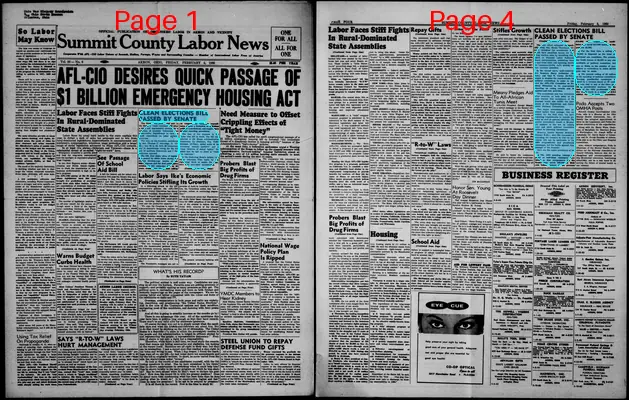
Summit County Labor News
Akron, Summit County, Ohio
What is this article about?
The U.S. Senate passed a 'clean elections' bill by a 59-22 vote, introduced by Sen. Thomas C. Hennings Jr. (D-Mo.), raising campaign spending limits, capping individual contributions at $10,000, and requiring detailed reporting for primaries and state committees. Anti-labor amendments failed; bill's House fate uncertain.
Merged-components note: Merged continuation from page 1 to page 4 due to 'Continued on Page Four' indicator.
Clippings
1 of 2
OCR Quality
Full Text
ELECTIONS
BILL
PASSED
BY
SENATE
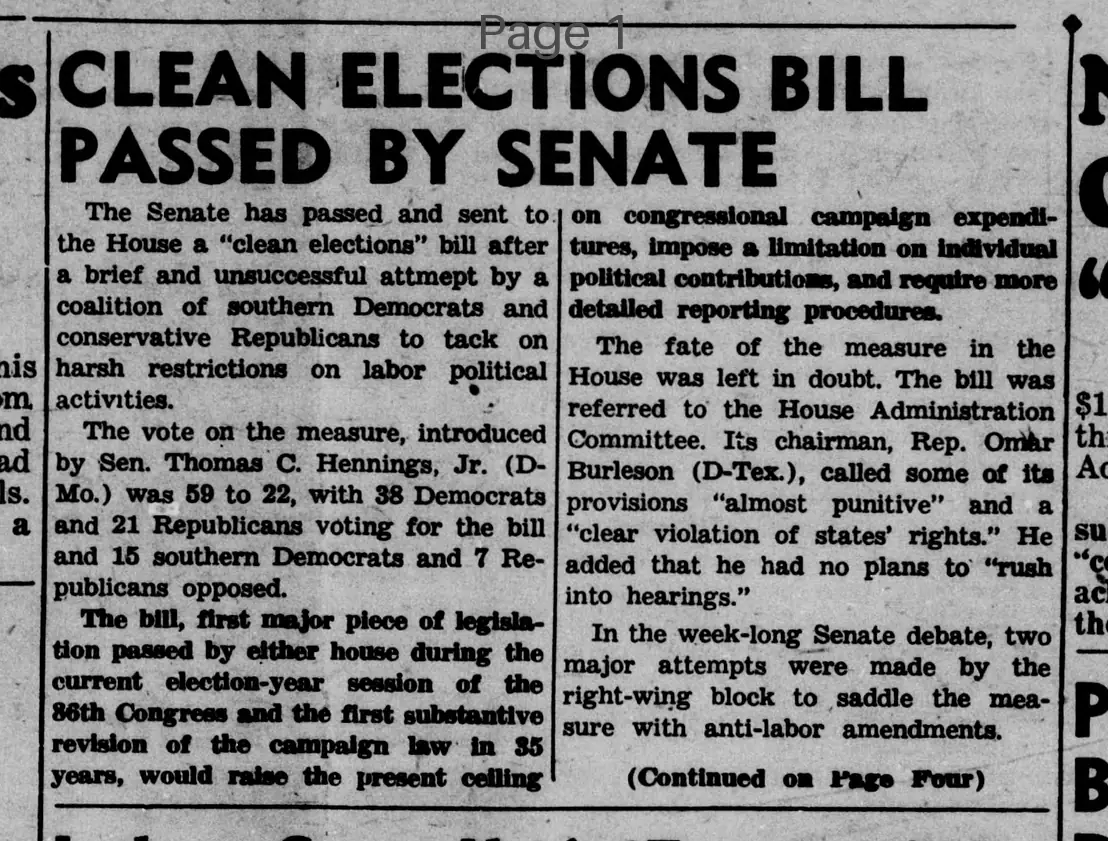
The Senate has passed and sent to the House a "clean elections" bill after a brief and unsuccessful attempt by a coalition of southern Democrats and conservative Republicans to tack on harsh restrictions on labor political activities.
The vote on the measure, introduced by Sen. Thomas C. Hennings, Jr. (D- Mo.) was 59 to 22, with 38 Democrats and 21 Republicans voting for the bill and 15 southern Democrats and 7 Republicans opposed.
The bill, first major piece of legislation passed by either house during the current, election-year session of the 86th Congress and the first substantive revision of the campaign law in 35 years, would raise the present ceiling on congressional campaign expenditures, impose a limitation on individual political contributions, and require more detailed reporting procedures.
The fate of the measure in the House was left in doubt. The bill was referred to the House Administration Committee. Its chairman, Rep. Omar Burleson (D-Tex.), called some of its provisions "almost punitive" and a "clear violation of states' rights." He added that he had no plans to "rush into hearings."
In the week-long Senate debate, two major attempts were made by the right-wing block to saddle the measure with anti-labor amendments,
(Continued on Page Four)
(Continued from Page One)
The first effort collapsed unexpectedly when Sen. Strom Thurmond (D-S.C.) withdrew his amendment that would have penalized unions for violating election laws by cancelling their rights to National Labor Relations Board representation, subjecting them to anti-trust laws, and applying double the Landrum-Griffin Act's already severe criminal penalties.
In the second move, arch-conservative Senators Barry Goldwater (R-Ariz.) and Carl T. Curtis (R-Neb.) sought to broaden the requirements for political committees in order to restrict the AFL-CIO Committee on Political Education in its year-around reporting on voting records and its register-and-vote activities.
This amendment also was withdrawn after senators on both sides of the aisle warned that acceptance of the proposal would also inhibit the operations of the Republican and Democratic National Committees.
Two major amendments were accepted before final passage. One extended, for the first time, the law's reporting requirements to include primary as well as general elections. The second amendment closed a 35-year-old loophole in the law by making local and state political committees subject to reporting regulations.
Minority Leader Everett McKinley Dirksen (R-Ill.), who had succeeded in amending the measure so that its provisions will not be applicable to the 1960 congressional and presidential campaigns, led the battle against final passage of the measure.
Here are the major provisions of the bill:
The 1925 spending ceilings imposed on individual candidates were raised so that campaigners for the Senate may spend $50,000 in their own behalf, instead of the previous $10,000, while congressional candidates may spend $12,500 instead of the previous $2,500.
For the first time, a ceiling of $10,000 is imposed on the total an individual can contribute. The present law limits donors to $5,000 to any one candidate or political committee, but sets no limits on the number of candidates or committees to which $5,000 gifts may be made.
The present ceiling of $3 million on the spending of national committees directing presidential campaigns is raised by a formula based on 20 cents per vote cast in any of the three preceding presidential elections. On the basis of the 1956 presidential totals, this would result in a ceiling of $12.5 million for each national committee.
What sub-type of article is it?
What themes does it cover?
What keywords are associated?
What entities or persons were involved?
Where did it happen?
Story Details
Key Persons
Location
U.S. Senate
Event Date
Current, Election Year Session Of The 86th Congress
Story Details
The Senate passed the clean elections bill by 59-22, overcoming southern Democrats and conservative Republicans' attempts to add anti-labor amendments proposed by Sens. Thurmond, Goldwater, and Curtis. Amendments for primaries and state committees were added; provisions exempt 1960 campaigns. Bill raises spending limits, caps contributions at $10,000, and enhances reporting.