Thank you for visiting SNEWPapers!
Sign up free
Story
August 4, 1879
Daily Globe
Saint Paul, Ramsey County, Minnesota
What is this article about?
Satirical account of a heated interview between Secretary Sherman and Senator Blaine in Portland, Maine, on July 28, where political banter escalates into a physical fight, interrupted by Congressman Reed. They reconcile, and a cover story of a runaway horse accident is reported.
Clipping
OCR Quality
95%
Excellent
Full Text
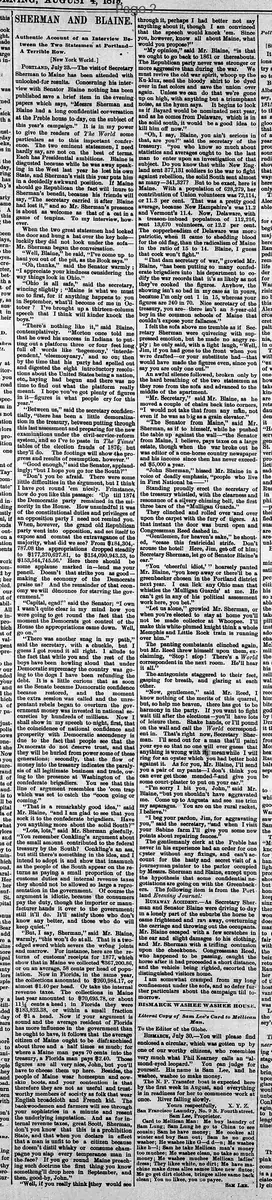
SHERMAN AND BLAINE
Authentic Account of an Interview Between the Two Statesmen at Portland-
A Terrible Row.
[New York World.]
PORTLAND, July 28. -The visit of Secretary Sherman to Maine has been attended with unlooked-for results. Concerning his interview with Senator Blaine nothing has been published save a brief item in the evening papers which says, "Messrs Sherman and Blaine had a long confidential conversation at the Preble house to day, on the subject of this year's campaign." It is in my power to give the readers of The World some particulars as to this important conference. The two eminent statesmen, I need hardly say, are not on the best of terms. Each has Presidential ambitions. Blaine is disgusted because while he was away speaking in the West last year he lost his own State, and Sherman's visit this year puts him in a decidedly awkward position. If Maine should go Republican the fact will inure to Sherman's benefit, because his friends will say, "The secretary carried it after Blaine had lost it," and so Mr. Sherman's presence is about as welcome as that of a cat in a game of tenpins. To my interview, however.
When the two great statesmen had locked the door and hung a hat over the key hole— luckily they did not look under the sofa— Mr. Sherman began the conversation.
"Well, Blaine," he said, "I've come up to haul you out of the pit, as the Book says."
"Oh, thanks," said the Senator warmly; "I appreciate your kindness considering the way things look in Ohio."
"Ohio is all safe," said the secretary, wincing slightly; "Maine is what we must see to first, for if anything happens to you in September, what'll become of me in October? I've brought up a thirteen-column speech that I think will kinder knock the boys."
"There's nothing like it," said Blaine, contemplatively. "Morton once told me that he owed his success in Indiana to putting out a platform three or four feet long full of words like 'hegemony,' 'interdependent,' 'eleemosynary,' and so on; then by the time that his party had spelled out and digested the eight introductory resolutions about the United States being a nation, etc., having had begun and there was no time to find out what the platform really meant. I hope you've got plenty of figures in it-figures is what people cry for this year."
"Between us," said the secretary confidentially, "there has been a little demoralization in the treasury, between putting through this last 'assessment' and preparing for the new examinations under the civil-service-reform system, and so I've to paste in The Times' tables of the election frauds of 1876: but they'll do. The footings will show the progress and results of resumption, however."
"Good enough," said the Senator, applaudingly; "but I hope you go for the South?"
"Don't you be afraid. There were some little difficulties in the argument, but I think I have got round 'em nicely. Frinstance, how do you like this passage: Up till 1874 the Democratic party remained in the minority in the House. How unmindful it was of the constitutional duties and privileges of an opposition party I need not remind you. When, however, the grand old Republican party went into opposition, and set itself to expose and combat the extravagance of the majority, what did we see? From $184,304,787.08 the appropriations dropped steadily to $177,370,627.81, to $154,090,943.53, to $153,544,745.56.' Here there should be some applause marked in-lend me your pencil. Doesn't that strike you as good-making the economy of the Democrats praise us? And the remainder of that economy we will denounce for starving the government."
"Capital, egad!" said the Senator; "I own I wasn't quite clear in my mind how you were going to get round the fact that the moment the Democrats got control of the House the appropriations came down. Well, go on."
"There was another snag in my path," said the secretary, with a chuckle, but I guess I got round it all right. I allude to the fact that while you and the rest of the boys have been howling aloud that under Democratic supremacy the country was going to the dogs I have been refunding the debt. It is a little curious that as soon as the Senate became Democratic confidence became restored, and the moment the extra session was called and the unrepentant rebels began to overturn the government money was invested in national securities by hundreds of millions. Now I shall show in my speech to-night, first, that the coincidence of national confidence and prosperity with Democratic ascendency is due to the fact that people see that the Democrats do not deserve trust, and that they will be hurled from power some of these generations; secondly, that the flow of money into the treasury indicates the paralysis of all legitimate business and trade, owing to the presence at Washington of the confederate brigadiers. You see that this line of argument resembles the 'coon trap which was set to catch the "coon going or coming."
"That is a remarkably good idea," said Mr. Blaine, "and I am glad to see that you sock it to the confederate brigadiers. Have you anything more about the solid South?"
"Lots, lots," said Mr. Sherman gleefully. "You remember Conkling's argument about the small amount contributed to the federal treasury by the South? Conkling's an ass, but still there's something in the idea, and I intend to adopt it and show that inasmuch as the people of the South appear on the returns as paying a small proportion of the customs duties and internal revenue taxes they should not be allowed so large a representation in the government. Of course the argument is idiotic, because the consumers pay the duty, though the importer or manufacturer hands it over to the government: still it'll do. It'll satisfy those who don't know any better, and those who do will keep quiet."
"But, I say, Sherman," said Mr. Blaine, warmly, "this won't do at all. That is a two-edged sword which severs the wrong joints and marrow. For instance, here are the returns of customs' receipts for 1877, which show that in Maine we collected $367,200.86, or on an average, 58 cents per head of population. Now in Florida, in the same year, the collections amounted to $260,984.17, or almost $1.40 per head. Or take the internal revenue taxes. The collections in Maine last year amounted to $70,695.78, or about 11 cents a head; in Florida they were $183,823.38, or within a small fraction of 1 a head. Now if your argument is sound and the average resident of Florida has more influence in the government than he ought to have, it follows that the average citizen of Maine ought to be disfranchised about three and a half times as much; for where a Maine man pays 70 cents into the treasury, a Florida man pays $2.40. Those figures are all very nice, John, but you'll have to cheese them up here. Besides, the people of Maine wear homespun and cowskin boots, and your contention is that therefore they are not as useful and trustworthy members of society as folk that wear English broadcloth and French kid. The backwoodsmen and farmers will see through your sophistries in a minute and resent the underlying imputation. And as for internal revenue taxes, great Scott, Sherman, don't you know that this is a prohibition State, and that when you declare in effect that a man is unfit to be a citizen because he doesn't distil whisky or consume champagne you slap every temperance man in the face? If you go round Maine preaching such doctrine the first thing you know something'll drop here in September, and then, good-by, John."
"Well, if you really think they would see through it, perhaps I had better not say anything about it, though I am convinced that the speech would knock 'em. Since you, however, know all about Maine, what would you propose?'
"My opinion," said Mr. Blaine, "is that we ought to go back to 1861 or thereabouts. The Republican party never was stronger or more aggressive than during the war. We must revive the old war spirit, whoop up the Ku-klux, send the bloody shirt to be dyed over in fast colors and save the union over again. Unless we can do that we're gone up on high, with anything but a triumphant noise, as the hymn says. It begins to look as if Bayard would be nominated next year, and as he comes from Delaware, which is in the solid south, it would be a good idea to kill him off now."
"Oh, I say, Blaine, you ain't serious in that, are you?" said the secretary of the treasury: "you who know so much about statistics and averages ought to be the last man to enter upon an investigation of that subject. Do you know that while New England sent 377,131 soldiers to the war to fight against rebellion, the solid South sent almost as many-341,327? But to be exact, here is Maine. With a population of 628,279, her contribution of Union volunteers was 72,114, or 11.3 per cent. That was a pretty good average, because New Hampshire's was 11.2 and Vermont's 11.4. Now, Delaware, with a treason-imbued population of 112,216, sent 13,670 volunteers, or 12.2 per cent. The copperheadism of Delaware was more patriotic, when it came to shedding blood for the old flag, than the radicalism of Maine in the ratio of 15 to 14. Blaine, I guess that cock won't fight."
"That damn secretary of war," growled Mr. Blaine, "has been putting so many confederate brigadiers into his department to co-dify the war records that it's as likely as not they've cooked the figures. Anyhow, the showing isn't so bad in my case as in yours, because I'm only out 1 in 15, whereas your figures are 240 in 70. Nice secretary of the treasury, you are--there isn't an 8-year-old boy in the common schools of Maine that couldn't expose your fallacies."
I felt the sofa above me tremble as if Secretary Sherman were quivering with suppressed emotion, but he made no angry reply; he only said, with a light laugh,"Well, Jim, if you had gone to the front when you were drafted-or your substitute had-that would have made the figures even, since you say you are only one out."
An awful silence followed, broken only by the hard breathing of the two statesmen as they rose from the sofa and advanced to the middle of the apartment.
"Mr. Secretary," said Mr. Blaine, as he moved a couple of chairs back into corners, "I would not take that from any man, not even if he was as big as a grain elevator."
"The Senator from Maine," said Mr. Sherman, as if to himself, while he pushed the table up against the wall--"the Senator from Maine, I believe, pays taxes on a large estate, though when the war broke out he was editor of a one-horse country newspaper and his income since then has never exceeded $5,000 a year."
"John Sherman," hissed Mr. Blaine in a voice of deadly emphasis, "people who live in First National banks shouldn't throw stones."
Standing proudly erect the secretary of the treasury whistled, with the clearness and resonance of a silvery-chiming bell, the first three bars of the "Mulligan Guards."
They clinched and rolled over and over upon the carpet with the fury of tigers. At that instant the door was burst open and Congressman Reed dashed in.
"Gentlemen, for heaven's sake," he shouted, "cease this fratricidal strife. Don't arouse the hotel! Here, Jim, get off of him; Secretary Sherman, let go of Senator Blaine's ear."
"You 'cheerful idiot,' " hoarsely panted Mr. Blaine, "you keep away or there'll be a greenbacker chosen in the Portland district next year. I can lick any Ohio man that whistles the 'Mulligan Guards' at me. He can't get in any of his political assessment work here, you bet."
"Let us alone," growled Mr. Sherman, "or when you're elected to stay at home you'll not be made collector at Whoopee. I'll make this white-plumed knight think a whole Memphis and Little Rock train is running over him."
The panting combatants clinched again, but Mr. Reed threw himself upon them, exclaiming, "Stop! stop! There's a World correspondent in the next room. He'll hear it all."
The antagonists staggered to their feet, gasping for breath, and glaring at each other.
"Now, gentlemen," said Mr. Reed, "I know nothing of the merits of this quarrel, but, so help me heaven, there has got to be harmony in the party. If you want to fight wait till after the elections-you'll have lots of leisure then. Shake hands, or I'll pound on the wall and call the World correspondent in. That's right now, Secretary Sherman. I'll send out for a man that'll paint your eye so that no one will ever guess that anything is wrong with it; meanwhile I will ring for an oyster which you had better hold against it. As for you, Mr. Blaine, I'll send you a pair of my pants--I don't think you can ever get those mended-and give you some court-plaster to put on your ear."
"I'm sorry I hit you, John," said Mr. Blaine, "but you shouldn't have aggravated me. Come up to Augusta and see me trim my asparagus. You are on the rural racket, I believe."
"I beg your pardon, Jim, for aggravating you," said the secretary, "and when I visit your Sabine farm I'll give you some new points about repairing fences."
The gentlemanly clerk at the Preble has never in his experience had an order for one oyster's without any fixings, and can't account for the hasty and secret visit of a journeyman painter to the parlor occupied by Messrs. Sherman and Blaine, except upon the hypothesis that some confidential negotiations are going on with the Greenbackers. The following item is from the Portland Evening Journal:
RUNAWAY ACCIDENT.-As Secretary Sherman and Senator Blaine were driving to-day in a lonely part of the suburbs the horse became frightened and ran away, overturning the carriage and throwing out the occupants. Mr. Blaine escaped with a few scratches in the ear and slight damages to his clothing, and Mr. Sherman with a trifling contusion upon the cheekbone. Congressman Reed, who happened to be passing, caught the horse after it had proceeded a short distance, and the vehicle being righted, escorted the distinguished visitors home.
I am somewhat cramped from my long confinement under the sofa, and so defer further particulars about the campaign till to-morrow.
Authentic Account of an Interview Between the Two Statesmen at Portland-
A Terrible Row.
[New York World.]
PORTLAND, July 28. -The visit of Secretary Sherman to Maine has been attended with unlooked-for results. Concerning his interview with Senator Blaine nothing has been published save a brief item in the evening papers which says, "Messrs Sherman and Blaine had a long confidential conversation at the Preble house to day, on the subject of this year's campaign." It is in my power to give the readers of The World some particulars as to this important conference. The two eminent statesmen, I need hardly say, are not on the best of terms. Each has Presidential ambitions. Blaine is disgusted because while he was away speaking in the West last year he lost his own State, and Sherman's visit this year puts him in a decidedly awkward position. If Maine should go Republican the fact will inure to Sherman's benefit, because his friends will say, "The secretary carried it after Blaine had lost it," and so Mr. Sherman's presence is about as welcome as that of a cat in a game of tenpins. To my interview, however.
When the two great statesmen had locked the door and hung a hat over the key hole— luckily they did not look under the sofa— Mr. Sherman began the conversation.
"Well, Blaine," he said, "I've come up to haul you out of the pit, as the Book says."
"Oh, thanks," said the Senator warmly; "I appreciate your kindness considering the way things look in Ohio."
"Ohio is all safe," said the secretary, wincing slightly; "Maine is what we must see to first, for if anything happens to you in September, what'll become of me in October? I've brought up a thirteen-column speech that I think will kinder knock the boys."
"There's nothing like it," said Blaine, contemplatively. "Morton once told me that he owed his success in Indiana to putting out a platform three or four feet long full of words like 'hegemony,' 'interdependent,' 'eleemosynary,' and so on; then by the time that his party had spelled out and digested the eight introductory resolutions about the United States being a nation, etc., having had begun and there was no time to find out what the platform really meant. I hope you've got plenty of figures in it-figures is what people cry for this year."
"Between us," said the secretary confidentially, "there has been a little demoralization in the treasury, between putting through this last 'assessment' and preparing for the new examinations under the civil-service-reform system, and so I've to paste in The Times' tables of the election frauds of 1876: but they'll do. The footings will show the progress and results of resumption, however."
"Good enough," said the Senator, applaudingly; "but I hope you go for the South?"
"Don't you be afraid. There were some little difficulties in the argument, but I think I have got round 'em nicely. Frinstance, how do you like this passage: Up till 1874 the Democratic party remained in the minority in the House. How unmindful it was of the constitutional duties and privileges of an opposition party I need not remind you. When, however, the grand old Republican party went into opposition, and set itself to expose and combat the extravagance of the majority, what did we see? From $184,304,787.08 the appropriations dropped steadily to $177,370,627.81, to $154,090,943.53, to $153,544,745.56.' Here there should be some applause marked in-lend me your pencil. Doesn't that strike you as good-making the economy of the Democrats praise us? And the remainder of that economy we will denounce for starving the government."
"Capital, egad!" said the Senator; "I own I wasn't quite clear in my mind how you were going to get round the fact that the moment the Democrats got control of the House the appropriations came down. Well, go on."
"There was another snag in my path," said the secretary, with a chuckle, but I guess I got round it all right. I allude to the fact that while you and the rest of the boys have been howling aloud that under Democratic supremacy the country was going to the dogs I have been refunding the debt. It is a little curious that as soon as the Senate became Democratic confidence became restored, and the moment the extra session was called and the unrepentant rebels began to overturn the government money was invested in national securities by hundreds of millions. Now I shall show in my speech to-night, first, that the coincidence of national confidence and prosperity with Democratic ascendency is due to the fact that people see that the Democrats do not deserve trust, and that they will be hurled from power some of these generations; secondly, that the flow of money into the treasury indicates the paralysis of all legitimate business and trade, owing to the presence at Washington of the confederate brigadiers. You see that this line of argument resembles the 'coon trap which was set to catch the "coon going or coming."
"That is a remarkably good idea," said Mr. Blaine, "and I am glad to see that you sock it to the confederate brigadiers. Have you anything more about the solid South?"
"Lots, lots," said Mr. Sherman gleefully. "You remember Conkling's argument about the small amount contributed to the federal treasury by the South? Conkling's an ass, but still there's something in the idea, and I intend to adopt it and show that inasmuch as the people of the South appear on the returns as paying a small proportion of the customs duties and internal revenue taxes they should not be allowed so large a representation in the government. Of course the argument is idiotic, because the consumers pay the duty, though the importer or manufacturer hands it over to the government: still it'll do. It'll satisfy those who don't know any better, and those who do will keep quiet."
"But, I say, Sherman," said Mr. Blaine, warmly, "this won't do at all. That is a two-edged sword which severs the wrong joints and marrow. For instance, here are the returns of customs' receipts for 1877, which show that in Maine we collected $367,200.86, or on an average, 58 cents per head of population. Now in Florida, in the same year, the collections amounted to $260,984.17, or almost $1.40 per head. Or take the internal revenue taxes. The collections in Maine last year amounted to $70,695.78, or about 11 cents a head; in Florida they were $183,823.38, or within a small fraction of 1 a head. Now if your argument is sound and the average resident of Florida has more influence in the government than he ought to have, it follows that the average citizen of Maine ought to be disfranchised about three and a half times as much; for where a Maine man pays 70 cents into the treasury, a Florida man pays $2.40. Those figures are all very nice, John, but you'll have to cheese them up here. Besides, the people of Maine wear homespun and cowskin boots, and your contention is that therefore they are not as useful and trustworthy members of society as folk that wear English broadcloth and French kid. The backwoodsmen and farmers will see through your sophistries in a minute and resent the underlying imputation. And as for internal revenue taxes, great Scott, Sherman, don't you know that this is a prohibition State, and that when you declare in effect that a man is unfit to be a citizen because he doesn't distil whisky or consume champagne you slap every temperance man in the face? If you go round Maine preaching such doctrine the first thing you know something'll drop here in September, and then, good-by, John."
"Well, if you really think they would see through it, perhaps I had better not say anything about it, though I am convinced that the speech would knock 'em. Since you, however, know all about Maine, what would you propose?'
"My opinion," said Mr. Blaine, "is that we ought to go back to 1861 or thereabouts. The Republican party never was stronger or more aggressive than during the war. We must revive the old war spirit, whoop up the Ku-klux, send the bloody shirt to be dyed over in fast colors and save the union over again. Unless we can do that we're gone up on high, with anything but a triumphant noise, as the hymn says. It begins to look as if Bayard would be nominated next year, and as he comes from Delaware, which is in the solid south, it would be a good idea to kill him off now."
"Oh, I say, Blaine, you ain't serious in that, are you?" said the secretary of the treasury: "you who know so much about statistics and averages ought to be the last man to enter upon an investigation of that subject. Do you know that while New England sent 377,131 soldiers to the war to fight against rebellion, the solid South sent almost as many-341,327? But to be exact, here is Maine. With a population of 628,279, her contribution of Union volunteers was 72,114, or 11.3 per cent. That was a pretty good average, because New Hampshire's was 11.2 and Vermont's 11.4. Now, Delaware, with a treason-imbued population of 112,216, sent 13,670 volunteers, or 12.2 per cent. The copperheadism of Delaware was more patriotic, when it came to shedding blood for the old flag, than the radicalism of Maine in the ratio of 15 to 14. Blaine, I guess that cock won't fight."
"That damn secretary of war," growled Mr. Blaine, "has been putting so many confederate brigadiers into his department to co-dify the war records that it's as likely as not they've cooked the figures. Anyhow, the showing isn't so bad in my case as in yours, because I'm only out 1 in 15, whereas your figures are 240 in 70. Nice secretary of the treasury, you are--there isn't an 8-year-old boy in the common schools of Maine that couldn't expose your fallacies."
I felt the sofa above me tremble as if Secretary Sherman were quivering with suppressed emotion, but he made no angry reply; he only said, with a light laugh,"Well, Jim, if you had gone to the front when you were drafted-or your substitute had-that would have made the figures even, since you say you are only one out."
An awful silence followed, broken only by the hard breathing of the two statesmen as they rose from the sofa and advanced to the middle of the apartment.
"Mr. Secretary," said Mr. Blaine, as he moved a couple of chairs back into corners, "I would not take that from any man, not even if he was as big as a grain elevator."
"The Senator from Maine," said Mr. Sherman, as if to himself, while he pushed the table up against the wall--"the Senator from Maine, I believe, pays taxes on a large estate, though when the war broke out he was editor of a one-horse country newspaper and his income since then has never exceeded $5,000 a year."
"John Sherman," hissed Mr. Blaine in a voice of deadly emphasis, "people who live in First National banks shouldn't throw stones."
Standing proudly erect the secretary of the treasury whistled, with the clearness and resonance of a silvery-chiming bell, the first three bars of the "Mulligan Guards."
They clinched and rolled over and over upon the carpet with the fury of tigers. At that instant the door was burst open and Congressman Reed dashed in.
"Gentlemen, for heaven's sake," he shouted, "cease this fratricidal strife. Don't arouse the hotel! Here, Jim, get off of him; Secretary Sherman, let go of Senator Blaine's ear."
"You 'cheerful idiot,' " hoarsely panted Mr. Blaine, "you keep away or there'll be a greenbacker chosen in the Portland district next year. I can lick any Ohio man that whistles the 'Mulligan Guards' at me. He can't get in any of his political assessment work here, you bet."
"Let us alone," growled Mr. Sherman, "or when you're elected to stay at home you'll not be made collector at Whoopee. I'll make this white-plumed knight think a whole Memphis and Little Rock train is running over him."
The panting combatants clinched again, but Mr. Reed threw himself upon them, exclaiming, "Stop! stop! There's a World correspondent in the next room. He'll hear it all."
The antagonists staggered to their feet, gasping for breath, and glaring at each other.
"Now, gentlemen," said Mr. Reed, "I know nothing of the merits of this quarrel, but, so help me heaven, there has got to be harmony in the party. If you want to fight wait till after the elections-you'll have lots of leisure then. Shake hands, or I'll pound on the wall and call the World correspondent in. That's right now, Secretary Sherman. I'll send out for a man that'll paint your eye so that no one will ever guess that anything is wrong with it; meanwhile I will ring for an oyster which you had better hold against it. As for you, Mr. Blaine, I'll send you a pair of my pants--I don't think you can ever get those mended-and give you some court-plaster to put on your ear."
"I'm sorry I hit you, John," said Mr. Blaine, "but you shouldn't have aggravated me. Come up to Augusta and see me trim my asparagus. You are on the rural racket, I believe."
"I beg your pardon, Jim, for aggravating you," said the secretary, "and when I visit your Sabine farm I'll give you some new points about repairing fences."
The gentlemanly clerk at the Preble has never in his experience had an order for one oyster's without any fixings, and can't account for the hasty and secret visit of a journeyman painter to the parlor occupied by Messrs. Sherman and Blaine, except upon the hypothesis that some confidential negotiations are going on with the Greenbackers. The following item is from the Portland Evening Journal:
RUNAWAY ACCIDENT.-As Secretary Sherman and Senator Blaine were driving to-day in a lonely part of the suburbs the horse became frightened and ran away, overturning the carriage and throwing out the occupants. Mr. Blaine escaped with a few scratches in the ear and slight damages to his clothing, and Mr. Sherman with a trifling contusion upon the cheekbone. Congressman Reed, who happened to be passing, caught the horse after it had proceeded a short distance, and the vehicle being righted, escorted the distinguished visitors home.
I am somewhat cramped from my long confinement under the sofa, and so defer further particulars about the campaign till to-morrow.
What sub-type of article is it?
Curiosity
Deception Fraud
What themes does it cover?
Deception
Social Manners
What keywords are associated?
Sherman Blaine Interview
Political Argument
Physical Fight
Maine Campaign
Republican Rivalry
Cover Story
What entities or persons were involved?
Sherman
Blaine
Reed
Where did it happen?
Portland, Maine
Story Details
Key Persons
Sherman
Blaine
Reed
Location
Portland, Maine
Event Date
July 28
Story Details
Secretary Sherman visits Senator Blaine in Portland for a confidential talk on the campaign, but their rivalry leads to arguments over political strategies and personal jabs, escalating to a physical fight interrupted by Congressman Reed, who forces reconciliation; a cover story of a runaway accident is published.