Thank you for visiting SNEWPapers!
Sign up free
Editorial
September 3, 1813
The Enquirer
Richmond, Henrico County, Virginia
What is this article about?
Editorial from Enquirer Office critiques British newspapers' errors regarding Russian mediation in the 1812 US-Great Britain conflict, refuting claims about its origins and US diplomacy while faulting Britain for not appointing commissioners.
Clipping
OCR Quality
95%
Excellent
Full Text
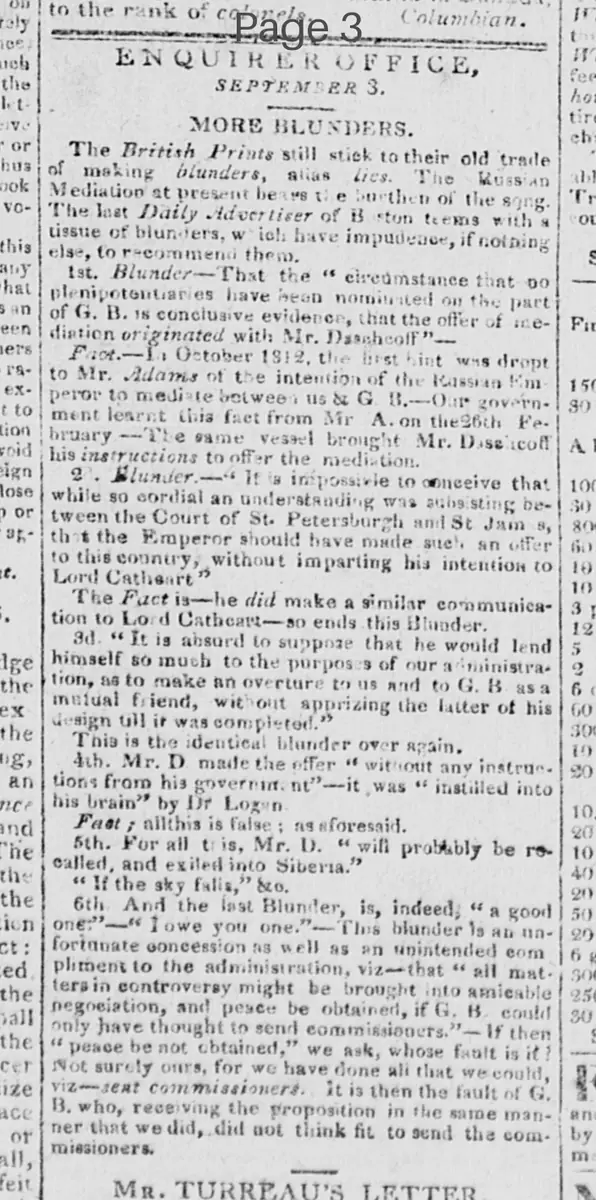
ENQUIRER OFFICE,
SEPTEMBER 3.
MORE BLUNDERS.
The British Prints still stick to their old trade of making blunders, alas tres. The Russian Mediation at present bears the burden of the song. The last Daily Advertiser of Boston teems with a tissue of blunders, which have impudence, if nothing else, to recommend them.
1st. Blunder—That the "circumstance that no plenipotentiaries have been nominated on the part of G.B. is conclusive evidence, that the offer of mediation originated with Mr. Daschkoff"
Fact.—1, October 1812, the first intimation was dropt to Mr. Adams of the intention of the Russian Emperor to mediate between us & G B.—Our government learnt this fact from Mr A. on the 26th February—The same vessel brought Mr. Daschkoff his instructions to offer the mediation.
2d. Blunder.—"It is impossible to conceive that while so cordial an understanding was subsisting between the Court of St. Petersburgh and St James, that the Emperor should have made such an offer to this country, without imparting his intention to Lord Cathcart"
The Fact is—he did make a similar communication to Lord Cathcart—so ends this Blunder.
3d "It is absurd to suppose that he would lend himself so much to the purposes of our administration, as to make an overture to us and to G.B as a mutual friend, without apprizing the latter of his design until it was completed."
This is the identical Blunder over again.
4th. Mr. D made the offer "without any instructions from his government"—it was "instilled into his brain" by Dr Logan
Fact: all this is false: as aforesaid.
5th. For all this, Mr. D. "will probably be recalled, and exiled into Siberia."
"If the sky falls," &c.
6th And the last Blunder, is, indeed, "a good one?"—"I owe you one."—This blunder is an unfortunate concession as well as an unintended compliment to the administration, viz—that "all matters in controversy might be brought into amicable negociation, and peace be obtained, if G.B could only have thought to send commissioners."—If then "peace be not obtained," we ask, whose fault is it Not surely ours, for we have done all that we could, viz—sent commissioners. it is then the fault of G. B. who, receiving the proposition in the same manner that we did, did not think fit to send the commissioners.
SEPTEMBER 3.
MORE BLUNDERS.
The British Prints still stick to their old trade of making blunders, alas tres. The Russian Mediation at present bears the burden of the song. The last Daily Advertiser of Boston teems with a tissue of blunders, which have impudence, if nothing else, to recommend them.
1st. Blunder—That the "circumstance that no plenipotentiaries have been nominated on the part of G.B. is conclusive evidence, that the offer of mediation originated with Mr. Daschkoff"
Fact.—1, October 1812, the first intimation was dropt to Mr. Adams of the intention of the Russian Emperor to mediate between us & G B.—Our government learnt this fact from Mr A. on the 26th February—The same vessel brought Mr. Daschkoff his instructions to offer the mediation.
2d. Blunder.—"It is impossible to conceive that while so cordial an understanding was subsisting between the Court of St. Petersburgh and St James, that the Emperor should have made such an offer to this country, without imparting his intention to Lord Cathcart"
The Fact is—he did make a similar communication to Lord Cathcart—so ends this Blunder.
3d "It is absurd to suppose that he would lend himself so much to the purposes of our administration, as to make an overture to us and to G.B as a mutual friend, without apprizing the latter of his design until it was completed."
This is the identical Blunder over again.
4th. Mr. D made the offer "without any instructions from his government"—it was "instilled into his brain" by Dr Logan
Fact: all this is false: as aforesaid.
5th. For all this, Mr. D. "will probably be recalled, and exiled into Siberia."
"If the sky falls," &c.
6th And the last Blunder, is, indeed, "a good one?"—"I owe you one."—This blunder is an unfortunate concession as well as an unintended compliment to the administration, viz—that "all matters in controversy might be brought into amicable negociation, and peace be obtained, if G.B could only have thought to send commissioners."—If then "peace be not obtained," we ask, whose fault is it Not surely ours, for we have done all that we could, viz—sent commissioners. it is then the fault of G. B. who, receiving the proposition in the same manner that we did, did not think fit to send the commissioners.
What sub-type of article is it?
Foreign Affairs
War Or Peace
What keywords are associated?
Russian Mediation
British Blunders
Diplomatic Negotiations
War Of 1812
Peace Commissioners
What entities or persons were involved?
British Prints
Russian Emperor
Mr. Daschkoff
Mr. Adams
Lord Cathcart
Dr Logan
G.B.
Us Administration
Editorial Details
Primary Topic
Refutation Of British Press Errors On Russian Mediation Offer
Stance / Tone
Critical Of British Misinformation, Defensive Of Us Diplomacy
Key Figures
British Prints
Russian Emperor
Mr. Daschkoff
Mr. Adams
Lord Cathcart
Dr Logan
G.B.
Us Administration
Key Arguments
Russian Mediation Offer Originated With Emperor, Not Daschkoff
Emperor Informed Both Us And Britain Simultaneously
Daschkoff Acted On Government Instructions, Not Personal Initiative
Us Sent Commissioners; Britain Did Not, Faulting Peace Efforts