Thank you for visiting SNEWPapers!
Sign up free
Editorial
January 7, 1835
Republican Herald
Providence, Providence County, Rhode Island
What is this article about?
This editorial, part of a series on banking, criticizes the U.S. banking system for lacking public confidence due to insufficient specie backing, frequent bank failures, and resulting financial losses to the public. It argues that paper currency is unreliable and a curse on the nation, citing examples from Rhode Island banks and the Bank of the United States.
Clipping
OCR Quality
95%
Excellent
Full Text
FOR THE HERALD.
BANKING.—NO. 9
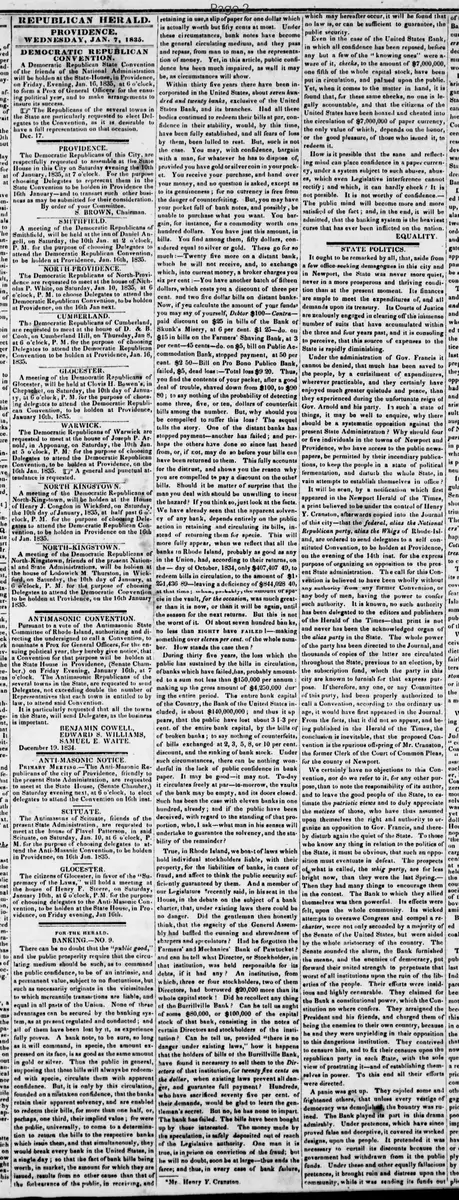
There can be no doubt that the 'public good,' and the public prosperity require that the circulating medium should be such, as to command the public confidence, to be of an intrinsic, and a permanent value, subject to no fluctuations, but such as necessarily originate in the vicissitudes to which mercantile transactions are liable, and equal in all parts of the Union. None of these advantages can be secured by the banking system, as at present regulated and conducted; and all of them have been lost by it, as experience fully proves. A bank note, to be sure, so long as it will command, in specie, the amount expressed on its face, is as good as the same amount in gold or silver. Thus the public in general, supposing that those bills will always be redeemed with specie, circulate them with apparent confidence. But, it is only by this circulation, founded on a mistaken confidence, that the banks retain their apparent solvency, and are enabled to redeem their bills, for more than one half, or perhaps, one third, their implied value; for were the public, universally, to come to a determination to return the bills to the respective banks which issue them, and that simultaneously, they would break every bank in the United States, in a single day; so that the fact of bank bills being worth, in market, the amount for which they are issued, results from no other cause than that of the forbearance of the public, in receiving, and retaining in use, a slip of paper for one dollar which is actually worth but fifty cents at most. Under these circumstances, bank notes have become the general circulating medium, and they pass and repass, from man to man, as the representation of money. Yet, in this article, public confidence has been much impaired, as well it may be, as circumstances will show.
Within thirty five years there have been incorporated in the United States, about seven hundred and twenty banks, exclusive of the United States Bank, and its branches. Had all these bodies continued to redeem their bills at par, confidence in their stability, would, by this time, have been fully established, and all fears of loss by them, been lulled to rest. But, such is not the case. You may, with confidence, bargain with a man, for whatever he has to dispose of provided you have gold or silver coin in your pocket. You receive your purchase, and hand over your money, and no question is asked, except as to its genuineness; for no currency is free from the danger of counterfeiting. But, you may have your pocket full of bank notes, and possibly, be unable to purchase what you want. You bargain, for instance, for a commodity worth one hundred dollars. You have just this amount, in bills. You find among them, fifty dollars, considered equal to silver or gold. These go for so much:—Twenty five more on a distant bank, which he will not receive, and, to exchange which, into current money, a broker charges you six per cent :—You have another batch of fifteen dollars, which costs you a discount of three per cent. and two five dollar bills on distant banks. Now, if you calculate the amount of your funds you may say of yourself, Debtor 100—Contra—paid discount on $25 in bills of the Bank of Skunk's Misery, at 6 per Cent. $1 25—do. on $15 in bills on the Farmers' Shaving Bank, at 3 per cent—45 cents—do. on $5, bill on Public Accommodation Bank, stopped payment, at 50 per cent. $2 50—Bill on Pro Bono Publico Bank, failed, $5, dead loss : Total loss $9 20. Thus, you find the contents of your pocket, after a good deal of trouble, shaved down from 100, to 90 80; to say nothing of the probability of detecting some three, five, or ten, dollars of counterfeit bills among the number. But, why should you be compelled to suffer this loss? The sequel tells the story. One of the distant banks has stopped payment—another has failed; and perhaps the others have done so since last heard from, or, if not, may do so before your bills can have been returned to them. This fully accounts for the distrust, and shows you the reason why you are compelled to pay a discount on the other bills. Should it be matter of surprise that the man you deal with should be unwilling to incur the hazard? If you think so, just look at the facts.
We have already seen that the apparent solvency of any bank, depends entirely on the public action in retaining and circulating its bills, in stead of returning them for specie. This will more fully appear, when we reflect that all the banks in Rhode Island, probably as good as any in the Union, had, according to their returns, on the 1st day of October, 1834, only $407,407 49, to redeem bills in circulation, to the amount of $1,251,436 89—leaving a deficiency of $844,028 40 at that time; when, probably the amount of specie in the vault, for the occasion, was much greater than it is now, or than it will be again, until the season for the next returns. But this is not the worst of it. Of about seven hundred banks, no less than EIGHTY have FAILED—making something over eleven per cent. of the whole number. How stands the case then?
During thirty five years, the loss which the public has sustained by the bills in circulation, of banks which have failed, has, probably amounted to a sum not less than $150,000 per annum : making up the gross amount of $4,250,000 during the entire period. The entire bank capital of the Country, the Bank of the United States included, is about $140,000,000; and thus it appears, that the public have lost about 3 1-3 per cent. of the entire bank capital, by the bills of broken banks; to say nothing of counterfeits, of bills exchanged at 2, 3, 5, 8, or 10 per cent. discount, and the sinking of bank stock. Under such circumstances, there can be nothing wonderful in the lack of public confidence in bank paper. It may be good—it may not. To-day it circulates freely at par—to-morrow, the vaults of the bank may be empty, and its doors closed. Such has been the case with eleven banks in one hundred, already; and if the public have been deceived, with regard to the standing of that proportion, who, I ask—what man in his senses will undertake to guarantee the solvency, and the stability of the remainder?
True, in Rhode Island, we boast of laws which hold individual stockholders liable, with their property, for the liabilities of banks, in cases of fraud, and affect to think the public security sufficiently guaranteed by them. And a member of our Legislature recently said, in his seat in the House, in the debate on the subject of a bank charter, that, under existing laws there could be no danger. Did the gentleman then honestly think, that the sagacity of the General Assembly had baffled the cunning and shrewdness of sharpers and speculators? Had he forgotten the Farmers' and Mechanics' Bank of Pawtucket? and can he tell what Director, or Stockholder, in that institution, was held responsible for its debts, if it had any? An institution, from which, three or four stockholders, two of them Directors, had borrowed $20,000 more than its whole capital stock! Did he recollect any thing of the Burrillville Bank? Can he tell us aught of some $80,000, or $100,000 of the capital stock of that bank, consisting in the notes of certain Directors and stockholders of the institution? Can he tell us, provided 'there is no danger under existing laws,' how it happens that the holders of bills of the Burrillville Bank, have found it necessary to sell them to the Directors of that institution, for twenty five cents on the dollar, when existing laws prevent all danger, and guarantee full payment? Hundreds, who have sacrificed seventy five per cent. of their demands, would be glad to learn the gentleman's secret. But no, he has none to impart. The bank has failed. The bills have been bought up by those interested. The money made by the speculation, is safely deposited out of reach of the Legislative authority. One man it is true, is in prison on conviction of the fraud; but he will no doubt, soon be at large—thus ends the farce; and thus, in every case of bank failure, which may hereafter occur, it will be found that no law is, or can be sufficient to guarantee, the public security.
Even in the case of the United States Bank, in which all confidence has been reposed, before any but a few of the 'knowing ones' were aware of it, checks, to the amount of $7,000,000. one fifth of the whole capital stock, have been put in circulation, and palmed upon the public. Yet, when it comes to the matter in hand, it is found that, for these same checks, no one is legally accountable, and that the citizens of the United States have been hoaxed and cheated into the circulation of $7,000,000 of paper currency the only value of which, depends on the honor, or the good pleasure, of those who issued it, to redeem it.
How is it possible that the sane and reflecting mind can place confidence in a paper currency, under a system subject to such abuses, abuses, which even Legislative interference cannot rectify; and which, it can hardly check? It is not possible. It is not worthy of confidence.— The public mind will become more and more satisfied of the fact; and, in the end, it will be admitted, that the banking system is the heaviest curse that has ever been inflicted on the nation.
BANKING.—NO. 9
There can be no doubt that the 'public good,' and the public prosperity require that the circulating medium should be such, as to command the public confidence, to be of an intrinsic, and a permanent value, subject to no fluctuations, but such as necessarily originate in the vicissitudes to which mercantile transactions are liable, and equal in all parts of the Union. None of these advantages can be secured by the banking system, as at present regulated and conducted; and all of them have been lost by it, as experience fully proves. A bank note, to be sure, so long as it will command, in specie, the amount expressed on its face, is as good as the same amount in gold or silver. Thus the public in general, supposing that those bills will always be redeemed with specie, circulate them with apparent confidence. But, it is only by this circulation, founded on a mistaken confidence, that the banks retain their apparent solvency, and are enabled to redeem their bills, for more than one half, or perhaps, one third, their implied value; for were the public, universally, to come to a determination to return the bills to the respective banks which issue them, and that simultaneously, they would break every bank in the United States, in a single day; so that the fact of bank bills being worth, in market, the amount for which they are issued, results from no other cause than that of the forbearance of the public, in receiving, and retaining in use, a slip of paper for one dollar which is actually worth but fifty cents at most. Under these circumstances, bank notes have become the general circulating medium, and they pass and repass, from man to man, as the representation of money. Yet, in this article, public confidence has been much impaired, as well it may be, as circumstances will show.
Within thirty five years there have been incorporated in the United States, about seven hundred and twenty banks, exclusive of the United States Bank, and its branches. Had all these bodies continued to redeem their bills at par, confidence in their stability, would, by this time, have been fully established, and all fears of loss by them, been lulled to rest. But, such is not the case. You may, with confidence, bargain with a man, for whatever he has to dispose of provided you have gold or silver coin in your pocket. You receive your purchase, and hand over your money, and no question is asked, except as to its genuineness; for no currency is free from the danger of counterfeiting. But, you may have your pocket full of bank notes, and possibly, be unable to purchase what you want. You bargain, for instance, for a commodity worth one hundred dollars. You have just this amount, in bills. You find among them, fifty dollars, considered equal to silver or gold. These go for so much:—Twenty five more on a distant bank, which he will not receive, and, to exchange which, into current money, a broker charges you six per cent :—You have another batch of fifteen dollars, which costs you a discount of three per cent. and two five dollar bills on distant banks. Now, if you calculate the amount of your funds you may say of yourself, Debtor 100—Contra—paid discount on $25 in bills of the Bank of Skunk's Misery, at 6 per Cent. $1 25—do. on $15 in bills on the Farmers' Shaving Bank, at 3 per cent—45 cents—do. on $5, bill on Public Accommodation Bank, stopped payment, at 50 per cent. $2 50—Bill on Pro Bono Publico Bank, failed, $5, dead loss : Total loss $9 20. Thus, you find the contents of your pocket, after a good deal of trouble, shaved down from 100, to 90 80; to say nothing of the probability of detecting some three, five, or ten, dollars of counterfeit bills among the number. But, why should you be compelled to suffer this loss? The sequel tells the story. One of the distant banks has stopped payment—another has failed; and perhaps the others have done so since last heard from, or, if not, may do so before your bills can have been returned to them. This fully accounts for the distrust, and shows you the reason why you are compelled to pay a discount on the other bills. Should it be matter of surprise that the man you deal with should be unwilling to incur the hazard? If you think so, just look at the facts.
We have already seen that the apparent solvency of any bank, depends entirely on the public action in retaining and circulating its bills, in stead of returning them for specie. This will more fully appear, when we reflect that all the banks in Rhode Island, probably as good as any in the Union, had, according to their returns, on the 1st day of October, 1834, only $407,407 49, to redeem bills in circulation, to the amount of $1,251,436 89—leaving a deficiency of $844,028 40 at that time; when, probably the amount of specie in the vault, for the occasion, was much greater than it is now, or than it will be again, until the season for the next returns. But this is not the worst of it. Of about seven hundred banks, no less than EIGHTY have FAILED—making something over eleven per cent. of the whole number. How stands the case then?
During thirty five years, the loss which the public has sustained by the bills in circulation, of banks which have failed, has, probably amounted to a sum not less than $150,000 per annum : making up the gross amount of $4,250,000 during the entire period. The entire bank capital of the Country, the Bank of the United States included, is about $140,000,000; and thus it appears, that the public have lost about 3 1-3 per cent. of the entire bank capital, by the bills of broken banks; to say nothing of counterfeits, of bills exchanged at 2, 3, 5, 8, or 10 per cent. discount, and the sinking of bank stock. Under such circumstances, there can be nothing wonderful in the lack of public confidence in bank paper. It may be good—it may not. To-day it circulates freely at par—to-morrow, the vaults of the bank may be empty, and its doors closed. Such has been the case with eleven banks in one hundred, already; and if the public have been deceived, with regard to the standing of that proportion, who, I ask—what man in his senses will undertake to guarantee the solvency, and the stability of the remainder?
True, in Rhode Island, we boast of laws which hold individual stockholders liable, with their property, for the liabilities of banks, in cases of fraud, and affect to think the public security sufficiently guaranteed by them. And a member of our Legislature recently said, in his seat in the House, in the debate on the subject of a bank charter, that, under existing laws there could be no danger. Did the gentleman then honestly think, that the sagacity of the General Assembly had baffled the cunning and shrewdness of sharpers and speculators? Had he forgotten the Farmers' and Mechanics' Bank of Pawtucket? and can he tell what Director, or Stockholder, in that institution, was held responsible for its debts, if it had any? An institution, from which, three or four stockholders, two of them Directors, had borrowed $20,000 more than its whole capital stock! Did he recollect any thing of the Burrillville Bank? Can he tell us aught of some $80,000, or $100,000 of the capital stock of that bank, consisting in the notes of certain Directors and stockholders of the institution? Can he tell us, provided 'there is no danger under existing laws,' how it happens that the holders of bills of the Burrillville Bank, have found it necessary to sell them to the Directors of that institution, for twenty five cents on the dollar, when existing laws prevent all danger, and guarantee full payment? Hundreds, who have sacrificed seventy five per cent. of their demands, would be glad to learn the gentleman's secret. But no, he has none to impart. The bank has failed. The bills have been bought up by those interested. The money made by the speculation, is safely deposited out of reach of the Legislative authority. One man it is true, is in prison on conviction of the fraud; but he will no doubt, soon be at large—thus ends the farce; and thus, in every case of bank failure, which may hereafter occur, it will be found that no law is, or can be sufficient to guarantee, the public security.
Even in the case of the United States Bank, in which all confidence has been reposed, before any but a few of the 'knowing ones' were aware of it, checks, to the amount of $7,000,000. one fifth of the whole capital stock, have been put in circulation, and palmed upon the public. Yet, when it comes to the matter in hand, it is found that, for these same checks, no one is legally accountable, and that the citizens of the United States have been hoaxed and cheated into the circulation of $7,000,000 of paper currency the only value of which, depends on the honor, or the good pleasure, of those who issued it, to redeem it.
How is it possible that the sane and reflecting mind can place confidence in a paper currency, under a system subject to such abuses, abuses, which even Legislative interference cannot rectify; and which, it can hardly check? It is not possible. It is not worthy of confidence.— The public mind will become more and more satisfied of the fact; and, in the end, it will be admitted, that the banking system is the heaviest curse that has ever been inflicted on the nation.
What sub-type of article is it?
Economic Policy
What keywords are associated?
Banking System
Paper Currency
Bank Failures
Public Confidence
Specie Redemption
Bank Fraud
Economic Losses
What entities or persons were involved?
Bank Of The United States
Farmers' And Mechanics' Bank Of Pawtucket
Burrillville Bank
Rhode Island Banks
General Assembly
Editorial Details
Primary Topic
Critique Of The Banking System And Paper Currency
Stance / Tone
Strongly Critical Of The Current Banking System
Key Figures
Bank Of The United States
Farmers' And Mechanics' Bank Of Pawtucket
Burrillville Bank
Rhode Island Banks
General Assembly
Key Arguments
Bank Notes Depend On Mistaken Public Confidence And Lack Sufficient Specie Backing
Over 700 Banks Incorporated In 35 Years, With 80 Failures Leading To Public Losses Of At Least $4,250,000
Discounts And Counterfeits Further Erode Value Of Bank Paper
Laws Holding Stockholders Liable Fail To Prevent Fraud And Protect The Public, As Seen In Specific Rhode Island Bank Failures
Even The Bank Of The United States Has Issued Unaccountable Checks Worth $7,000,000
The Banking System Is Inherently Abusive And Unworthy Of Confidence, A Curse On The Nation