Thank you for visiting SNEWPapers!
Sign up free
Poem
January 5, 1827
Phenix Gazette
Alexandria, Virginia
What is this article about?
A plaintive poem reflecting on the dying year as a symbol of lost joys, seasonal changes, and life's inevitable sorrows, emphasizing enduring suffering over fleeting happiness. Attributed to IANTHE, with a Petrarch quote.
Clipping
OCR Quality
95%
Excellent
Full Text
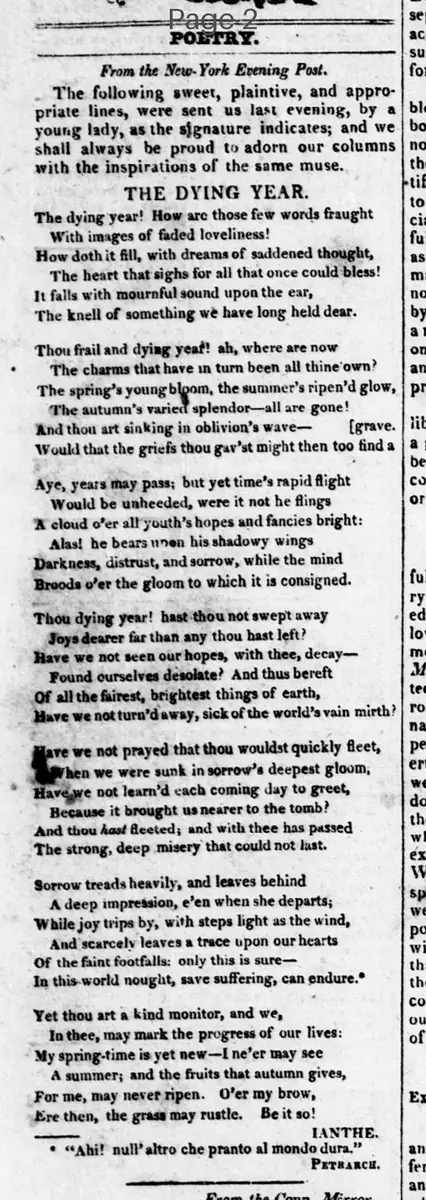
POETRY.
From the New-York Evening Post.
The following sweet, plaintive, and appropriate lines, were sent us last evening, by a
young lady, as the signature indicates; and we
shall always be proud to adorn our columns
with the inspirations of the same muse.
THE DYING YEAR.
The dying year! How are those few words fraught
With images of faded loveliness!
How doth it fill, with dreams of saddened thought,
The heart that sighs for all that once could bless!
It falls with mournful sound upon the ear,
The knell of something we have long held dear.
Thou frail and dying year! ah, where are now
The charms that have in turn been all thine own?
The spring's young bloom, the summer's ripen'd glow,
The autumn's varied splendor—all are gone!
And thou art sinking in oblivion's wave—
[grave.
Would that the griefs thou gar'st might then too find a
Aye, years may pass; but yet time's rapid flight
Would be unheeded, were it not he brings
A cloud o'er all youth's hopes and fancies bright:
Alas! he bears upon his shadowy wings
Darkness, distrust, and sorrow, while the mind
Broods o'er the gloom to which it is consigned.
Thou dying year! hast thou not swept away
Joys dearer far than any thou hast left?
Have we not seen our hopes, with thee, decay—
Found ourselves desolate? And thus bereft
Of all the fairest, brightest things of earth,
Have we not turn'd away, sick of the world's vain mirth?
Have we not prayed that thou wouldst quickly fleet,
When we were sunk in sorrow's deepest gloom,
Have we not learn'd each coming day to greet,
Because it brought us nearer to the tomb?
And thou hast fleeted; and with thee has passed
The strong, deep misery that could not last.
Sorrow treads heavily, and leaves behind
A deep impression, e'en when she departs;
While joy trips by, with steps light as the wind,
And scarcely leaves a trace upon our hearts
Of the faint footfalls: only this is sure—
In this world nought, save suffering, can endure.
Yet thou art a kind monitor, and we,
In thee, may mark the progress of our lives:
My spring-time is yet new—I ne'er may see
A summer; and the fruits that autumn gives,
For me, may never ripen. O'er my brow,
Ere then, the grass may rustle.
Be it so!
IANTHE.
"Ahi! null' altro che pranto al mondo dura."
PETRARCH.
From the New-York Evening Post.
The following sweet, plaintive, and appropriate lines, were sent us last evening, by a
young lady, as the signature indicates; and we
shall always be proud to adorn our columns
with the inspirations of the same muse.
THE DYING YEAR.
The dying year! How are those few words fraught
With images of faded loveliness!
How doth it fill, with dreams of saddened thought,
The heart that sighs for all that once could bless!
It falls with mournful sound upon the ear,
The knell of something we have long held dear.
Thou frail and dying year! ah, where are now
The charms that have in turn been all thine own?
The spring's young bloom, the summer's ripen'd glow,
The autumn's varied splendor—all are gone!
And thou art sinking in oblivion's wave—
[grave.
Would that the griefs thou gar'st might then too find a
Aye, years may pass; but yet time's rapid flight
Would be unheeded, were it not he brings
A cloud o'er all youth's hopes and fancies bright:
Alas! he bears upon his shadowy wings
Darkness, distrust, and sorrow, while the mind
Broods o'er the gloom to which it is consigned.
Thou dying year! hast thou not swept away
Joys dearer far than any thou hast left?
Have we not seen our hopes, with thee, decay—
Found ourselves desolate? And thus bereft
Of all the fairest, brightest things of earth,
Have we not turn'd away, sick of the world's vain mirth?
Have we not prayed that thou wouldst quickly fleet,
When we were sunk in sorrow's deepest gloom,
Have we not learn'd each coming day to greet,
Because it brought us nearer to the tomb?
And thou hast fleeted; and with thee has passed
The strong, deep misery that could not last.
Sorrow treads heavily, and leaves behind
A deep impression, e'en when she departs;
While joy trips by, with steps light as the wind,
And scarcely leaves a trace upon our hearts
Of the faint footfalls: only this is sure—
In this world nought, save suffering, can endure.
Yet thou art a kind monitor, and we,
In thee, may mark the progress of our lives:
My spring-time is yet new—I ne'er may see
A summer; and the fruits that autumn gives,
For me, may never ripen. O'er my brow,
Ere then, the grass may rustle.
Be it so!
IANTHE.
"Ahi! null' altro che pranto al mondo dura."
PETRARCH.
What sub-type of article is it?
Elegy
Ode
What themes does it cover?
Nature Seasons
Death Mourning
Moral Virtue
What keywords are associated?
Dying Year
Passing Seasons
Life Sorrows
Time Flight
Enduring Suffering
What entities or persons were involved?
Ianthe
Poem Details
Title
The Dying Year
Author
Ianthe
Subject
Reflection On The Passing Year
Key Lines
The Dying Year! How Are Those Few Words Fraught
With Images Of Faded Loveliness!
How Doth It Fill, With Dreams Of Saddened Thought,
The Heart That Sighs For All That Once Could Bless!
It Falls With Mournful Sound Upon The Ear,
The Knell Of Something We Have Long Held Dear.
Sorrow Treads Heavily, And Leaves Behind
A Deep Impression, E'en When She Departs;
While Joy Trips By, With Steps Light As The Wind,
And Scarcely Leaves A Trace Upon Our Hearts
Of The Faint Footfalls: Only This Is Sure—
In This World Nought, Save Suffering, Can Endure.