Thank you for visiting SNEWPapers!
Sign up free
Public Ledger
Memphis, Shelby County, Tennessee
What is this article about?
Samuel Sickman, a prominent merchant from California, PA, disappeared in Pittsburgh in fall 1868 after checking into a hotel. Presumed murdered or drowned, his wife identified bodies and erected a monument. After 13 years, he returned from Europe, revealing he had deposited money and left voluntarily.
Clipping
OCR Quality
Full Text
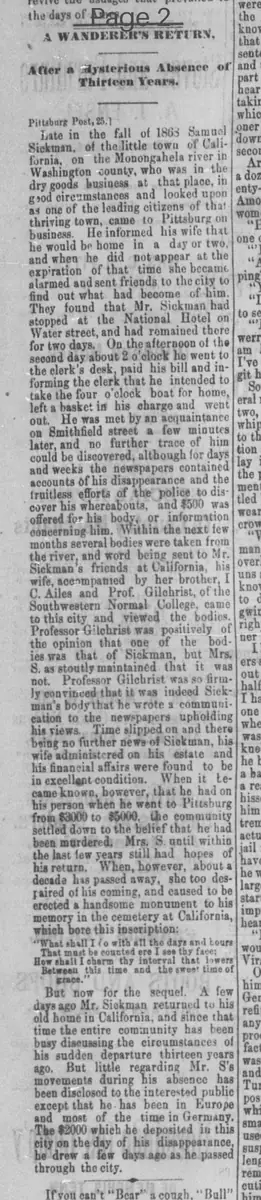
After a Mysterious Absence of Thirteen Years.
Pittsburg Post, 25th.
Late in the fall of 1868 Samuel Sickman, of the little town of California, on the Monongahela river in Washington county, who was in the dry goods business at that place, in good circumstances and looked upon as one of the leading citizens of that thriving town, came to Pittsburg on business. He informed his wife that he would be home in a day or two, and when he did not appear at the expiration of that time she became alarmed and sent friends to the city to find out what had become of him. They found that Mr. Sickman had stopped at the National Hotel on Water street, and had remained there for two days. On the afternoon of the second day about 2 o'clock he went to the clerk's desk, paid his bill and informing the clerk that he intended to take the four o'clock boat for home, left a basket in his charge and went out. He was met by an acquaintance on Smithfield street a few minutes later, and no further trace of him could be discovered, although for days and weeks the newspapers contained accounts of his disappearance and the fruitless efforts of the police to discover his whereabouts, and $500 was offered for his body, or information concerning him. Within the next few months several bodies were taken from the river, and word being sent to Mr. Sickman's friends at California, his wife, accompanied by her brother, J. C. Ailes and Prof. Gilchrist, of the Southwestern Normal College, came to this city and viewed the bodies. Professor Gilchrist was positively of the opinion that one of the bodies was that of Sickman, but Mrs. S. as stoutly maintained that it was not. Professor Gilchrist was so firmly convinced that it was indeed Sickman's body that he wrote a communication to the newspapers upholding his views. Time slipped on and there being no further news of Sickman, his wife administered on his estate and his financial affairs were found to be in excellent condition. When it became known, however, that he had on his person when he went to Pittsburg from $3000 to $5000, the community settled down to the belief that he had been murdered. Mrs. S. until within the last few years still had hopes of his return. When, however, about a decade has passed away, she too despaired of his coming, and caused to be erected a handsome monument to his memory in the cemetery at California, which bore this inscription:
"What shall I do with all the days and hours
That must be counted ere I see thy face?
How shall I charm the interval that lowers
Between this time and the sweet time of grace."
But now for the sequel. A few days ago Mr. Sickman returned to his old home in California, and since that time the entire community has been busy discussing the circumstances of his sudden departure thirteen years ago. But little regarding Mr. S's movements during his absence has been disclosed to the interested public except that he has been in Europe and most of the time in Germany. The $2000 which he deposited in this city on the day of his disappearance, he drew a few days ago as he passed through the city.
What sub-type of article is it?
What themes does it cover?
What keywords are associated?
What entities or persons were involved?
Where did it happen?
Story Details
Key Persons
Location
California On The Monongahela River, Washington County; Pittsburg; Europe; Germany
Event Date
Late In The Fall Of 1868; Thirteen Years Later
Story Details
Samuel Sickman disappeared from Pittsburgh in 1868 after leaving a hotel, presumed murdered due to carrying large sum of money. His wife identified bodies and erected a monument after years of hope. He returned after 13 years from Europe, having deposited money upon leaving.