Thank you for visiting SNEWPapers!
Sign up free
Story
July 6, 1827
American Watchman And Delaware Advertiser
Wilmington, New Castle County, Delaware
What is this article about?
Humorous description of a militia muster, or 'Battalion day,' in Orwigsburg, Pennsylvania, where the event is more a festive gathering of dancing, drinking, and frolicking than military training, with little regard for discipline.
Clipping
OCR Quality
95%
Excellent
Full Text
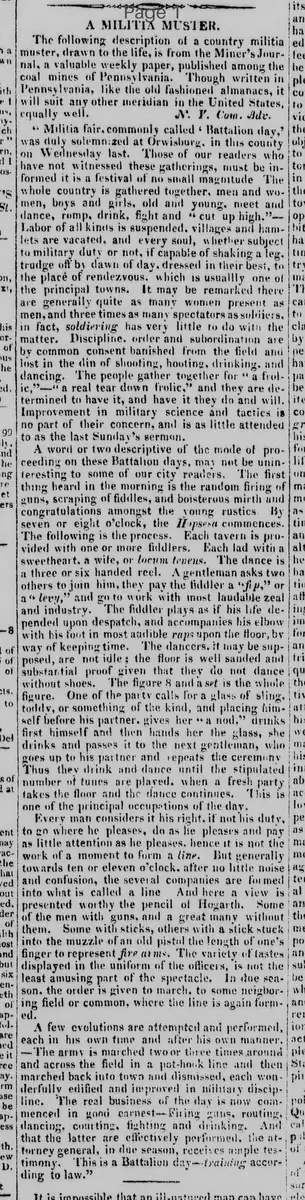
A MILITIA MUSTER.
The following description of a country militia muster, drawn to the life, is from the Miner's Journal, a valuable weekly paper, published among the coal mines of Pennsylvania. Though written in Pennsylvania, like the old fashioned almanacs, it will suit any other meridian in the United States, equally well.
N. Y. Com. Adv.
"Militia fair, commonly called 'Battalion day' was duly solemnized at Orwigsburg, in this county on Wednesday last. Those of our readers who have not witnessed these gatherings, must be informed it is a festival of no small magnitude The whole country is gathered together, men and women, boys and girls, old and young, meet and dance, romp, drink, fight and "cut up high."— Labor of all kinds is suspended. villages and hamlets are vacated, and every soul, whether subject to military duty or not, if capable of shaking a leg. trudge off by dawn of day, dressed in their best, to the place of rendezvous. which is usually one of the principal towns. It may be remarked there are generally quite as many women present as men, and three times as many spectators as soldiers. in fact, soldiering has very little to do with the matter. Discipline, order and subordination are by common consent banished from the field and lost in the din of shooting, hooting, drinking. and dancing. 'The people gather together for "a frolic,"' a real tear down frolic," and they are determined to have it, and have it they do and will. Improvement in military science and tactics is no part of their concern, and is as little attended to as the last Sunday's sermon.
A word or two descriptive of the mode of proceeding on these Battalion days, may not be uninteresting to some of our city readers. The first thing heard in the morning is the random firing of guns, scraping of fiddles, and boisterous mirth and congratulations amongst the young rustics By seven or eight o'clock, the Hopsesa commences. The following is the process. Each tavern is provided with one or more fiddlers. Each lad with a sweetheart, a wife, or locum tenens. The dance is a three or six handed reel. A gentleman asks two others to join him, they pay the fiddler a "fip," or a "levy," and go to work with most laudable zeal and industry. The fiddler plays as if his life depended upon despatch, and accompanies his elbow with his foot in most audible raps upon the floor, by way of keeping time. The dancers. it may be supposed, are not idle; the floor is well sanded and substantial proof given that they do not dance without shoes. The figure 8 and a set is the whole figure. One of the party calls for a glass of sling. toddy, or something of the kind, and placing himself before his partner, gives her "a nod." drinks first himself and then hands her the glass, she drinks and passes it to the next gentleman, who goes up to his partner and repeats the ceremony Thus they drink and dance until the stipulated number of tunes are played. when a fresh party takes the floor and the dance continues. This is one of the principal occupations of the day.
Every man considers it his right, if not his duty, to go where he pleases, do as he pleases and pay as little attention as he pleases. hence it is not the work of a moment to form a line. But generally towards ten or eleven o'clock. after no little noise and confusion, the several companies are formed into what is called a line And here a view is presented worthy the pencil of Hogarth. Some of the men with guns, and a great many without them. Some with sticks, others with a stick stuck into the muzzle of an old pistol the length of one's finger to represent fire arms. The variety of tastes displayed in the uniform of the officers, is not the least amusing part of the spectacle. In summer season, the order is given to march. to some neighboring field or common, where the line is again formed.
A few evolutions are attempted and performed. each in his own time and after his own manner. —The army is marched two or three times around and across the field in a pot-hook line and then marched back into town and dismissed, each wonderfully edified and improved in military discipline. The real business of the day is now commenced in good earnest—Firing guns, routing. dancing. courting, fighting and drinking. And that the latter are effectively performed. the attorney general, in due season, receives ample testimony. This is a Battalion day—'training according to law.'"
The following description of a country militia muster, drawn to the life, is from the Miner's Journal, a valuable weekly paper, published among the coal mines of Pennsylvania. Though written in Pennsylvania, like the old fashioned almanacs, it will suit any other meridian in the United States, equally well.
N. Y. Com. Adv.
"Militia fair, commonly called 'Battalion day' was duly solemnized at Orwigsburg, in this county on Wednesday last. Those of our readers who have not witnessed these gatherings, must be informed it is a festival of no small magnitude The whole country is gathered together, men and women, boys and girls, old and young, meet and dance, romp, drink, fight and "cut up high."— Labor of all kinds is suspended. villages and hamlets are vacated, and every soul, whether subject to military duty or not, if capable of shaking a leg. trudge off by dawn of day, dressed in their best, to the place of rendezvous. which is usually one of the principal towns. It may be remarked there are generally quite as many women present as men, and three times as many spectators as soldiers. in fact, soldiering has very little to do with the matter. Discipline, order and subordination are by common consent banished from the field and lost in the din of shooting, hooting, drinking. and dancing. 'The people gather together for "a frolic,"' a real tear down frolic," and they are determined to have it, and have it they do and will. Improvement in military science and tactics is no part of their concern, and is as little attended to as the last Sunday's sermon.
A word or two descriptive of the mode of proceeding on these Battalion days, may not be uninteresting to some of our city readers. The first thing heard in the morning is the random firing of guns, scraping of fiddles, and boisterous mirth and congratulations amongst the young rustics By seven or eight o'clock, the Hopsesa commences. The following is the process. Each tavern is provided with one or more fiddlers. Each lad with a sweetheart, a wife, or locum tenens. The dance is a three or six handed reel. A gentleman asks two others to join him, they pay the fiddler a "fip," or a "levy," and go to work with most laudable zeal and industry. The fiddler plays as if his life depended upon despatch, and accompanies his elbow with his foot in most audible raps upon the floor, by way of keeping time. The dancers. it may be supposed, are not idle; the floor is well sanded and substantial proof given that they do not dance without shoes. The figure 8 and a set is the whole figure. One of the party calls for a glass of sling. toddy, or something of the kind, and placing himself before his partner, gives her "a nod." drinks first himself and then hands her the glass, she drinks and passes it to the next gentleman, who goes up to his partner and repeats the ceremony Thus they drink and dance until the stipulated number of tunes are played. when a fresh party takes the floor and the dance continues. This is one of the principal occupations of the day.
Every man considers it his right, if not his duty, to go where he pleases, do as he pleases and pay as little attention as he pleases. hence it is not the work of a moment to form a line. But generally towards ten or eleven o'clock. after no little noise and confusion, the several companies are formed into what is called a line And here a view is presented worthy the pencil of Hogarth. Some of the men with guns, and a great many without them. Some with sticks, others with a stick stuck into the muzzle of an old pistol the length of one's finger to represent fire arms. The variety of tastes displayed in the uniform of the officers, is not the least amusing part of the spectacle. In summer season, the order is given to march. to some neighboring field or common, where the line is again formed.
A few evolutions are attempted and performed. each in his own time and after his own manner. —The army is marched two or three times around and across the field in a pot-hook line and then marched back into town and dismissed, each wonderfully edified and improved in military discipline. The real business of the day is now commenced in good earnest—Firing guns, routing. dancing. courting, fighting and drinking. And that the latter are effectively performed. the attorney general, in due season, receives ample testimony. This is a Battalion day—'training according to law.'"
What sub-type of article is it?
Curiosity
Historical Event
What themes does it cover?
Social Manners
What keywords are associated?
Militia Muster
Battalion Day
Frolic
Dancing
Drinking
Military Training
Where did it happen?
Orwigsburg, In This County
Story Details
Location
Orwigsburg, In This County
Event Date
Wednesday Last
Story Details
Description of a militia muster as a festive gathering with dancing, drinking, and minimal military activity, where discipline is ignored in favor of frolicking.