Thank you for visiting SNEWPapers!
Sign up free
Alexandria Gazette & Daily Advertiser
Alexandria, Virginia
What is this article about?
The Quarterly Review for February 1818 reports the disappearance of polar ice from Greenland's coast after centuries, observed in 1817 voyages, potentially allowing access to lost colonies, climate impacts, and a northern passage to the Pacific. Expeditions are planned.
Clipping
OCR Quality
Full Text
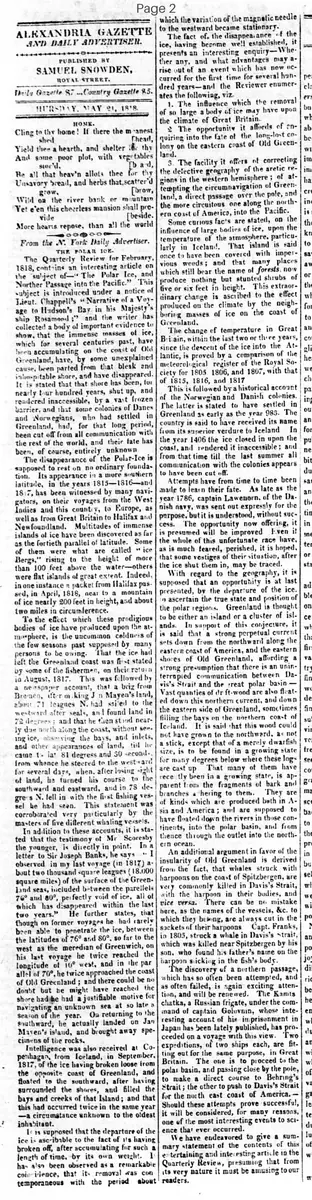
THE POLAR ICE.
The Quarterly Review for February, 1818, contains an interesting article on the subject of The Polar Ice, and Northern Passage into the Pacific. This subject is introduced under a notice of Lieut. Chappell's "Narrative of a Voyage to Hudson's Bay in his Majesty's ship Rosamond;" and the writer has collected a body of important evidence to show, that the immense masses of ice, which for several centuries past, have been accumulating on the coast of Old Greenland, have, by some unexplained cause, been parted from that bleak and inhospitable shore, and have disappeared.
It is stated that that shore has been, for nearly four hundred years, shut up, and rendered inaccessible, by a vast frozen barrier, and that some colonies of Danes and Norwegians, who had settled in Greenland, had, for that long period, been cut off from all communication with the rest of the world, and their fate has been, of course, entirely unknown.
The disappearance of the Polar Ice is supposed to rest on no ordinary foundation. Its appearance in a more Southern latitude, in the years 1815-1816 and 1817, has been witnessed by many navigators, on their voyages from the West Indies and this country, to Europe, as well as from Great Britain to Halifax and Newfoundland. Multitudes of immense islands of ice have been discovered as far as the fortieth parallel of latitude. Some of them were what are called "ice Bergs," rising to the height of more than 100 feet above the water-others were flat islands of great extent. Indeed, in one instance a packet from Halifax passed, in April, 1818, near to a mountain of ice nearly 200 feet in height, and about two miles in circumference.
To the effect which these prodigious bodies of ice have produced upon the atmosphere, is the uncommon coldness of the few seasons past supposed by many persons to be owing. That the ice had left the Greenland coast was first stated by some of the fishermen, on their return in August, 1817. This was followed by a newspaper account, that a brig from Bremen, in making Jan Mayen's land, about 21 leagues N. had sailed to the westward after seals, and found land in 72 degrees; and that he then stood nearly due north along the coast, without seeing ice, observing the bays, and inlets, and other appearances of land, til he came to lat 81 degrees and 50 seconds. from whence he steered to the westward for several days, when, after losing sight of land, he turned his course to the southward and eastward, and in 78 degrees N. fell in with the first fishing vessels he had seen. This statement was corroborated very particularly by the masters of five different whaling vessels.
In addition to these accounts, it is stated that the testimony of Mr Scoresby the younger, is directly in point. In a letter to Sir Joseph Banks, he says I observed in my last voyage (in 1817) about two thousand square leagues (18,000 square miles) of the surface of the Greenland seas, included between the parallels 76° and 80, perfectly void of ice, all of which has disappeared within the last two years."
He further states, that though on former voyages he had rarely been able to penetrate the ice, between the latitudes of 76° and 80°, so far to the west as the meridian of Greenwich, on his last voyage he twice reached the longitude of 10 west, and in the parallel of 70°, he twice approached the coast of Old Greenland; and there could be no doubt but he might have reached the shore had he had a justifiable motive for navigating an unknown sea at so late a Season of the year. On returning to the southward, he actually landed on Jan Mayen's island, and brought away specimens of the rocks.
Intelligence was also received at Copenhagen, from Iceland, in September, 1817, of the ice having broken loose from the opposite coast of Greenland, and floated to the southward, after having surrounded the shores, and filled the bays and creeks of that Island: and that this had occurred twice in the same year -a circumstance unknown to the oldest inhabitant.
It is supposed that the departure of the ice is ascribable to the fact of its having broken off, after accumulating for such a length of time, by its own weight. It has also been observed as a remarkable coincidence, that its removal was contemporaneous with the period about which the variation of the magnetic needle to the westward became stationary.
The fact of the disappearance of the ice, having become well established, it presents an interesting enquiry-Whether any, and what advantages may arise out of an event which has now occurred for the first time for several hundred years--and the Reviewer enumerates the following, viz.
1. The influence which the removal of so large a body of ice may have upon the climate of Great Britain.
2 The opportunity it affords of enquiring into the fate of the long-lost colonies on the eastern coast of Old Greenland.
3. The facility it offers of correcting the defective geography of the arctic regions in the western hemisphere; of attempting the circumnavigation of Greenland, a direct passage over the pole, and the more circuitous one along the northeastern coast of America, into the Pacific.
Some curious facts are stated, on the influence of large bodies of ice, upon the temperature of the atmosphere, particularly in Iceland. That island is said once to have been covered with impervious woods; and that many places which still bear the name of forests, now produce nothing but stunted shrubs of five or six feet in height. This extraordinary change is ascribed to the effect produced on the climate by the neighboring masses of ice on the coast of Greenland,
The change of temperature in Great Britain, within the last two or three years, since the descent of the ice into the Atlantic, is proved by a comparison of the meteorological register of the Royal Society for 1805 1806, and 1807, with that of 1815, 1816, and 1817
This is followed by a historical account of the Norwegian and Danish colonies. The latter is stated to have settled in Greenland as early as the year 986. The country is said to have received its name from its superior verdure to Iceland In the year 1406 the ice closed in upon the coast, and rendered it inaccessible; and from that time till the last summer all communication with the colonies appears to have been cut off.
Attempts have from time to time been made to learn their fate. As late as the year 1786, captain Lawenorn, of the Danish navy, was sent out expressly for the purpose, but it is understood, without success. The opportunity now offering, it is presumed will be improved Even it the whole of this unfortunate race have, as is much feared, perished, it is hoped, that some vestiges of their situation, after the ice shut them in, may be traced.
With regard to the geography, it is supposed that an opportunity is at last presented, by the departure of the ice, to ascertain the true state and position of the polar regions. Greenland is thought to be either an island or a cluster of islands. In support of this conjecture, it is said that a strong perpetual current sets down from the northward along the eastern coast of America, and the eastern shores of Old Greenland, affording a strong presumption that there is an uninterrupted communication between Davis's Strait and the great polar basin -Vast quantities of drift-wood are also floated down this northern current, and down the eastern side of Greenland, sometimes filling the bays on the northern coast of Iceland. It is said that this wood could not have grown to the northward, as not a stick, except that of a merely dwarfish size, is to be found in a growing state for many degrees below where these logs are cast up That many of them have recently been in a growing state, is apparent from the fragments of bark and branches adhering to them. They are of kinds which are produced both in Asia and America; and are supposed to have floated down the rivers in those continents, into the polar basin, and from thence through the outlet into the northern ocean.
An additional argument in favor of the insularity of Old Greenland is derived from the fact, that whales struck with harpoons on the coast of Spitzbergen, are very commonly killed in Davis's Strait, with the harpoon in their bodies, and vice versa. There can be no mistake here, as the names of the vessels, &c. to which they belong, are always cut in the sockets of their harpoons Capt. Franks, in 1805, struck a whale in Davis's strait, which was killed near Spitzbergen by his son, who found his father's name on the harpoon sticking in the fish's body.
The discovery of a northern passage, which has so often been attempted, and as often failed, is again exciting attention, and will be renewed. The Kamtschatka, a Russian frigate, under the command of captain Goluvnin, whose interesting account of his imprisonment in Japan has been lately published, has proceeded on a voyage with this view. Two expeditions, of two ships each, are fitting out for the same purpose, in Great Britain. The one is to proceed to the polar basin, and passing close by the pole, to make a direct course to Behring's Strait; the other to push to Davis's Strait for the north east coast of America.-
Should these attempts prove successful, it will be considered, for many reasons, one of the most interesting events to science that ever occurred.
We have endeavored to give a summary statement of the contents of this entertaining and interesting article in the Quarterly Review, presuming that from its very nature it must be amusing to our readers.
What sub-type of article is it?
What keywords are associated?
What entities or persons were involved?
Where did it happen?
Foreign News Details
Primary Location
Old Greenland
Event Date
1817 1818
Key Persons
Outcome
disappearance of polar ice after centuries, enabling potential access to lost colonies (possibly perished), climate changes in europe, and opportunities for northern passages and expeditions.
Event Details
The Quarterly Review details evidence from voyages and whalers showing polar ice has detached from Greenland's coast, first noted in 1817, appearing in southern latitudes in 1815-1817. This ends 400 years of isolation for Danish-Norwegian colonies since 1406. Observations by Scoresby and others confirm vast ice-free areas. Implications include climate effects, colony fate inquiries, geographical corrections, and renewed expeditions for northern passage to Pacific.