Thank you for visiting SNEWPapers!
Sign up free
Staunton Spectator, And General Advertiser
Staunton, Virginia
What is this article about?
The Virginia General Assembly convened in Richmond on December 2, electing officers in Senate and House. Governor James McDowell's message highlighted financial surplus, urged internal improvements, common schools for indigent children, court reforms, and militia adjustments. Resolutions passed on treasury funds and constitutional convention inquiry.
Clipping
OCR Quality
Full Text
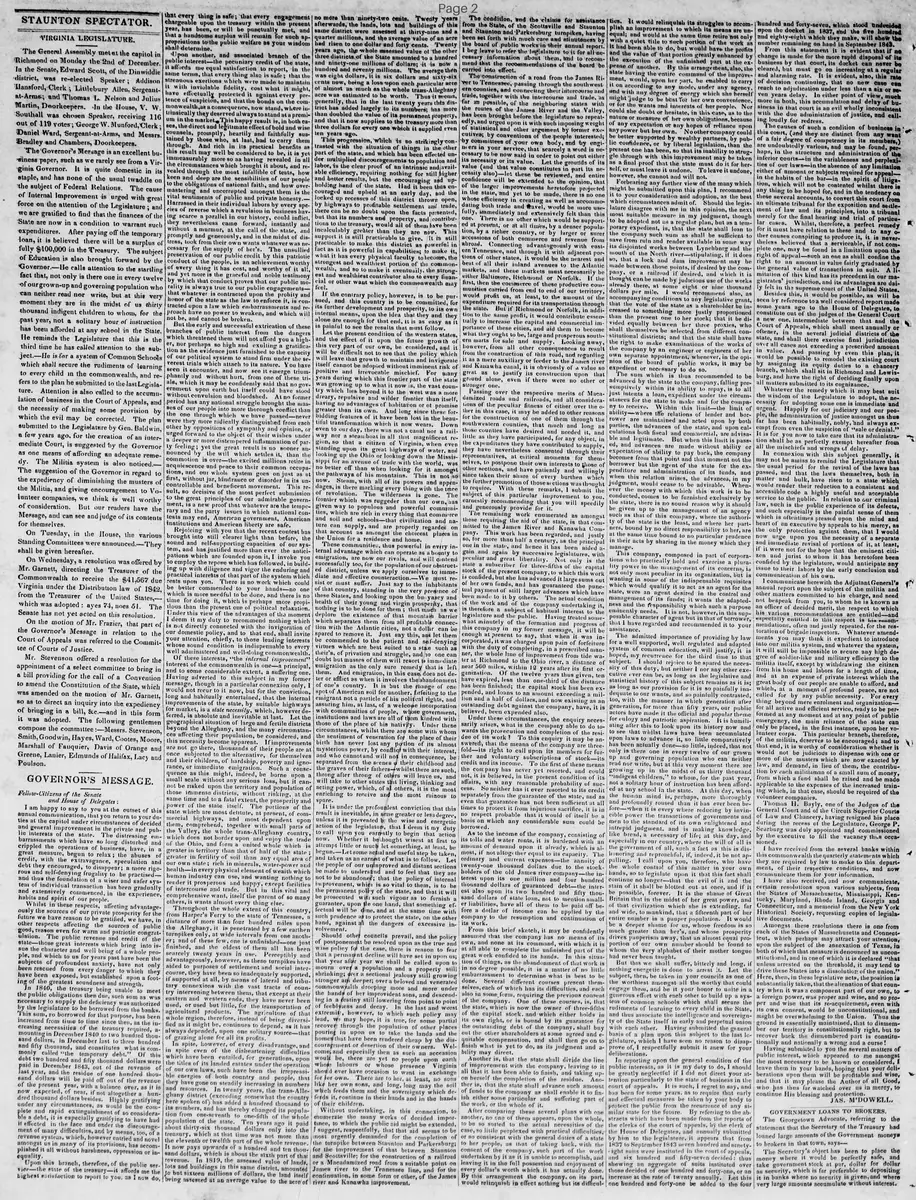
VIRGINIA LEGISLATURE.
The General Assembly met at the capitol in Richmond on Monday the 2nd of December.
In the Senate, Edward Scott, of the Dinwiddie district, was re-elected Speaker; Addison Hansford, Clerk; Littlebury Allen, Sergeant-at-Arms; and Thomas L. Nelson and Julius Martin, Doorkeepers. In the House, V. W. Southall was chosen Speaker, receiving 116 out of 119 votes; George W. Munford, Clerk; Daniel Ward, Sergeant-at-Arms, and Messrs. Bradley and Chambers, Doorkeepers.
The Governor's Message is an excellent business paper, such as we rarely see from a Virginia Governor. It is quite domestic in its staple, and has none of the usual twaddle on the subject of Federal Relations. The cause of Internal Improvement is urged with great force on the attention of the Legislature; and we are gratified to find that the finances of the State are now in a condition to warrant such expenditures. After paying off the temporary loan, it is believed there will be a surplus of fully $100,000 in the Treasury. The subject of Education is also brought forward by the Governor. He calls attention to the startling fact that, not only is there one in every twelve of our grown-up and governing population who can neither read nor write, but at this very moment there are in the midst of us thirty thousand indigent children to whom, for the past year, not a solitary hour of instruction has been afforded at any school in the State. He reminds the Legislature that this is the third time he has called attention to the subject. He is for a system of Common Schools which shall secure the rudiments of learning to every child in the commonwealth, and refers to the plan he submitted to the last Legislature. Attention is also called to the accumulation of business in the Court of Appeals, and the necessity of making some provision by which the evil may be corrected. The plan submitted to the Legislature by Gen. Baldwin, a few years ago, for the creation of an intermediate Court, is suggested by the Governor as one means of affording an adequate remedy. The Militia system is also noticed. The suggestion of the Governor in regard to the expediency of diminishing the musters of the Militia, and giving encouragement to Volunteer companies, we think is well worthy of consideration. But our readers have the Message, and can see and judge of its contents for themselves.
On Tuesday, in the House, the various Standing Committees were announced. They shall be given hereafter.
On Wednesday, a resolution was offered by Mr. Garnett, directing the Treasurer of the Commonwealth to receive the $41,567 due Virginia under the Distribution law of 1842, from the Treasurer of the United States, which was adopted: ayes 74, noes 51. The Senate has not yet acted on this resolution.
On the motion of Mr. Frazier, that part of the Governor's Message in relation to the Court of Appeals was referred to the Committee of Courts of Justice.
Mr. Stevenson offered a resolution for the appointment of a select committee to bring in a bill providing for the call of a Convention to amend the Constitution of the State, which was amended on the motion of Mr. Garnett, so as to direct an inquiry into the expediency of bringing in a bill, &c.—and in this form it was adopted. The following gentlemen compose the committee:—Messrs. Stevenson, Smith, Goodwin, Hayes, Ward, Cootes, Moore, Marshall of Fauquier, Davis of Orange and Greene, Lanier, Edmunds of Halifax, Lacy and Poulson.
GOVERNOR'S MESSAGE.
Fellow-Citizens of the Senate and House of Delegates:
I am happy to say to you at the outset of this annual communication, that you return to your duties at the capitol under circumstances of decided and general improvement in the private and public interests of the state. The distressing embarrassments which have so long disturbed and crippled the operations of business, have, in a great measure, begun to relax; the abuses of credit, with the extravagance, speculation and debt they encouraged, to disappear; a more rigorous and self-denying frugality to be practised—and thus the foundation of a wiser and safer system of individual transaction has been gradually and extensively commenced, in the experience, habits and spirit of our people.
Whilst in these respects, affecting advantageously the sources of our private prosperity for the future we have reason to be gratified, we have, in other respects affecting the sources of public good, reason even for warm and patriotic congratulation. The public revenue and credit of the state—those great interests which bring into issue the character and well being of a whole people, and which to us for years past have been the subjects of profoundest anxiety, have not only been rescued from every danger to which they have been exposed, but established upon a footing of the greatest soundness and strength.
In 1840, the treasury being unable to meet the public obligations then due, such sum as was necessary to supply the deficiency was authorized by the legislature to be borrowed from the banks. This sum, so borrowed for that purpose, has been increased from time to time since then, as the increasing necessities of the treasury required, amounting in December 1840 to two hundred thousand dollars, in December last to three hundred and fifty thousand, and constitutes what is commonly called "the temporary debt." Of this debt two hundred and fifty thousand dollars were paid in December 1843, out of the revenue of last year, and the residue of one hundred thousand dollars will be paid off out of the revenue of the present year, with a balance over, as it is now expected, of near, if not altogether a hundred thousand dollars besides. Highly gratifying under any circumstances, as would be the complete and rapid extinguishment of so considerable a debt, it is especially gratifying to have had it effected in the face and under the discouragement of many difficulties, and by means, too, of a revenue system, which, however untried and novel amongst us in many of its provisions, has accomplished it all without harshness, oppression or inequality.
Upon this branch, therefore, of the public service—the state of the treasury—it affords me the highest satisfaction to report to you, as I now do, that every thing is safe; that every engagement chargeable upon the treasury within the present year, has been, or will be punctually met, and that a handsome surplus will remain for such appropriations to the public welfare as your wisdom shall determine.
Upon another, and associated branch of the public interest—the pecuniary credit of the state, it affords me equal satisfaction to report, in the same terms, that every thing also is safe; that the strenuous exertions which were made to maintain it with inviolable fidelity, cost what it might, have effectually protected it against every pretence of suspicion, and that the bonds on the commonwealth, as a consequence, now stand, where intrinsically they deserved always to stand at a premium in the market. This happy result is, in both cases, the direct and legitimate effect of bold and wise counsels, promptly, heartily and faithfully sustained by those who, at last, had to carry them through. And rich in its practical benefits as this result may well be considered to be, it is yet immeasurably more so as having revealed in all the circumstances which brought it about, and revealed through the most infallible of tests, how keen and deep are the sensibilities of our people to the obligations of national faith, and how overmastering and uncorrupted amongst them is the vital sentiments of public and private honesty. Harrassed in their individual labors by every species of reverse which a revulsion in business having scarce a parallel in our history, could inflict, they nevertheless came forward, instantly and without a murmur, at the call of the state, and promptly and generously, and in the midst of distress, took from their own wants whatever was necessary for the supply of hers. The unsullied preservation of our public credit by this patriotic conduct of the people, is an achievement worthy of every thing it has cost, and worthy of it all, and yet more is the graceful and noble testimony by which that conduct proves that our public morality is always true to our public engagements—that whatever is contracted upon the probity and honor of the state as the law to enforce it, is contracted upon a law which embarrassments and reproach have no power to weaken, and which will not be, and cannot be broken.
But the early and successful extrication of these branches of public interest from the dangers which threatened them will not afford you a higher, nor perhaps so high and exulting a gratification as the evidence just furnished to the capacity of our political system to stand firm under the severest trials which attach to its nature. You have seen it encounter, and now see it emerge triumphantly and without hurt, from one of these trials, which it may be confidently said that no government upon earth but itself could have stood without convulsion and bloodshed. At no former period has any national struggle brought the masses of our people into more thorough conflict than the one through which we have passed—never were they more radically distinguished from each other by oppositions of sympathy and opinion, or urged forward to the object of their wishes under a deeper or more distempered inflammation of party feeling; yet the great result is no sooner announced by the will which settles it, than the commotion is over—the excited millions retire in acquiescence and peace to their common occupations, and our whole system goes on just as at first, without jar, hindrance or disorder in its uncontrollable and beneficent movement. This result, so decisive of the most perfect submission to the great principles of our admirable government, is a new proof that whatever are the temporary and the party issues in which national contests may end, American government, American institutions and American liberty are safe.
Rejoicing with you that the recent contest has brought into still clearer light than before, the sound and self-supporting capacities of our system, and has justified more than ever the anticipations which are founded upon it, I invoke you to employ the repose which has followed, in building up with diligence and vigor the enduring and practical interests of that part of the system which rests upon you. There is no work which could be better commended to your hands—no one which is more needful to be done, and there is no time for doing it, which is perhaps more propitious than the present one of political relaxation.
Under this view of the advantages of the moment I deem it my duty to recommend nothing which is not directly connected with the invigoration of our domestic policy, and to that end, shall invite your attention, chiefly, to those leading interests whose sound condition is indispensable to every well-administered and well-doing commonwealth.
Of these interests, "the internal improvement" interest of the commonwealth is one—a principal one, and to some considerable extent, a suffering one. Having adverted to this subject in my former message, though in a particular connexion only, I would not recur to it now, but for the conviction, long and habitually entertained, that the internal improvements of the state, by suitable highways for market, is a state necessity, which, however deferred, is absolute and inevitable at last. Let the geographical situation of large and fertile districts beyond the Alleghany, and the many circumstances affecting their population, be considered, and this necessity become apparent. If improvements are not go there, thousands of their people are at once subjected to the alternative, for themselves and their children, of hardship, poverty and ignorance, or immediate emigration. Such a consequence as this might, indeed, be borne upon a small scale without any serious loss, but it cannot be risked upon the territory and population of those immense districts, without risking, at the same time and to a fatal extent, the prosperity and power of the state itself. The portions of the state which are most destitute, at present, of commercial highways, and most dependent upon them, comprehend, together with small parts of the Valley, the whole trans-Alleghany country, which does not border upon and enjoy the trade of the Ohio, and form a united whole which is greater in territory than that of half of the state: greater in fertility of soil than any equal area of our own state; rich in minerals, water-power and health—in every physical element of wealth which human industry can use, and wanting nothing to render it prosperous and happy, except facilities of intercourse and trade. But in this vital and comprehensive want, itself the parent of so many others, it wants almost every thing else.
Throughout the whole extent of this country, from Harper's Ferry to the state of Tennessee, a distance of more than four hundred miles upon the Alleghany, it is penetrated by a few earthen turnpikes only, at wide intervals from one another; and of these few, one is unfinished—one just finished, and the oldest of them all has been scarcely twenty years in use. Perceptibly and advantageously, however, as these turnpikes have aided to purposes of settlement and social intercourse, they have been so inadequately supported, if supported at all, by means of lateral and tributary connexions with the vast tracts of country intervening between them, that except at their eastern and western ends, they have never been used, or used but little, for the transportation of agricultural products. The agriculture of that whole region, therefore, instead of being diversified as it might be, continues to depend, as it has always depended, upon one solitary source—that of grazing alone for all its profits.
In spite, however, of every disadvantage, and in spite even of the disheartening difficulties which have been entailed, for generations, upon the titles of its landed estates under the operation of our own laws, such have been the irrepressible energies of both country and people, that they have gone on steadily increasing in numbers and resources. In twenty years, the trans-Alleghany district (exceeding somewhat the country here spoken of) has added a hundred thousand to its numbers, and has thereby changed its population from one-seventh to one-fifth of the whole population of the state. Ten years ago it paid about thirty-six thousand dollars only into the treasury, which at that time was not more than the eleventh or twelfth part of the whole revenue. It now pays upwards of a hundred and ten thousand dollars, which is about the sixth part of that revenue. In 1819, the assessed value of lands lots and buildings in this same district, amounted to but sixteen millions of dollars, the land itself being assessed at an average value to the acre of no more than ninety-two cents. Twenty years afterwards, the lands, lots and buildings of this same district were assessed at thirty-nine and a quarter millions, and the average value of an acre had risen to one dollar and forty cents. Twenty years ago, the whole assessed value of the other three districts of the State amounted to a hundred and ninety-one millions of dollars; it is now a hundred and seventy millions. The average then was eight dollars, it is six dollars and sixty-six cents now, being a loss upon each particular acre of almost as much as the whole trans-Alleghany acre was estimated to be worth. Thus it seems, generally, that in the last twenty years this district has added largely to its numbers; has more than doubled the value of its permanent property, and that it now supplies to the treasury more than three dollars for every one which it supplied even ten years ago.
This progression, which is so strikingly contrasted with the situation of things in the other part of the state, and which has been effected under multiplied discouragements to population and labor, is the clear proof of an intrinsic and available efficiency, requiring nothing for still higher and better results, but the encouraging and upholding hand of the state. Had it been thus encouraged and upheld at an early day, and the locked-up recesses of this district thrown open, by highways to profitable settlement and trade, there can be no doubt upon the facts presented, but that its numbers and property, and contributions to the treasury, would all of them have been incalculably greater than they are now. This support it is still practicable to give. It is still practicable to make this district as powerful in fact as it is powerful in capabilities; to make it, what it has every physical faculty to become, the strongest and wealthiest portion of the commonwealth, and so to make it eventually, the strongest and wealthiest contributor also to every financial or other want which the commonwealth may feel.
If the contrary policy, however, is to be pursued, and this country is to be committed, for its further development and prosperity, to its own internal means, upon the idea that they and they alone are enough for that end, it is as easy as it is painful to see the results that must follow. Let the present condition of the western states, and the effect of it upon the future growth of this very part of our own, be considered, and it will be difficult not to see that the policy which will leave that growth to maintain and invigorate itself cannot be adopted without imminent risk of positive and irrevocable mischief. For many years during which this frontier part of the state was growing up to what it now is, the vast country which lies beyond it to the west was a more dreary, repulsive and wilder frontier than itself, having no advantages of habitation or of promise greater than its own. And long since these forbidding features of it have been lost in the beautiful transformation which it now wears. Down even to our day, there was not a canal nor a railway nor a steamboat in all that magnificent region, so that a citizen of Virginia, when even standing upon its great highways of water, and looking up the Ohio or looking down the Mississippi for an avenue of trade with the world, was no better off than when looking for it amongst the pathways of his mountains. This is not so now. Steam, with all of its powers and appendages, is there marking every thing with the trace of revolution. The wilderness is gone. The frontier which was ruggeder than our own, has given way to populous and powerful communities, which are rich in every thing that commerce and soil and schools—that civilization and nature can supply, and are properly regarded on that account as amongst the choicest places in the Union for a residence and home.
These communities, thus powerful in every internal advantage which can operate as a bounty to emigration, are now our rivals, and will contend successfully too, for the population of our obstructed district, unless we apply ourselves to immediate and effective counteraction. We must resist or must suffer. Just say to the inhabitants of that country, standing in the very presence of these States, and looking upon the buoyancy and health of their young and virgin prosperity, that nothing is to be done for them; that much as we deplore the existence of that mountain barrier which separates them from all profitable connexion with the Atlantic cities, not a dollar can be spared to remove it. Just say this, and let them be commended to the patient and self-denying virtues which are best suited to a state such as theirs, of privation and struggle, and no one can doubt but masses of them will resort to immediate emigration as the only sure remedy that is left them. And emigration, in this case, does not deter or afflict as when it involves the abandonment of one's country. It is but the change of one spot of American soil for another, forfeiting to the emigrant not a particle of his political rights, and assuring him, at last, of a welcome incorporation with communities of people, whose government, institutions and laws are all of them kindred with those of the place of his nativity. Under these circumstances, whilst there are some with whom the sentiment of veneration for the place of their birth has never lost any portion of its almost mysterious power, by conflict with their interest, and who cannot and will not in consequence, be separated from the scenes of their childhood and the graves of their fathers—whilst there are such, throng after throng of others will leave us, and will take to other states that living, thinking and acting power, which, of all others, it is the most enriching to receive and the most ruinous to spare.
It is under the profoundest conviction that this result is inevitable, in some greater or less degree, unless it is prevented by the wise and energetic action of the legislature, that I deem it my duty to call upon you earnestly to begin that action now. Whether it be thought wisest at first to attempt little or much let something, at least, be begun—Let some actual and useful step be taken, and taken as an earnest of what is to follow. Let the people of our unimproved and distant sections be made to understand and to feel that they are not to be abandoned; that the policy of internal improvement, which is so vital to them, is to be the permanent policy of the state, and that it will be prosecuted with such vigour as to furnish a guarantee, upon the one hand, that something effectual will be done, and at the same time with such prudence as to protect the state, on the other hand, against all the dangers of excessive involvement.
Should other councils prevail, and the policy of postponement be resolved upon as the true and wise policy for the case, there is reason to fear that a permanent decline will have set in upon us; that year after year we shall be called upon to mourn over a population and a property still shrinking; over a sectional jealousy still growing stronger and deeper; over a beloved and venerated commonwealth drooping more and more under the hands of her improvident sons, and descending in a destiny still lowering from point to point of feebleness and decay. In the last and worst extremity, however, to which such policy may lead, we may hope, it is true, for some partial recovery through the population of other places pouring in upon us to take the lands and the homes that have been rendered cheap by the discouragement or desertion of their owners. Welcome, and especially then as such an accession would be, there are yet no people upon earth whose labours or whose presence Virginia should ever have occasion to want in exchange for her own. There are to her, at least, no sons like her own sons, and long, long may the soil which feeds them and the sovereignty which defends it, continue in their hands and in the hands of their children.
Without undertaking, in this connexion, to enumerate the many works of decided importance, to which the public aid might be extended, I suggest, respectfully, that that aid seems to be most urgently demanded for the completion of the turnpike between Staunton and Parkersburg; for the improvement of that between Staunton and Scottsville; for the construction of a railroad or a Macadamized road from a suitable point on James river to the Tennessee line, and for the continuation, in some form or other, of the James river and Kanawha improvement.
The condition, and the claims for assistance from the State, of the Scottsville and Staunton and Staunton and Parkersburg turnpikes, having been set forth with much care and minuteness by the board of public works in their annual report, I beg leave to refer the legislature to it for all necessary information about them, and to recommend that the recommendations of the board be carried into effect.
The construction of a road from the James River to Tennessee, passing through the southwestern counties, and connecting their intercourse and trade, together with the intercourse and trade, as far as possible, of the neighboring states with the routes of the James River and the Valley, has been brought before the legislature so repeatedly, and urged upon it with such imposing weight of statistical and other argument by former executives; by conventions of the people interested; by committees of your own body, and by engineers in your service, that scarcely a word is necessary to be now said in order to point out either its necessity or its value. Let the grounds of its value (and that value constitutes in part its necessity also)—let these be reviewed, and entire confidence will be extended to the opinion, that of the larger improvements heretofore projected in the state, and yet to be made, there is no one whose efficiency in creating as well as accommodating both trade and travel, would be more usefully, immediately and extensively felt than this one. There is no other which would be supported at present, or at all times, by a denser population, by a richer country, or by larger or surer accessions of both commerce and revenue from abroad. Connecting advantageously with eastern Tennessee, and through it with adjacent portions of other states, it would be the nearest and best of all their inland avenues to the Atlantic markets, and these markets must necessarily be either Baltimore, Richmond or Norfolk. If the first, then the commerce of these productive communities carried from end to end of our territory, would profit us, at least, to the amount of the expenditure required for its transportation through the state. But if Richmond or Norfolk, in addition to the same profit, it would contribute essentially to increase the capital and commercial importance of these cities, and aid them to become what they ought to be, large and prosperous southern marts for sale and supply. Looking away, however, from all other consequences to result from the construction of this road, and regarding it as a mere auxiliary or feeder to the James river and Kanawha canal, it is obviously of a value so great as to justify its construction upon that ground alone, even if there were no other or stronger one.
Passing over the respective merits of Macadamized roads and railroads, and all considerations of the peculiar fitness of either over the other in this case, it may be added to other reasons for the construction of one of them through the southwestern counties, that much and long as those counties have desired and needed it, and little as they have participated, for any object, in the expenditures they have contributed to supply, they have nevertheless consented through their representatives, at critical moments for themselves, to postpone their own interests to those of other sections, and have patiently and willingly since taken their share of every burthen which the further promotion of those sections was thought to require. With these remarks, I submit the subject of this particular improvement to you, earnestly recommending that you will speedily and generously provide for it.
The remaining work enumerated as amongst those requiring the aid of the state, is that committed to the James River and Kanawha Company. This work has been regarded, and justly so, for more than half a century, as the principal one in the state, and hence it has been aided again and again by successive legislatures, with peculiar and great liberality. Not only is the state a subscriber for three-fifths of the capital stock of the present company, to which this work is confided, but she has advanced it large sums out of her own funds, and has guaranteed the punctual payment of still larger advances which have been made to it by others. The actual condition of the work and of the company undertaking it, is therefore a subject of habitual interest to the legislature and the public. Having treated somewhat minutely of the formation and progress of this company in my former message, it will be enough at present to say, that when it was incorporated, it was charged upon pain of forfeiture with the duty of completing, in a prescribed manner, the whole line of improvement from tide water at Richmond to the Ohio river, a distance of near 500 miles, within 12 years after its first organization. Of the twelve years thus given, ten have expired, less than one-third of the distance has been finished; the capital stock has been expended, and loans to an amount exceeding a million and a half of dollars, and now existing as an outstanding debt against the company, have, it is believed, been expended also.
Under these circumstances, the enquiry necessarily arises, what is the company able to do towards the prosecution and completion of the residue of its work? To this enquiry it may be answered, that the means of the company are three-fold—its right to call upon its members for further and voluntary subscriptions of stock—its credit and its income. To the first of these means the company has never yet resorted, and could not, it is believed, in the present condition of its affairs, with any reasonable probability of success. So neither has it ever resorted to its credit separately from the guarantee of the state, and as even that guarantee has not been sufficient at all times to protect it from injurious sacrifice, it is in no respect probable that it would of itself be a basis on which any considerable sum could be borrowed.
As to the income of the company, consisting of its tolls and water rents, it is burdened with an amount of demand upon it already, which is almost, if not altogether equal to its capacity. The ordinary and current expenses—the annuity of twenty-one thousand dollars due to the stock-holders of the old James river company—the interest upon its one million and four hundred thousand dollars of guaranteed debt—the interest also upon its two hundred and fifty thousand dollars of state loan, not to mention smaller liabilities, have all of them to be paid off before a dollar of income can be applied by the company to the resumption and continuation of its work.
From this brief sketch, it may be confidently assumed that the company has no means of its own, and none at its command, with which it is at all able to complete the unfinished part of the great work confided to its hands. In this situation of things, as the abandonment of that work is in no degree possible, it is a matter of no little embarrassment to determine what is best to be done. Several different courses present themselves, each of which has its difficulties, and each also in some form, requiring the previous consent of the company. One of these courses, is, that the state, which is now the owner of three-fifths of the capital stock, and which either holds in its own right, or is bound by its guarantee for the outstanding debt of the company, shall buy out the other shareholders at some agreed and equitable compensation, and shall then go on to finish what is yet to do, as its judgment and ability may direct.
Another is, that the state shall divide the line of improvement with the company, leaving to it all that it has been able to finish, and taking upon herself the completion of the residue. Another is, that the state shall advance such amount of funds to the company as shall enable it to finish either some particular and suffering part of the work, or the whole of it.
After comparing these several plans with one another, no one of them appears, upon the whole, to be so suited to the actual necessities of the case, so little perplexed with practical difficulties, or so consistent with the general duties of a state to her people, as that of taking back, with the consent of the company, such part of the work undertaken by it as it is unable to accomplish, and leaving it in the full possession and enjoyment of every dollar's worth which it has actually done. By this arrangement the company, on its part, would relinquish in effect nothing but its difficulties. It would relinquish its struggles to accomplish an improvement to which its means are unequal; and would at the same time retire not only with a quiet title to such portion of the work as it had been able to do, but would have the profits and the value of that portion greatly enhanced by the execution of the unfinished part at the expense of another. By this arrangement, also, the state having the entire command of the improvement, would, upon her part, be enabled to carry it on according to any mode, under any agency, and with any degree of energy which she herself might judge to be best for her own convenience, or for the wants and interests of her people. Nor could she doubt or hesitate, in this case, as to the nature or measure of her own obligations, because of any expectation or any hopes of reliance upon any power but her own. No other company could be better supported by wealthy partners, by public confidence, or by liberal legislation, than the present one has been, so that its inability to struggle through with this improvement may be taken as a final proof that the state must do it for herself, or must leave it undone. To leave it undone, however, she cannot and will not.
Forbearing any further view of the many which might be submitted upon this plan, I recommend it to your consideration and adoption, as the best which circumstances admit of. Should the legislature disagree with me in this opinion, the next most suitable measure in my judgment, though to be adopted not as a regular plan, but as a temporary expedient, is, that the state shall loan to the company such sum as shall be sufficient to save from ruin and render available in some way its disjointed works between Lynchburg and the mouth of the North river—stipulating, if it does so, that a lock and dam improvement may be made between those points, if desired by the company, or a railroad if desired, and which it is thought can be made by judicious use of the works already there, at some eight or nine thousand dollars per mile. I would recommend also, as accompanying conditions to any legislative grant, that the vote of the state as a shareholder be increased to something more justly proportioned than the present one to her stock; that it be divided equally between her three proxies, who shall themselves be selected from different constitutional districts; and that the state shall have the right to make examinations of the works of the company by an engineer or engineers of her own separate appointment, whenever, in the opinion of the board of public works, it may be expedient or necessary to do so.
The sum which is thus recommended to be advanced by the state to the company, falling presumptively within its ability to repay, is to all just intents a loan, expedient under the circumstances for the state to make and for the company to receive. Within this limit—the limit of ability—where the relations of lender and borrower are maintained and acted upon by both parties, the advances of the state, and upon calculations both fiscal and commercial, are advisable and legitimate. But when this limit is passed, and advances are made without ability or expectation of ability to pay back, the company becomes from that point and that moment not the borrower but the agent of the state for the expenditure and administration of its funds, and when this relation arises, the advances, in my judgment, would cease to be advisable. Whenever the money with which this work is to be conducted, comes to be furnished exclusively by the state, there is no sound reason why it should be given up to the management of an agency such as that of this company, where the authority of the state is the least, and where her partners, bound by no direct responsibility to her, are at the same time bound to no particular prudence in their acts by sharing in the money which they manage.
This company, composed in part of corporations who practically hold and exercise a plurality power in the management of its concerns, is not only most peculiar in its organization, but is wanting in some of the indispensable requisites which would qualify it to act as an agent for the state, were an agent desired in the control and management of its funds; it wants the adaptedness and the responsibility which such a purpose eminently needs. It is not, however, in this supposable character of agent but in that of borrower, that I have regarded and recommended it to your assistance.
The admitted importance of providing by law for a well supported, well regulated and adapted system of common education, will justify, it is hoped, my recurrence for the third time to that subject. I should rejoice to be spared the necessity of this duty, but neither I nor any other executive ever can be, as long as the legislative and statistical history of this subject remains as it is; as long as our provision for it is so painfully inadequate to our wants, and so painfully contrasted, too, with the manner in which generation after generation, for more than fifty years, our public actors have made it the official and popular theme for eulogy and patriotic aspiration. It is humiliating after this to look upon its history now and to see that whilst laws have been accumulated upon laws to advance it, so little comparatively has been actually done—so little, indeed, that not only is there one in every twelve of our grown up and governing population who can neither read nor write, but at this very moment there are growing up in the midst of us thirty thousand "indigent children," to whom, for the past year, not a solitary hour of instruction has been afforded at any school in the state. At this day, when the human mind is, perhaps, more thoroughly and profoundly roused than it has ever been before—when it is every where reducing by invincible power the transactions of governments and men to the standard of its own enlightened and intrepid judgment, and is making knowledge, like bread, a necessary of life; at this day, and especially in our country, where the will of all is the government of all, such a fact as this is dishonoring and reproachful, if, indeed, it be not appalling. I call upon you, therefore, who have the whole control of this matter in your own hands, so to legislate upon it that this fact shall continue no longer—that the evil of it and the stain of it shall be blotted out at once, and if it be possible, forever. It is the shame of Great Britain that in the midst of her great power, and of that civilization which she is extending, far and wide, to mankind, that a fifteenth part of her entire number is a pauper population. It would be a deeper shame for us, whose freedom is so much greater than hers, and whose prosperity drives pauperism away, that an almost equal proportion of our own number should be found to whom the very alphabet of their mother tongue had never been taught.
But this we shall suffer, bitterly and long, if nothing energetic is done to arrest it. Let the subject, then, be taken in your councils as one of the worthiest amongst all the worthy that could engage them, and be it your honor to unite in a generous effort with each other to build up a system of common schools which shall secure the rudiments of learning to every child in the State, and thus associate the intelligence and sovereignty of the State itself in early and perpetual union with each other. Having submitted the general basis of a plan upon this subject to the last legislature, which I have seen no reason to disapprove of, I respectfully submit it anew for your deliberations.
In reporting upon the general condition of the public interests, as it is my duty to do, I should be greatly neglectful if I did not direct your attention particularly to the state of business in the court of appeals. It is such, I regret to say, and has been for some years, as to require that early and effectual measures be taken by your body to protect the public from the recurrence of any similar state for the future. By referring to the abstracts which have been made from the reports of the clerks of the court of appeals, by the clerk of the House of Delegates, and annually submitted by him to the legislature, it appears that from 1837 to September 1843 seven hundred and ninety-eight suits were instituted in the court of appeals, and six hundred and fifty-seven decided; thus shewing an aggregate of suits instituted over those decided of one hundred and forty-one, or an increase at the rate of twenty annually. Let this one hundred and forty-one be added to the four hundred and forty-seven, which stood undecided upon the docket in 1837, and the five hundred and eighty-eight which they make, will shew the number remaining on hand in September 1843.
From this statement it is evident that if no change is made for the more rapid disposal of its business by that court, its docket can never be cleared, but must go on increasing at a regular and alarming rate. It is evident, also, this rate of decision continuing, that no new case can reach to adjudication under less than a six or seven years delay. In either point of view, much more in both, this accumulation and delay of business in that court is an evil wholly inconsistent with the due administration of justice, and calling loudly for redress.
The causes of such a condition of business in this court, (and they are distinct from any want of a fair degree of competency in its members,) are undoubtedly various, and may be found, perhaps, in the structure and administration of the inferior courts—in the variableness and perplexities of our laws—in the absence of any limitation either of amount or subjects required for appeal—in the habits of the bar—in the spirit of litigation, which will not be contented whilst there is any thing to be hoped for, and in the tendency on these several accounts, to convert this court from an ultimate tribunal for the exposition and settlement of law and its principles, into a tribunal merely for the final hearing and trial of particular cases. Whilst, therefore, a perfect remedy for it must have relation to these and to any other causes conspiring to produce it, it is nevertheless believed that a serviceable, if not complete one, may be found in a limitation upon the right of appeal—such an one as shall confine the right to an amount in value fairly graduated by the general value of transactions in suit. A limitation of this kind has its precedent in our magistrates' jurisdiction, and its advantages are daily felt in the supreme court of the United States.
Besides this, it would be possible, as will be seen by reference to a well considered report made some years ago to the House of Delegates, to constitute out of the judges of the General Court a new one, intermediate between that and the Court of Appeals, which shall meet annually or oftener, in the several judicial districts of the state, and shall there exercise final jurisdiction over all cases not exceeding a prescribed amount in value. And passing by even this plan, it would be possible to remodel the existing court by assigning its equity duties to a chancery branch, which shall sit in Richmond and Lewisburg, and have the right of deciding finally upon all matters submitted to its cognizance.
Whatever the remedy which it may best suit the wisdom of the Legislature to adopt, the necessity for adopting some one is immediate and urgent. Happily for our judiciary and our people, the administration of justice amongst us thus far has been habitually, nobly, and always exempt from even the suspicion of "sale or denial." It is for you now to take care that its administration shall be as perfectly exempt hereafter from all the mischiefs and wrongs of delay.
In connexion with this subject generally, it may not be amiss to remind the Legislature that the usual period for the revisal of the laws has passed, and that the laws themselves, both in matter and bulk, have risen to a state which would render their reduction to a consistent and accessible code a highly useful and acceptable service to the public. In relation to our criminal law, such is the public experience of its defects, and such especially is the painful sense of them which is oftentimes pressed upon the mind and heart of an executive by appeals to his mercy, as the only protection against them, that I would now urge upon you the necessity of a separate and immediate revisal of portions of it, at least, if it were not for the hope that the eminent citizen and jurist to whom it has heretofore been confided by the legislature, would anticipate any issue to their labors by the early conclusion and communication of his own.
I communicate herewith the Adjutant General's annual report upon the subject of the militia and other matters committed to his charge, and need not bespeak from you, to whom he is known as an officer of decided merit, the respect to which his various recommendations are entitled—and especially entitled to this respect is his recommendation, often and justly repeated, for the restoration of brigade inspectors. Whatever amendments you may think it expedient to introduce into our militia system, and whatever the system, it will still be impossible to secure any high degree of soldier-like and military efficiency to the militia itself, except by withdrawing the citizen from his home and labors for a length of time, and at an expense of private interest which the great body of our people are unable to afford, and which, at a moment of profound peace, are not called for by any public necessity. For every thing beyond mere enrolment and organization—for all active and efficient service, ready to be performed at any moment and at any point of public emergency, the main reliance of the state can only be placed, in the first instance, upon her volunteer corps. This particular branch, therefore, of the militia, deserves to be encouraged; and to that end, it is worthy of consideration whether it would not be judicious to dispense with one or more of the musters which are now exacted by law, and demand, in lieu of them, the contribution by each militiaman of a small sum of money, from which a fund shall be raised and be made applicable to the expenses of the increased training which, in that case, should be required of the volunteer companies.
Thomas H. Bayly, one of the Judges of the General Court and of the Circuit Superior Courts of Law and Chancery, having resigned his place during the recess of the Legislature, George P. Scarburg was duly appointed and commissioned by the executive to fill the vacancy thus occasioned.
I have received from the several banks within this commonwealth the quarterly statements which they are required by law to make to this department, of their respective conditions, and now communicate them for your information.
I have also received, and now communicate, certain resolutions upon various subjects, from the States of Massachusetts, Mississippi, Kentucky, Maryland, Rhode Island, Georgia and Connecticut, and a memorial from the New York Historical Society, requesting copies of legislative documents.
Amongst these resolutions there is one from each of the States of Massachusetts and Connecticut, which perhaps may attract your attention, upon the subject of the annexation of Texas, in both of which that measure is denounced as unconstitutional, and in one of which it is declared "that unless arrested on the threshold, it may tend to drive these States into a dissolution of the union."
Here, then, in these legislative acts, the position is substantially taken, that the alienation of that country when it was a component part of our own, to a foreign power, was proper and wise, and so proper and wise that its re-acquirement, even with its own consent, would be unconstitutional, and might be overwhelming to the Union. Thus the ground is essentially maintained, that to dismember our territory is constitutionally right, but to recover back the dismembered part is constitutionally and nationally a wrong and a curse!
Having submitted to you the several matters of public interest, which appeared to me amongst the most necessary to be known or considered, I leave them in your hands, hoping that your deliberations upon them will be profitable and wise, and that it may please the Author of all Good, who has thus far watched over us in mercy, to continue His blessing and protection.
JAS. M'DOWELL.
What sub-type of article is it?
What keywords are associated?
What entities or persons were involved?
Where did it happen?
Domestic News Details
Primary Location
Richmond, Virginia
Event Date
Monday The 2nd Of December
Key Persons
Outcome
elections held; resolutions adopted (ayes 74, noes 51 on treasury funds; constitutional convention inquiry committee appointed); expected treasury surplus of $100,000; calls for internal improvements, education system, court reforms, and militia changes.
Event Details
The General Assembly met at the capitol in Richmond. Senate and House elected speakers, clerks, and officers. Governor's message discussed state finances, internal improvements like turnpikes and roads, education for indigent children, Court of Appeals backlog, and militia system. Resolutions referred parts of message to committees and directed treasury actions and constitutional inquiry.