Thank you for visiting SNEWPapers!
Sign up free
Editorial
February 16, 1798
Gazette Of The United States, & Philadelphia Daily Advertiser
Philadelphia, Philadelphia County, Pennsylvania
What is this article about?
An essay critiquing modern demands for liberty and equality, arguing that natural liberty is limited by divine and civil laws, British civil liberty is optimal, and radical equality in property or influence is unattainable and harmful, leading to anarchy.
Clipping
OCR Quality
95%
Excellent
Full Text
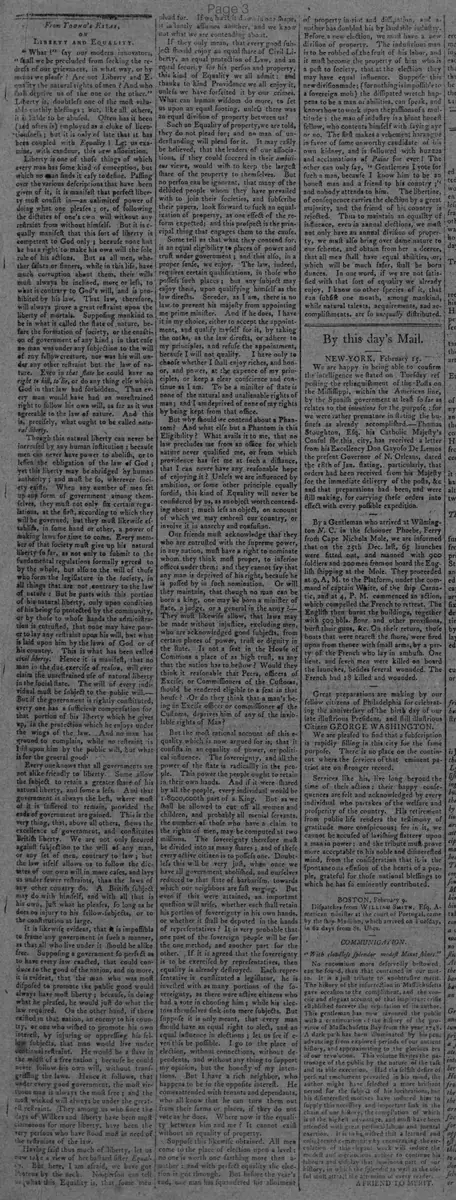
From Toone's Essay
Liberty and Equality.
"What!" say our modern innovators, "shall we be precluded from seeking the redress of our grievances, in what way, or by means we please? Are not Liberty and Equality the natural rights of men? And who shall deprive us of the one or the other."
Liberty is, doubtless, one of the most valuable earthly blessings; but, like all others, it is liable to be abused. Often has it been (and often is) employed as a cloak of licentiousness; but it is only of late that it has been coupled with Equality! Let us examine, with candour, this new association.
Liberty is one of those things of which every man has some kind of conception, but which no man finds it easy to define. Passing over the various descriptions that have been given of it, it is manifest that perfect liberty must consist in an unlimited power of doing what one pleases; or, of following the dictates of one's own will without any restraint from without himself. But it is equally manifest that this sort of liberty is competent to God only; because none but he has a right to make his own will the sole rule of his actions. But as all men, whether saints or sinners, while in this life, have much corruption about them, their wills must always be inclined, more or less, to what is contrary to God's will, and is prohibited by his law. That law, therefore, will always prove a great restraint upon the liberty of mortals. Supposing mankind to be in what is called the state of nature, before the formation of society, or the institution of government of any kind; in that case no man was under any subjection to the will of any fellow creature, nor was his will under any other restraint but the law of nature. Even in that state he could have no right to kill, to lie, or do any thing else which God in that law had forbidden. Thus every man would have had an unrestrained right to follow his own will, as far as it was agreeable to the law of nature. And this is, precisely, what ought to be called natural liberty.
Though this natural liberty can never be increased by any human institution; because men can never have power to abolish, or to lessen the obligation of the law of God; yet this liberty may be abridged by human authority; and must be so, wherever society exists. When any number of men set up any form of government among themselves, they must not only fix certain regulations, at the first, according to which they will be governed, but they must likewise establish, in some hand or other, a power of making laws for time to come. Every member of that society must give up his natural liberty so far, as not only to submit to the fundamental regulations formally agreed to by the whole, but also to the will of those who form the legislature in the society, in all things that are not contrary to the law of nature: But he parts with this portion of his natural liberty, only upon condition of his being so protected by the community, or by those to whose hands the administration is entrusted, that none may have power to lay any restraint upon his will, but what is laid upon him by the laws of God or of his country. This is what has been called civil liberty. Hence it is manifest, that no man in the due exercise of reason, will ever claim the unrestrained use of natural liberty in the social state. The will of every individual must be subject to the public will. But if the government is rightly constituted, every one has a sufficient compensation for that portion of his liberty which he gives up, in the protection which he enjoys under the wings of the law. And no man has ground to complain, while no restraint is laid upon him by the public will, but what is for the general good.
Every one knows that all governments are not alike friendly to liberty. Some allow the subject to retain a greater share of his natural liberty, and some a less. And that government is always the best, where most of it is suffered to remain, provided the ends of government are gained. This is the very thing, that, above all others, shows the excellence of government, and constitutes British liberty. We are not only secured against subjection to the will of any man, or any set of men, contrary to law; but the law itself allows us to follow the dictates of our own will in more cases, and lays us under fewer restraints, than the laws of any other country do. A British subject may do with himself, and with all that is his own, just what he pleases, so long as he does no injury to his fellow subjects, or to the constitution at large.
It is likewise evident, that it is impossible to frame any government in such a manner, as that all who live under it should be alike free. Supposing a government so perfect as to have every law enacted, that could conduce to the good of the nation, and no more, it is evident, that the man who was most disposed to promote the public good would always have most liberty; because, in doing what he pleased, he would just do what the law required. On the other hand, if there existed in that nation, an enemy to his country, or one who wished to promote his own interest, by injuring or oppressing his fellow subjects, that man would live under continual restraint. He would be a slave in the midst of a free nation: because he could never follow his own will, without transgressing the laws. Hence it follows, that under every good government, the most virtuous man is always the most free; and the most wicked will always be under the greatest restraint. They among us who since the days of Wilkes and liberty have been most clamorous for more liberty, have been the very persons who have stood most in need of the restraints of the law.
Having said thus much of liberty, let us now take a view of her bastard sister Equality. But here, I am afraid, we have got the matter by the wrong end. No person can tell us what this Equality is, that some men plead for. If we hunt it down in one shape, it instantly assumes another, and we know not what we are contending about.
If they only mean, that every good subject should enjoy an equal share of Civil Liberty, an equal protection of Law, and an equal security for his person and property, this kind of Equality we all admit: and thanks to kind Providence we all enjoy it, unless we have forfeited it by our crimes. What can human wisdom do more, to set us upon an equal footing, unless there was an equal division of property between us?
Such an Equality of property, we are told, they do not plead for; and no man of understanding will plead for it. It may easily be believed, that the leaders of our associations, if they could succeed in their ambitious views, would wish to keep the largest share of the property to themselves. But no person can be ignorant, that many of the deluded people whom they have prevailed with to join their societies, and subscribe their papers, look forward to such an equalization of property, as one effect of the reform expected; and this prospect is the principal thing that engages them to the cause.
Some tell us that what they contend for, is an equal eligibility to places of power and trust under government; and this also, in a proper sense, we enjoy. The law, indeed, requires certain qualifications, in those who possess such places; but any subject may enjoy them, upon qualifying himself as the law directs. Seceder, as I am, there is no law to prevent his majesty from appointing me prime minister. And if he does, I have it in my choice, either to accept the appointment, and qualify myself for it, by taking the oaths, as the law directs, or adhere to my principles, and refuse the appointment, because I will not qualify. I have only to choose whether I shall enjoy riches, and honor, and power, at the expense of my principles, or keep a clear conscience and continue as I am. To be a minister of state is none of the natural and unalienable rights of man; and I am deprived of none of my rights by being kept from that office.
But why should we contend about a Phantom? And what else but a Phantom is this Eligibility? What avails it to me, that no law precludes me from an office for which nature never qualified me, or from which providence has set me at such a distance, that I can never have any reasonable hope of enjoying it? Unless we are influenced by ambition, or some other principle equally sordid, this kind of Equality will never be considered by us, as an object worth contending about; much less an object, on account of which we may embroil our country, or involve it in anarchy and confusion.
Our friends must acknowledge that they who are entrusted with the supreme power, in any nation, must have a right to nominate whom they think most proper, to inferior offices under them: and they cannot say that any man is deprived of his right, because he is passed by in such nomination. Or will they maintain, that though no man can be born a king, one may be born a minister of state, a judge, or a general in the army?
They must likewise allow, that laws may be made without injustice, excluding men, who are acknowledged good subjects, from certain places of power, trust or dignity in the state. Is not a seat in the House of Commons a place of as high trust, as any that the nation has to bestow? Would they think it reasonable that Peers, officers of Excise, or Commissioners of the Customs, should be rendered eligible to a seat in that house? Or do they think that a man's being an Excise officer or commissioner of the Customs, deprives him of any of the inviolable rights of Man?
But the most rational account of this Equality which is now argued for is, that it consists in an equality of power, or political influence. The sovereignty, and all the power of the state is radically in the people. This power the people ought to retain in their own hands. And if it were shared by all the people, every individual would be 1-800,000th part of a King. But as we shall be allowed to cut off all women and children, and probably all menial servants, the number of those who have a claim to the rights of men, may be computed at two millions. The sovereignty therefore must be divided into as many shares; and of these every active citizen is to possess one. Doubtless this will be very just, when once we have all government abolished, and ourselves reduced to that state of barbarism, towards which our neighbors are fast verging. But even if this were attained, an important question will arise, whether each shall retain his portion of sovereignty in his own hands, or whether it shall be deputed in the hands of representatives? It is very probable that one part of the sovereign people will be for the one method, and another part for the other. If it is agreed that the sovereignty is to be exercised by representatives, then equality is already destroyed. Each representative is constituted a legislator, he is invested with as many portions of the sovereignty, as there were active citizens who had a vote in choosing him; while his electors themselves sink into mere subjects. But suppose it is only meant, that every man should have an equal right to select, and an equal influence in elections; let us see if even this be possible. I go to the place of election, without connections, without dependents, and without any thing to support my opinion, but the honesty of my intentions. But I have a rich neighbor, who happens to be in the opposite interest. He comes attended with tenants and dependents, who all know that he can turn them out from their farms or places, if they do not vote as he does. Where now is the equality between him and me? It cannot exist without an equality of property.
Suppose this likewise obtained. All men come to the place of election upon a level: no one is worth one farthing more than another: and with perfect equality the election is got through. But before the year's end, one man has squandered his allotment of property in riot and dissipation. Another has doubled his by laudable industry. Before a new election, we must have a new division of property. The industrious man is to be robbed of the fruit of his labor, and it must become the property of him who is a pest to society, that at the election they may have equal influence. Suppose this new division made: (for nothing is impossible to a sovereign mob) the dissipated wretch happens to be a man of abilities, can speak, and knows how to work upon the passions of a multitude: the man of industry is a blunt honest fellow, who contents himself with saying aye or no. The first makes a vehement harangue in favor of some unworthy candidate of his own kidney, and is followed with huzzas and acclamations of Paine for ever! The other can only say, "Gentlemen I vote for such a man, because I know him to be an honest man and a friend to his country;" and nobody attends to him. The libertine, of consequence carries the election by a great majority, and the friend of his country is rejected. Thus to maintain an equality of influence, even in annual elections, we must not only have an annual division of property, we must also bring over dame nature to our scheme, and obtain from her a decree, that all men shall have equal abilities, or, which will be much safer, shall be born dunces. In one word, if we are not satisfied with that sort of equality we already enjoy, I know no other species of it, that can subsist one month, among mankind, while natural talents, acquirements, and accomplishments, are so unequally distributed.
Liberty and Equality.
"What!" say our modern innovators, "shall we be precluded from seeking the redress of our grievances, in what way, or by means we please? Are not Liberty and Equality the natural rights of men? And who shall deprive us of the one or the other."
Liberty is, doubtless, one of the most valuable earthly blessings; but, like all others, it is liable to be abused. Often has it been (and often is) employed as a cloak of licentiousness; but it is only of late that it has been coupled with Equality! Let us examine, with candour, this new association.
Liberty is one of those things of which every man has some kind of conception, but which no man finds it easy to define. Passing over the various descriptions that have been given of it, it is manifest that perfect liberty must consist in an unlimited power of doing what one pleases; or, of following the dictates of one's own will without any restraint from without himself. But it is equally manifest that this sort of liberty is competent to God only; because none but he has a right to make his own will the sole rule of his actions. But as all men, whether saints or sinners, while in this life, have much corruption about them, their wills must always be inclined, more or less, to what is contrary to God's will, and is prohibited by his law. That law, therefore, will always prove a great restraint upon the liberty of mortals. Supposing mankind to be in what is called the state of nature, before the formation of society, or the institution of government of any kind; in that case no man was under any subjection to the will of any fellow creature, nor was his will under any other restraint but the law of nature. Even in that state he could have no right to kill, to lie, or do any thing else which God in that law had forbidden. Thus every man would have had an unrestrained right to follow his own will, as far as it was agreeable to the law of nature. And this is, precisely, what ought to be called natural liberty.
Though this natural liberty can never be increased by any human institution; because men can never have power to abolish, or to lessen the obligation of the law of God; yet this liberty may be abridged by human authority; and must be so, wherever society exists. When any number of men set up any form of government among themselves, they must not only fix certain regulations, at the first, according to which they will be governed, but they must likewise establish, in some hand or other, a power of making laws for time to come. Every member of that society must give up his natural liberty so far, as not only to submit to the fundamental regulations formally agreed to by the whole, but also to the will of those who form the legislature in the society, in all things that are not contrary to the law of nature: But he parts with this portion of his natural liberty, only upon condition of his being so protected by the community, or by those to whose hands the administration is entrusted, that none may have power to lay any restraint upon his will, but what is laid upon him by the laws of God or of his country. This is what has been called civil liberty. Hence it is manifest, that no man in the due exercise of reason, will ever claim the unrestrained use of natural liberty in the social state. The will of every individual must be subject to the public will. But if the government is rightly constituted, every one has a sufficient compensation for that portion of his liberty which he gives up, in the protection which he enjoys under the wings of the law. And no man has ground to complain, while no restraint is laid upon him by the public will, but what is for the general good.
Every one knows that all governments are not alike friendly to liberty. Some allow the subject to retain a greater share of his natural liberty, and some a less. And that government is always the best, where most of it is suffered to remain, provided the ends of government are gained. This is the very thing, that, above all others, shows the excellence of government, and constitutes British liberty. We are not only secured against subjection to the will of any man, or any set of men, contrary to law; but the law itself allows us to follow the dictates of our own will in more cases, and lays us under fewer restraints, than the laws of any other country do. A British subject may do with himself, and with all that is his own, just what he pleases, so long as he does no injury to his fellow subjects, or to the constitution at large.
It is likewise evident, that it is impossible to frame any government in such a manner, as that all who live under it should be alike free. Supposing a government so perfect as to have every law enacted, that could conduce to the good of the nation, and no more, it is evident, that the man who was most disposed to promote the public good would always have most liberty; because, in doing what he pleased, he would just do what the law required. On the other hand, if there existed in that nation, an enemy to his country, or one who wished to promote his own interest, by injuring or oppressing his fellow subjects, that man would live under continual restraint. He would be a slave in the midst of a free nation: because he could never follow his own will, without transgressing the laws. Hence it follows, that under every good government, the most virtuous man is always the most free; and the most wicked will always be under the greatest restraint. They among us who since the days of Wilkes and liberty have been most clamorous for more liberty, have been the very persons who have stood most in need of the restraints of the law.
Having said thus much of liberty, let us now take a view of her bastard sister Equality. But here, I am afraid, we have got the matter by the wrong end. No person can tell us what this Equality is, that some men plead for. If we hunt it down in one shape, it instantly assumes another, and we know not what we are contending about.
If they only mean, that every good subject should enjoy an equal share of Civil Liberty, an equal protection of Law, and an equal security for his person and property, this kind of Equality we all admit: and thanks to kind Providence we all enjoy it, unless we have forfeited it by our crimes. What can human wisdom do more, to set us upon an equal footing, unless there was an equal division of property between us?
Such an Equality of property, we are told, they do not plead for; and no man of understanding will plead for it. It may easily be believed, that the leaders of our associations, if they could succeed in their ambitious views, would wish to keep the largest share of the property to themselves. But no person can be ignorant, that many of the deluded people whom they have prevailed with to join their societies, and subscribe their papers, look forward to such an equalization of property, as one effect of the reform expected; and this prospect is the principal thing that engages them to the cause.
Some tell us that what they contend for, is an equal eligibility to places of power and trust under government; and this also, in a proper sense, we enjoy. The law, indeed, requires certain qualifications, in those who possess such places; but any subject may enjoy them, upon qualifying himself as the law directs. Seceder, as I am, there is no law to prevent his majesty from appointing me prime minister. And if he does, I have it in my choice, either to accept the appointment, and qualify myself for it, by taking the oaths, as the law directs, or adhere to my principles, and refuse the appointment, because I will not qualify. I have only to choose whether I shall enjoy riches, and honor, and power, at the expense of my principles, or keep a clear conscience and continue as I am. To be a minister of state is none of the natural and unalienable rights of man; and I am deprived of none of my rights by being kept from that office.
But why should we contend about a Phantom? And what else but a Phantom is this Eligibility? What avails it to me, that no law precludes me from an office for which nature never qualified me, or from which providence has set me at such a distance, that I can never have any reasonable hope of enjoying it? Unless we are influenced by ambition, or some other principle equally sordid, this kind of Equality will never be considered by us, as an object worth contending about; much less an object, on account of which we may embroil our country, or involve it in anarchy and confusion.
Our friends must acknowledge that they who are entrusted with the supreme power, in any nation, must have a right to nominate whom they think most proper, to inferior offices under them: and they cannot say that any man is deprived of his right, because he is passed by in such nomination. Or will they maintain, that though no man can be born a king, one may be born a minister of state, a judge, or a general in the army?
They must likewise allow, that laws may be made without injustice, excluding men, who are acknowledged good subjects, from certain places of power, trust or dignity in the state. Is not a seat in the House of Commons a place of as high trust, as any that the nation has to bestow? Would they think it reasonable that Peers, officers of Excise, or Commissioners of the Customs, should be rendered eligible to a seat in that house? Or do they think that a man's being an Excise officer or commissioner of the Customs, deprives him of any of the inviolable rights of Man?
But the most rational account of this Equality which is now argued for is, that it consists in an equality of power, or political influence. The sovereignty, and all the power of the state is radically in the people. This power the people ought to retain in their own hands. And if it were shared by all the people, every individual would be 1-800,000th part of a King. But as we shall be allowed to cut off all women and children, and probably all menial servants, the number of those who have a claim to the rights of men, may be computed at two millions. The sovereignty therefore must be divided into as many shares; and of these every active citizen is to possess one. Doubtless this will be very just, when once we have all government abolished, and ourselves reduced to that state of barbarism, towards which our neighbors are fast verging. But even if this were attained, an important question will arise, whether each shall retain his portion of sovereignty in his own hands, or whether it shall be deputed in the hands of representatives? It is very probable that one part of the sovereign people will be for the one method, and another part for the other. If it is agreed that the sovereignty is to be exercised by representatives, then equality is already destroyed. Each representative is constituted a legislator, he is invested with as many portions of the sovereignty, as there were active citizens who had a vote in choosing him; while his electors themselves sink into mere subjects. But suppose it is only meant, that every man should have an equal right to select, and an equal influence in elections; let us see if even this be possible. I go to the place of election, without connections, without dependents, and without any thing to support my opinion, but the honesty of my intentions. But I have a rich neighbor, who happens to be in the opposite interest. He comes attended with tenants and dependents, who all know that he can turn them out from their farms or places, if they do not vote as he does. Where now is the equality between him and me? It cannot exist without an equality of property.
Suppose this likewise obtained. All men come to the place of election upon a level: no one is worth one farthing more than another: and with perfect equality the election is got through. But before the year's end, one man has squandered his allotment of property in riot and dissipation. Another has doubled his by laudable industry. Before a new election, we must have a new division of property. The industrious man is to be robbed of the fruit of his labor, and it must become the property of him who is a pest to society, that at the election they may have equal influence. Suppose this new division made: (for nothing is impossible to a sovereign mob) the dissipated wretch happens to be a man of abilities, can speak, and knows how to work upon the passions of a multitude: the man of industry is a blunt honest fellow, who contents himself with saying aye or no. The first makes a vehement harangue in favor of some unworthy candidate of his own kidney, and is followed with huzzas and acclamations of Paine for ever! The other can only say, "Gentlemen I vote for such a man, because I know him to be an honest man and a friend to his country;" and nobody attends to him. The libertine, of consequence carries the election by a great majority, and the friend of his country is rejected. Thus to maintain an equality of influence, even in annual elections, we must not only have an annual division of property, we must also bring over dame nature to our scheme, and obtain from her a decree, that all men shall have equal abilities, or, which will be much safer, shall be born dunces. In one word, if we are not satisfied with that sort of equality we already enjoy, I know no other species of it, that can subsist one month, among mankind, while natural talents, acquirements, and accomplishments, are so unequally distributed.
What sub-type of article is it?
Constitutional
Moral Or Religious
What keywords are associated?
Liberty
Equality
Civil Liberty
Natural Rights
Government Restraint
British Liberty
Political Equality
Property Division
What entities or persons were involved?
Modern Innovators
Wilkes
Paine
British Subject
Editorial Details
Primary Topic
Defense Of Civil Liberty And Critique Of Radical Equality
Stance / Tone
Conservative Defense Of British Liberty Against Innovators
Key Figures
Modern Innovators
Wilkes
Paine
British Subject
Key Arguments
Liberty Is A Natural Right Restrained By God's Law And Civil Laws For Protection
Civil Liberty Involves Submitting To Public Will In Exchange For Security
British Government Allows Greatest Liberty Without Injury To Others
Equality In Civil Liberty And Law Protection Is Already Enjoyed
Radical Equality Of Property Or Political Influence Is Impossible And Leads To Anarchy
Virtuous Men Are Freest Under Good Government
Eligibility To Office Requires Qualifications, Not A Natural Right