Thank you for visiting SNEWPapers!
Sign up free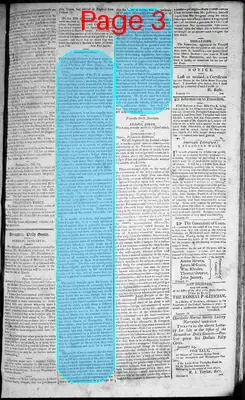
Literary
January 31, 1809
Alexandria Daily Gazette, Commercial & Political
Alexandria, Virginia
What is this article about?
Extract from Samuel Wheipley's 'A Compend of History' praising the unique, planned design of the U.S. government, emphasizing the need for public virtue to sustain it. Discusses differences between American and European views of liberty, warns against foreign influence in governance, and advocates limiting political roles to native-born citizens.
Clipping
OCR Quality
95%
Excellent
Full Text
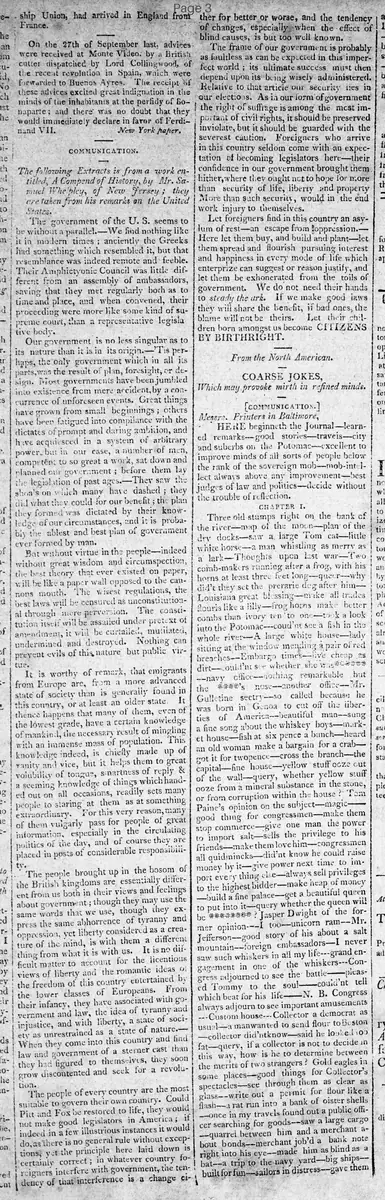
COMMUNICATION.
The following Extracts is from a work entitled. A Compend of History, by Mr. Samuel Wheipley, of New Jersey; they are taken from his remarks on the United States.
The government of the U. S. seems to be without a parallel.--We find nothing like it in modern times; anciently the Greeks had something which resembled it, but that resemblance was indeed remote and feeble. Their Amphictyonic Council was little different from an assembly of ambassadors, saving that they met regularly both as to time and place, and when convened, their proceedings were more like some kind of supreme court, than a representative legislative body.
Our government is no less singular as to its nature than it is in its origin.--'Tis perhaps, the only government which in all its parts, was the result of plan, foresight, or design. Most governments have been jumbled into existence from mere accident, by a concurrence of unforeseen events. Great things have grown from small beginnings; others have been fatigued into compliance with the dictates of prompt and daring ambition, and have acquiesced in a system of arbitrary power, but in our case, a number of men, competent to so great a work, sat down and planned our government; before them lay the legislation of past ages.--They saw the shoals on which many have dashed; they did what they could for our benefit; the plan they formed was dictated by their knowledge of our circumstances, and it is probably the ablest and best plan of government ever formed by man.
But without virtue in the people--indeed without great wisdom and circumspection, the best theory that ever existed on paper, will be like a paper wall opposed to the cannon's mouth. The wisest regulations, the best laws will be censured as unconstitutional through mere perversion. The constitution itself will be assailed under pretext of amendment, it will be curtailed, mutilated, undermined and destroyed. Nothing can prevent evils of this nature but public virtue.
It is worthy of remark, that emigrants from Europe are, from a more advanced state of society than is generally found in this country, or at least an older state. It thence happens that many of them, even of the lowest grade, have a certain knowledge of mankind, the necessary result of mingling with an immense mass of population. This knowledge indeed, is chiefly made up of volubility of tongue, smartness of reply & vanity and vice, but it helps them to a seeming knowledge of things which handed out on all occasions, readily sets many people to staring at them as at something extraordinary. For this very reason, many of them vulgarly pass for people of great information, especially in the circulating politics of the day, and of course they are placed in posts of considerable responsibility.
The people brought up in the bosom of the British kingdoms are essentially different from us both in their views and feelings about government; though they may use the same words that we use, though they express the same abhorrence of tyranny and oppression, yet liberty considered as a creature of the mind, is with them a different thing from what it is with us. It is no difficult matter to account for the licentious views of liberty and the romantic ideas of the freedom of this country entertained by the lower classes of Europeans. From their infancy, they have associated with government and law, the idea of tyranny and injustice, and with liberty, a state of society as unrestrained as a state of nature.--When they come into this country and find law and government of a sterner cast than they had figured to themselves, they soon grow discontented and seek for a revolution.
The people of every country are the most suitable to govern their own country. Could not make good legislators in America; if Pitt and Fox be restored to life, they would indeed in a few illustrious instances it would do, as there is no general rule without exceptions, yet the principle here laid down is certainly correct; in whatever country foreigners interfere with government, the tendency of that interference is a change either for better or worse, and the tendency of changes, especially when the effect of blind causes, is but too well known.
The frame of our government is probably as faultless as can be expected in this imperfect world; its ultimate success must then depend upon its being wisely administered. Relative to that article our security lies in our elections. As in our form of government the right of suffrage is among the most important of civil rights, it should be preserved inviolate, but it should be guarded with the severest caution. Foreigners who arrive in this country seldom come with an expectation of becoming legislators here--their confidence in our government brought them hither, where they ought not to hope for more than security of life, liberty and property. More than such security, would in the end work injury to themselves.
Let foreigners find in this country an asylum of rest--an escape from oppression.--Here let them buy, and build and plant--let them spread and flourish pursuing interest and happiness in every mode of life which enterprize can suggest or reason justify, and let them be exonerated from the toils of government. We do not need their hands to steady the ark. If we make good laws they will share the benefit, if bad ones, the blame will not be theirs. Let their children born amongst us become CITIZENS BY BIRTHRIGHT.
The following Extracts is from a work entitled. A Compend of History, by Mr. Samuel Wheipley, of New Jersey; they are taken from his remarks on the United States.
The government of the U. S. seems to be without a parallel.--We find nothing like it in modern times; anciently the Greeks had something which resembled it, but that resemblance was indeed remote and feeble. Their Amphictyonic Council was little different from an assembly of ambassadors, saving that they met regularly both as to time and place, and when convened, their proceedings were more like some kind of supreme court, than a representative legislative body.
Our government is no less singular as to its nature than it is in its origin.--'Tis perhaps, the only government which in all its parts, was the result of plan, foresight, or design. Most governments have been jumbled into existence from mere accident, by a concurrence of unforeseen events. Great things have grown from small beginnings; others have been fatigued into compliance with the dictates of prompt and daring ambition, and have acquiesced in a system of arbitrary power, but in our case, a number of men, competent to so great a work, sat down and planned our government; before them lay the legislation of past ages.--They saw the shoals on which many have dashed; they did what they could for our benefit; the plan they formed was dictated by their knowledge of our circumstances, and it is probably the ablest and best plan of government ever formed by man.
But without virtue in the people--indeed without great wisdom and circumspection, the best theory that ever existed on paper, will be like a paper wall opposed to the cannon's mouth. The wisest regulations, the best laws will be censured as unconstitutional through mere perversion. The constitution itself will be assailed under pretext of amendment, it will be curtailed, mutilated, undermined and destroyed. Nothing can prevent evils of this nature but public virtue.
It is worthy of remark, that emigrants from Europe are, from a more advanced state of society than is generally found in this country, or at least an older state. It thence happens that many of them, even of the lowest grade, have a certain knowledge of mankind, the necessary result of mingling with an immense mass of population. This knowledge indeed, is chiefly made up of volubility of tongue, smartness of reply & vanity and vice, but it helps them to a seeming knowledge of things which handed out on all occasions, readily sets many people to staring at them as at something extraordinary. For this very reason, many of them vulgarly pass for people of great information, especially in the circulating politics of the day, and of course they are placed in posts of considerable responsibility.
The people brought up in the bosom of the British kingdoms are essentially different from us both in their views and feelings about government; though they may use the same words that we use, though they express the same abhorrence of tyranny and oppression, yet liberty considered as a creature of the mind, is with them a different thing from what it is with us. It is no difficult matter to account for the licentious views of liberty and the romantic ideas of the freedom of this country entertained by the lower classes of Europeans. From their infancy, they have associated with government and law, the idea of tyranny and injustice, and with liberty, a state of society as unrestrained as a state of nature.--When they come into this country and find law and government of a sterner cast than they had figured to themselves, they soon grow discontented and seek for a revolution.
The people of every country are the most suitable to govern their own country. Could not make good legislators in America; if Pitt and Fox be restored to life, they would indeed in a few illustrious instances it would do, as there is no general rule without exceptions, yet the principle here laid down is certainly correct; in whatever country foreigners interfere with government, the tendency of that interference is a change either for better or worse, and the tendency of changes, especially when the effect of blind causes, is but too well known.
The frame of our government is probably as faultless as can be expected in this imperfect world; its ultimate success must then depend upon its being wisely administered. Relative to that article our security lies in our elections. As in our form of government the right of suffrage is among the most important of civil rights, it should be preserved inviolate, but it should be guarded with the severest caution. Foreigners who arrive in this country seldom come with an expectation of becoming legislators here--their confidence in our government brought them hither, where they ought not to hope for more than security of life, liberty and property. More than such security, would in the end work injury to themselves.
Let foreigners find in this country an asylum of rest--an escape from oppression.--Here let them buy, and build and plant--let them spread and flourish pursuing interest and happiness in every mode of life which enterprize can suggest or reason justify, and let them be exonerated from the toils of government. We do not need their hands to steady the ark. If we make good laws they will share the benefit, if bad ones, the blame will not be theirs. Let their children born amongst us become CITIZENS BY BIRTHRIGHT.
What sub-type of article is it?
Essay
What themes does it cover?
Political
Liberty Freedom
Moral Virtue
What keywords are associated?
American Government
Public Virtue
Foreign Emigrants
Political Liberty
Elections
Constitution
What entities or persons were involved?
Mr. Samuel Wheipley, Of New Jersey
Literary Details
Title
Remarks On The United States
Author
Mr. Samuel Wheipley, Of New Jersey
Subject
On The Government Of The United States
Form / Style
Prose Reflection On Political Theory
Key Lines
'Tis Perhaps, The Only Government Which In All Its Parts, Was The Result Of Plan, Foresight, Or Design.
But Without Virtue In The People Indeed Without Great Wisdom And Circumspection, The Best Theory That Ever Existed On Paper, Will Be Like A Paper Wall Opposed To The Cannon's Mouth.
Let Their Children Born Amongst Us Become Citizens By Birthright.