Thank you for visiting SNEWPapers!
Sign up free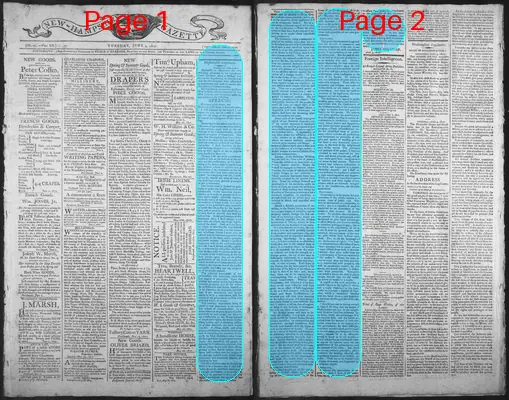
The New Hampshire Gazette
Portsmouth, Rockingham County, New Hampshire
What is this article about?
On June 3, 1807, Massachusetts Governor James Sullivan delivered an address to the assembled legislature, outlining his views on governmental principles, the importance of the judiciary, militia readiness, education, religion, public virtue, and national union.
Merged-components note: This is the continuation of Governor Sullivan's address to the Massachusetts Legislature across pages; relabeled from editorial to domestic_news as it reports on legislative proceedings.
Clippings

1 of 2
OCR Quality
Full Text
Massachusetts Legislature.
WEDNESDAY, JUNE 3, 1807.
Agreeably to adjournment, the two branches assembled in the representatives' Chamber when a message was sent to his Excellency, to inform him that the two branches were assembled in convention, and ready to receive His Excellency's Communication.
His Excellency, attended by the Sheriff of Suffolk, and accompanied by the Hon. Council, and Secretary, came in, and delivered the following SPEECH:
Gentlemen of the Senate, and Gentlemen of the House of Representatives,
I AM induced, by the respect I entertain for you, and by a wish to comply with the usage of this government, to request the indulgence of this meeting.
An attempt to lay before you the consideration of particular measures, which, in my opinion, might tend to the advantage of the Commonwealth, would appear as a piece of ostentation. The time that has elapsed, since I was introduced to the chair, has not been sufficient for a minute review of our internal police. I shall, therefore, by special messages, suggest to you, such matters as shall appear to me to deserve your legislative attention.
Though I do not make a communication to you on the business of this session, yet my constituents, at this interesting crisis, have a right to expect from me, without reserve or equivocation, a declaration of my sentiments on the duties of the office they have called me to sustain. In complying with this, I must, of course, express my ideas of some of the most important, general principles of our government.
The Constitution is formed on principles to guard the Legislature from an interference of the executive department; yet in order to prevent those errors which might otherwise happen, from the hurry of business, or a change of members in either house, it is made a part of the governor's duty, carefully to revise the acts passed by the legislature, and to propose such objections as he may have to any bill they shall lay before him. In the performance of this important duty, I shall always treat you with the respect due to the legislature of the State. And, as I can have no object in view but the true interest of the Commonwealth, you will receive my objections, should I make any, as offered with an intention to preserve the happiness of the State, and to promote the public welfare. Should a question happen to arise on the constitutionality of a bill, I must submit myself, explicitly, to your candor and justice: for however we may differ in opinion on the application of the Constitution, in this we shall always agree, that on an entire preservation of the social compact, by which we exist as a Commonwealth, and which is the supreme law of the legislature itself, the safety and the prosperity of the people depend.
The judiciary department of our government will, invariably, claim the first regard of patriotism. Upon the wisdom and purity of that department, freedom, property, and all the valuable possessions in civil society depend.—In all countries, the principles and feelings of the magistrates and judges ought to be in a coincidence with the nature of the government:—This is its principal source of energy.
The judiciary department being so necessary and important, is an expensive branch of administration. In a State, where an enquiry by grand juries, and trials by petit juries, are fixed by the Constitution as the strong barriers of the people's rights, the modes of punishing crimes, and of obtaining justice, on private demands, are more expensive still. A cheap, ready, and plain manner of obtaining remedies for wrongs and of compelling the execution of contracts by fixed, established rules, forms the strongest lines of a good government.
Under this impression, the people, in forming the Constitution, declared, that all the judges should hold their offices, as long as they should behave themselves well:—And that the judges of the supreme judicial court should have permanent and honorable salaries, established by law.
The office of jurors may be thought by some to be a burden—but if that institution should be abolished, there would no longer be freedom or property. It ought to be guarded by laws, not only against corruption, but against all undue influence and party prejudice.
There is no doubt, but that improvements may be effected in the jurisprudence of the commonwealth: and therefore the attention of the legislature will not be withdrawn from it. But in all alterations, a sacred regard will be had to the Constitution: While the plans adopted shall have such a degree of perfection, as to render them respectable and permanent.
The Governor, being commander in chief of the militia, when they are not in the actual service of the United States, must have a duty devolved upon him, which is of no less consequence to the other States in the Nation, than it is to this Commonwealth. When we contemplate the immeasurable shores we give to the sea: the vast extent of territory our national dominion spreads itself over, we are obliged to confess the error of a reliance on a standing army, for an effective defence against the invasion of a foreign enemy. To preserve the forms of war, with the principles and feelings of military discipline, some regular troops are necessary; but our defence must remain with the militia. They are a perpetual guard against internal commotions; and invincible power to shield a country against its external enemies. The soil must be protected by its owners. This description includes all the people, because all have an equal right to acquire, and possess fee simple estates.
Impressed with these sentiments, the militia shall have my unceasing attention throughout the year.
Peace with all the world, is the great object of our National Councils; yet, if we would maintain so invaluable a blessing, we must be prepared to meet every hostile aggression, and to repel every invading insult. A dependence on any other power for assistance, will, finally, involve us in difficulties, from which we cannot extricate ourselves, without great expense and danger. A treaty of alliance must open a wide door to the influence of a foreign nation: it would weaken the natural pillars of our national independence.
Europe, as the illustrious Washington has told us, "has a set of primary interests, which to us, have none, or a very remote relation. Hence she must be engaged in frequent controversies, the causes of which, are essentially foreign to our concerns."
Those cautious sentiments have been carefully adopted by the present President. From the wisdom, firmness and moderation of his measures, under the favor of God, we remain the quiet spectators of those wasting wars which the situation of European powers may have rendered expedient, or necessary, amongst them, but by which they are deluged in blood, and oppressed with expenses.
Should a suitable proportion of our militia, in the United States, be trained to a proper degree of discipline, and be properly armed, though the first column of an invading enemy might not be instantly repelled, yet the decisive appearance of victory, would be soon exhibited on the standard of our union.
It is true that the art of war, like other arts, is to be, most perfectly learned from practice and experience; but, this is a bloody, and an expensive method of acquiring knowledge. In a nation, where, it is not received as an established truth, that war is the natural state of man; in a country, where no invasion is to be expected, but from the error, or rashness, not from the interest, of a foreign power, the art of war may be sufficiently cultivated, at a moderate expense, by military schools, and otherwise, in time of peace. Each State in the Nation, has the same interest in the discipline of the militia of the others, as it has in that of its own: and, therefore, there can be no impropriety in contemplating this, as a subject of national concernment. Whether you, Gentlemen, will conceive it to be your duty, to use your influence with Congress, on an affair of such magnitude, as far as it shall comport with the National and State Constitutions; or whether you will turn your attention to the militia of your own state alone, I cheerfully submit to your wisdom. But this I venture to affirm, that all neglect, or delay in this business, is incompatible with the safety of the country.
No foreign power will dare to invade our country, in a project of conquest, unless the United States, like the ancient republics, by controversies and animosities amongst themselves, shall furnish their enemies with the hopes as well as the means of success. To preserve a union of interest, and sentiment, so absolutely necessary to our existence as a nation, jealousies are to be laid aside; charity cherished, and a reciprocity of affection and civility to be exhibited. All the States must be the country of the citizens of each, and each State the country of all. Our national union glowing on the public opinion, is the best defence of our sovereignty: and those who would check it there, would sever the root from whence the tree of Liberty draws, in copious streams its principal nourishment.
The chief magistrate of the nation, being an elective officer, the voice of the majority, taken according to the forms of the Constitution, must be decisive in the choice: it is the voice of all. To treat the election with disrespect, is to treat the Constitution with contempt. Nothing can tend more to derogate from the respect due to us as a nation, than an appearance of uneasiness, and dissatisfaction at the forms and principles of our own governments.
GENTLEMEN,
The great improvements in agriculture, the increase of commerce, and the encouragement of the arts in our country, furnish the most satisfactory proofs of the perfection of our political institutions. But the path of public, as well as of private prosperity, is to be trodden with care. Governments depending, for their execution, in so great a measure upon the will of the governed, so frequently expressed by their suffrages, demand, for their preservation, great intelligence in the body of the people. To maintain this, our institution of town schools is admirably adapted. These, with the academies and colleges, are rendered indispensable, by the nature of our government: and claim the constant attention of the legislature, for their support and encouragement.
The sentiments in regard to public worship, piety, religion and morality, interwoven with the Constitution of the Commonwealth, so far as we have a right to decide, have had great influence on the people. We observe with great pleasure the erection of edifices for public worship of various denominations in christianity: teachers every where settled and supported; and public devotion generally attended upon. These circumstances, under our established form of government, which excludes all persecution and intolerance on principles of religion and modes of worship, give to our State a very honorable appearance, in the view of the enlightened part of the world. The principles and precepts of the gospel, if they are attended to and improved for religious and moral purposes only, will always make good men; and good men can never be bad citizens. Upon the literary and religious institutions of the State, our happiness as a people, essentially depends: and I shall rejoice in seeing the legislature attentive to their encouragement and support: While, at the same time, that freedom of opinion, and those rights of conscience, which are solemnly recognized in the Constitution, are sacredly maintained.
Gentlemen,
Government, in its nature, is a concentration of the public opinion to a certain form of public rule. This may be maintained, in a despotism, by terror; but in a republic, it must be supported by an attachment of the people to their country. By public virtue. To produce this attachment, the powers of the government must be exerted to give equal advantages to all its subjects: not to create wealth, or exclusive privileges to any; but in securing to all, respectively, as far as it can be done by general laws, well executed, the enjoyment of the various gifts which God bestows upon them. For, to use the language of our declaration of rights, "no man, or corporation, or association of men, have any other title to obtain advantages distinct from those of the community, than what arises from the consideration of services rendered to the public." Where the laws secure to every man the same privileges to acquire and hold property, the wish to accumulate wealth, by fair means, and honest industry, is inseparable from patriotism. Enterprize and industry are in the class of public virtues, because they are the unfailing source of wealth to a nation.
A respect to the civil authority, a correct regard to the rights of others, and a ready obedience to the laws, confer on a people a dignity of character, which is intimately blended with the social virtues; and habitually becomes the strength of a civil community.
Should any one be daring enough to suggest the idea, that the people of Massachusetts are not, in the enlightened situation God has bestowed upon them, under the advantages they are favored with, and the habits acquired from the manner of their education, competent to the support of a free government, by their suffrages, frequently exercised, such person ought to be restrained, as a dangerous incendiary: because it is as essentially wrong to speak as to act treason.
Every citizen has an unalienable right to express his opinion upon the administration of the government, and the conduct of his rulers: But there are certain primary principles, which constitute the leading, essential, distinguishing features of an elective republic: These are to be treated with a solemn reverence, and supported by a religious respect.
GENTLEMEN,
I embrace this opportunity to express the sense I have of the honor done me by my fellow citizens—and to assure them of my firm attachment to the principles of the Commonwealth. They may rely with safety, that it is my determination to exert myself, uniformly, to maintain the dignity and faith of this State, and to strengthen and consolidate the National Union, on the principles of the National Government. At the same time, I assure you, Gentlemen, that, on my part, nothing shall be omitted, which will render this session pleasant to you, and beneficial to your constituents.
JAMES SULLIVAN.
June 3, 1807.
What sub-type of article is it?
What keywords are associated?
What entities or persons were involved?
Where did it happen?
Domestic News Details
Primary Location
Massachusetts
Event Date
June 3, 1807
Key Persons
Event Details
Governor James Sullivan delivered a speech to the Massachusetts Senate and House of Representatives assembled in convention, expressing his sentiments on governmental duties, the role of the executive in revising legislation, the importance of the judiciary and juries, improvements in jurisprudence, the militia as a defense force, national union, education through schools and colleges, religious institutions, public virtue, and equal privileges under the law.