Thank you for visiting SNEWPapers!
Sign up free
Herald Of The United States
Warren, Bristol County, Rhode Island
What is this article about?
This essay from the Boston Weekly Magazine condemns detraction and calumny as the most unbearable harms, equating them to robbing one's reputation. It argues that a good name is more valuable than riches, especially for the poor whose character is their sole fortune. Examples include unjustly withholding character references from servants and clerks, leading to social outcast status and potential crime. It urges overcoming prejudices and treating character delicately.
Merged-components note: Continuation of the essay 'On Detraction and Calumny' from the Boston Weekly Magazine.
Clipping
OCR Quality
Full Text
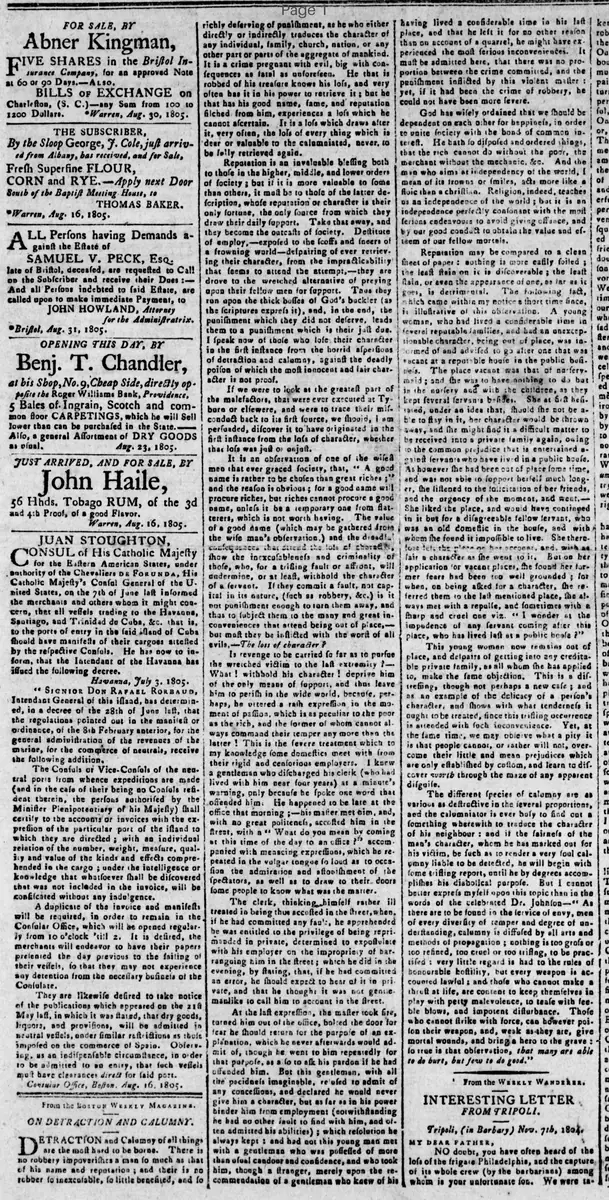
ON DETRACTION AND CALUMNY.
DETRACTION and Calumny of all things
are the most hard to be borne. There is
no robbery impoverishes a man so much as that
of his name and reputation; and there is no
robber so inexcusable, so little benefited, and so
richly deserving of punishment, as he who either
directly or indirectly traduces the character of
any individual, family, church, nation, or any
other part or parts of the aggregate of mankind.
It is a crime pregnant with evil, big with con-
sequences as fatal as unforeseen. He that is
robbed of his treasure knows his loss, and very
often has it in his power to retrieve it: but he
that has his good name, fame, and reputation
filched from him, experiences a loss which he
cannot ascertain. It is a loss which draws after
it, very often, the loss of every thing which is
dear or valuable to the calumniated, never, to
be fully retrieved again.
Reputation is an invaluable blessing both
to those in the higher, middle, and lower orders
of society; but if it is more valuable to some
than others, it must be to those of the latter de-
scription, whose reputation or character is their
only fortune, the only source from which they
draw their daily support. Take that away, and
they become the outcasts of society. Destitute
of employ,—exposed to the scoffs and sneers of
a frowning world—despairing of ever retriev-
ing their character, from the impracticability
that seems to attend the attempt,—they are
driven to the wretched alternative of preying
upon their fellow men for support. Thus they
run upon the thick bosses of God's buckler (as
the scriptures express it), and, in short, the
punishment which they did not deserve, leads
them to a punishment which is their just due.
I speak now of those who lose their character
in the first instance from the horrid aspersions
of detraction and calumny, against the deadly
poison of which the most innocent and fair char-
acter is not proof.
If we were to look at the greatest part of
the malefactors, that were ever executed at Ty-
burn or elsewhere, and were to trace their mis-
conduct back to its first source, we should, I am
persuaded, discover it to have originated in the
first instance from the loss of character, whether
that loss was just or unjust.
It is an observation of one of the wisest
men that ever graced society, that, "A good
name is rather to be chosen than great riches;"
and the reason is obvious; for a good name will
procure riches, but riches cannot procure a good
name, unless it be a temporary one from flat-
terers, which is not worth having. The value
of a good name (which may be gathered from
the wise man's observation, and the dreadful
consequences that attend the loss of character)
show the inexcusableness and criminality of
those, who, for a trifling fault or affront, will
undermine, or at least, withhold the character
of a servant. If they commit a fault, not cap-
ital in its nature, (such as robbery, &c.) is it
not punishment enough to turn them away, and
thus to subject them to the many and great in-
conveniences that attend being out of place,—
but must they be inflicted with the worst of all
evil,—The loss of character?
Is revenge to be carried so far as to pursue
the wretched victim to the last extremity—.
What! withhold his character! deprive him
of the only means of support, and thus leave
him to perish in the wide world, because, per-
haps, he uttered a rash expression in the mo-
ment of passion, which is as peculiar to the poor
as the rich, and the former of whom cannot al-
ways command their temper any more than the
latter! This is the severe treatment which, to
my knowledge some domestics meet with from
their rigid and censorious employers. I know
a gentleman who discharged his clerk (who had
lived with him near four years) at a minute's
warning, only because he spoke one word that
offended him: He happened to be late at the
office that morning;—his master met him, and,
with no great politeness, accosted him in the
street, with a "What do you mean by coming
at this time of the day to an office?" accom-
panied with menacing expressions, which he re-
peated in the vulgar tongue so loud as to occa-
sion the admiration and astonishment of the
spectators, as well as to draw to their doors
some people to know what was the matter.
The clerk, thinking himself rather ill
treated in being thus accosted in the street, when,
if he had committed any fault, he apprehended
he was entitled to the privilege of being repri-
manded in private, determined to expostulate
with his employer on the impropriety of bar-
ranging him in the street; which he did in the
evening, by stating, that, if he had committed
an error, he should expect to hear of it in pri-
vate, and that he thought it was not gentleman-
like to call him to account in the street.
At the last expression, the master took fire.
turned him out of the office, bolted the door for
fear he should return for the purpose of an ex-
planation, which he never afterwards would ad-
mit of, though he went to him repeatedly for
that purpose, as well to ask his pardon if he had
offended him. But this gentleman, with all
the ill pacifiedness imaginable, refused to admit of
any conciliation, and declared he would never
give him a character, but as far as in his power
hinder him from employment (notwithstanding
he had no other fault to find with him, and of-
ten admitted his abilities); which resolution he
always kept: and had not this young man met
with a gentleman who was possessed of more
than usual candour and confidence, and who took
him, though a stranger, merely upon the re-
commendation of a gentleman who knew of his
having lived a considerable time in his last.
place, and that he left it for no other reason
than on account of a quarrel, he might have ex-
perienced the most serious inconveniences. It
must be admitted here, that there was no pro-
portion between the crime committed, and the
punishment inflicted by this violent master:
yet, if it had been the crime of robbery, he
could not have been more severe.
God has wisely ordained that we should be
dependent on each other for happiness, in order
to unite society with the bond of common in-
terest. He hath so disposed and ordered things,
that the rich cannot do without the poor, the
merchant without the mechanic, &c. And the
man who aims at independency of the world, I
mean of its frowns or smiles, acts more like
a rogue than a christian. Religion, indeed, teaches
us an independence of the world; but it is an
independence perfectly consonant with the most
serious endeavours to avoid giving offence, and
by our good conduct to obtain the value and es-
teem of our fellow mortals.
Reputation may be compared to a clean
sheet of paper: nothing is more easily soiled;
the least stain on it is discoverable; the least
stain, or even the appearance of one, so far as it
goes, is detrimental. The following fact,
which came within my notice short time since,
is illustrative of this observation. A young
woman, who had lived a considerable time in
several reputable families, and had an unexcep-
tionable character, being out of place, was in-
formed of and advised to go after one that was
vacant at a reputable house in the public busi-
ness. The place vacant was that of nurse-
maid: and she was to have nothing to do but
in the nursery and with the children, as they
kept several servants besides. She at first hesi-
tated, under an idea that, should she not be a-
ble to stay in it, her character would be thrown
away, and she might find it a difficult matter to
be received into a private family again, owing
to the common prejudice that is entertained a-
gainst servants who have lived in a public house.
As however she had been out of place some time,
and was not able to support herself much long-
er, she listened to the solicitation of her friends,
and the urgency of the moment, and went.
She liked the place, and would have continued
in it but for a disagreeable fellow servant, who
was an old domestic in the house, and with
whom she found it impossible to live. She there-
fore gave the required notice, and, with as fair a
character as she went to it. But on her
application for vacant places, she found her for-
mer fears had been too well grounded; for
when, on being asked for a character, she re-
ferred them to the last mentioned place, she al-
ways met with a repulse, and sometimes with a
sharp and cruel one viz. "I wonder at the
impudence of any servant coming after this
place, who has lived last at a public house?"
This young woman now remains out of
place, and despairs of getting into any credita-
ble private family, as all whom she has applied
to, make the same objection, This is a di-
tressing, though not perhaps a new case; and
as an example of the delicacy of a person's
character, and how it ought to be treated, since this trifling occurrence
is attended with such inconvenience. Yet, at
the same time, we may observe what a pity it
is that people cannot, or rather will not, over-
come their little and mean prejudices which
are only established by custom, and learn to dis-
cover worth through the maze of any apparent
disguise.
The different species of calumny are as
various as destructive in the several proportions,
and the calumniator is ever busy to find out a
something wherewith to traduce the character
of his neighbour: and if the fairness of the
man's character, whom he has marked out for
his victim, be such as to render a very foul cal-
umniy liable to be detected, he will begin with
some trifling report, until he by degrees accom-
plishes his diabolical purpose. But I cannot
better express myself upon this topic than in the
words of the celebrated Dr. Johnson—"As
there are to be found in the service of envy, men
of every diversity of temper and degree of un-
derstanding, calumny is diffused by all arts and
methods of propagation; nothing is too gross or
too refined, too cruel or too trifling, to be prac-
tised: very little regard is had to the rules of
honourable hostility, but every weapon is ac-
counted lawful; and those who cannot make a
threat at life, are content to keep themselves in
play with petty malevolence, to tease with fee-
ble blows, and impotent disturbance. Those
who cannot strike with force, can however poi-
son their weapon, and, weak as they are, give
mortal wounds, and bring a hero to the grave:
so true is that observation, that many are able
to do harm, but few to do good."
What sub-type of article is it?
What themes does it cover?
What keywords are associated?
Literary Details
Title
On Detraction And Calumny.
Subject
On Detraction And Calumny
Key Lines