Thank you for visiting SNEWPapers!
Sign up free
Domestic News
February 12, 1808
The National Intelligencer And Washington Advertiser
Washington, District Of Columbia
What is this article about?
In a U.S. House of Representatives debate, Mr. Milnor advocates for discussing the removal of the federal capital from Washington, D.C., to Philadelphia, highlighting excessive expenditures, poor city planning, health concerns, and the need for a commercial hub, while countering opponents' arguments on constitutionality and contracts.
Clipping
OCR Quality
98%
Excellent
Full Text
DEBATE
On the proposition for the removal of the Seat of Government to Philadelphia.
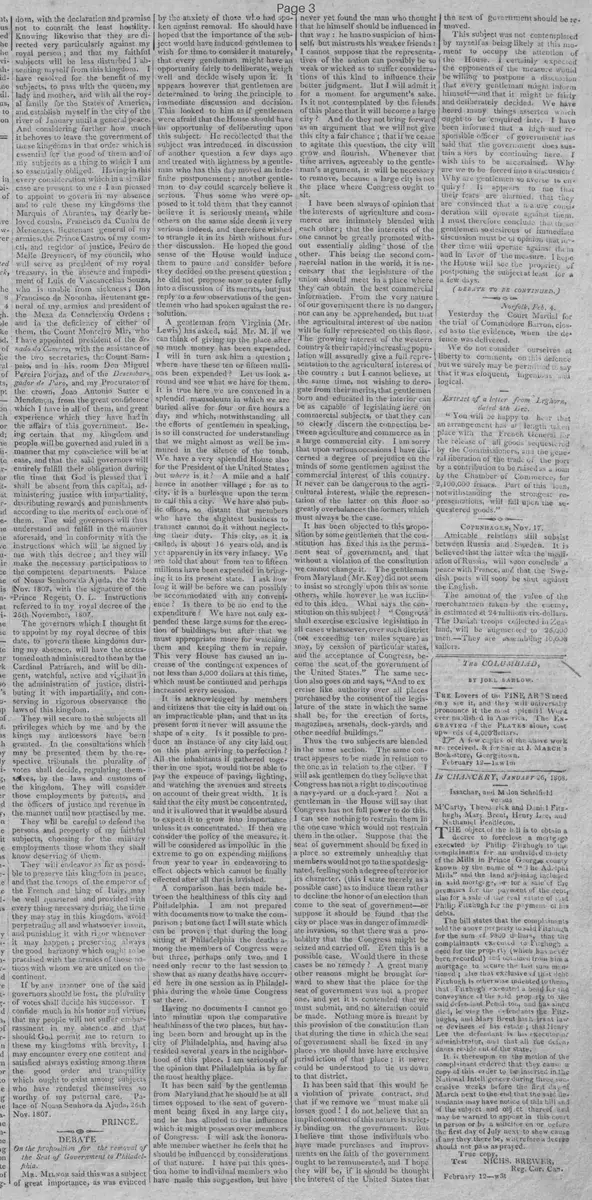
Mr. Milnor said this was a subject of great importance, as was evinced by the anxiety of those who had spoken against removal. He should have hoped that the importance of the subject would have induced gentlemen to wish for time to consider it maturely, that every gentleman might have an opportunity fairly to deliberate, weigh well and decide wisely upon it. It appears however that gentlemen are determined to bring the principle to immediate discussion and decision. This looked to him as if gentlemen were afraid that the House should have an opportunity of deliberating upon this subject. He recollected that the subject was introduced in discussion of another question a few days ago and treated with lightness by a gentleman who has this day moved an indefinite postponement; another gentleman to day could scarcely believe it serious. Thus some who were opposed to it told them that they cannot believe it is seriously meant, while others on the same side deem it very serious indeed, and therefore wished to strangle it in its birth without further discussion. He hoped the good sense of the House would induce them to pause and consider before they decided on the present question; he did not propose now to enter fully into a discussion of its merits, but just reply to a few observations of the gentlemen who had spoken against the resolution.
A gentleman from Virginia (Mr. Lewis) has asked, said Mr. M. if we can think of giving up the place after so much money has been expended. I will in turn ask him a question; where have these ten or fifteen millions been expended? Let us look around and see what we have for them. It is true here we are convened in a splendid mausoleum in which we are buried alive for four or five hours a day, and which, notwithstanding all the efforts of gentlemen in speaking, is so ill constructed for understanding that we might almost as well be immured in the silence of the tomb. We have a very splendid House also for the President of the United States; but where is it? A mile and a half hence in another village; for as to city, it is a burlesque upon the term to call this a city. We have also public offices, so distant that members who have the slightest business to transact cannot do it without neglecting their duty. This city, as it is called, is about 16 years old, and is yet apparently in its very infancy. We are told that about from ten to fifteen millions have been expended in bringing it to its present state. I ask how long it will be before we can possibly be accommodated with any convenience? Is there to be no end to the expenditure? We have not only expended these large sums for the erection of buildings, but after that we must appropriate more for watching them and keeping them in repair. This very House has caused an increase of the contingent expences of not less than 5,000 dollars at this time, which must be continued and perhaps increased every session.
It is acknowledged by members and citizens that the city is laid out on an impracticable plan, and that in its present form it never will assume the shape of a city. Is it possible to produce an instance of any city laid out on this plan arriving to perfection? All the inhabitants if gathered together in one spot, would not be able to pay the expence of paving, lighting, and watching the avenues and streets on account of their great width. It is said that the city must be concentrated, and it is allowed that it would be absurd to expect it to grow into importance unless it is concentrated. If then we consider the policy of the measure, it will be considered as impolitic in the extreme to go on expending millions from year to year in endeavoring to effect objects which cannot be finally effected after all that is lavished.
A comparison has been made between the healthiness of this city and Philadelphia. I am not prepared with documents now to make the comparison; but one fact I will state which can be proven; that during the long sitting at Philadelphia the deaths among the members of Congress were but three, perhaps only two, and I need only recur to the last session to shew that as many deaths have occurred here in one session as in Philadelphia during the whole time Congress sat there.
Having no documents I cannot go into minutiæ upon the comparative healthiness of the two places, but having been born and brought up in the city of Philadelphia, and having also resided several years in the neighborhood of this place, I am seriously of the opinion that Philadelphia is by far the most healthy place.
It has been said by the gentleman from Maryland that he should be at all times opposed to the seat of government being fixed in any large city, and he has alluded to the influence which it might possess over members of Congress. I will ask the honorable member whether he feels that he should be influenced by considerations of that nature. I have put this question home to individual members who have made this suggestion, but have never yet found the man who thought that he himself should be influenced in that way: he has no suspicion of himself, but mistrusts his weaker friends: I cannot suppose that the representatives of the nation can possibly be so weak or wicked as to suffer considerations of this kind to influence their better judgment. But I will admit it for a moment for argument's sake.
Is it not contemplated by the friends of this place that it will become a large city? And do they not bring forward as an argument that we will not give this city a fair chance; that if we cease to agitate this question, the city will grow and flourish. Whenever that time arrives, agreeably to the gentleman's argument, it will be necessary to remove, because a large city is not the place where Congress ought to sit.
I have been always of opinion that the interests of agriculture and commerce are intimately blended with each other; that the interests of the one cannot be greatly promoted without essentially aiding those of the other. This being the second commercial nation in the world, it is necessary that the legislature of the union should meet in a place where they can obtain the best commercial information. From the very nature of our government there is no danger, nor can any be apprehended, but that the agricultural interest of the nation will be fully represented on this floor. The growing interest of the western country & their rapidly increasing population will assuredly give a full representation to the agricultural interest of the country; but I cannot believe, at the same time, not wishing to derogate from their merits, that gentlemen born and educated in the interior can be as capable of legislating here on commercial subjects, or that they can so clearly discern the connection between agriculture and commerce as in a large commercial city, I am sorry that upon various occasions I have discerned a degree of prejudice on the minds of some gentlemen against the commercial interest of this country. It never can be dangerous to the agricultural interest, while the representation of the latter on this floor so greatly overbalances the former, which must always be the case.
It has been objected to this proposition by some gentlemen that the constitution has fixed this as the permanent seat of government, and that without a violation of the constitution we cannot change it. The gentleman from Maryland (Mr. Key) did not seem to insist so strongly upon this as some others, while however he was inclined to this idea. What says the constitution on this subject? "Congress shall exercise exclusive legislation in all cases whatsoever, over such district (not exceeding ten miles square) as may, by cession of particular states, and the acceptance of Congress, become the seat of the government of the United States." The same section also goes on and says, "And to exercise like authority over all places purchased by the consent of the legislature of the state in which the same shall be, for the erection of forts, magazines, arsenals, dock-yards, and other needful buildings."
Thus the two subjects are blended in the same section. The same contract appears to be made in relation to the one as in relation to the other. I will ask gentlemen do they believe that Congress has not a right to discontinue a navy-yard or a dock-yard? Not a gentleman in the House will say that Congress has not full power to do this. I can see nothing to restrain them in the one case which would not restrain them in the other. Suppose that the seat of government should be fixed in a place so extremely unhealthy that members would not go to the spot designated, feeling such a degree of terror for its character, (this I state merely as a possible case) as to induce them rather to decline the honor of an election than come to the seat of government—or suppose it should be found that the city or place was in danger of immediate invasion, so that there was a probability that the Congress might be seized and carried off. Even this is a possible case. Would there in these cases be no remedy? A great many other reasons might be brought forward to shew that the place for the seat of government was not a proper one, and yet it is contended that we must submit, and no alteration could be made. Nothing more is meant by this provision of the constitution than that during the time in which the seat of government shall be fixed in any place, we should have exclusive jurisdiction of that place; it never could be understood to tie us down to that district.
It has been said that this would be a violation of private contract, and that if we remove we must make all losses good! I do not believe that an implied contract of this nature is strictly binding on the government. But I believe that those individuals who have made purchases and improvements on the faith of the government ought to be remunerated, and I hope they will be, if it should be thought the interest of the United States that the seat of government should be removed.
This subject was not contemplated by myself as being likely at this moment to occupy the attention of the House. I certainly expected the opponents of the measure would be willing to postpone a discussion that every gentleman might inform himself and that it might be fairly and deliberately decided. We have heard many things asserted which ought to be enquired into. I have been informed that a high and responsible officer of government has said that the government does sustain a loss by continuing here. I wish this to be ascertained. Why are we to be forced into a discussion? Why are gentlemen so averse to enquiry? It appears to me that their fears are alarmed, that they are convinced that a mature consideration will operate against them. I must therefore conclude that those gentlemen so desirous of immediate discussion must be of opinion that further time will operate against them and in favor of the measure. I hope the House will see the propriety of postponing the subject at least for a few days.
(DEBATE TO BE CONTINUED.)
On the proposition for the removal of the Seat of Government to Philadelphia.
Mr. Milnor said this was a subject of great importance, as was evinced by the anxiety of those who had spoken against removal. He should have hoped that the importance of the subject would have induced gentlemen to wish for time to consider it maturely, that every gentleman might have an opportunity fairly to deliberate, weigh well and decide wisely upon it. It appears however that gentlemen are determined to bring the principle to immediate discussion and decision. This looked to him as if gentlemen were afraid that the House should have an opportunity of deliberating upon this subject. He recollected that the subject was introduced in discussion of another question a few days ago and treated with lightness by a gentleman who has this day moved an indefinite postponement; another gentleman to day could scarcely believe it serious. Thus some who were opposed to it told them that they cannot believe it is seriously meant, while others on the same side deem it very serious indeed, and therefore wished to strangle it in its birth without further discussion. He hoped the good sense of the House would induce them to pause and consider before they decided on the present question; he did not propose now to enter fully into a discussion of its merits, but just reply to a few observations of the gentlemen who had spoken against the resolution.
A gentleman from Virginia (Mr. Lewis) has asked, said Mr. M. if we can think of giving up the place after so much money has been expended. I will in turn ask him a question; where have these ten or fifteen millions been expended? Let us look around and see what we have for them. It is true here we are convened in a splendid mausoleum in which we are buried alive for four or five hours a day, and which, notwithstanding all the efforts of gentlemen in speaking, is so ill constructed for understanding that we might almost as well be immured in the silence of the tomb. We have a very splendid House also for the President of the United States; but where is it? A mile and a half hence in another village; for as to city, it is a burlesque upon the term to call this a city. We have also public offices, so distant that members who have the slightest business to transact cannot do it without neglecting their duty. This city, as it is called, is about 16 years old, and is yet apparently in its very infancy. We are told that about from ten to fifteen millions have been expended in bringing it to its present state. I ask how long it will be before we can possibly be accommodated with any convenience? Is there to be no end to the expenditure? We have not only expended these large sums for the erection of buildings, but after that we must appropriate more for watching them and keeping them in repair. This very House has caused an increase of the contingent expences of not less than 5,000 dollars at this time, which must be continued and perhaps increased every session.
It is acknowledged by members and citizens that the city is laid out on an impracticable plan, and that in its present form it never will assume the shape of a city. Is it possible to produce an instance of any city laid out on this plan arriving to perfection? All the inhabitants if gathered together in one spot, would not be able to pay the expence of paving, lighting, and watching the avenues and streets on account of their great width. It is said that the city must be concentrated, and it is allowed that it would be absurd to expect it to grow into importance unless it is concentrated. If then we consider the policy of the measure, it will be considered as impolitic in the extreme to go on expending millions from year to year in endeavoring to effect objects which cannot be finally effected after all that is lavished.
A comparison has been made between the healthiness of this city and Philadelphia. I am not prepared with documents now to make the comparison; but one fact I will state which can be proven; that during the long sitting at Philadelphia the deaths among the members of Congress were but three, perhaps only two, and I need only recur to the last session to shew that as many deaths have occurred here in one session as in Philadelphia during the whole time Congress sat there.
Having no documents I cannot go into minutiæ upon the comparative healthiness of the two places, but having been born and brought up in the city of Philadelphia, and having also resided several years in the neighborhood of this place, I am seriously of the opinion that Philadelphia is by far the most healthy place.
It has been said by the gentleman from Maryland that he should be at all times opposed to the seat of government being fixed in any large city, and he has alluded to the influence which it might possess over members of Congress. I will ask the honorable member whether he feels that he should be influenced by considerations of that nature. I have put this question home to individual members who have made this suggestion, but have never yet found the man who thought that he himself should be influenced in that way: he has no suspicion of himself, but mistrusts his weaker friends: I cannot suppose that the representatives of the nation can possibly be so weak or wicked as to suffer considerations of this kind to influence their better judgment. But I will admit it for a moment for argument's sake.
Is it not contemplated by the friends of this place that it will become a large city? And do they not bring forward as an argument that we will not give this city a fair chance; that if we cease to agitate this question, the city will grow and flourish. Whenever that time arrives, agreeably to the gentleman's argument, it will be necessary to remove, because a large city is not the place where Congress ought to sit.
I have been always of opinion that the interests of agriculture and commerce are intimately blended with each other; that the interests of the one cannot be greatly promoted without essentially aiding those of the other. This being the second commercial nation in the world, it is necessary that the legislature of the union should meet in a place where they can obtain the best commercial information. From the very nature of our government there is no danger, nor can any be apprehended, but that the agricultural interest of the nation will be fully represented on this floor. The growing interest of the western country & their rapidly increasing population will assuredly give a full representation to the agricultural interest of the country; but I cannot believe, at the same time, not wishing to derogate from their merits, that gentlemen born and educated in the interior can be as capable of legislating here on commercial subjects, or that they can so clearly discern the connection between agriculture and commerce as in a large commercial city, I am sorry that upon various occasions I have discerned a degree of prejudice on the minds of some gentlemen against the commercial interest of this country. It never can be dangerous to the agricultural interest, while the representation of the latter on this floor so greatly overbalances the former, which must always be the case.
It has been objected to this proposition by some gentlemen that the constitution has fixed this as the permanent seat of government, and that without a violation of the constitution we cannot change it. The gentleman from Maryland (Mr. Key) did not seem to insist so strongly upon this as some others, while however he was inclined to this idea. What says the constitution on this subject? "Congress shall exercise exclusive legislation in all cases whatsoever, over such district (not exceeding ten miles square) as may, by cession of particular states, and the acceptance of Congress, become the seat of the government of the United States." The same section also goes on and says, "And to exercise like authority over all places purchased by the consent of the legislature of the state in which the same shall be, for the erection of forts, magazines, arsenals, dock-yards, and other needful buildings."
Thus the two subjects are blended in the same section. The same contract appears to be made in relation to the one as in relation to the other. I will ask gentlemen do they believe that Congress has not a right to discontinue a navy-yard or a dock-yard? Not a gentleman in the House will say that Congress has not full power to do this. I can see nothing to restrain them in the one case which would not restrain them in the other. Suppose that the seat of government should be fixed in a place so extremely unhealthy that members would not go to the spot designated, feeling such a degree of terror for its character, (this I state merely as a possible case) as to induce them rather to decline the honor of an election than come to the seat of government—or suppose it should be found that the city or place was in danger of immediate invasion, so that there was a probability that the Congress might be seized and carried off. Even this is a possible case. Would there in these cases be no remedy? A great many other reasons might be brought forward to shew that the place for the seat of government was not a proper one, and yet it is contended that we must submit, and no alteration could be made. Nothing more is meant by this provision of the constitution than that during the time in which the seat of government shall be fixed in any place, we should have exclusive jurisdiction of that place; it never could be understood to tie us down to that district.
It has been said that this would be a violation of private contract, and that if we remove we must make all losses good! I do not believe that an implied contract of this nature is strictly binding on the government. But I believe that those individuals who have made purchases and improvements on the faith of the government ought to be remunerated, and I hope they will be, if it should be thought the interest of the United States that the seat of government should be removed.
This subject was not contemplated by myself as being likely at this moment to occupy the attention of the House. I certainly expected the opponents of the measure would be willing to postpone a discussion that every gentleman might inform himself and that it might be fairly and deliberately decided. We have heard many things asserted which ought to be enquired into. I have been informed that a high and responsible officer of government has said that the government does sustain a loss by continuing here. I wish this to be ascertained. Why are we to be forced into a discussion? Why are gentlemen so averse to enquiry? It appears to me that their fears are alarmed, that they are convinced that a mature consideration will operate against them. I must therefore conclude that those gentlemen so desirous of immediate discussion must be of opinion that further time will operate against them and in favor of the measure. I hope the House will see the propriety of postponing the subject at least for a few days.
(DEBATE TO BE CONTINUED.)
What sub-type of article is it?
Politics
What keywords are associated?
Seat Of Government Removal
Washington Philadelphia
Congressional Debate
Mr Milnor Speech
Constitutional Arguments
What entities or persons were involved?
Mr. Milnor
Mr. Lewis
Mr. Key
Where did it happen?
Washington
Domestic News Details
Primary Location
Washington
Key Persons
Mr. Milnor
Mr. Lewis
Mr. Key
Event Details
Mr. Milnor speaks in favor of debating the proposition to remove the seat of government from Washington to Philadelphia, addressing concerns about expenditures, city planning, health, commercial interests, and constitutionality, urging postponement for further consideration.