Thank you for visiting SNEWPapers!
Sign up free
The National Intelligencer And Washington Advertiser
Washington, District Of Columbia
What is this article about?
In the House of Commons on July 18, the Secretary at War proposes a bill to amend the 1796 defense act, enabling the King to call out subjects aged 17-55 for defense against French invasion, including enrollment, training, and compensation. Mr. Windham criticizes ministerial delays and advocates for volunteer systems over compulsion.
Merged-components note: These components form a single continuous report on the British parliamentary debate on defense against invasion, spanning pages 2 and 3 with sequential reading orders.
Clippings
1 of 2
OCR Quality
Full Text
IMPERIAL PARLIAMENT.
HOUSE OF COMMONS, JULY 18.
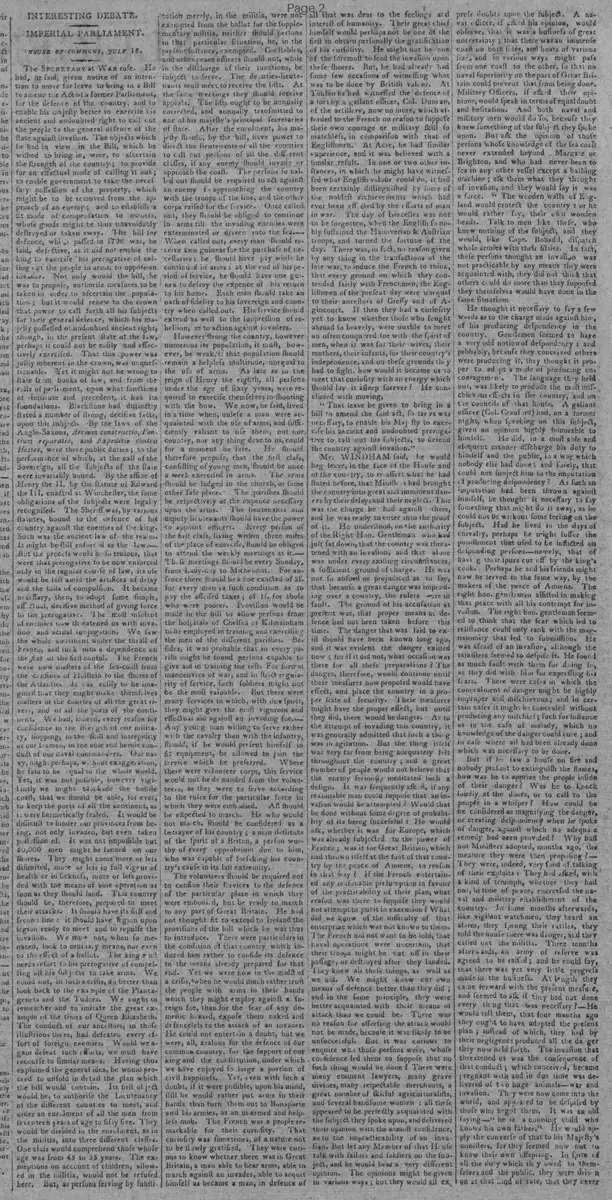
The Secretary at War rose. He said, he had given notice of an intention to move for leave to bring in a Bill to amend the Act of a former Parliament, for the defence of the country, and to enable his Majesty better to exercise his ancient and undoubted right to call out the people to the general defence of the state against invasion. The objects which he had in view in the Bill, which he wished to bring in, were, to ascertain the strength of the country; to provide for an effectual mode of calling it out; to enable government to take the necessary possession of the property, which might be to be removed from the approach of an enemy; and to establish a fit mode of compensation to owners, whose goods might be thus unavoidably destroyed or taken away. The bill for defence, which passed in 1796 was, he said, defective, as it did not enable the King to exercise his prerogative of calling out the people in arms, to oppose an invader. Not only would the bill, he was to propose, authorize measures to be taken in order to ascertain the population; but it would renew to the crown that power to call forth all his subjects for their general defence, which his Majesty possessed of undoubted ancient right, though, in the present state of the law, perhaps it could not be easily and effectively exercised. That this power was justly inherent in the crown, was unquestionable. Yet it might not be wrong to state from books of law, and from the rolls of parliament, upon what sanctions of statute and precedent, it had its foundations. Blackstone had distinctly stated a number of strong, decisive facts, upon this subject. By the laws of the Anglo-Saxons, Arcus constructio, Pontium reparatio, and Expeditio contra Hostes, were three public duties; to the performance of which, at the call of the Sovereign, all the subjects of the state were invariably bound. By the assize of Henry the II. by the statute of Edward the II. enacted at Winchester, the same obligations of the subjects were legally recognized. The Sheriff was, by various statutes, bound to the defence of his country against the enemies of the king. Such was the ancient law of the realm. It might be still enforced as the law.—But the process would be so tedious, that were that prerogative to be now enforced only in the regular course of law, its use would be lost amid the artifices of delay and the toils of compulsion. It became necessary, then, to adopt some simple, effectual, decisive method of giving force to the prerogative. The most imminent of enemies now threatened us with invasion and actual subjugation. We saw the whole continent under the thrall of France, and sunk into a dependence on the fiat of the first consul. The French were now masters of the sea-coast from the confines of Holstein to the shores of the Atlantic. It was easily to be imagined that they might make themselves masters of the courses of all the great rivers, and of all the ports of the continent. We had, indeed, every reason for confidence in the strength of our military, shipping, in the skill and intrepidity of our seamen, in the able and heroic conduct of our naval commanders. Our navy, might perhaps, without exaggeration, be said to be equal to the whole world. Yet, it was not possible, however vigilantly we might blockade the hostile coasts, that we should be able, for ever, to keep the ports of all the continent, as it were hermetically sealed. It would be difficult to hinder our provinces from being, not only invaded, but even taken possession of. It was not impossible but 50,000 men might be landed on our shores. They might come more or less disunited, more or less in full vigor of health or in sickness, more or less provided with the means of sole operation as soon as they should land. This country should be, therefore, prepared to meet their attacks. It should have its first and second line: it should have legion upon legion ready to meet and to repulse the invasion. We must not, when menaced, look to ordinary means, nor even to the effect of a ballot. The King must needs resort to his prerogative of compelling all his Subjects to take arms. We could not, in such a crisis, do better than look back to the example of the Plantagenets and the Tudors. We ought to remember and to imitate the great example of the times of Queen Elizabeth. The conduct of our ancestors, in those illustrious times, had defeated every effort of foreign enemies. Would we again defeat such efforts, we must have recourse to similar means. Having thus explained the general idea, he would proceed to unfold in detail the plan which the bill would contain. Its first object would be, to authorize the Lieutenancy of the different counties to meet, and order an enrollment of all the men from seventeen years of age to fifty five. They would be divided in the enrollment, as in the militia, into three different classes. One class would comprehend those whose age was from 45 to 55 years. The exemptions on account of children, allowed in the militia, would not be refused here. But, as persons serving by substitution merely, in the militia, were not exempted from the ballot for the supplementary militia, neither should persons in that particular situation, be, in the present instance, exempted. Constables, and other peace officers should not, while in the discharge of their functions, be subject to serve. The deputy-lieutenants must meet to receive the lists. At the same meetings they should receive appeals. The lists ought to be annually corrected, and annually transmitted to one of his Majesty's principal secretaries of state. After the enrollment, his Majesty should, by the bill, have power to direct the lieutenants of all the counties to call out persons of all the different classes, if any enemy should invade or approach the coast. The persons so called out should be required to act against an enemy, approaching the country with the troops of the line, and the other corps raised for the service. Once called out, they should be obliged to continue in arms till the invading enemies were exterminated or driven into the sea. When called out, every man should receive two guineas for the purchase of necessaries: he should have pay while he continued in arms: at the end of his period of service, he should have one guinea to defray the expense of his return to his home. Each man should take an oath of fidelity to his sovereign and country when called out. His service should extend as well to the suppression of rebellion, as to action against invaders. However strong the country, however numerous its population, it must, however, be weak, if that population should remain a helpless multitude, unequal to the use of arms. As late as in the reign of Henry the eighth, all persons under the age of sixty years, were required to exercise themselves in shooting with the bow. We now, he said, lived in a time when, unless a man were acquainted with the use of arms, and sufficiently valiant to use them, not our country, nor any thing dear to us, could for a moment be safe. He should therefore propose, that the first class, consisting of young men, should be once a week exercised in arms. The arms should be lodged in the church, or some other safe place. The parishes should be respectively at the expense necessary upon the arms. The lieutenants and deputy lieutenants should have the power to appoint officers. Every person of the first class, living within three miles of the place of exercise, should be obliged to attend the weekly meetings at it.—The meetings should be every Sunday, from Lady-day to Michaelmas. For absence there should be a fine exacted of 5s. for every man in such condition as to pay the assessed taxes; of 1s. for those who were poorer. Provision would be made in the bill to allow persons from the hospitals of Chelsea or Kilmainham to be employed in training and exercising the men of the different parishes. Besides, it was probable that in every parish might be found persons capable to give aid in training the rest. For field manoeuvres of war, and in strict regularity of service, such old soldiers might not be the most valuable. But there were many services in which, with true spirit, they might give, the most vigorous and effectual aid against an invading foe.—Any young man willing to serve rather with the cavalry than with the infantry, should, if he would present himself in fit equipment, be allowed to join the service which he preferred. Where there were volunteer corps, this service would not be demanded from the volunteers, as they were to serve according to the rules for the particular force in which they were embodied. All should be expected to march. He who would not march, should be considered as a betrayer of his country; a man destitute of the spirit of a Briton, a person worthy of every opprobrium due to him, who was capable of forsaking his country's cause in its last extremity. The volunteers should be required not to confine their services to the defence of the particular place in which they were embodied, but be ready to march to any part of Great Britain. He had not thought fit to extend to Ireland the provisions of the bill which he was thus to introduce. There were particulars in the condition of that country which induced him rather to consider its defence to the means already prepared for that end. Yet we were now in the midst of a crisis, when he would much rather trust the people with arms in their hands which they might employ against a foreign foe, than for the fear of any domestic hazard, expose them naked and defenceless to the attack of an invader. He could not entertain a doubt, but we were, all, zealous for the defence of our common country, for the support of our king and the constitution, under which we have enjoyed so large a portion of civil happiness. Yet, even with such a doubt, if it were possible, upon his mind, still he would rather put arms in their hands than turn them out to Bonaparte and his armies, as an unarmed and helpless mob. The French was a people remarkable for their curiosity. That curiosity was sometimes, of a nature not to be slowly gratified. They were curious to know whether there was in Great Britain, a man able to bear arms, able to march against an invader, able to acquit himself as became a man, in defence of all that was dear to the feelings and interest of humanity. Their great chief himself would perhaps not be one of the first to obtain personally the gratification of his curiosity. He might not be one of the foremost to lead the invasion upon these shores. But, he had already had some few occasions of witnessing what was to be done by British valour. At Toulon he had witnessed the defence of a fort by a gallant officer, Col. Duncan of the artillery, now no more, which afforded to the French no reason to suppose their own courage or military skill of matchless, in comparison with that of Englishmen. At Acre, he had similar experience, and it was believed with a similar result. In one or two other instances, in which he might have witnessed what English valour could do, it had been certainly distinguished by some of the noblest achievements which had ever been effected by the efforts of man in war. The day of Lincelles was not to be forgotten, when the English so nobly sustained the Hanoverian & Austrian troops, and turned the fortune of the day. There was, in fact, no reason given by any thing in the transactions of the late war, to induce the French to think, that every ground on which they contended fairly with Frenchmen, the Englishmen of the present day were unequal to their ancestors of Cressy and of Agincourt. If then they had a curiosity yet to know whether those who fought so bravely, were unable to meet an often conquered foe with the spirit of men, when it was for their wives, their mothers, their infants, for their country's independence, and on these grounds they had to fight, how would it become us to meet that curiosity with an energy which should lay it asleep forever? He concluded with moving,
"That leave be given to bring in a bill to amend the said act, so far as was necessary, to enable his Majesty to exercise his ancient and undoubted prerogative to call out his subjects, to defend the country against invasion."
Mr. Windham said, he would beg leave, in the face of the House and of the country, to re-assert what he had stated before, that Ministers had brought the country into great and imminent dangers by their delays and their neglect. This was the charge he had against them. and he was ready to enter into the proof of it. He understood, on the authority of the Right Hon. Gentleman who had just sat down, that the country was threatened with an invasion, and that alone was under every existing circumstances, a sufficient ground of charge. He was not so absurd or prejudiced as to say—that because a great danger was impending over a country, the rulers were in fault. The ground of his accusation at present was, that proper means of defence had not been taken before this time. The danger that was said to exist should have been known long ago, and it was evident the danger existed now; for if it did not, what occasion was there for all these preparations? The danger, therefore, would continue until these measures now proposed would have effect, and place the country in a proper state of security. These measures might have the proper effect, but until they did, there would be danger. As to the attempt of invading this country, it was generally admitted that such a thing was in agitation. But the thing itself was very far from being adequately felt throughout the country; and a great number of people would not believe that the enemy seriously meditated such a design. It was frequently asked, if any reasonable man could suppose that an invasion would be attempted? Would that be done without some degree of probability of its being successful: He would ask, whether it was of Europe, which was already subjected to the power of France: was it for Great Britain, which had thrown itself at the foot of that country by the peace of Amiens, to reason in that way? If the French entertained any reasonable presumption in favour of the practicability of their plan, what reason was there to suppose they would not attempt to put it in execution? What did we know of the difficulty of that enterprize which was not known to them? The French did not want to be told, that naval operations were uncertain, that their troops might be cut off in their passage, or destroyed after they landed. They knew all these things, as well as we did. We might know our own means of defence better than they did; and in the same principle, they were better acquainted with their means of attack than we could be. There was no reason for asserting the attack would not be made, because it was likely to be unsuccessful. But it was curious to enquire who those persons were, whose confidence led them to suppose that no such thing would be done? There were many eminent lawyers, many grave divines, many respectable merchants, a great number of skilful agriculturalists, and several handsome women: all these appeared to be perfectly acquainted with the subject they spoke upon, and delivered their opinion with the utmost confidence, as to the impracticability of an invasion. But let any Member of that House talk with sailors and soldiers on the subject, and he would hear a very different opinion. The opinions might be given in various ways; but they would all express doubts upon the subject. A naval officer, if asked his opinion, would observe, that it was a business of great uncertainty; that there was an immense coast on both sides, and boats of various size; and in various ways might pass from one coast to the other, so that no naval superiority on the part of Great Britain could prevent that from being done. Military Officers, if asked their opinions, would speak in terms of equal doubt and hesitation. And both naval and military men would do so, because they knew something of the subject they spoke upon. But ask the opinion of those persons whose knowledge of the sea coast never extended beyond Margate or Brighton, and who had never been to sea in any other vessel except a bathing machine; ask them what they thought of invasion, and they would say it was a farce. The wooden walls of England would protect the country: or he would rather say, their own wooden heads. Talk to men like these, who knew nothing of the subject, and they would, like Capt. Bobadil, dispatch whole armies with their fifties. In fact. these persons thought an invasion was not practicable by any means they were acquainted with, they did not think that others could do more than they supposed they themselves would have done in the same situation.
He thought it necessary to say a few words as to the charge made against him, of his producing despondency in the country. Gentlemen seemed to have a very odd notion of despondency: and probably, because they conceived others were producing it, they thought it proper to adopt a mode of producing false courage. The language they held out, was likely to produce the most mischievous effects in the country, and on the councils of that house. A gallant officer (Col. Crawford) had, on a former night, when speaking on this subject, given an opinion highly honorable to himself. He did, in a most able and eloquent manner discharge his duty to himself and the public, in a way which nobody else had done: and surely, that could not subject him to the imputation producing despondency? As such an imputation had been thrown against himself, he thought it necessary to say something that might do it away, as he could not be without some feeling on the subject. Had he lived in the days of chivalry, perhaps he might suffer the punishment that used to be inflicted on desponding persons—namely, that of having their spurs cut off by the king's cook. Perhaps he and his friends might now be served in the same way, by the makers of the peace of Amiens. The right hon. gentleman assisted in making that peace with all his contempt for invasion. The right hon. gentleman seemed to think that the fear which led to resistance could only rank with the magnanimity that led to submission. He was afraid of an invasion, although the ministers seemed to despise it. He found as much fault with them for doing so, as they did with him for expressing his fears. There were cases in which the concealment of danger might be highly improper and mischievous; and in certain cases it might be concealed without producing any mischief; such for instance as in the case of malady, which no knowledge of the danger could cure; and in case where all had been already done which was necessary to be done. But if I saw a house on fire and nobody present to extinguish the flames how was he to apprise the people inside of their danger? Was he to knock loudly at the doors, or to call to the people in a whisper? How could he be considered as magnifying the danger, or creating despondency when he spoke of danger, against which no adequate remedy had been provided? Why had not Ministers adopted, months ago, this measure they were then proposing?—They were, indeed, very fond of talking of their exploits: They had asked, with a kind of triumph, whether they had not, in time of peace, increased the naval and military establishment of the country. In some months afterwards, like vigilant watchmen, they heard an alarm, they sprung their rattles, they told the house there was danger, and they called out the militia. Three months afterwards, an army of reserve was agreed to be raised; and he could say, that there was yet very little progress made in the business. At length they came forward with the present measure, and seemed to ask if they had not done every thing that was necessary? He would tell them, that four months ago they ought to have adopted the present plan; instead of which, they had by their negligence produced all the danger they now held forth. The invasion that threatened us was the consequence of that conduct; which conceived, became pregnant with and in due time was delivered of two huge animals—war and invasion. They were now come into the world, and appeared to be despised by those who begot them. It was an old saying—"he is a cunning child who knows his own father." He would apply the converse of that to his Majesty's ministers, for they seemed now not to know their own offspring. In spite of all the duty which they owed to themselves and the public, they were driven on at that wind of haste, that they never
thought proper to come to the measure they now proposed, until four or five months had elapsed from the first appearance of danger.
After having gone on at such a rate as this, he would ask if it was not high time for the vigour of the country to interpose and stop it? It might be asked what inducements could those men who manage the affairs of the executive government have for acting in this manner. It might be said, they could have no interest in hastening the destruction of the country; and that they had not gone out of the ordinary course of proceeding which had hitherto been observed.
Whatever excuse might be made for them, they could never escape the charge of having put the country in a situation of great danger; for no man could say but that we should be safer now, if those measures had been proposed at the proper time; and inasmuch as they had been delayed so long, there was great danger. But after having stated this charge against ministers, let it not be supposed that he had come to the end of his charge; or there were many other parts of the conduct of ministers equally reprehensible. They had shewn themselves deficient in all the necessary modes of preparation! They had not taken the counsel of any great military man. They had no military council to direct the operations of our armies, or devise the best means of defence or attack.
Lord Grey and every general officer not in actual service, should be appointed to form a council of that kind. Their business should be to consider and form the plan of every military operation to be undertaken. Each individual in it should act so as to be able to say—omnia percepi, atque animo sœpe peregi.
Every morning should be minutely weighed, and nothing be left undone. There was nothing more remarkable in the enemy, whose conduct the right honorable gentleman recommended it to the house to imitate, than the extraordinary attention and minuteness with which they examined every subject and point before them; and a great deal of their success in the late war, was owing to the plans which had been previously devised, of every operation that had been performed. Was there not a great variety of subjects with regard to our operations that required a degree of consideration which it was impossible, either for the commander in chief, or for the generals, to bestow upon them? One great advantage of a military council in this country would be, that of its implying no kind of disparagement to any individual. No one person could undertake to say, that he could consider and determine upon every thing. The multiplicity of things which a person at the head of the military force of the country had to consider, rendered such a thing impossible. A military council, therefore, could imply no disparagement to the illustrious commander in chief; nor would it take away from his discretionary power; for every thing resolved on by the council, should be submitted to him before adopted, and must receive the approbation of his Majesty. It would, therefore, be a council of discussion, and not of decision.
A measure like that now proposed, could never be carried into effect, if the Councils of the country were not properly exercised. The whole world would be a scene like that of men being trampled on by their own bullocks. With regard to the measure itself, it was one which he should not object to; and he thought it very proper that a power should be vested in the king to call his subjects out in case of an invasion: but he had considerable doubts how far the measure would enable the government to make great exertions. He had a general objection to the compulsory system which formed the principle of this measure. Although he thought it very right to have that as a reserve, yet it would have been much better at first to have had recourse to the volunteer system. That experiment should have been tried before ever the present had been proposed; but instead of that, they took an opposite and dangerous course: they never told the danger, until they came with their compulsory system. Under the impression of danger, the voluntary system should have first been had recourse to. Never was there such a libel on the country as to suppose that it could not be moved until it was compelled to do so. It was in the very nature of a compulsory service that men were disinclined to the performance of it. There was nothing in it to flatter a man's vanity or excite their zeal. He was therefore afraid this service would be sluggishly, carelessly and reluctantly executed. Men would be disinclined to it, not only from their natural impatience of restraint, but from their modesty, and that spirit of depreciation which would prevail in show and appearance, and which generally disinclines the people of England to things of this sort. They were not like the people of France, attached to military show and parade. If a great number of men, with habits and sentiments such as he had just alluded to, were brought out to exercise, they might become the sport of the mob which surrounded them, and that might produce a very bad effect. As a proof
of the evil arising from a compulsory system, he would just notice the provisional cavalry that had been raised in the late war, and which had always shewn a great disinclination to the service. There was a most material difference between the two services. The volunteer was actuated by good will, and by a desire of distinction. Of those compelled men, many would be good for nothing, and must be thrown away. Very little good could be expected from men exercised in a church yard, and exercised so seldom as they must be. The government would thus have an immense body without power: it would be like the man who thought the merit of the book he was writing consisted in its size; and therefore thought it enough for him to make it very large. There was a great risk that before the machine could be put in motion, the enemy would come and spoil the whole of the work. The measure that had been agreed upon some days before, was not yet carried into effect, and it appeared, that all those things which had been done by means of parliamentary measures, which were like great guns, which made a great noise, but seldom with the greatest effect. The country did not want all this apparatus. According to the volunteer system, there might be a number of men much more applicable to the public service, although a fewer number. A living dog was better than a dead lion. But by this measure nothing would be done in time. He did not look on this measure as one that was improper to be adopted, but as one on which no reliance was to be placed. The voluntary zeal of the country could alone be relied on. There was never a country in which so much wealth was combined with so much greatness power, and intelligence; in which the people were bound together by so many ties, and became the happiest people on earth. If, therefore, the fate of that country should unfortunately become disastrous, if she should be conquered by a violent enemy, he would exhibit such an example as never did exist in the world before. Let no Englishman suppose that he could survive the fate of his country. Even the miserable state of existence enjoyed by the people of Switzerland would then be denied us. It was the destruction of the people of this country, and not the country itself, that the French sought after. What would they do with an island like this? Possessed as they are of the Rhine and other great rivers, what did they want with our river Thames? They would, in short, cast these away as useless things, as was formerly done at Carthage. It was hardly necessary to bring this truth home to the breast of every man, that he could never expect again to enjoy his wealth, his luxury, his comforts or any privileges, if a French invasion should be successful. The first thing, therefore, to be done was, to tell men, and convince them of their danger; with which they were not sufficiently impressed. It must be an up-hill work to do this. They never had experience of such a thing before. An honorable baronet (Sir William Erskine) had on a former night spoken of the advantage the British possessed in point of spirit, courage, bodily strength, &c. over other troops, particularly the Austrians, whom he described as mere machines. He must say, that without the machinery of discipline, little expectation could be formed of the efficacy of our troops. This was therefore an additional reason for paying more attention to the voluntary efforts of the people. He then noticed the power given to certain volunteer corps to choose their own officers; a power which he highly disapproved of, as being likely to produce the most mischievous consequences. The object now was, to call forth the valor and energies of the country. But that could not be done if men were to be put in trammels. Let skilful officers be appointed; and instead of any thing compulsory, let the energies of the people go on. If that was done, the best hopes would be raised in the country. He would not oppose the present measure, but he thought inconveniences would result from it in various ways.
What sub-type of article is it?
What keywords are associated?
What entities or persons were involved?
Where did it happen?
Foreign News Details
Primary Location
Great Britain
Event Date
July 18
Key Persons
Outcome
motion for leave to bring in the bill to amend the 1796 defense act and enable the king to call out subjects against invasion.
Event Details
The Secretary at War moves for a bill to enroll men aged 17-55, train them, and allow the King to call them out against invaders, citing ancient rights and French threats. Mr. Windham criticizes delays in defense preparations, prefers volunteers over compulsion, and calls for a military council.