Thank you for visiting SNEWPapers!
Sign up free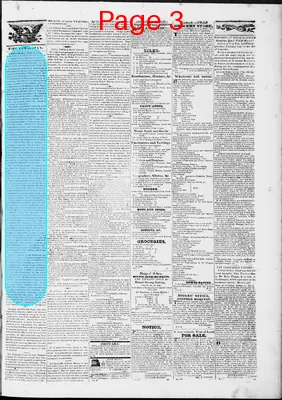
Lynchburg Virginian
Lynchburg, Virginia
What is this article about?
An Alabama convention at Courtland on October 25, 1831, plans a railroad from Tuscumbia to Memphis as part of a larger scheme connecting the Atlantic to the Mississippi via railroads through Virginia and Tennessee. Lynchburg expresses strong support and addresses Richmond's reluctance.
Clipping

OCR Quality
Full Text
LYNCHBURG, NOV. 7, 1831.
"Another Link in the Grand Chain."
A convention of delegates from several towns in Alabama, assembled at Courtland, on the 25th of October, for the purpose of taking into consideration the propriety of constructing a rail road from some point above the highest obstruction in the Muscle Shoals, on the Tennessee river, to some point on the Mississippi.
At this Convention it was determined that the eastern terminus of this rail road should be the town of Tuscumbia, on the Tennessee, and that it should terminate at Memphis, on the Mississippi, passing through the towns of Courtland and Tuscumbia, and such towns in West Tennessee as may be convenient. A committee was then appointed to prepare a Memorial to the Legislature of Alabama, praying for a charter; and another, to draft an address to the public on the subject.
This scheme constitutes the third link in the great plan of connecting the waters of the Atlantic with those of the Mississippi, by means of a rail road, traversing the heart of Virginia and Tennessee, and inviting along its route a vast proportion of the rich trade of those States and of Alabama, which now finds its way to Mobile & New Orleans. A letter to the Editors of the Rail Road Advocate, from Tuscumbia, says, "the ultimate object of the Company is to co-operate with the States of Mississippi and Tennessee, in extending this road to the town of Memphis, and some believe that it will be extended from the head of the Muscle Shoals to Knoxville." If this be done, and a company be chartered to extend the rail road from New River to Knoxville, we shall, in a few years, have a direct rail road communication from Lynchburg to the Mississippi—and at each extremity, there will, without question, be steamboat navigation, amply sufficient to afford an outlet for all the produce, merchandise, &c., which may be transported on the road.
The "Rail Road Advocate," (valuable one, published at Rogersville, Tennessee) remarks, "as the stock is readily taken up for that part of the road already chartered, we shall have no fears as to the success of the work; for, once begun, the importance and necessity of its continuance will be obvious to all, and an increasing interest will be felt by the public." The editors of the Advocate will, before this, have seen, that the stock in the Lynchburg and New River link of the road will be very readily taken up—and, so far as the subscriptions have yet been entered, we assure them, and the distant public elsewhere, that they are not made by transient individuals or speculators, but by substantial men—the property-holders of this place, whose vital interests are at stake in the result of this noble enterprise. Viewed at first, rather as a thing to be hoped for, than as an experiment to be tried, there was at one time among us a feeling of timidity and despondency which augured ill for the success of the scheme. But, all such feelings have disappeared. A new and strange energy has taken the place of sluggish indifference and doubt. All around us seem to be awakened to new life, and to be animated by a spirit of zeal and perseverance which never yet failed, and which never will fail, to surmount the greatest difficulties and to conquer impossibilities—to exalt valor where cause the "cloud caps" to vanish, as before a magician's spell. We will do this—we must do this. Pride compasses human ability, and it can, therefore, be done.
The conduct pursued by the Richmond people towards us, of this en masse, though only a few of their newspapers are justly accountable for it, is, to say the least of it, a strange comment on their affected zeal—some months ago. Probably they may be able to make some satisfactory explanation of their conduct in declining to open books for subscriptions, in that place; for, as to that which they have offered, it is all trash. Let them deal candidly with us at once, and tell us what we are to expect from them, and we shall know how to act. We are not beggars, humbly suing for their aid; but equals, urging them an equal participation in a scheme in which they have at least an equal interest with ourselves. They may co-operate with us or not, as they please. But be this understood by them, that there are other outlets to market besides Richmond—and we, of Lynchburg, will not "buckle fortunes on their backs," whether they will or no! Verbum sat.
What sub-type of article is it?
What themes does it cover?
What keywords are associated?
Where did it happen?
Story Details
Location
Courtland, Alabama; Tuscumbia, Tennessee; Memphis, Mississippi; Lynchburg, Virginia
Event Date
October 25, 1831
Story Details
Delegates from Alabama towns convene at Courtland to plan a railroad from Tuscumbia on the Tennessee River to Memphis on the Mississippi, forming the third link in a grand rail connection from the Atlantic to the Mississippi via Virginia and Tennessee. Committees are appointed for a charter memorial and public address. Lynchburg shows renewed enthusiasm for the project despite initial doubts and criticizes Richmond's lack of support.