Thank you for visiting SNEWPapers!
Sign up free
Editorial
January 14, 1928
Imperial Valley Press
El Centro, Imperial County, California
What is this article about?
Editorial defends reprinting a 1846 Missouri slave sale ad against protests from colored community, arguing no ridicule intended, highlighting negro progress since emancipation, and asserting slavery's shame lies with whites. Praises negro loyalty and achievements.
Clipping
OCR Quality
100%
Excellent
Full Text
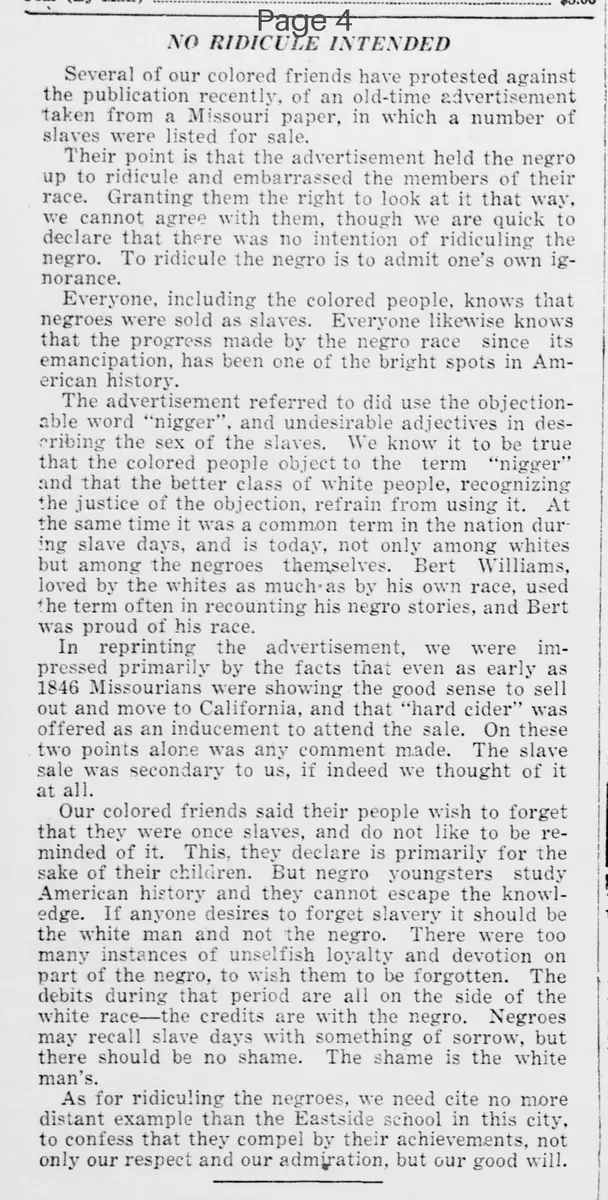
NO RIDICULE INTENDED
Several of our colored friends have protested against the publication recently of an old-time advertisement taken from a Missouri paper, in which a number of slaves were listed for sale.
Their point is that the advertisement held the negro up to ridicule and embarrassed the members of their race. Granting them the right to look at it that way, we cannot agree with them, though we are quick to declare that there was no intention of ridiculing the negro. To ridicule the negro is to admit one's own ignorance.
Everyone, including the colored people, knows that negroes were sold as slaves. Everyone likewise knows that the progress made by the negro race since its emancipation has been one of the bright spots in American history.
The advertisement referred to did use the objectionable word "nigger", and undesirable adjectives in describing the sex of the slaves. We know it to be true that the colored people object to the term "nigger" and that the better class of white people, recognizing the justice of the objection, refrain from using it. At the same time it was a common term in the nation during slave days, and is today, not only among whites but among the negroes themselves. Bert Williams, loved by the whites as much as by his own race, used the term often in recounting his negro stories, and Bert was proud of his race.
In reprinting the advertisement, we were impressed primarily by the facts that even as early as 1846 Missourians were showing the good sense to sell out and move to California, and that "hard cider" was offered as an inducement to attend the sale. On these two points alone was any comment made. The slave sale was secondary to us, if indeed we thought of it at all.
Our colored friends said their people wish to forget that they were once slaves, and do not like to be reminded of it. This, they declare, is primarily for the sake of their children. But negro youngsters study American history and they cannot escape the knowledge. If anyone desires to forget slavery it should be the white man and not the negro. There were too many instances of unselfish loyalty and devotion on part of the negro to wish them to be forgotten. The debits during that period are all on the side of the white race—the credits are with the negro. Negroes may recall slave days with something of sorrow, but there should be no shame. The shame is the white man's.
As for ridiculing the negroes, we need cite no more distant example than the Eastside school in this city, to confess that they compel by their achievements, not only our respect and our admiration, but our good will.
Several of our colored friends have protested against the publication recently of an old-time advertisement taken from a Missouri paper, in which a number of slaves were listed for sale.
Their point is that the advertisement held the negro up to ridicule and embarrassed the members of their race. Granting them the right to look at it that way, we cannot agree with them, though we are quick to declare that there was no intention of ridiculing the negro. To ridicule the negro is to admit one's own ignorance.
Everyone, including the colored people, knows that negroes were sold as slaves. Everyone likewise knows that the progress made by the negro race since its emancipation has been one of the bright spots in American history.
The advertisement referred to did use the objectionable word "nigger", and undesirable adjectives in describing the sex of the slaves. We know it to be true that the colored people object to the term "nigger" and that the better class of white people, recognizing the justice of the objection, refrain from using it. At the same time it was a common term in the nation during slave days, and is today, not only among whites but among the negroes themselves. Bert Williams, loved by the whites as much as by his own race, used the term often in recounting his negro stories, and Bert was proud of his race.
In reprinting the advertisement, we were impressed primarily by the facts that even as early as 1846 Missourians were showing the good sense to sell out and move to California, and that "hard cider" was offered as an inducement to attend the sale. On these two points alone was any comment made. The slave sale was secondary to us, if indeed we thought of it at all.
Our colored friends said their people wish to forget that they were once slaves, and do not like to be reminded of it. This, they declare, is primarily for the sake of their children. But negro youngsters study American history and they cannot escape the knowledge. If anyone desires to forget slavery it should be the white man and not the negro. There were too many instances of unselfish loyalty and devotion on part of the negro to wish them to be forgotten. The debits during that period are all on the side of the white race—the credits are with the negro. Negroes may recall slave days with something of sorrow, but there should be no shame. The shame is the white man's.
As for ridiculing the negroes, we need cite no more distant example than the Eastside school in this city, to confess that they compel by their achievements, not only our respect and our admiration, but our good will.
What sub-type of article is it?
Slavery Abolition
Social Reform
Moral Or Religious
What keywords are associated?
Slave Advertisement
Negro Ridicule
Slavery History
Racial Progress
Emancipation
White Shame
What entities or persons were involved?
Colored Friends
Negro Race
Bert Williams
Eastside School
Editorial Details
Primary Topic
Defense Against Protests Over Reprinting Historical Slave Advertisement
Stance / Tone
Supportive Of Negro Progress And Placing Shame Of Slavery On Whites
Key Figures
Colored Friends
Negro Race
Bert Williams
Eastside School
Key Arguments
No Intention To Ridicule Negroes In Reprinting Advertisement
Negroes Were Sold As Slaves Historically
Progress Of Negro Race Since Emancipation Is A Bright Spot
Objectionable Word 'Nigger' Was Common In Slave Days
Focus Was On Missourians Moving To California And 'Hard Cider' Inducement
Negroes Should Not Wish To Forget Slavery Due To Their Loyalty
Shame Of Slavery Belongs To White Race
Negro Achievements Compel Respect And Admiration