Thank you for visiting SNEWPapers!
Sign up free
Democratic Enquirer
Mcarthur, Vinton County, Ohio
What is this article about?
Detailed account of the accidental shooting and death of Ohio politician Clement L. Vallandigham on June 17, 1871, in Lebanon, Ohio, while preparing for a murder trial. Includes medical updates, family reactions, and funeral arrangements in Dayton.
Merged-components note: These components collectively form a single coherent news story detailing the death, shooting incident, medical details, and funeral arrangements of C. L. Vallandigham, continued across multiple sections of the page.
Clipping
OCR Quality
Full Text
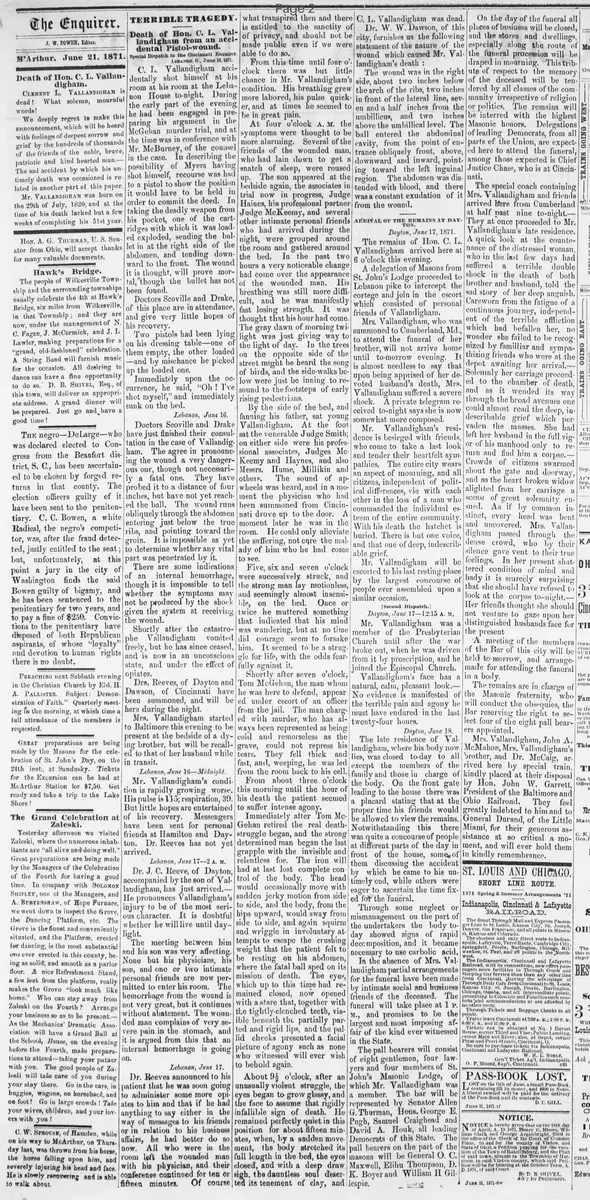
CLEMENT L. VALLANDIGHAM is dead!
What solemn, mournful words!
We deeply regret to make this announcement, which will be heard with feelings of deepest sorrow and grief by the hundreds of thousands of the friends of the noble, brave, patriotic and kind hearted man.
The sad accident by which his untimely death was occasioned is related in another part of this paper.
Mr. Vallandigham was born on the 29th of July, 1820, and at the time of his death lacked but a few weeks of completing his 51st year.
TERRIBLE TRAGEDY.
Death of Hon. C. L. Vallandigham from an accidental Pistol-wound.
Special Dispatch to the Cincinnati Enquirer.
LEBANON, O., June 16, 1871.
C. L. Vallandigham accidentally shot himself at his room at the Lebanon House to-night. During the early part of the evening he had been engaged in preparing his argument in the McGehan murder trial, and at the time was in conference with Mr. McBurney, of the counsel in the case. In describing the possibility of Myers having shot himself, recourse was had to a pistol to show the position it would have to be held in order to commit the deed. In taking the deadly weapon from his pocket, one of the cartridges with which it was loaded exploded, sending the bullet in at the right side of the abdomen, and tending downward to the front. The wound it is thought, will prove mortal, though the bullet has not been found.
Doctors Scoville and Drake, of this place are in attendance, and give very little hopes of his recovery.
Two pistols had been lying on his dressing table--one of them empty, the other loaded--and by mischance he picked up the loaded one.
Immediately upon the occurrence, he said, "Oh! I've shot myself," and immediately sunk on the bed.
Lebanon, June 16.
Doctors Scoville and Drake have just finished their consultation in the case of Vallandigham. They agree in pronouncing the wound a very dangerous one, though not necessarily a fatal one. They have probed it to a distance of four inches, but have not yet reached the ball. The wound runs obliquely through the abdomen entering just below the true ribs, and pointing toward the groin. It is impossible as yet to determine whether any vital part was penetrated by it.
There are some indications of an internal hemorrhage, though it is impossible to tell whether the symptoms may not be produced by the shock given the system at receiving the wound.
Shortly after the catastrophe Vallandigham vomited freely, but he has since ceased, and is now in an unconscious state, and under the effect of opiates.
Drs. Reeves, of Dayton and Dawson, of Cincinnati have been summoned, and will be here during the night.
Mrs. Vallandigham started to Baltimore this evening to be present at the bedside of a dying brother, but will be recalled to that of her husband while in transit.
Lebanon, June 16—Midnight.
Mr. Vallandigham's condition is rapidly growing worse. His pulse is 115; respiration, 39. But little hopes are entertained of his recovery. Messengers have been sent for personal friends at Hamilton and Dayton.
Dr. Reeves has not yet arrived.
Lebanon, June 17-2 A. M.
Dr. J. C. Reeve, of Dayton, accompanied by the son of Vallandigham, has just arrived. He pronounces Vallandigham's injury to be of the most serious character. It is doubtful whether he will live until daylight.
The meeting between him and his son was very affecting.
None but his physicians, his son, and one or two intimate personal friends are now permitted to enter his room. The hemorrhage from the wound is not very great, but it continues without abatement. The wounded man complains of very severe pain in the stomach, and it is argued from this that an internal hemorrhage is going on.
Lebanon, June 17.
Dr. Reeves announced to his patient that he was soon going to administer some more opiates to him and that if he had anything to say either in the way of messages to his friends or in relation to his business affairs, he had better do so now.
All who were in the room left the wounded man with his physician, and their conference continued for ten or fifteen minutes.
Of course what transpired then and there is entitled to the sanctity of privacy, and should not be made public even if we were able to do so.
From this time until four o'clock there was but little change in Mr. Vallandigham's condition. His breathing grew more labored, his pulse quicker, and at times he seemed to be in great pain.
At four o'clock A. M. the symptoms were thought to be more alarming. Several of the friends of the wounded man, who had lain down to get a snatch of sleep, were roused up.
The son appeared at the bedside again, the associates in trial now in progress, Judge Haines, his professional partner Judge McKeemy, and several other intimate personal friends who had arrived during the night, were grouped around the room and gathered around the bed. In the past two hours a very noticeable change had come over the appearance of the wounded man.
His breathing was still more difficult, and he was manifestly fast losing strength. It was thought that his hour had come.
The gray dawn of morning twilight was just giving way to the light of day. In the trees on the opposite side of the street might be heard the song of birds, and the side-walks below were just beginning to resound to the footsteps of early rising pedestrians.
By the side of the bed, and fanning his father, sat young Vallandigham. At the foot sat the venerable Judge Smith; on either side were his professional associates, Judges McKeemy and Haynes, and also Messrs. Hume, Millikin and others.
The sound of approaching wheels was heard, and in a moment the physician who had been summoned from Cincinnati drove up to the door. A moment later he was in the room. He could only alleviate the suffering, not cure the malady of him who he had come to see.
Five, six and seven o'clock were successively struck, and the strong man lay motionless, and seemingly almost insensible, on the bed.
Once or twice he muttered something that indicated that his mind was wandering, but at no time did courage seem to forsake him. It seemed to be a struggle for life, with the odds fearfully against it.
Shortly after seven o'clock, Tom McGehan, the man whom he was here to defend, appeared under escort of an officer from the jail. The man charged with murder, who has always been represented as being cold and remorseless as the grave, could not repress his tears.
They fell thick and fast, and, weeping, he was led from the room back to his cell.
From about three o'clock this morning until the hour of his death the patient seemed to suffer intense agony.
Immediately after Tom McGehan retired the real death-struggle began, and the strong determined man began the last grapple with the invisible and relentless foe. The iron will had at last lost complete control of the body. The head would occasionally move with sudden jerky motion from side to side, and the body, from the hips upward, would sway from side to side, and again squirm and wriggle in involuntary attempts to escape the crushing weight that the patient felt to be resting on his abdomen, where the fatal ball sped on its mission of death. The eyes, which up to this time had remained closed, now opened with a stare that, together with the tightly-clenched teeth, visible beneath the partially parted and rigid lips, and the pallid cheeks presented a facial picture of agony such as none who witnessed will ever wish to behold again.
About 9 o'clock, after an unusually violent struggle, the eyes began to grow glassy, and the face to assume that rigidly infallible sign of death. He remained perfectly quiet in this position for about fifteen minutes, when, by a sudden movement, the body stretched its full length in the bed, the eyes closed, and with a deep drawing sigh, the dauntless soul deserted its tenement of clay, and C. L. Vallandigham was dead.
Dr. W. W. Dawson, of this city, furnishes us the following statement of the nature of the wound which caused Mr. Vallandigham's death:
The wound was in the right side, about two inches below the arch of the ribs, two inches in front of the lateral line, seven and a half inches from the umbilicus, and two inches above the umbilical level. The ball entered the abdominal cavity, from the point of entrance obliquely front, above, downward and inward, pointing toward the left inguinal region. The abdomen was distended with blood, and there was a constant exudation of it from the wound.
ARRIVAL OF THE REMAINS AT DAYTON.
Dayton, June 17, 1871.
The remains of Hon. C. L. Vallandigham arrived here at 6 o'clock this evening.
A delegation of Masons from St. John's Lodge proceeded to Lebanon pike to intercept the cortege and join in the escort which consisted of personal friends of Vallandigham.
Mrs. Vallandigham, who was summoned to Cumberland, Md., to attend the funeral of her brother, will not arrive home until to-morrow evening.
It is almost needless to say that upon being apprised of her devoted husband's death, Mrs. Vallandigham suffered a severe shock. A private telegram received to-night says she is now somewhat more composed.
Mr. Vallandigham's residence is besieged with friends, who come to take a last look and tender their heartfelt sympathies. The entire city wears an aspect of mourning, and all citizens, independent of political differences, vie with each other in the loss of a man who commanded the individual esteem of the entire community.
With his death the hatchet is buried. There is but one voice, and that one of deep, indescribable grief.
Mr. Vallandigham will be escorted to his last resting-place by the largest concourse of people ever assembled upon a similar occasion.
Mr. Vallandigham was a member of the Presbyterian Church until after the war broke out, when he was driven from it by proscription, and he joined the Episcopal Church.
Vallandigham's face has a natural, calm, pleasant look. No evidence is manifested of the terrible pain and agony he must have endured in the last twenty-four hours.
Dayton, June 18.
The late residence of Vallandigham, where his body now lies, was closed to-day to all except the members of the family and those in charge of the body. On the front gate leading to the house there was a placard stating that at the proper time his friends would be allowed to view the remains.
Notwithstanding this there was quite a concourse of people at different parts of the day in front of the house, some of them discussing the accident by which he came to his untimely end, while others were eager to ascertain the time fixed for the funeral.
Through some neglect or mismanagement on the part of the undertakers the body to-day showed signs of rapid decomposition, and it became necessary to use carbolic acid.
In the absence of Mrs. Vallandigham partial arrangements for the funeral have been made by intimate social and business friends of the deceased. The funeral will take place at 1 p. m., and promises to be the largest and most imposing affair of the kind ever witnessed in the State.
The pall bearers will consist of eight gentlemen, four lawyers and four members of St. John's Masonic Lodge, of which Mr. Vallandigham was a member. The bar will be represented by Senator Allen G. Thurman, Hons. George E. Pugh, Samuel Craighead and David A. Houk, all leading Democrats of this State. The pall bearers on the part of the Masons will be General O. C. Maxwell, Elihu Thompson, D. K. Boyer and William H. Gillespie.
On the day of the funeral all places of business will be closed and the stores and dwellings especially along the route of the funeral procession will be draped in mourning. This tribute of respect to the memory of the deceased will be tendered by all classes of the community irrespective of religion or politics. The remains will be interred with the highest Masonic honors. Delegations of leading Democrats, from all parts of the Union, are expected here to attend the funeral. Among those expected is Chief Justice Chase, who is at Cincinnati.
The special coach containing Mrs. Vallandigham and friends arrived here from Cumberland at half past nine to-night. They at once proceeded to Mr. Vallandigham's late residence.
A quick look at the countenance of the distressed woman, who in the last few days had suffered a terrible double shock in the death of both brother and husband, told the sad story of her deep anguish.
Careworn from the fatigue of a continuous journey, independent of the terrible affliction which had befallen her, no wonder she failed to be recognized by familiar and sympathizing friends who were at the depot awaiting her arrival.
Solemnly her carriage proceeded to the chamber of death, and as it wended its way through the broad avenues one could almost read the deep, indescribable grief which pervaded the masses. She had left her husband in the full vigor of his manhood only to return and find him a corpse.
Crowds of citizens swarmed about the gate and doorway, and as the heart broken widow alighted from her carriage a scene of great solemnity ensued. As if by common instinct, every head was bent and uncovered. Mrs. Vallandigham passed through the dense crowd, who by their silence gave vent to their true feelings. In her present shattered condition of mind and body it is scarcely surprising that she should have refused to look at the corpse to-night.
Her friends thought she should not venture to gaze upon her distinguished husband's face for the present.
A meeting of the members of the Bar of this city will be held to-morrow, and arrangements made for attending the funeral in a body.
The remains are in charge of the Masonic fraternity, who will conduct the obsequies, the Bar reserving the right to select four of the eight pall bearers appointed.
Mrs. Vallandigham, John A. McMahon, Mrs. Vallandigham's brother, and Dr. McCaig, arrived here by special train, kindly placed at their disposal by Hon. John W. Garrett, President of the Baltimore and Ohio Railroad. They feel greatly indebted to him and to General Durand, of the Little Miami, for their generous assistance at so critical a moment, and will ever hold them in kindly remembrance.
What sub-type of article is it?
What themes does it cover?
What keywords are associated?
What entities or persons were involved?
Where did it happen?
Story Details
Key Persons
Location
Lebanon, Ohio; Dayton, Ohio
Event Date
June 16 17, 1871
Story Details
Clement L. Vallandigham accidentally shoots himself while demonstrating a pistol position during preparation for the McGehan murder trial in Lebanon, Ohio. He suffers a fatal abdominal wound, endures agony through the night, and dies around 9 AM on June 17. His remains are taken to Dayton for a grand funeral amid widespread mourning.