Thank you for visiting SNEWPapers!
Sign up free
Daily Kennebec Journal
Augusta, Kennebec County, Maine
What is this article about?
Hon. S. W. Matthews' speech laments shift from prosperity to widespread unemployment and business failures, blaming Democratic free trade policies. He reviews U.S. tariff history, praises protectionism, and critiques the Wilson bill for favoring Southern industries and imposing income tax. (248 characters)
Clipping
OCR Quality
Full Text
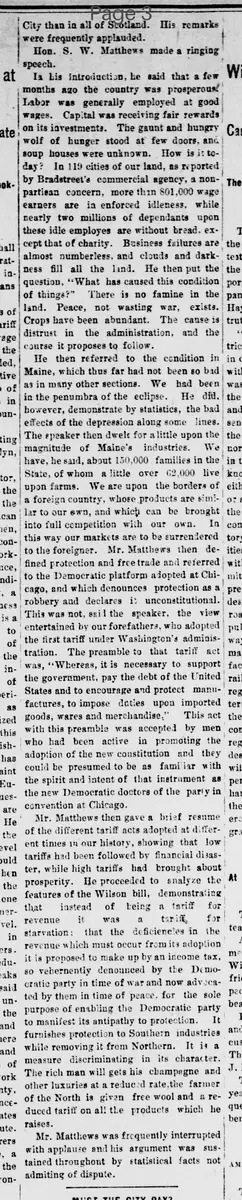
In his introduction, he said that a few months ago the country was prosperous. Labor was generally employed at good wages. Capital was receiving fair rewards on its investments. The gaunt and hungry wolf of hunger stood at few doors, and soup houses were unknown. How is it to-day? In 119 cities of our land, as reported by Bradstreet's commercial agency, a non-partisan concern, more than 800,000 wage earners are in enforced idleness, while nearly two millions of dependants upon these idle employes are without bread, except that of charity. Business failures are almost numberless, and clouds and darkness fill all the land. He then put the question, "What has caused this condition of things?" There is no famine in the land. Peace, not wasting war, exists. Crops have been abundant. The cause is distrust in the administration, and the course it proposes to follow.
He then referred to the condition in Maine, which thus far had not been so bad as in many other sections. We had been in the penumbra of the eclipse. He did, however, demonstrate by statistics, the bad effects of the depression along some lines.
The speaker then dwelt for a little upon the magnitude of Maine's industries. We have, he said, about 150,000 families in the State, of whom a little over 62,000 live upon farms. We are upon the borders of a foreign country, whose products are similar to our own, and which can be brought into full competition with our own. In this way our markets are to be surrendered to the foreigner. Mr. Matthews then defined protection and free trade and referred to the Democratic platform adopted at Chicago, and which denounces protection as a robbery and declares it unconstitutional. This was not, said the speaker, the view entertained by our forefathers, who adopted the first tariff under Washington's administration. The preamble to that tariff act was, "Whereas, it is necessary to support the government, pay the debt of the United States and to encourage and protect manufactures, to impose duties upon imported goods, wares and merchandise." This act with this preamble was accepted by men who had been active in promoting the adoption of the new constitution and they could be presumed to be as familiar with the spirit and intent of that instrument as the new Democratic doctors of the party in convention at Chicago.
Mr. Matthews then gave a brief resume of the different tariff acts adopted at different times in our history, showing that low tariffs had been followed by financial disaster, while high tariffs had brought about prosperity. He proceeded to analyze the features of the Wilson bill, demonstrating that instead of being a tariff for revenue it was a tariff for starvation: that the deficiencies in the revenue which must occur from its adoption it is proposed to make up by an income tax, so vehernently denounced by the Democratic party in time of war and now advocated by them in time of peace, for the sole purpose of enabling the Democratic party to manifest its antipathy to protection. It furnishes protection to Southern industries while removing it from Northern. It is a measure discriminating in its character. The rich man will get his champagne and other luxuries at a reduced rate, the farmer of the North is given free wool and a reduced tariff on all the products which he raises.
Mr. Matthews was frequently interrupted with applause and his argument was sustained throughout by statistical facts not admitting of dispute.
What sub-type of article is it?
What themes does it cover?
What keywords are associated?
What entities or persons were involved?
Where did it happen?
Story Details
Key Persons
Location
Maine
Event Date
A Few Months Ago
Story Details
Hon. S. W. Matthews delivers a speech contrasting recent prosperity with current economic depression affecting 800,000 wage earners and dependents. He attributes the crisis to distrust in the administration and Democratic free trade policies, reviews historical tariffs showing high tariffs bring prosperity, criticizes the Wilson bill as discriminatory and revenue-deficient, proposing an income tax.