Thank you for visiting SNEWPapers!
Sign up free
Maryland Independent
La Plata, Port Tobacco, Waldorf, Charles County, Maryland
What is this article about?
The All Union Trade Unions council in Moscow decides to split Russia's 47 trade unions into 154 units as part of the Soviet Union's decentralization policy, supported by Josef V. Stalin, to improve efficiency and closer leadership contact. Divisions will be geographical and occupational.
Clipping
OCR Quality
Full Text
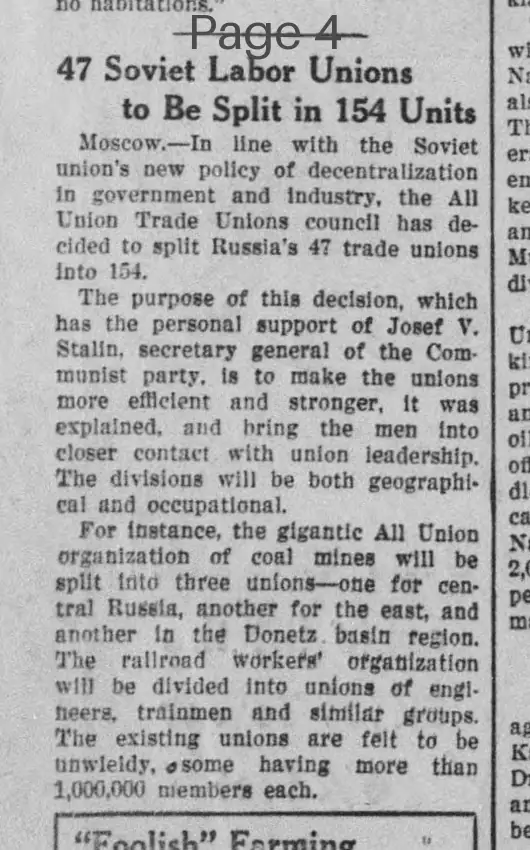
Moscow.—In line with the Soviet union's new policy of decentralization in government and industry, the All Union Trade Unions council has decided to split Russia's 47 trade unions into 154.
The purpose of this decision, which has the personal support of Josef V. Stalin, secretary general of the Communist party, is to make the unions more efficient and stronger, it was explained, and bring the men into closer contact with union leadership.
The divisions will be both geographical and occupational. For instance, the gigantic All Union organization of coal mines will be split into three unions—one for central Russia, another for the east, and another in the Donetz basin region.
The railroad workers' organization will be divided into unions of engineers, trainmen and similar groups.
The existing unions are felt to be unwieldy, some having more than 1,000,000 members each.
What sub-type of article is it?
What keywords are associated?
What entities or persons were involved?
Where did it happen?
Foreign News Details
Primary Location
Moscow
Key Persons
Outcome
split of 47 trade unions into 154 units to enhance efficiency and strengthen unions through geographical and occupational divisions.
Event Details
The All Union Trade Unions council decides to divide Russia's 47 trade unions into 154 as part of decentralization policy in government and industry, with personal support from Josef V. Stalin. Purpose is to make unions more efficient, stronger, and bring members closer to leadership. Examples include splitting coal miners' union into three regional ones and railroad workers into occupational groups like engineers and trainmen. Existing unions seen as unwieldy with over 1,000,000 members each.