Thank you for visiting SNEWPapers!
Sign up free
The New Hampshire Gazette And General Advertiser
Portsmouth, Rockingham County, New Hampshire
What is this article about?
In the South Carolina House of Representatives on October 21, a message from the Governor included a French vice-consul's letter offering options to settle a $39,040 public debt, referred to committee. A British consul's complaint about the valuation bill violating the treaty of peace was debated and laid on the table after objections from Major Butler, Dr. Ramsay, Mr. Bee, Mr. Pinkney, and Chancellor Rutledge.
Clipping
OCR Quality
Full Text
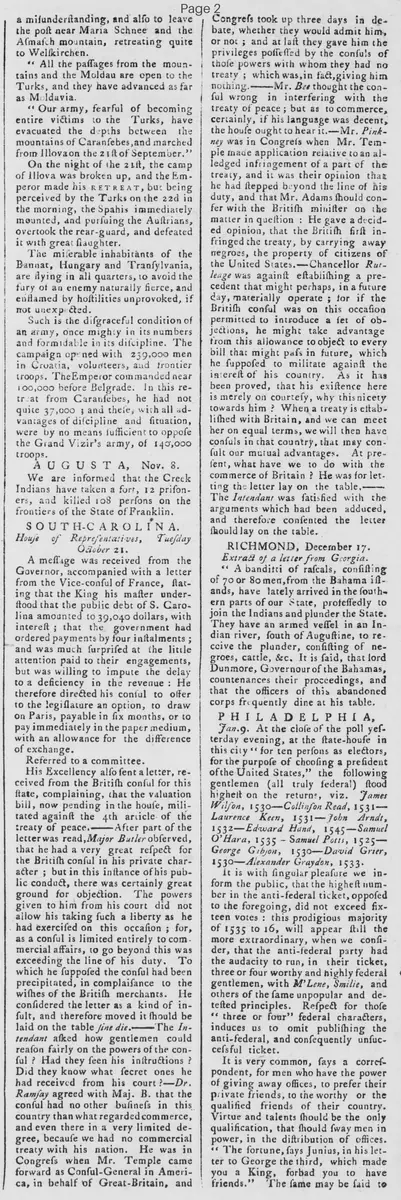
House of Representatives, Tuesday, October 21.
A message was received from the Governor, accompanied with a letter from the Vice-consul of France, stating that the King his master understood that the public debt of S. Carolina amounted to 39,040 dollars, with interest; that the government had ordered payments by four instalments; and was much surprised at the little attention paid to their engagements, but was willing to impute the delay to a deficiency in the revenue: He therefore directed his consul to offer to the legislature an option, to draw on Paris, payable in six months, or to pay immediately in the paper medium, with an allowance for the difference of exchange.
Referred to a committee.
His Excellency also sent a letter, received from the British consul for this state, complaining, that the valuation bill, now pending in the house, militated against the 4th article of the treaty of peace.--After part of the letter was read, Major Butler observed, that he had a very great respect for the British consul in his private character; but in this instance of his public conduct, there was certainly great ground for objection. The powers given to him from his court did not allow his taking such a liberty as he had exercised on this occasion; for, as a consul is limited entirely to commercial affairs, to go beyond this was exceeding the line of his duty. To which he supposed the consul had been precipitated, in complaisance to the wishes of the British merchants. He considered the letter as a kind of insult, and therefore moved it should be laid on the table sine die.--The Intendant asked how gentlemen could reason fairly on the powers of the consul? Had they seen his instructions? Did they know what secret ones he had received from his court?--Dr. Ramsay agreed with Maj. B. that the consul had no other business in this country than what regarded commerce, and even there in a very limited degree, because we had no commercial treaty with his nation. He was in Congress when Mr. Temple came forward as Consul-General in America, in behalf of Great-Britain, and Congress took up three days in debate, whether they would admit him, or not; and at last they gave him the privileges possessed by the consuls of those powers with whom they had no treaty; which was, in fact, giving him nothing.--Mr. Bee thought the consul wrong in interfering with the treaty of peace; but as to commerce, certainly, if his language was decent, the house ought to hear it.--Mr. Pinkney was in Congress when Mr. Temple made application relative to an alleged infringement of a part of the treaty, and it was their opinion that he had stepped beyond the line of his duty, and that Mr. Adams should confer with the British minister on the matter in question: He gave a decided opinion, that the British first infringed the treaty, by carrying away negroes, the property of citizens of the United States.--Chancellor Rutledge was against establishing a precedent that might perhaps, in a future day, materially operate; for if the British consul was on this occasion permitted to introduce a set of objections, he might take advantage from this allowance to object to every bill that might pass in future, which he supposed to militate against the interest of his country. As it has been proved, that his existence here is merely on courtesy, why this nicety towards him? When a treaty is established with Britain, and we can meet her on equal terms, we will then have consuls in that country, that may consult our mutual advantages. At present, what have we to do with the commerce of Britain? He was for letting the letter lay on the table,--The Intendant was satisfied with the arguments which had been adduced, and therefore consented the letter should lay on the table.
What sub-type of article is it?
What keywords are associated?
What entities or persons were involved?
Where did it happen?
Domestic News Details
Primary Location
South Carolina
Event Date
Tuesday, October 21
Key Persons
Outcome
french debt letter referred to committee; british consul's letter laid on the table sine die.
Event Details
The House received a Governor's message with a French vice-consul's letter on settling South Carolina's 39,040 dollar debt to France via Paris draft or paper medium. Separately, a British consul's letter complained the pending valuation bill violated the treaty of peace; after debate on the consul's overreach, it was tabled.