Thank you for visiting SNEWPapers!
Sign up free
Editorial
January 13, 1826
Kentucky Gazette
Lexington, Fayette County, Kentucky
What is this article about?
Appeal by Kentucky legislators to the people urging compromise in the Court of Appeals reorganization crisis. They criticize old judges' refusal to resign, detail failed negotiations, legislative outrages, and minor reforms passed, calling for peace and balanced judiciary.
Clipping
OCR Quality
95%
Excellent
Full Text
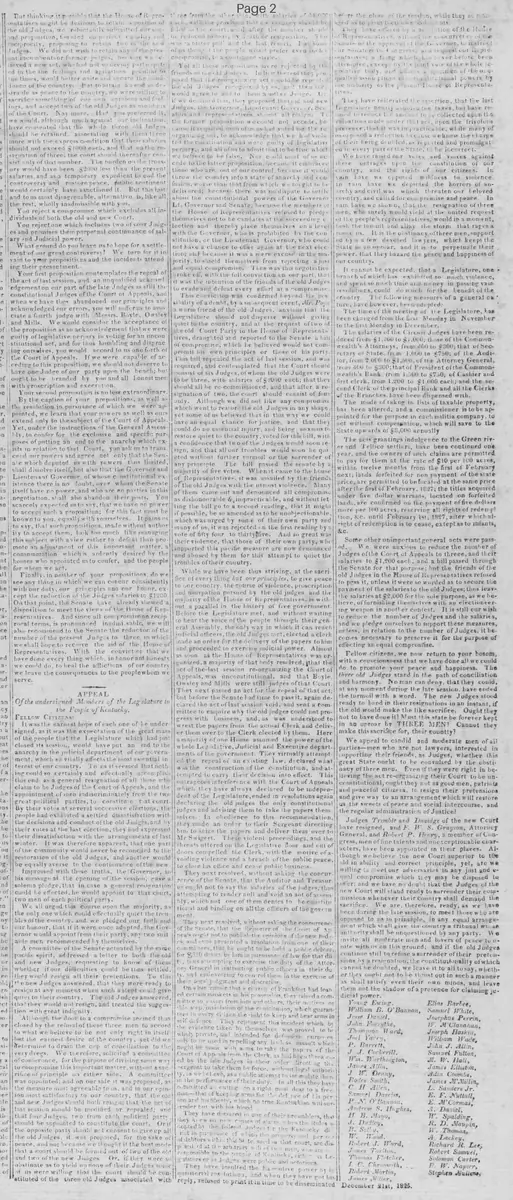
APPEAL
Of the undersigned Members of the Legislature to the People of Kentucky.
It was the earnest hope of each one of the undersigned, as it was the expectation of the great mass of the people that the Legislature which had just closed its session, would have put an end to the anarchy in the judicial department of our government, which so vitally affects the most essential interests of our country. To us it seemed that nothing could so certainly and effectually accomplish this end, as a general resignation of all those who claim to be Judges of the Court of Appeals, and the appointment of men indiscriminately from the two great political parties, to constitute that court.
By their votes at several successive elections, the people had exhibited a settled dissatisfaction with the decisions and conduct of the old Judges, and by their votes at the last election, they had expressed their dissatisfaction with the arrangements of last winter. It was therefore apparent, that one part of the community would never be reconciled to the restoration of the old Judges, and another would be equally averse to the continuance of the new.
Impressed with these truths, the Governor, in his message at the opening of the session, gave a solemn pledge, that in case a general resignation could be effected, he would appoint to that court, two men of each political party.
We all urged this course upon the majority, as the only one which could effectually quiet the troubles of the country, and we pledged our faith and our honour, that if it were once adopted, the Governor would appoint from their party, any two suitable men recommended by themselves.
A committee of the Senate actuated by the same pacific spirit, addressed a letter to both the old and new Judges, requesting to know of them whether if our difficulties could be thus settled, they would resign all their pretensions. To this the new Judges answered, that they were ready to resign at any moment when such a step could give quiet to their country. The old Judges answered, that they would not resign, and treated the suggestion with great indignity.
Although the door to a compromise seemed thus closed by the refusal of these three men to accord to what we believe to be not only right in itself but the earnest desire of the country, yet did we determine to drain the cup of conciliation to the very dregs. We therefore, solicited a committee of conference, for the purpose of devising some way to compromise this important matter, without sacrifice of principle on either side. A committee was appointed, and on our side it was proposed, as the measure most agreeable to us, and in our opinion most satisfactory to our country, that the old and new Judges should both resign; that the act of last session should be modified or repealed; and that four Judges two from each political party, should be appointed to constitute the court. Or if the opposite party should not consent to give up all the old Judges, it was proposed, for the sake of peace, and not because we thought it the best mode that a court should be formed out of two of the old and two of the new Judges. Or, if they were so obstinate as to yield none of their Judges some of us were willing that the court should be constituted of the three old Judges associated with three from the other side, with salaries reduced to $1000 each, with the provision that on vacancy shall be filled in the court, and after the number shall be reduced to four, the other resignation. This was a bitter pill and the last resort. But some of us thought the people would prefer even such a compromise, to a continued rule.
Yet all these propositions were rejected by the friends of the old Judges. In lieu thereof they proposed that the reorganizing act should be repealed the old Judges recognized by us, and then we would agree to add to them a fourth Judge. Or if we declined this, they proposed that old and new Judges, the Governor, Lieutenant Governor, Senators and representatives should all resign. In the former proposition we could not accede, because it required such of us as had voted for the reorganizing act, to acknowledge that we had violated the constitution and were guilty of legislative perjury, and all of us to admit that to be true which we believe to be false. Nor could most of us accede to the latter proposition, because it embraced those who are out of our control because it would throw the country into a state of anarchy and confusion, worse than that from which we sought to be delivered; because there was no dispute to settle about the constitutional powers of the Governor Lt. Governor and Senate, because the members of the House of Representatives refused to pledge themselves not to be candidates at the succeeding election and thereby place themselves on a level with the Governor, who is prohibited by the constitution, or the Lieutenant Governor, who could not have a chance to offer again at the next election; and because it was a mere excuse in the majority, to shield themselves from rejecting a just and equal compromise. Thus was this negotiation broke off, with the full conviction on our part, that it was the intention of the friends of the old Judges to evade and defeat every effort at a compromise.
This conviction was confirmed beyond the possibility of a doubt, by a subsequent event, Mr. Pope a warm friend of the old Judges, anxious that the Legislature should not disperse without giving quiet to the country, and at the request of two of the old Court Party in the House of Representatives, draughted and reported to the Senate a bill of compromise, which he believed would not compromise his own principles or those of his party.
This bill repealed the act of last session, and was required, and contemplated that the Court should consist of six Judges, of whom the old Judges were to be three, with salaries of $1000 each; that they should all be re-commissioned, and that after a resignation of two, the court should consist of four only. Although we did not like any compromise which went to restore the old Judges in any shape, yet some of us believed that in this way we could have an equal chance for justice, and that they could do no essential injury, and being anxious to restore quiet to the country, voted for this bill, with a confidence that two of the Judges would soon resign, and that all our troubles would soon be quieted without further turmoil or the surrender of any principle. The bill passed the senate by a majority of five votes. When it came to the House of Representatives, it was assailed by the friends of the old Judges with the utmost violence. Many of them came out and denounced all compromise as dishonourable & impracticable, and without letting the bill go to a second reading, that it might if possible, be so amended as to be unobjectionable, which was urged by some of their own party and many of us, it was rejected on the first reading by a vote of fifty four to thirty five. And so great was their violence, that those of their own party, who supported this pacific measure are now denounced and abused by them for this attempt to quiet the troubles of their country.
While we have been thus striving, at the sacrifice of every thing but our principles, to give peace to our country, the course of violence, proscription and usurpation pursued by the old judges and the majority of the House of Representatives, is without a parallel in the history of free government.
Before the Legislature met, and without waiting to hear the voice of the people through their general Assembly, the only way in which it can reach judicial officers, the old Judges met, elected a clerk made an order for the delivery of the papers to him and proceeded to exercise judicial power. Almost as soon as the House of Representatives was organized, a majority of that body resolved, that the act of the last session re-organizing the Court of Appeals, was unconstitutional, and that Boyle. Owsley and Mills were still judges of that Court.
They next passed an act for the repeal of that act; but before the Senate had time to pass it, again declared the act of last session void, and sent a committee to enquire why the old judges could not progress with business, and, as was understood to wrest the papers from the actual Clerk and deliver them over to the Clerk elected by them. Here a majority of one House assumed the power of the whole Legislative, Judicial and Executive departments of the government. They virtually attempted the repeal of an existing law, declared what was the construction of the constitution, and attempted to carry their decision into effect. This outrageous interference with the Court of Appeals which they have always declared to be independent of the Legislature, ended in resolutions again declaring the old judges the only constitutional judges and advising them to take the papers themselves. In obedience to this recommendation, they made an order to their Sergeant directing him to seize the papers and deliver them over to Mr Swigert. These violent proceedings, and the threats uttered on the Legislative floor and out of doors compelled the Clerk, with the motive of avoiding violence and a breach of the public peace, to close his office and cease public business.
They next resolved, without asking the concurrence of the Senate, that the Auditor and Treasurer ought not to pay the salaries of the judges, thus attempting to render null and void an act of assembly, which not one of them denies to be constitutional and binding on all the officers of the government.
They next resolved, without asking the concurrence of the Senate, that the Reporter of The Court of Appeals ought not to publish the opinions of the new Judges and even presented a resolution from one of their committees, that he ought to be held a public debtor, for $500 drawn by him in pursuance of law for that duty, thus attempting to exercise the duty of the Attorney General in instructing public officers in their duty. and endeavoring to control them in the exercise of their legal judgment and discretion.
On another occasion that a citizen of Frankfort had loaned certain muskets in his possession, they raised a committee to extort from him and others, their motives or his step, in violation of the constitution, which guarantees to every citizen the right to keep and bear arms in self defence. They represent this incident which by the evidence taken by themselves was proved to be wholly private, and intended for defensive purposes only to be used in repelling any lawless assault which might be made with a view to take the papers of the Court of Appeals from the Clerk, as had been threatened by the late Judges in their order directing the Sergeant to take them by force, without legal authority, is incredible, as a public attempt to intimidate them in. the performance of their duty. In all this they have committed a outrage on a right most dear to a free man-that of keeping arms for the defence of his person and his liberty, which no true Kentuckian will surrender but with his blood.
They have declared in one of their preambles, that they see no necessity of a law on the subject of the Rules adopted by the federal judges for the Kentucky district in pursuance of which the property and persons of debtors within this State sued in that court, are disposed of at the arbitrary will of two men, who are responsible to the people of Kentucky, either as Legislators or as Judges were public and notorious.
They have insulted the Executive power by inquisitorial resolutions, and when they have got his reply, refused to print it in time to be disseminated among the people as to print the one committee acts.
They have ordered by a resolution of the House of Representatives, silent concurrence of the Senate or the approval the Governor, to instruct our members to Congress and request our representatives; a thing which has never before been attempted, except by joint vote of the whole legislative body. and affords a specimen of the unequalled assumption of constitutional powers by the majority of the present House of Representatives.
They have reiterated the assertion, that the last Legislature nearly doubled the taxes, but have refused to reduce the amount to be collected upon the valuations made under that act, upon the frivolous pretence, that it was impracticable, while many of us opposed are desirous because we knew the charge of their being doubled, as repeated and promulgated in every part of the State, to be incorrect.
We have raised our voices and voices against these outrages upon the constitution of our country, and the rights of our citizens. In vain have we opposed mildness to violence. In vain have we depicted the horrors of anarchy and civil war which threaten our beloved country, and called for compromise and peace. In vain have we shown, that the resignation of three men, who surely would yield at the united request of the people's representatives, would in a moment, hush, the tumult and allay the storm that rages around us. It is the obstinacy of three men, supported by a few devoted lawyers, which keeps the State in an uproar. and it is to perpetuate their power, that they hazard the peace and happiness of our country.
It cannot be expected, that a Legislature, one branch of which has exhibited so much violence, and spent so much time and money in passing vain resolutions, could do much for the benefit of the country. The following measures of a general nature, have however, been adopted:
The time of the meeting of the Legislature, has been changed from the 1st Monday in November to the first Monday in December.
The salaries of the Circuit Judges have been reduced from $1,200 to $1,000; those of the Commonwealth's Attorneys, from $600 to $300; that of Secretary of State, from $1,000 to $750; of the Auditor, from $2,000 to $1,500, of the Attorney General, from $400 to $300; that of President of the Commonwealth's Bank from $1,500 to $750; of Cashier and first clerk, from $1,200 to $1,000 each; and the second Clerk of the principal Bank and all the Clerks of the Branches, have been dispensed with.
The mode of taking in lists of taxable property, has been altered, and a commissioner is to be appointed for the purpose in each militia company, to act without compensation, which will save to the State upwards of $8,000 annually.
The acts granting indulgence to the Green river and Tellico settlers, have been continued one year, and the owners of such claims are permitted to pay for them at the rate of $10 per 100 acres, within twelve months from the first of February next; lands forfeited for non payment of the state price, are permitted to be relocated at the same price after the first of February, 1827; the titles acquired under five dollar warrants, located on forfeited lands, are confirmed on the payment of five dollars more per 100 acres, reserving all rights of redemption, &c. until February 1st, 1827, after which all right of redemption is to cease, except as to infants, &c.
Some other unimportant general acts were passed. We were anxious to reduce the number of Judges of the Court of Appeals to three, and their salaries to $1,200 each, and a bill passed through the Senate for that purpose; but the friends of the old Judges in the House of Representatives refused to pass it, unless it were so worded as to secure the payment of the salaries to the old Judges; thus leaving the salaries at $2,000 for the sole purpose, as we believe, of furnishing themselves with an electioneering weapon in another contest. It is still our wish to reduce the number of Judges and the salaries, and we pledge ourselves to support these measures, unless, in relation to the number of Judges, it becomes necessary to preserve it for the purpose of effecting an equal compromise.
Fellow citizens, we now return to your bosom, with a consciousness that we have done all we could do to promote your peace and happiness. The three old Judges stand in the path of conciliation and harmony. No man can deny, that they could, at any moment during the late session, have ended the turmoil with a word. The new Judges stood ready to hand in their resignations in an instant, if the old would make the like sacrifice. Ought they not to have done it? Must this state be forever kept in an uproar by THREE MEN? Cannot they make this sacrifice for their country?
We appeal to candid and moderate men of all parties-men who are not lawyers, interested in supporting their friends, as Judges, whether this great State ought to be convulsed by the obstinacy of three men. Even if they were right in believing the act re-organizing their Court to be unconstitutional, ought they not as good men, patriots and peaceful citizens, to resign their pretensions and give way to an arrangement which will restore us the sweets of peace and social intercourse, and the regular administration of Justice?
Judges Trimble and Davidge of the new Court have resigned, and F. W. S. Grayson, Attorney General, and Robert P. Henry, a member of Congress, men of fine talents and unexceptionable characters, have been appointed in their places. Although we believe the new Court superior to the old in ability and correct principle, yet, are we willing to meet our adversaries in any just and equal compromise which they may be disposed to offer; and we have no doubt that the Judges of the new Court will stand ready to surrender their commissions whenever their country shall demand the sacrifice. We are, therefore, ready, as we have been during the late session, to meet those who are opposed to us in principle, in any equal arrangement which shall give the country a tribunal whose authority shall be unquestioned by any party. We invite all moderate men and lovers of peace to unite with us on this ground; and if the old Judges continue still to refuse a surrender of their pretensions by a resignation, the constitutionality of which cannot be doubted, we leave it to all to say, whether they ought not to be thrust out in such a manner as shall satisfy even their own minds, and leave them not the shadow of a pretence for claiming judicial power.
Young Ewing.
Elias Barbee,
William B. O'Bannon
Samuel White,
Jesse Daniel,
Josephus Perrin,
John Forsythe,
W. M'Clanahan,
Thompson Ward,
Joseph Haskin,
Joel Yancy,
William Wade,
P. Barrett,
John J. Allin,
J. J. Cockerill.
Samuel Fulton,
Wm. Worthington,
M. W. Hall,
James Allin,
James Elliston,
J W. Berry,
Adin Coombs,
Rodes Smith,
James M'Millin
C. H. Allen,
L. Sanders Jr.
Samuel Darniss,
E. F. Nuttall,
P. N. O'Bannon,
E. M'Cormack,
Andrew S. Hughes,
A. Daniel,
H B. Mayo,
W. Spalding,
J. Dudley,
R. D. Maupin,
B. Self,
W. Thomas,
W. Wood,
A. Lackey,
Robert J. Ward,
Richard R. Lee
James Tarlton,
Robert Samuel,
Thomas Fletcher,
Solomon Carter
L. C. Chenoweth,
B. W. Naper,
Robert Martin,
Stephen Mullens,
James Miller,
Of the undersigned Members of the Legislature to the People of Kentucky.
It was the earnest hope of each one of the undersigned, as it was the expectation of the great mass of the people that the Legislature which had just closed its session, would have put an end to the anarchy in the judicial department of our government, which so vitally affects the most essential interests of our country. To us it seemed that nothing could so certainly and effectually accomplish this end, as a general resignation of all those who claim to be Judges of the Court of Appeals, and the appointment of men indiscriminately from the two great political parties, to constitute that court.
By their votes at several successive elections, the people had exhibited a settled dissatisfaction with the decisions and conduct of the old Judges, and by their votes at the last election, they had expressed their dissatisfaction with the arrangements of last winter. It was therefore apparent, that one part of the community would never be reconciled to the restoration of the old Judges, and another would be equally averse to the continuance of the new.
Impressed with these truths, the Governor, in his message at the opening of the session, gave a solemn pledge, that in case a general resignation could be effected, he would appoint to that court, two men of each political party.
We all urged this course upon the majority, as the only one which could effectually quiet the troubles of the country, and we pledged our faith and our honour, that if it were once adopted, the Governor would appoint from their party, any two suitable men recommended by themselves.
A committee of the Senate actuated by the same pacific spirit, addressed a letter to both the old and new Judges, requesting to know of them whether if our difficulties could be thus settled, they would resign all their pretensions. To this the new Judges answered, that they were ready to resign at any moment when such a step could give quiet to their country. The old Judges answered, that they would not resign, and treated the suggestion with great indignity.
Although the door to a compromise seemed thus closed by the refusal of these three men to accord to what we believe to be not only right in itself but the earnest desire of the country, yet did we determine to drain the cup of conciliation to the very dregs. We therefore, solicited a committee of conference, for the purpose of devising some way to compromise this important matter, without sacrifice of principle on either side. A committee was appointed, and on our side it was proposed, as the measure most agreeable to us, and in our opinion most satisfactory to our country, that the old and new Judges should both resign; that the act of last session should be modified or repealed; and that four Judges two from each political party, should be appointed to constitute the court. Or if the opposite party should not consent to give up all the old Judges, it was proposed, for the sake of peace, and not because we thought it the best mode that a court should be formed out of two of the old and two of the new Judges. Or, if they were so obstinate as to yield none of their Judges some of us were willing that the court should be constituted of the three old Judges associated with three from the other side, with salaries reduced to $1000 each, with the provision that on vacancy shall be filled in the court, and after the number shall be reduced to four, the other resignation. This was a bitter pill and the last resort. But some of us thought the people would prefer even such a compromise, to a continued rule.
Yet all these propositions were rejected by the friends of the old Judges. In lieu thereof they proposed that the reorganizing act should be repealed the old Judges recognized by us, and then we would agree to add to them a fourth Judge. Or if we declined this, they proposed that old and new Judges, the Governor, Lieutenant Governor, Senators and representatives should all resign. In the former proposition we could not accede, because it required such of us as had voted for the reorganizing act, to acknowledge that we had violated the constitution and were guilty of legislative perjury, and all of us to admit that to be true which we believe to be false. Nor could most of us accede to the latter proposition, because it embraced those who are out of our control because it would throw the country into a state of anarchy and confusion, worse than that from which we sought to be delivered; because there was no dispute to settle about the constitutional powers of the Governor Lt. Governor and Senate, because the members of the House of Representatives refused to pledge themselves not to be candidates at the succeeding election and thereby place themselves on a level with the Governor, who is prohibited by the constitution, or the Lieutenant Governor, who could not have a chance to offer again at the next election; and because it was a mere excuse in the majority, to shield themselves from rejecting a just and equal compromise. Thus was this negotiation broke off, with the full conviction on our part, that it was the intention of the friends of the old Judges to evade and defeat every effort at a compromise.
This conviction was confirmed beyond the possibility of a doubt, by a subsequent event, Mr. Pope a warm friend of the old Judges, anxious that the Legislature should not disperse without giving quiet to the country, and at the request of two of the old Court Party in the House of Representatives, draughted and reported to the Senate a bill of compromise, which he believed would not compromise his own principles or those of his party.
This bill repealed the act of last session, and was required, and contemplated that the Court should consist of six Judges, of whom the old Judges were to be three, with salaries of $1000 each; that they should all be re-commissioned, and that after a resignation of two, the court should consist of four only. Although we did not like any compromise which went to restore the old Judges in any shape, yet some of us believed that in this way we could have an equal chance for justice, and that they could do no essential injury, and being anxious to restore quiet to the country, voted for this bill, with a confidence that two of the Judges would soon resign, and that all our troubles would soon be quieted without further turmoil or the surrender of any principle. The bill passed the senate by a majority of five votes. When it came to the House of Representatives, it was assailed by the friends of the old Judges with the utmost violence. Many of them came out and denounced all compromise as dishonourable & impracticable, and without letting the bill go to a second reading, that it might if possible, be so amended as to be unobjectionable, which was urged by some of their own party and many of us, it was rejected on the first reading by a vote of fifty four to thirty five. And so great was their violence, that those of their own party, who supported this pacific measure are now denounced and abused by them for this attempt to quiet the troubles of their country.
While we have been thus striving, at the sacrifice of every thing but our principles, to give peace to our country, the course of violence, proscription and usurpation pursued by the old judges and the majority of the House of Representatives, is without a parallel in the history of free government.
Before the Legislature met, and without waiting to hear the voice of the people through their general Assembly, the only way in which it can reach judicial officers, the old Judges met, elected a clerk made an order for the delivery of the papers to him and proceeded to exercise judicial power. Almost as soon as the House of Representatives was organized, a majority of that body resolved, that the act of the last session re-organizing the Court of Appeals, was unconstitutional, and that Boyle. Owsley and Mills were still judges of that Court.
They next passed an act for the repeal of that act; but before the Senate had time to pass it, again declared the act of last session void, and sent a committee to enquire why the old judges could not progress with business, and, as was understood to wrest the papers from the actual Clerk and deliver them over to the Clerk elected by them. Here a majority of one House assumed the power of the whole Legislative, Judicial and Executive departments of the government. They virtually attempted the repeal of an existing law, declared what was the construction of the constitution, and attempted to carry their decision into effect. This outrageous interference with the Court of Appeals which they have always declared to be independent of the Legislature, ended in resolutions again declaring the old judges the only constitutional judges and advising them to take the papers themselves. In obedience to this recommendation, they made an order to their Sergeant directing him to seize the papers and deliver them over to Mr Swigert. These violent proceedings, and the threats uttered on the Legislative floor and out of doors compelled the Clerk, with the motive of avoiding violence and a breach of the public peace, to close his office and cease public business.
They next resolved, without asking the concurrence of the Senate, that the Auditor and Treasurer ought not to pay the salaries of the judges, thus attempting to render null and void an act of assembly, which not one of them denies to be constitutional and binding on all the officers of the government.
They next resolved, without asking the concurrence of the Senate, that the Reporter of The Court of Appeals ought not to publish the opinions of the new Judges and even presented a resolution from one of their committees, that he ought to be held a public debtor, for $500 drawn by him in pursuance of law for that duty, thus attempting to exercise the duty of the Attorney General in instructing public officers in their duty. and endeavoring to control them in the exercise of their legal judgment and discretion.
On another occasion that a citizen of Frankfort had loaned certain muskets in his possession, they raised a committee to extort from him and others, their motives or his step, in violation of the constitution, which guarantees to every citizen the right to keep and bear arms in self defence. They represent this incident which by the evidence taken by themselves was proved to be wholly private, and intended for defensive purposes only to be used in repelling any lawless assault which might be made with a view to take the papers of the Court of Appeals from the Clerk, as had been threatened by the late Judges in their order directing the Sergeant to take them by force, without legal authority, is incredible, as a public attempt to intimidate them in. the performance of their duty. In all this they have committed a outrage on a right most dear to a free man-that of keeping arms for the defence of his person and his liberty, which no true Kentuckian will surrender but with his blood.
They have declared in one of their preambles, that they see no necessity of a law on the subject of the Rules adopted by the federal judges for the Kentucky district in pursuance of which the property and persons of debtors within this State sued in that court, are disposed of at the arbitrary will of two men, who are responsible to the people of Kentucky, either as Legislators or as Judges were public and notorious.
They have insulted the Executive power by inquisitorial resolutions, and when they have got his reply, refused to print it in time to be disseminated among the people as to print the one committee acts.
They have ordered by a resolution of the House of Representatives, silent concurrence of the Senate or the approval the Governor, to instruct our members to Congress and request our representatives; a thing which has never before been attempted, except by joint vote of the whole legislative body. and affords a specimen of the unequalled assumption of constitutional powers by the majority of the present House of Representatives.
They have reiterated the assertion, that the last Legislature nearly doubled the taxes, but have refused to reduce the amount to be collected upon the valuations made under that act, upon the frivolous pretence, that it was impracticable, while many of us opposed are desirous because we knew the charge of their being doubled, as repeated and promulgated in every part of the State, to be incorrect.
We have raised our voices and voices against these outrages upon the constitution of our country, and the rights of our citizens. In vain have we opposed mildness to violence. In vain have we depicted the horrors of anarchy and civil war which threaten our beloved country, and called for compromise and peace. In vain have we shown, that the resignation of three men, who surely would yield at the united request of the people's representatives, would in a moment, hush, the tumult and allay the storm that rages around us. It is the obstinacy of three men, supported by a few devoted lawyers, which keeps the State in an uproar. and it is to perpetuate their power, that they hazard the peace and happiness of our country.
It cannot be expected, that a Legislature, one branch of which has exhibited so much violence, and spent so much time and money in passing vain resolutions, could do much for the benefit of the country. The following measures of a general nature, have however, been adopted:
The time of the meeting of the Legislature, has been changed from the 1st Monday in November to the first Monday in December.
The salaries of the Circuit Judges have been reduced from $1,200 to $1,000; those of the Commonwealth's Attorneys, from $600 to $300; that of Secretary of State, from $1,000 to $750; of the Auditor, from $2,000 to $1,500, of the Attorney General, from $400 to $300; that of President of the Commonwealth's Bank from $1,500 to $750; of Cashier and first clerk, from $1,200 to $1,000 each; and the second Clerk of the principal Bank and all the Clerks of the Branches, have been dispensed with.
The mode of taking in lists of taxable property, has been altered, and a commissioner is to be appointed for the purpose in each militia company, to act without compensation, which will save to the State upwards of $8,000 annually.
The acts granting indulgence to the Green river and Tellico settlers, have been continued one year, and the owners of such claims are permitted to pay for them at the rate of $10 per 100 acres, within twelve months from the first of February next; lands forfeited for non payment of the state price, are permitted to be relocated at the same price after the first of February, 1827; the titles acquired under five dollar warrants, located on forfeited lands, are confirmed on the payment of five dollars more per 100 acres, reserving all rights of redemption, &c. until February 1st, 1827, after which all right of redemption is to cease, except as to infants, &c.
Some other unimportant general acts were passed. We were anxious to reduce the number of Judges of the Court of Appeals to three, and their salaries to $1,200 each, and a bill passed through the Senate for that purpose; but the friends of the old Judges in the House of Representatives refused to pass it, unless it were so worded as to secure the payment of the salaries to the old Judges; thus leaving the salaries at $2,000 for the sole purpose, as we believe, of furnishing themselves with an electioneering weapon in another contest. It is still our wish to reduce the number of Judges and the salaries, and we pledge ourselves to support these measures, unless, in relation to the number of Judges, it becomes necessary to preserve it for the purpose of effecting an equal compromise.
Fellow citizens, we now return to your bosom, with a consciousness that we have done all we could do to promote your peace and happiness. The three old Judges stand in the path of conciliation and harmony. No man can deny, that they could, at any moment during the late session, have ended the turmoil with a word. The new Judges stood ready to hand in their resignations in an instant, if the old would make the like sacrifice. Ought they not to have done it? Must this state be forever kept in an uproar by THREE MEN? Cannot they make this sacrifice for their country?
We appeal to candid and moderate men of all parties-men who are not lawyers, interested in supporting their friends, as Judges, whether this great State ought to be convulsed by the obstinacy of three men. Even if they were right in believing the act re-organizing their Court to be unconstitutional, ought they not as good men, patriots and peaceful citizens, to resign their pretensions and give way to an arrangement which will restore us the sweets of peace and social intercourse, and the regular administration of Justice?
Judges Trimble and Davidge of the new Court have resigned, and F. W. S. Grayson, Attorney General, and Robert P. Henry, a member of Congress, men of fine talents and unexceptionable characters, have been appointed in their places. Although we believe the new Court superior to the old in ability and correct principle, yet, are we willing to meet our adversaries in any just and equal compromise which they may be disposed to offer; and we have no doubt that the Judges of the new Court will stand ready to surrender their commissions whenever their country shall demand the sacrifice. We are, therefore, ready, as we have been during the late session, to meet those who are opposed to us in principle, in any equal arrangement which shall give the country a tribunal whose authority shall be unquestioned by any party. We invite all moderate men and lovers of peace to unite with us on this ground; and if the old Judges continue still to refuse a surrender of their pretensions by a resignation, the constitutionality of which cannot be doubted, we leave it to all to say, whether they ought not to be thrust out in such a manner as shall satisfy even their own minds, and leave them not the shadow of a pretence for claiming judicial power.
Young Ewing.
Elias Barbee,
William B. O'Bannon
Samuel White,
Jesse Daniel,
Josephus Perrin,
John Forsythe,
W. M'Clanahan,
Thompson Ward,
Joseph Haskin,
Joel Yancy,
William Wade,
P. Barrett,
John J. Allin,
J. J. Cockerill.
Samuel Fulton,
Wm. Worthington,
M. W. Hall,
James Allin,
James Elliston,
J W. Berry,
Adin Coombs,
Rodes Smith,
James M'Millin
C. H. Allen,
L. Sanders Jr.
Samuel Darniss,
E. F. Nuttall,
P. N. O'Bannon,
E. M'Cormack,
Andrew S. Hughes,
A. Daniel,
H B. Mayo,
W. Spalding,
J. Dudley,
R. D. Maupin,
B. Self,
W. Thomas,
W. Wood,
A. Lackey,
Robert J. Ward,
Richard R. Lee
James Tarlton,
Robert Samuel,
Thomas Fletcher,
Solomon Carter
L. C. Chenoweth,
B. W. Naper,
Robert Martin,
Stephen Mullens,
James Miller,
What sub-type of article is it?
Legal Reform
Partisan Politics
Constitutional
What keywords are associated?
Kentucky Judiciary
Court Of Appeals
Judicial Compromise
Old Judges
New Judges
Political Parties
Legislative Crisis
Constitutional Violation
What entities or persons were involved?
Old Judges (Boyle, Owsley, Mills)
New Judges (Trimble, Davidge)
Governor
Mr. Pope
Young Ewing
Kentucky Legislature
House Of Representatives
Editorial Details
Primary Topic
Compromise On Kentucky Court Of Appeals Reorganization
Stance / Tone
Advocating Compromise And Criticizing Old Judges' Obstinacy
Key Figures
Old Judges (Boyle, Owsley, Mills)
New Judges (Trimble, Davidge)
Governor
Mr. Pope
Young Ewing
Kentucky Legislature
House Of Representatives
Key Arguments
People Dissatisfied With Old Judges' Decisions
Governor Pledged Balanced Appointments Upon Resignations
New Judges Willing To Resign For Peace
Old Judges Refused Resignation And Treated Suggestions With Indignity
Multiple Compromise Proposals Rejected By Old Judges' Supporters
Legislative Actions By House Majority Usurp Other Branches' Powers
Minor Reforms Passed Including Salary Reductions And Land Indulgences
Appeal For Old Judges To Resign To End Turmoil