Thank you for visiting SNEWPapers!
Sign up free
Editorial
November 2, 1804
The National Intelligencer And Washington Advertiser
Washington, District Of Columbia
What is this article about?
Editorial defends new 1804 import duties for protecting Mediterranean trade, arguing they are more efficient and equitable than reinstating 1801-abolished internal taxes. Emphasizes avoiding permanent taxes without fixed purposes, lower collection costs, and that duties tax luxury, benefiting the poor.
Clipping
OCR Quality
95%
Excellent
Full Text
FOR THE NATIONAL INTELLIGENCER.
TO THE PEOPLE.
THE DEFENCE:
No. XIII.
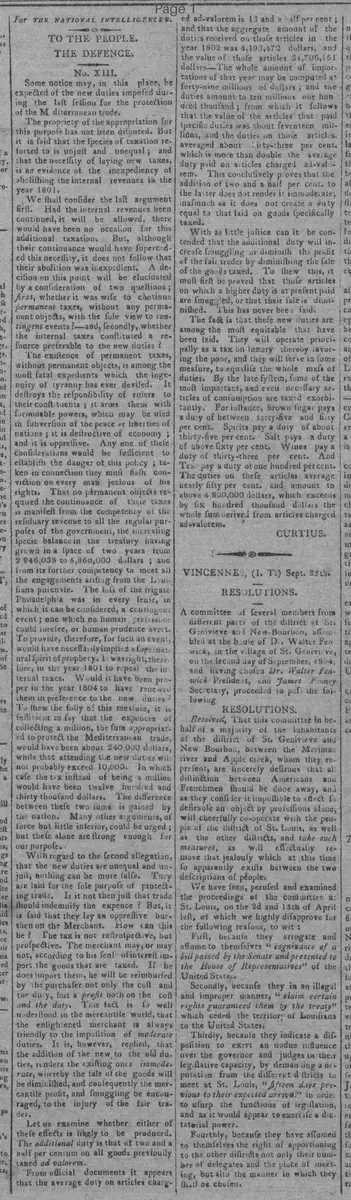
Some notice may, in this place, be expected of the new duties imposed during the last session for the protection of the Mediterranean trade.
The propriety of the appropriation for this purpose has not been disputed. But it is said that the species of taxation resorted to is unjust and unequal; and that the necessity of laying new taxes, is an evidence of the inexpediency of abolishing the internal revenues in the year 1801.
We shall consider the last argument first. Had the internal revenues been continued, it will be allowed, there would have been no occasion for this additional taxation. But, although their continuance would have superseded this necessity. it does not follow that their abolition was inexpedient. A decision on this point will be elucidated by a consideration of two questions; first, whether it was wise to continue permanent taxes, without any permanent objects, with the sole view to contingent events? and, secondly, whether the internal taxes constituted a resource preferable to the new duties?
The existence of permanent taxes, without permanent objects, is among the most fatal expedients which the ingenuity of tyranny has ever devised. It destroys the responsibility of rulers to their constituents : it arms them with formidable powers, which may be used in subversion of the peace or liberties of nations ; it is destructive of economy ; and it is oppressive. Any one of these considerations would be sufficient to establish the danger of this policy ; taken in connection they must carry conviction on every man jealous of his rights. That no permanent objects required the continuance of these taxes is manifest from the competency of the residual revenue to all the regular purposes of the government, the increasing specie balance in the treasury having grown in a space of two years from 2,946,038 to 5,860,000 dollars ; and from its further competency to meet all the engagements arising from the Louisiana purchase. The loss of the frigate Philadelphia was in every sense, in which it can be considered, a contingent event ; one which no human prescience could foresee, or human prudence avert. To provide, therefore, for such an event, would have necessarily implied supernatural spirit of prophecy. It was right, therefore, in the year 1801 to repeal the internal taxes. Would it have been proper in the year 1804 to have renewed them in preference to the new duties?
To show the folly of this measure, it is sufficient to say that the expenses of collecting a million, the sum appropriated to protect the Mediterranean trade, would have been about 240,000 dollars, while that attending the new duties will not probably exceed 10,000. In which case the tax instead of being a million would have been twelve hundred and thirty thousand dollars. The difference between these two sums is gained by the nation. Many other arguments, of force but little inferior, could be urged ; but these alone are strong enough for our purpose.
With regard to the second allegation, that the new duties are unequal and unjust, nothing can be more false. They are laid for the sole purpose of protecting trade. Is it not then just that trade should indemnify the expense? But, it is said that they lay an oppressive burden on the Merchant. How can this be ? The tax is not retrospective, but prospective. The merchant may, or may not, according to his sense of interest import the goods that are taxed. If he does import them, he will be reimbursed by the purchaser not only the cost and the duty, but a profit both on the cost and the duty. Thus fact is so well understood in the mercantile world, that the enlightened merchant is always friendly to the imposition of moderate duties. It is, however, replied, that the addition of the new to the old duties, renders the existing ones immoderate, whereby the sale of the goods will be diminished, and consequently the mercantile profit, and smuggling be encouraged, to the injury of the fair trader.
Let us examine whether either of these effects is likely to be produced. The additional duty is that of two and a half per centum on all goods previously taxed ad-valorem.
From official documents it appears that the average duty on articles charged ad-valorem is 13 and a half per cent : and that the aggregate amount of the duties received on those articles in the year 1802 was 4,193,472 dollars, and the value of those articles 31,706,161 dollars The whole amount of importations of that year may be computed at forty-nine millions of dollars ; and the duties amount to ten millions one hundred thousand: from which it follows that the value of the articles that paid specific duties was about seventeen millions, and the duties on those articles. averaged about thirty-three per cent. which is more than double the average duty paid on articles charged ad-valorem. This conclusively proves that the addition of two and a half per cent. to the latter does not render it immoderate; inasmuch as it does not create a duty equal to that laid on goods specifically taxed.
With as little justice can it be contended that the additional duty will increase smuggling or diminish the profit of the fair trader by diminishing the sale of the goods taxed. To show this, it must first be proved that those articles on which a higher duty is at present paid are smuggled, or that their sale is diminished, This has never been said.
The fact is that these new duties are among the most equitable that have been laid. They will operate principally as a tax on luxury thereby favoring the poor, and they will serve in some measure, to equalize the whole mass of duties. By the late system, some of the most important, and even necessary articles of consumption are taxed exorbitantly. For instance, brown sugar pays a duty of between forty-five and fifty per cent. Spirits pay a duty of about thirty-five per cent. Salt pays a duty of above sixty per cent. Wines pay a duty of thirty-three per cent. And Tea. pay a duty of one hundred percent.
The duties on these articles average nearly fifty per cent. and amount to above 4,800,000 dollars. which exceeds by six hundred thousand dollars the whole sum derived from articles charged ad-valorem.
CURTIUS.
TO THE PEOPLE.
THE DEFENCE:
No. XIII.
Some notice may, in this place, be expected of the new duties imposed during the last session for the protection of the Mediterranean trade.
The propriety of the appropriation for this purpose has not been disputed. But it is said that the species of taxation resorted to is unjust and unequal; and that the necessity of laying new taxes, is an evidence of the inexpediency of abolishing the internal revenues in the year 1801.
We shall consider the last argument first. Had the internal revenues been continued, it will be allowed, there would have been no occasion for this additional taxation. But, although their continuance would have superseded this necessity. it does not follow that their abolition was inexpedient. A decision on this point will be elucidated by a consideration of two questions; first, whether it was wise to continue permanent taxes, without any permanent objects, with the sole view to contingent events? and, secondly, whether the internal taxes constituted a resource preferable to the new duties?
The existence of permanent taxes, without permanent objects, is among the most fatal expedients which the ingenuity of tyranny has ever devised. It destroys the responsibility of rulers to their constituents : it arms them with formidable powers, which may be used in subversion of the peace or liberties of nations ; it is destructive of economy ; and it is oppressive. Any one of these considerations would be sufficient to establish the danger of this policy ; taken in connection they must carry conviction on every man jealous of his rights. That no permanent objects required the continuance of these taxes is manifest from the competency of the residual revenue to all the regular purposes of the government, the increasing specie balance in the treasury having grown in a space of two years from 2,946,038 to 5,860,000 dollars ; and from its further competency to meet all the engagements arising from the Louisiana purchase. The loss of the frigate Philadelphia was in every sense, in which it can be considered, a contingent event ; one which no human prescience could foresee, or human prudence avert. To provide, therefore, for such an event, would have necessarily implied supernatural spirit of prophecy. It was right, therefore, in the year 1801 to repeal the internal taxes. Would it have been proper in the year 1804 to have renewed them in preference to the new duties?
To show the folly of this measure, it is sufficient to say that the expenses of collecting a million, the sum appropriated to protect the Mediterranean trade, would have been about 240,000 dollars, while that attending the new duties will not probably exceed 10,000. In which case the tax instead of being a million would have been twelve hundred and thirty thousand dollars. The difference between these two sums is gained by the nation. Many other arguments, of force but little inferior, could be urged ; but these alone are strong enough for our purpose.
With regard to the second allegation, that the new duties are unequal and unjust, nothing can be more false. They are laid for the sole purpose of protecting trade. Is it not then just that trade should indemnify the expense? But, it is said that they lay an oppressive burden on the Merchant. How can this be ? The tax is not retrospective, but prospective. The merchant may, or may not, according to his sense of interest import the goods that are taxed. If he does import them, he will be reimbursed by the purchaser not only the cost and the duty, but a profit both on the cost and the duty. Thus fact is so well understood in the mercantile world, that the enlightened merchant is always friendly to the imposition of moderate duties. It is, however, replied, that the addition of the new to the old duties, renders the existing ones immoderate, whereby the sale of the goods will be diminished, and consequently the mercantile profit, and smuggling be encouraged, to the injury of the fair trader.
Let us examine whether either of these effects is likely to be produced. The additional duty is that of two and a half per centum on all goods previously taxed ad-valorem.
From official documents it appears that the average duty on articles charged ad-valorem is 13 and a half per cent : and that the aggregate amount of the duties received on those articles in the year 1802 was 4,193,472 dollars, and the value of those articles 31,706,161 dollars The whole amount of importations of that year may be computed at forty-nine millions of dollars ; and the duties amount to ten millions one hundred thousand: from which it follows that the value of the articles that paid specific duties was about seventeen millions, and the duties on those articles. averaged about thirty-three per cent. which is more than double the average duty paid on articles charged ad-valorem. This conclusively proves that the addition of two and a half per cent. to the latter does not render it immoderate; inasmuch as it does not create a duty equal to that laid on goods specifically taxed.
With as little justice can it be contended that the additional duty will increase smuggling or diminish the profit of the fair trader by diminishing the sale of the goods taxed. To show this, it must first be proved that those articles on which a higher duty is at present paid are smuggled, or that their sale is diminished, This has never been said.
The fact is that these new duties are among the most equitable that have been laid. They will operate principally as a tax on luxury thereby favoring the poor, and they will serve in some measure, to equalize the whole mass of duties. By the late system, some of the most important, and even necessary articles of consumption are taxed exorbitantly. For instance, brown sugar pays a duty of between forty-five and fifty per cent. Spirits pay a duty of about thirty-five per cent. Salt pays a duty of above sixty per cent. Wines pay a duty of thirty-three per cent. And Tea. pay a duty of one hundred percent.
The duties on these articles average nearly fifty per cent. and amount to above 4,800,000 dollars. which exceeds by six hundred thousand dollars the whole sum derived from articles charged ad-valorem.
CURTIUS.
What sub-type of article is it?
Taxation
Economic Policy
Trade Or Commerce
What keywords are associated?
Internal Taxes
Import Duties
Mediterranean Trade
Tax Equity
Ad Valorem Duties
Specific Duties
Luxury Tax
What entities or persons were involved?
Merchants
Government
Congress
Editorial Details
Primary Topic
Defense Of New Import Duties For Mediterranean Trade Protection And 1801 Internal Tax Abolition
Stance / Tone
Strongly Supportive Of New Duties And Tax Abolition
Key Figures
Merchants
Government
Congress
Key Arguments
Abolition Of Internal Taxes In 1801 Was Wise As No Permanent Objects Required Them And Revenue Sufficed For Regular Needs And Louisiana Purchase
Permanent Taxes Without Fixed Purposes Enable Tyranny, Destroy Responsibility, And Promote Oppression
New Duties Cost Far Less To Collect (10,000 Vs 240,000 Dollars) Than Internal Taxes For Same Revenue
Duties Are Just As They Protect Trade And Are Reimbursed By Purchasers With Profit
Additional 2.5% Ad Valorem Duty Does Not Make Rates Immoderate, As Specific Duties Average Higher (33% Vs 13.5%)
New Duties Tax Luxury, Favor The Poor, And Equalize Duties Compared To High Taxes On Necessities Like Salt (60%) And Tea (100%)