Thank you for visiting SNEWPapers!
Sign up free
The Patowmac Guardian, And Berkeley Advertiser
Martinsburg, Shepherdstown, Berkeley County, Jefferson County, West Virginia
What is this article about?
Letter from Fort-Washington describes broken treaty, U.S. army preparations for campaign against Indians, including 3,000 regulars and 1,500 Kentucky volunteers under General Scott, high morale, and General Wayne's rigorous training.
Clipping
OCR Quality
Full Text
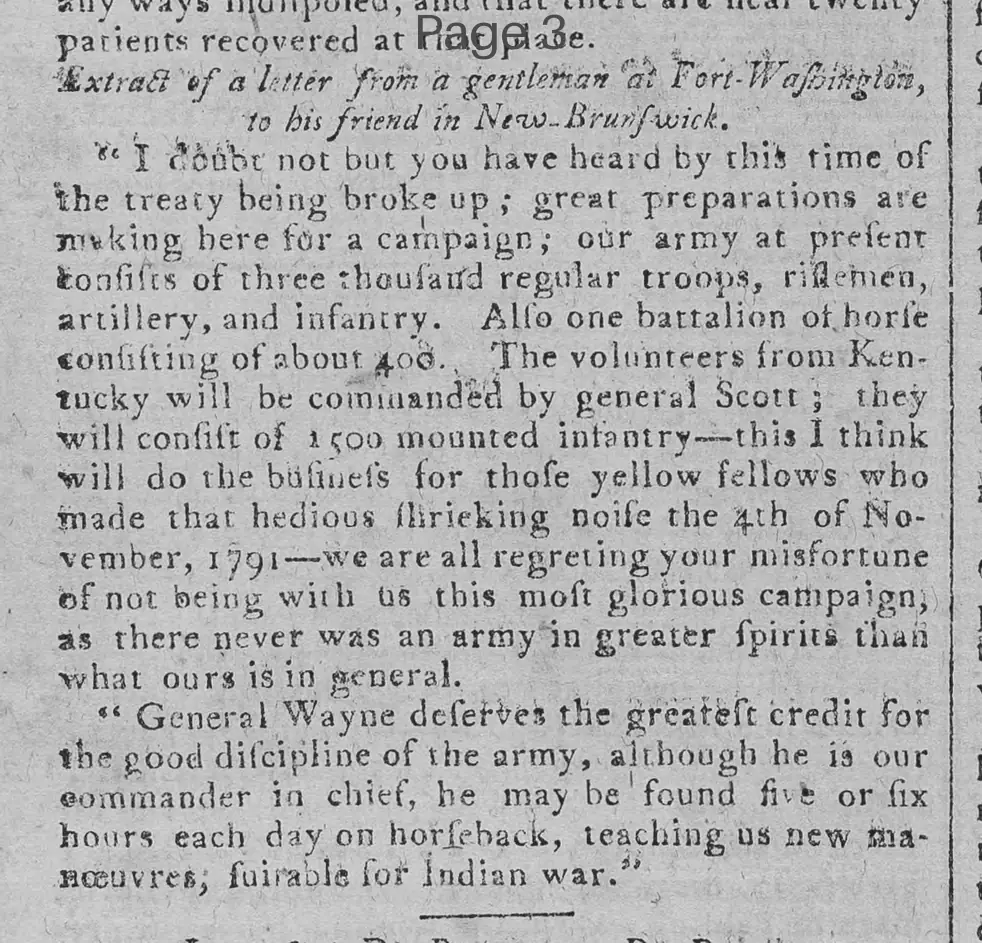
I doubt not but you have heard by this time of the treaty being broke up; great preparations are making here for a campaign; our army at present consists of three thousand regular troops, riflemen, artillery, and infantry. Also one battalion of horse consisting of about 400. The volunteers from Kentucky will be commanded by general Scott; they will consist of 1500 mounted infantry—this I think will do the business for those yellow fellows who made that hideous shrieking noise the 4th of November, 1791—we are all regretting your misfortune of not being with us this most glorious campaign, as there never was an army in greater spirits than what ours is in general.
General Wayne deserves the greatest credit for the good discipline of the army, although he is our commander in chief, he may be found five or six hours each day on horseback, teaching us new manoeuvres; suitable for Indian war.
What sub-type of article is it?
What keywords are associated?
What entities or persons were involved?
Where did it happen?
Domestic News Details
Primary Location
Fort Washington
Key Persons
Event Details
Extract of a letter reporting the breakup of a treaty, preparations for a campaign against Indians, army composition of three thousand regular troops including riflemen, artillery, infantry, and one battalion of horse of about 400, plus 1500 mounted infantry volunteers from Kentucky commanded by General Scott, high spirits in the army, and praise for General Wayne's discipline and daily instruction in maneuvers suitable for Indian war, referencing a previous incident on the 4th of November, 1791.