Thank you for visiting SNEWPapers!
Sign up free
Literary
June 28, 1822
American Watchman And Delaware Advertiser
Wilmington, New Castle County, Delaware
What is this article about?
A young American in Havana recounts his misfortunes: arriving broke, falling into a gambling trap by a false friend, receiving news of his lover's inheritance, attempting to flee debt but failing due to lacking a passport, paying off the debt, falling ill, and dying, while the narrator survives a pestilence.
Clipping
OCR Quality
98%
Excellent
Full Text
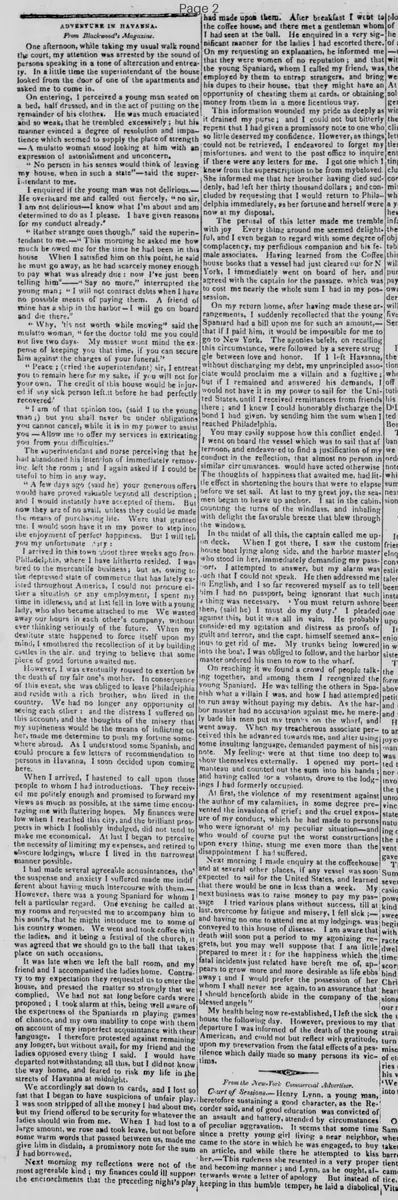
APOSTROPHE IN HAVANA:
From Blackwood's Magazine.
One afternoon, while taking my usual walk round the court, my attention was arrested by the sound of persons speaking in a tone of altercation and entreaty. In a little time the superintendent of the house looked from the door of one of the apartments and asked me to come in.
On entering, I perceived a young man seated on a bed, half dressed, and in the act of putting on the remainder of his clothes. He was much emaciated and so weak, that he trembled excessively; but his manner evinced a degree of resolution and impatience which seemed to supply the place of strength. A mulatto woman stood looking at him with an expression of astonishment and unconcern.
"No person in his senses would think of leaving my house, when in such a state," said the superintendent to me.
I enquired if the young man was not delirious.
He overheard me and called out fiercely, "no sir I am not delirious - I know what I'm about and am determined to do as I please. I have given reasons for my conduct already."
"Rather strange ones though," said the superintendent to me. "This morning he asked me how much he owed me for the time he had been in this house. When I satisfied him on this point, he said he must go away, as he had scarcely money enough to pay what was already due: now I've just been telling him - "
"Say no more," interrupted the young man; "I will not contract debts when I have no possible means of paying them. A friend of mine has a ship in the harbor - I will go on board and die there."
"Why, 'tis not worth while moving" said the mulatto woman, "for the doctor told me you could not live two days. My master won't mind the expense of keeping you that time, if you can secure him against the charges of your funeral."
"Peace," cried the superintendent "sir, I entreat you to remain here for my sake, if you will not for your own. The credit of this house would be injured if any sick person left it before he had perfectly recovered."
"I am of that opinion too," said I to the young man; "but you shall never be under obligations you cannot cancel, while it is in my power to assist you - Allow me to offer my services in extricating you from your difficulties."
The superintendent and nurse perceiving that he had abandoned his intention of immediately removing, left the room; and I again asked if I could be useful to him in any way.
"A few days ago," said he "your generous offers would have proved valuable beyond all description; and I would instantly have accepted of them. But now they are of no avail, unless they could be made the means of purchasing life. Were that granted me, I would soon have it in my power to step into the enjoyment of perfect happiness. But I will tell you my unfortunate story:
I arrived in this town about three weeks ago from Philadelphia, where I have hitherto resided. I was bred to the mercantile business; but as, owing to the depressed state of commerce that has lately existed throughout America, I could not procure either a situation or any employment, I spent my time in idleness, and at last fell in love with a young lady, who also became attached to me. We wasted away our hours in each other's company, without ever thinking seriously of the future. When my destitute state happened to force itself upon my mind, I smothered the recollection of it by building castles in the air, and trying to believe that some piece of good fortune awaited me.
However, I was eventually roused to exertion by the death of my fair one's mother. In consequence of this event, she was obliged to leave Philadelphia and reside with a rich brother, who lived in the country. We had no longer any opportunity of seeing each other: and the distress I suffered on this account, and the thoughts of the misery that my supineness would be the means of inflicting on her, made me determine to push my fortune somewhere abroad. As I understood some Spanish, and could procure a few letters of recommendation to persons in Havana, I soon decided upon coming here.
When I arrived, I hastened to call upon those people to whom I had introductions. They received me politely enough and promised to forward my views as much as possible, at the same time encouraging me with flattering hopes. My finances were low when I reached this city, and the brilliant prospects in which I foolishly indulged, did not tend to make me economical. At last I began to perceive the necessity of limiting my expenses, and retired to obscure lodgings, where I lived in the narrowest manner possible.
I had made several agreeable acquaintances, though the suspense and anxiety I suffered made me indifferent about having much intercourse with them. However, there was a young Spaniard for whom I felt a particular regard. One evening he called at my rooms and requested me to accompany him to his aunt's, that he might introduce me to some of his country women. We went and took coffee with the ladies, and it being a festival of the church, it was agreed that we should go to the ball that takes place on such occasions.
It was late when we left the ball room, and my friend and I accompanied the ladies home. Contrary to my expectation they requested us to enter the house, and pressed the matter so strongly that we complied. We had not sat long before cards were proposed; I took alarm at this, being well aware of the expertness of the Spaniards in playing games of chance, and my own inability to cope with them on account of my imperfect acquaintance with their language. I therefore protested against remaining any longer, but without avail, for my friend and the ladies opposed every thing I said. I would have departed notwithstanding all this, but I did not know the way home, and feared to risk my life in the streets of Havana at midnight.
We accordingly sat down to cards, and I lost so fast that I began to have suspicions of unfair play. I was soon stripped of all the money I had about me: but my friend offered to be security for whatever the ladies should win from me. When I had lost to a large amount, we rose and took leave, but not before some warm words that passed between us, made me give him in disdain, a promissory note for the sum I had borrowed.
Next morning my reflections were not of the most agreeable kind; my finances could ill support the encroachments that the preceding night's play had made upon them. After breakfast I went to the coffee house, and there met a gentleman whom I had seen at the ball. He enquired in a very significant manner for the ladies I had escorted there. On my requesting an explanation, he informed me that they were women of no reputation; and that the young Spaniard, whom I called my friend, was employed by them to entrap strangers, and bring his dupes to their house, that they might have an opportunity of cheating them at cards, or obtaining money from them in a more licentious way.
This information wounded my pride as deeply as it drained my purse; and I could not but bitterly repent that I had given a promissory note to one who so little deserved my confidence. However, as things could not be retrieved, I endeavored to forget my misfortunes, and went to the post office to inquire if there were any letters for me. I got one which I knew from the superscription to be from my beloved.
She informed me that her brother having died suddenly, had left her thirty thousand dollars; and concluded by requesting that I would return to Philadelphia immediately, as her fortune and herself were now at my disposal.
The perusal of this letter made me tremble with joy. Every thing around me seemed delightful, and I even began to regard with some degree of complacency, my perfidious companion and his female associates. Having learned from the Coffee house books that a vessel had just cleared out for New York, I immediately went on board of her, and agreed with the captain for the passage, which was to cost me nearly the whole sum I had in my possession.
On my return home, after having made these arrangements, I suddenly recollected that the young Spaniard had a bill upon me for such an amount,— that if I paid him, it would be impossible for me to go to New York. The agonies I felt, on recalling this circumstance, were followed by a severe struggle between love and honor. If I left Havana, without discharging my debt, my unprincipled associate would proclaim me a villain and a fugitive; but if I remained and answered his demands, I would not have it in my power to sail for the United States, until I received remittances from friends there; and I knew I could honorably discharge the bond I had given, by sending him the sum when I reached Philadelphia.
You may easily suppose how this conflict ended. I went on board the vessel which was to sail that afternoon, and endeavored to find a justification of my conduct in the reflection, that almost no person in similar circumstances, would have acted otherwise. The thoughts of happiness that awaited me, had little effect in shortening the hours that were to elapse before we set sail. At last to my great joy, the seamen began to heave up anchor. I sat in the cabin, counting the turns of the windlass, and inhaling with delight the favorable breeze that blew through the windows.
In the midst of all this, the captain called me up on deck. When I got there, I saw the custom house boat lying along side, and the harbor master who stood in her, immediately demanding my passport. I attempted to answer, but my alarm was such that I could not speak. He then addressed me in English, and I so far recovered myself as to tell him I had no passport, being ignorant that such a thing was necessary. "You must return ashore then," said he "I must do my duty." I pleaded against this, but it was all in vain. He probably considered my agitation and distress as proofs of guilt and terror, and the capt. himself seemed anxious to get rid of me. My trunks being lowered into the boat, I was obliged to follow, and the harbor master ordered his men to row to the wharf.
On reaching it we found a crowd of people talking together, and among them I recognized the young Spaniard. He was telling the others in Spanish what a villain I was, and how I had attempted to run away without paying my debts. As the harbor master had no accusation against me, he merely bade his men put my trunks on the wharf, and went away. When my treacherous associate perceived this he advanced towards me, and after using some insulting language, demanded payment of his note. My feelings were at that time too deep to show themselves externally. I opened my portmanteau and counted out the sum into his hands; and having called for a volanto, drove to the lodgings I had formerly occupied.
At first, the violence of my resentment against the author of my calamities, in some degree prevented the invasions of grief; and the cruel exposure of my conduct, which he had made to persons who were ignorant of my peculiar situation - and who would of course put the worst constructions upon every thing, stung me even more than the disappointment I had suffered.
Next morning I made enquiry at the coffeehouse and at several other places, if any vessel was soon expected to sail for the United States, and learned that there would be one in less than a week.
My next business was to raise money to pay my passage. I tried various plans without success, till at last, overcome by fatigue and misery, I fell sick; and having no one to attend me at my lodgings, was conveyed to this house of disease. I am aware that death will soon put a period to my agonizing regrets, but you may well suppose that I am little prepared to meet it: for the happiness which the fatal incidents just related have bereft me of, appears to grow more and more desirable as life ebbs away; and I would prefer the possession of her whom I shall never see again, to an assurance that I should henceforth abide in the company of the blessed angels."
My health being now re-established, I left the sick house the following day. However, previous to my departure I was informed of the death of the young American, and could not but reflect with gratitude, upon my preservation from the fatal effects of a pestilence which daily made so many persons its victims.
From Blackwood's Magazine.
One afternoon, while taking my usual walk round the court, my attention was arrested by the sound of persons speaking in a tone of altercation and entreaty. In a little time the superintendent of the house looked from the door of one of the apartments and asked me to come in.
On entering, I perceived a young man seated on a bed, half dressed, and in the act of putting on the remainder of his clothes. He was much emaciated and so weak, that he trembled excessively; but his manner evinced a degree of resolution and impatience which seemed to supply the place of strength. A mulatto woman stood looking at him with an expression of astonishment and unconcern.
"No person in his senses would think of leaving my house, when in such a state," said the superintendent to me.
I enquired if the young man was not delirious.
He overheard me and called out fiercely, "no sir I am not delirious - I know what I'm about and am determined to do as I please. I have given reasons for my conduct already."
"Rather strange ones though," said the superintendent to me. "This morning he asked me how much he owed me for the time he had been in this house. When I satisfied him on this point, he said he must go away, as he had scarcely money enough to pay what was already due: now I've just been telling him - "
"Say no more," interrupted the young man; "I will not contract debts when I have no possible means of paying them. A friend of mine has a ship in the harbor - I will go on board and die there."
"Why, 'tis not worth while moving" said the mulatto woman, "for the doctor told me you could not live two days. My master won't mind the expense of keeping you that time, if you can secure him against the charges of your funeral."
"Peace," cried the superintendent "sir, I entreat you to remain here for my sake, if you will not for your own. The credit of this house would be injured if any sick person left it before he had perfectly recovered."
"I am of that opinion too," said I to the young man; "but you shall never be under obligations you cannot cancel, while it is in my power to assist you - Allow me to offer my services in extricating you from your difficulties."
The superintendent and nurse perceiving that he had abandoned his intention of immediately removing, left the room; and I again asked if I could be useful to him in any way.
"A few days ago," said he "your generous offers would have proved valuable beyond all description; and I would instantly have accepted of them. But now they are of no avail, unless they could be made the means of purchasing life. Were that granted me, I would soon have it in my power to step into the enjoyment of perfect happiness. But I will tell you my unfortunate story:
I arrived in this town about three weeks ago from Philadelphia, where I have hitherto resided. I was bred to the mercantile business; but as, owing to the depressed state of commerce that has lately existed throughout America, I could not procure either a situation or any employment, I spent my time in idleness, and at last fell in love with a young lady, who also became attached to me. We wasted away our hours in each other's company, without ever thinking seriously of the future. When my destitute state happened to force itself upon my mind, I smothered the recollection of it by building castles in the air, and trying to believe that some piece of good fortune awaited me.
However, I was eventually roused to exertion by the death of my fair one's mother. In consequence of this event, she was obliged to leave Philadelphia and reside with a rich brother, who lived in the country. We had no longer any opportunity of seeing each other: and the distress I suffered on this account, and the thoughts of the misery that my supineness would be the means of inflicting on her, made me determine to push my fortune somewhere abroad. As I understood some Spanish, and could procure a few letters of recommendation to persons in Havana, I soon decided upon coming here.
When I arrived, I hastened to call upon those people to whom I had introductions. They received me politely enough and promised to forward my views as much as possible, at the same time encouraging me with flattering hopes. My finances were low when I reached this city, and the brilliant prospects in which I foolishly indulged, did not tend to make me economical. At last I began to perceive the necessity of limiting my expenses, and retired to obscure lodgings, where I lived in the narrowest manner possible.
I had made several agreeable acquaintances, though the suspense and anxiety I suffered made me indifferent about having much intercourse with them. However, there was a young Spaniard for whom I felt a particular regard. One evening he called at my rooms and requested me to accompany him to his aunt's, that he might introduce me to some of his country women. We went and took coffee with the ladies, and it being a festival of the church, it was agreed that we should go to the ball that takes place on such occasions.
It was late when we left the ball room, and my friend and I accompanied the ladies home. Contrary to my expectation they requested us to enter the house, and pressed the matter so strongly that we complied. We had not sat long before cards were proposed; I took alarm at this, being well aware of the expertness of the Spaniards in playing games of chance, and my own inability to cope with them on account of my imperfect acquaintance with their language. I therefore protested against remaining any longer, but without avail, for my friend and the ladies opposed every thing I said. I would have departed notwithstanding all this, but I did not know the way home, and feared to risk my life in the streets of Havana at midnight.
We accordingly sat down to cards, and I lost so fast that I began to have suspicions of unfair play. I was soon stripped of all the money I had about me: but my friend offered to be security for whatever the ladies should win from me. When I had lost to a large amount, we rose and took leave, but not before some warm words that passed between us, made me give him in disdain, a promissory note for the sum I had borrowed.
Next morning my reflections were not of the most agreeable kind; my finances could ill support the encroachments that the preceding night's play had made upon them. After breakfast I went to the coffee house, and there met a gentleman whom I had seen at the ball. He enquired in a very significant manner for the ladies I had escorted there. On my requesting an explanation, he informed me that they were women of no reputation; and that the young Spaniard, whom I called my friend, was employed by them to entrap strangers, and bring his dupes to their house, that they might have an opportunity of cheating them at cards, or obtaining money from them in a more licentious way.
This information wounded my pride as deeply as it drained my purse; and I could not but bitterly repent that I had given a promissory note to one who so little deserved my confidence. However, as things could not be retrieved, I endeavored to forget my misfortunes, and went to the post office to inquire if there were any letters for me. I got one which I knew from the superscription to be from my beloved.
She informed me that her brother having died suddenly, had left her thirty thousand dollars; and concluded by requesting that I would return to Philadelphia immediately, as her fortune and herself were now at my disposal.
The perusal of this letter made me tremble with joy. Every thing around me seemed delightful, and I even began to regard with some degree of complacency, my perfidious companion and his female associates. Having learned from the Coffee house books that a vessel had just cleared out for New York, I immediately went on board of her, and agreed with the captain for the passage, which was to cost me nearly the whole sum I had in my possession.
On my return home, after having made these arrangements, I suddenly recollected that the young Spaniard had a bill upon me for such an amount,— that if I paid him, it would be impossible for me to go to New York. The agonies I felt, on recalling this circumstance, were followed by a severe struggle between love and honor. If I left Havana, without discharging my debt, my unprincipled associate would proclaim me a villain and a fugitive; but if I remained and answered his demands, I would not have it in my power to sail for the United States, until I received remittances from friends there; and I knew I could honorably discharge the bond I had given, by sending him the sum when I reached Philadelphia.
You may easily suppose how this conflict ended. I went on board the vessel which was to sail that afternoon, and endeavored to find a justification of my conduct in the reflection, that almost no person in similar circumstances, would have acted otherwise. The thoughts of happiness that awaited me, had little effect in shortening the hours that were to elapse before we set sail. At last to my great joy, the seamen began to heave up anchor. I sat in the cabin, counting the turns of the windlass, and inhaling with delight the favorable breeze that blew through the windows.
In the midst of all this, the captain called me up on deck. When I got there, I saw the custom house boat lying along side, and the harbor master who stood in her, immediately demanding my passport. I attempted to answer, but my alarm was such that I could not speak. He then addressed me in English, and I so far recovered myself as to tell him I had no passport, being ignorant that such a thing was necessary. "You must return ashore then," said he "I must do my duty." I pleaded against this, but it was all in vain. He probably considered my agitation and distress as proofs of guilt and terror, and the capt. himself seemed anxious to get rid of me. My trunks being lowered into the boat, I was obliged to follow, and the harbor master ordered his men to row to the wharf.
On reaching it we found a crowd of people talking together, and among them I recognized the young Spaniard. He was telling the others in Spanish what a villain I was, and how I had attempted to run away without paying my debts. As the harbor master had no accusation against me, he merely bade his men put my trunks on the wharf, and went away. When my treacherous associate perceived this he advanced towards me, and after using some insulting language, demanded payment of his note. My feelings were at that time too deep to show themselves externally. I opened my portmanteau and counted out the sum into his hands; and having called for a volanto, drove to the lodgings I had formerly occupied.
At first, the violence of my resentment against the author of my calamities, in some degree prevented the invasions of grief; and the cruel exposure of my conduct, which he had made to persons who were ignorant of my peculiar situation - and who would of course put the worst constructions upon every thing, stung me even more than the disappointment I had suffered.
Next morning I made enquiry at the coffeehouse and at several other places, if any vessel was soon expected to sail for the United States, and learned that there would be one in less than a week.
My next business was to raise money to pay my passage. I tried various plans without success, till at last, overcome by fatigue and misery, I fell sick; and having no one to attend me at my lodgings, was conveyed to this house of disease. I am aware that death will soon put a period to my agonizing regrets, but you may well suppose that I am little prepared to meet it: for the happiness which the fatal incidents just related have bereft me of, appears to grow more and more desirable as life ebbs away; and I would prefer the possession of her whom I shall never see again, to an assurance that I should henceforth abide in the company of the blessed angels."
My health being now re-established, I left the sick house the following day. However, previous to my departure I was informed of the death of the young American, and could not but reflect with gratitude, upon my preservation from the fatal effects of a pestilence which daily made so many persons its victims.
What sub-type of article is it?
Prose Fiction
What themes does it cover?
Love Romance
Commerce Trade
Moral Virtue
What keywords are associated?
Havana
Gambling Debt
Forbidden Love
Honor Struggle
Illness Death
American Abroad
What entities or persons were involved?
From Blackwood's Magazine
Literary Details
Title
Apostrophe In Havana
Author
From Blackwood's Magazine
Key Lines
"I Will Not Contract Debts When I Have No Possible Means Of Paying Them. A Friend Of Mine Has A Ship In The Harbor I Will Go On Board And Die There."
"A Few Days Ago," Said He "Your Generous Offers Would Have Proved Valuable Beyond All Description; And I Would Instantly Have Accepted Of Them. But Now They Are Of No Avail, Unless They Could Be Made The Means Of Purchasing Life."
She Informed Me That Her Brother Having Died Suddenly, Had Left Her Thirty Thousand Dollars; And Concluded By Requesting That I Would Return To Philadelphia Immediately, As Her Fortune And Herself Were Now At My Disposal.
The Agonies I Felt, On Recalling This Circumstance, Were Followed By A Severe Struggle Between Love And Honor.
I Am Aware That Death Will Soon Put A Period To My Agonizing Regrets, But You May Well Suppose That I Am Little Prepared To Meet It: For The Happiness Which The Fatal Incidents Just Related Have Bereft Me Of, Appears To Grow More And More Desirable As Life Ebbs Away; And I Would Prefer The Possession Of Her Whom I Shall Never See Again, To An Assurance That I Should Henceforth Abide In The Company Of The Blessed Angels."