Thank you for visiting SNEWPapers!
Sign up free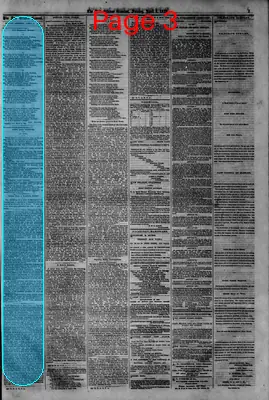
Poem
April 5, 1868
The New Orleans Crescent
New Orleans, Orleans County, Louisiana
What is this article about?
A romantic poem published in the New Orleans Crescent on April 5, 1868, by Mary Thacker of Hamburg, Arkansas, dated March 16, 1868. It expresses a fantastical vision of love for Evelyn, imagining crowns, dewdrops, rainbows, and an idyllic life, repeatedly calling it a 'madman's dream.' The text also includes a humor column 'Jots and Tittles' by Jocko, a satirical letter from a Texas debtor dated February 15, 1868, and a news item on a drunken New York socialite.
Clipping

OCR Quality
95%
Excellent
Full Text
The New Orleans
Crescent
SUNDAY EDITION, APRIL 5, 1868.
"If thou wert my own fair bride, Evelyn,
If thou wert my own fair bride,
O then I would wear for a crown, Evelyn,
Which should rival Amaryllis's pride.
I would place on thy radiant brow a crown,
Which with heaven's own light should gleam;
But this is a madman's dream, Evelyn;
Yes, this is madman's dream.
Each drop of the beaded dew, Evelyn,
Each drop of the beaded dew,
Should glisten with more than the diamond's light,
Evelyn, it should glisten for you;
And each flower should breathe a divine perfume
As it bends o'er the crystal stream.
But this is a madman's dream, Evelyn.
Yes, this is madman's dream.
O, I would encircle thy path,
With rainbow hues which should put to flight
The storm-cloud's flash of wrath.
The stars of heaven should ever shine
On thee with a haloed beam.
But this is a madman's dream, Evelyn;
Yes, this is madman's dream.
IV.
On some far distant ocean isle, Evelyn,
On some far distant ocean isle,
Our home should be, and the holiest gift
I would crave of heaven is thy smile;
Inhaling ecstatic bliss with each breath.
A life of enchantment 'twould seem.
But this is a madman's dream, Evelyn;
Yes, this is madman's dream.
The strings of some charmed lute, Evelyn,
Yes, the strings of some charmed lute,
Should lull thee into a seraphic repose,
Or else should forever be mute;
An angel's wing should fan thy brow
As thou sleepest beside the stream.
Say, is this a madman's dream, Evelyn
O, is it a madman's dream?
MARY THACKER
Hamburg, Ark., March 16, 1868.
For the New Orleans Sunday Crescent.
JOTS AND TITTLES,
BY JOCKO.
Where there's a will there's a way—as the man said when he ran away from a willful wife.
Woman is the modern Sphinx—she destroys those who fail to solve the enigmas of her being.
The Black Art—the way a creole girl uses her eyes.
Skeptical question.—Do attic rooms necessarily induce rheumatism?
Schematic question.—Can any one pretend that there is more than the difference of a single unit between Arianism and Unitarianism?
Cheap boarding-house breakfast—Chiz—Isay, Toggs, do you know why these are called scrambled eggs?
Toggs—No. Why is it?
Chiz—Because there's always such a scramble for them. (Mrs. Sneakins, the landlady, looks severe, but says nothing.)
Pilkins—Fantastic style of architecture, that dancing academy is—hey, Jilkins?
Jilkins—Yes—very. Light fantastic.
Sazum means rock. Now, when it is said of a young lady's lovers that she sacks 'em; are we to understand that she merely lets them "rock along."
Wall-flowers—mural blossoms.
Why is the hall of a negro minstrel troupe like a surgeon's office? Because when you go there you are pretty sure to see "Bones."
Why is a Mississippi steamboat like a life-preserver? Because it is liable to be blown up.
Why is an apt quotation like an Irishman? Because it is apt to be Pat.
Letter from a Southern Debtor.
The following is a letter to the attorney of a leading bank, in answer to a demand for the payment of an old debt, by a Texan. It will, perhaps, show some persons a new way to pay old debts:
Texas, February 15, 1868.
Gentlemen—Your kind favor of the 13th inst., informing me that you hold for collection a slight suspicion of debt in the shape of a note made by W. and B. to E. B. & Co., for $728 17, came duly to hand. Your very liberal proposition fills my bosom with the deepest feeling of gratitude, mingled with regret that I am not immediately prepared to accept it in its full beneficence.
Money, I have none—estate, real and personal, all gone—swept off by the cruel and relentless hand of war; but I am still young, hopeful, and in high expectation that I will be able, in a very short time, to settle fully with all my creditors, paying them up to the last cent as the law directs.
And in order to satisfy your mind upon the ultimate success of my plans, I will make a clean breast of them.
My debts amount to about $50,000. Now I have what the law requires to settle all these claims—to-wit: $50 to pay the register's fees, and have availed myself of the financial and legal ability of George P. Finlay, Esq., to engineer the scheme.
I have also been promised the assistance of Judge John C. Watrous and Colonel Jesse C. Stancel, and in the course of about six months I hope to make an exhibit, which, if not entirely satisfactory to my creditors, will be a legal liquidation of all my debts. If you should conclude to sue, please do so in Judge Watrous's court at Galveston, as it will be more convenient to me. My defenses will all be on record.
If you have any other claims due from me, you will find, by examination of my schedule on file in the United States District Court, that I have fully provided for their liquidation, making no preferences. You will appreciate my disinterestedness in pursuing this course, when I assure you that my business had become so complicated and entangled that nothing but the sword of the bankrupt law (God bless Congress for it) could cut the "Gordian knot."
I am civiliter mortuus, and when my estate is fully administered, I shall prepare to shuffle off the old man (peace to his ashes) and put on the new, fresh from a resurrection as delightful and pleasing to my weary soul as the balmy breezes of spring to the poor invalid whose heart swells to bursting at the pleasant prospect of returning convalescence,
With high hopes of future glory, honor, wealth and happiness, under the benign influence of a country whose broad ægis spreads its protecting wings over the poor debtor, I am, gentlemen,
very respectfully, etc.
Lady Drunkards in New York—A few days ago a carriage, with a liveried coachman, drew up to the station house of the twenty-ninth precinct, containing a widow woman, elegantly attired, in a gross state of intoxication. It required the united efforts of the driver and two policemen to carry the partially insensible woman into the station house. The charge was made by the lady's own coachman, that she was in the habit of driving down town two or three times a week, on a shopping excursion, and it was her custom, on these occasions, to visit fashionable restaurants to dine, not forgetting to drink sufficient wine to always go home gloriously drunk. On this occasion she became so totally oblivious, and consequently so uncontrollable that John felt it his duty to deposit his load at a station house instead of at her elegant mansion in the upper part of the island; besides this, it was yet daylight, and it would never do for the gossips of the neighborhood to behold the sight of a lady of wealth and rank coming home in such a state.
After the "lady" had remained in the station house a sufficient length of time to become partially sober, she was taken to the Jefferson Market Police Court, where she was sentenced to ten days' imprisonment. She was accordingly locked up in a cell, but it is said when she became perfectly sober, and to a realizing sense of her degraded position, she drew forth her plethoric pocket-book, paid the fine and was released from confinement. "This woman, not yet forty years of age, was but a few short years ago a reigning belle of New York's society, and bears the name of an honored old New York family. Out of respect to a family which has suffered no other disgrace, we refrain from printing her name. When she was brought to the station house she had with her in her carriage a basket filled with fruit, bon-bons and other fancy nick-nacks of womanly fancy; but, probably from shame at her humiliated condition, she has since failed to call or send for them. Cases such as this are rare in this city, we are happy to be able to say, although we do not deny that drunkenness among women, particularly of the upper classes, is by no means a rarity.—[N. Y. Sunday Dispatch.
Crescent
SUNDAY EDITION, APRIL 5, 1868.
"If thou wert my own fair bride, Evelyn,
If thou wert my own fair bride,
O then I would wear for a crown, Evelyn,
Which should rival Amaryllis's pride.
I would place on thy radiant brow a crown,
Which with heaven's own light should gleam;
But this is a madman's dream, Evelyn;
Yes, this is madman's dream.
Each drop of the beaded dew, Evelyn,
Each drop of the beaded dew,
Should glisten with more than the diamond's light,
Evelyn, it should glisten for you;
And each flower should breathe a divine perfume
As it bends o'er the crystal stream.
But this is a madman's dream, Evelyn.
Yes, this is madman's dream.
O, I would encircle thy path,
With rainbow hues which should put to flight
The storm-cloud's flash of wrath.
The stars of heaven should ever shine
On thee with a haloed beam.
But this is a madman's dream, Evelyn;
Yes, this is madman's dream.
IV.
On some far distant ocean isle, Evelyn,
On some far distant ocean isle,
Our home should be, and the holiest gift
I would crave of heaven is thy smile;
Inhaling ecstatic bliss with each breath.
A life of enchantment 'twould seem.
But this is a madman's dream, Evelyn;
Yes, this is madman's dream.
The strings of some charmed lute, Evelyn,
Yes, the strings of some charmed lute,
Should lull thee into a seraphic repose,
Or else should forever be mute;
An angel's wing should fan thy brow
As thou sleepest beside the stream.
Say, is this a madman's dream, Evelyn
O, is it a madman's dream?
MARY THACKER
Hamburg, Ark., March 16, 1868.
For the New Orleans Sunday Crescent.
JOTS AND TITTLES,
BY JOCKO.
Where there's a will there's a way—as the man said when he ran away from a willful wife.
Woman is the modern Sphinx—she destroys those who fail to solve the enigmas of her being.
The Black Art—the way a creole girl uses her eyes.
Skeptical question.—Do attic rooms necessarily induce rheumatism?
Schematic question.—Can any one pretend that there is more than the difference of a single unit between Arianism and Unitarianism?
Cheap boarding-house breakfast—Chiz—Isay, Toggs, do you know why these are called scrambled eggs?
Toggs—No. Why is it?
Chiz—Because there's always such a scramble for them. (Mrs. Sneakins, the landlady, looks severe, but says nothing.)
Pilkins—Fantastic style of architecture, that dancing academy is—hey, Jilkins?
Jilkins—Yes—very. Light fantastic.
Sazum means rock. Now, when it is said of a young lady's lovers that she sacks 'em; are we to understand that she merely lets them "rock along."
Wall-flowers—mural blossoms.
Why is the hall of a negro minstrel troupe like a surgeon's office? Because when you go there you are pretty sure to see "Bones."
Why is a Mississippi steamboat like a life-preserver? Because it is liable to be blown up.
Why is an apt quotation like an Irishman? Because it is apt to be Pat.
Letter from a Southern Debtor.
The following is a letter to the attorney of a leading bank, in answer to a demand for the payment of an old debt, by a Texan. It will, perhaps, show some persons a new way to pay old debts:
Texas, February 15, 1868.
Gentlemen—Your kind favor of the 13th inst., informing me that you hold for collection a slight suspicion of debt in the shape of a note made by W. and B. to E. B. & Co., for $728 17, came duly to hand. Your very liberal proposition fills my bosom with the deepest feeling of gratitude, mingled with regret that I am not immediately prepared to accept it in its full beneficence.
Money, I have none—estate, real and personal, all gone—swept off by the cruel and relentless hand of war; but I am still young, hopeful, and in high expectation that I will be able, in a very short time, to settle fully with all my creditors, paying them up to the last cent as the law directs.
And in order to satisfy your mind upon the ultimate success of my plans, I will make a clean breast of them.
My debts amount to about $50,000. Now I have what the law requires to settle all these claims—to-wit: $50 to pay the register's fees, and have availed myself of the financial and legal ability of George P. Finlay, Esq., to engineer the scheme.
I have also been promised the assistance of Judge John C. Watrous and Colonel Jesse C. Stancel, and in the course of about six months I hope to make an exhibit, which, if not entirely satisfactory to my creditors, will be a legal liquidation of all my debts. If you should conclude to sue, please do so in Judge Watrous's court at Galveston, as it will be more convenient to me. My defenses will all be on record.
If you have any other claims due from me, you will find, by examination of my schedule on file in the United States District Court, that I have fully provided for their liquidation, making no preferences. You will appreciate my disinterestedness in pursuing this course, when I assure you that my business had become so complicated and entangled that nothing but the sword of the bankrupt law (God bless Congress for it) could cut the "Gordian knot."
I am civiliter mortuus, and when my estate is fully administered, I shall prepare to shuffle off the old man (peace to his ashes) and put on the new, fresh from a resurrection as delightful and pleasing to my weary soul as the balmy breezes of spring to the poor invalid whose heart swells to bursting at the pleasant prospect of returning convalescence,
With high hopes of future glory, honor, wealth and happiness, under the benign influence of a country whose broad ægis spreads its protecting wings over the poor debtor, I am, gentlemen,
very respectfully, etc.
Lady Drunkards in New York—A few days ago a carriage, with a liveried coachman, drew up to the station house of the twenty-ninth precinct, containing a widow woman, elegantly attired, in a gross state of intoxication. It required the united efforts of the driver and two policemen to carry the partially insensible woman into the station house. The charge was made by the lady's own coachman, that she was in the habit of driving down town two or three times a week, on a shopping excursion, and it was her custom, on these occasions, to visit fashionable restaurants to dine, not forgetting to drink sufficient wine to always go home gloriously drunk. On this occasion she became so totally oblivious, and consequently so uncontrollable that John felt it his duty to deposit his load at a station house instead of at her elegant mansion in the upper part of the island; besides this, it was yet daylight, and it would never do for the gossips of the neighborhood to behold the sight of a lady of wealth and rank coming home in such a state.
After the "lady" had remained in the station house a sufficient length of time to become partially sober, she was taken to the Jefferson Market Police Court, where she was sentenced to ten days' imprisonment. She was accordingly locked up in a cell, but it is said when she became perfectly sober, and to a realizing sense of her degraded position, she drew forth her plethoric pocket-book, paid the fine and was released from confinement. "This woman, not yet forty years of age, was but a few short years ago a reigning belle of New York's society, and bears the name of an honored old New York family. Out of respect to a family which has suffered no other disgrace, we refrain from printing her name. When she was brought to the station house she had with her in her carriage a basket filled with fruit, bon-bons and other fancy nick-nacks of womanly fancy; but, probably from shame at her humiliated condition, she has since failed to call or send for them. Cases such as this are rare in this city, we are happy to be able to say, although we do not deny that drunkenness among women, particularly of the upper classes, is by no means a rarity.—[N. Y. Sunday Dispatch.
What sub-type of article is it?
Ode
Song
What themes does it cover?
Love Courtship
What keywords are associated?
Evelyn
Madmans Dream
Romantic Ideal
Heavenly Crown
Distant Isle
What entities or persons were involved?
Mary Thacker
Hamburg, Ark., March 16, 1868.
Poem Details
Author
Mary Thacker Hamburg, Ark., March 16, 1868.
Subject
Romantic Fantasy To Evelyn
Form / Style
Rhymed Stanzas With Refrain
Key Lines
If Thou Wert My Own Fair Bride, Evelyn,
If Thou Wert My Own Fair Bride,
O Then I Would Wear For A Crown, Evelyn,
Which Should Rival Amaryllis's Pride.
But This Is A Madman's Dream, Evelyn;
Yes, This Is Madman's Dream.
O, I Would Encircle Thy Path,
With Rainbow Hues Which Should Put To Flight
The Storm Cloud's Flash Of Wrath.