Thank you for visiting SNEWPapers!
Sign up free
Literary
November 11, 1817
Portland Gazette, And Maine Advertiser
Portland, Cumberland County, Maine
What is this article about?
This essay argues that Josephus, the Jewish historian, was a Nazarene or Ebionite Christian based on his testimony about Jesus Christ in 'Antiquities.' It explains his cautious wording due to writing for Romans and Greeks, and attributes Jewish rejection of Josephus to his pro-Christian passages, including erasures in Hebrew manuscripts.
Clipping
OCR Quality
95%
Excellent
Full Text
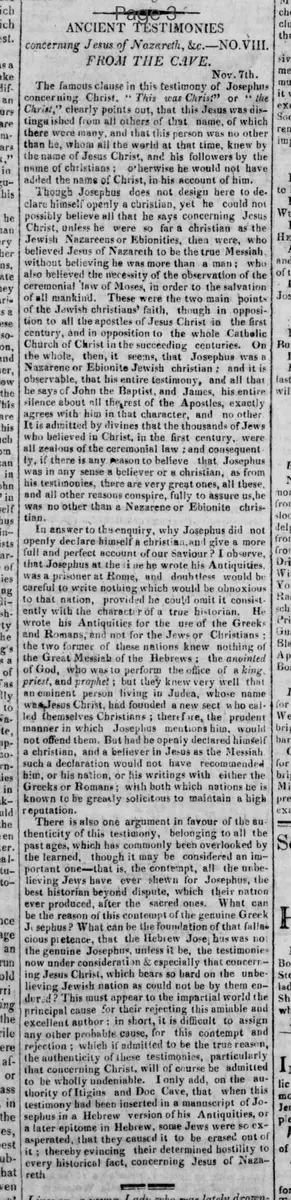
ANCIENT TESTIMONIES concerning Jesus of Nazareth, &c.—NO. VIII. FROM THE CAVE. Nov. 7th.
The famous clause in this testimony of Josephus concerning Christ, 'This was Christ' or 'the Christ,' clearly points out, that this Jesus was distinguished from all others of that name, of which there were many, and that this person was no other than he, whom all the world at that time, knew by the name of Jesus Christ, and his followers by the name of christians; otherwise he would not have added the name of Christ, in his account of him. Though Josephus does not design here to declare himself openly a christian, yet he could not possibly believe all that he says concerning Jesus Christ, unless he were so far a christian as the Jewish Nazarenes or Ebionites, then were, who believed Jesus of Nazareth to be the true Messiah, without believing he was more than a man; who also believed the necessity of the observation of the ceremonial law of Moses, in order to the salvation of all mankind. These were the two main points of the Jewish christians' faith, though in opposition to all the apostles of Jesus Christ in the first century, and in opposition to the whole Catholic Church of Christ in the succeeding centuries. On the whole, then, it seems, that Josephus was a Nazarene or Ebionite Jewish christian; and it is observable, that his entire testimony, and all that he says of John the Baptist, and James, his entire silence about all the rest of the Apostles, exactly agrees with him in that character, and no other.
It is admitted by divines that the thousands of Jews who believed in Christ, in the first century, were all zealous of the ceremonial law; and consequently, if there is any reason to believe that Josephus was in any sense a believer or a christian, as from his testimonies, there are very great ones, all these, and all other reasons conspire, fully to assure us, he was no other than a Nazarene or Ebionite christian.
In answer to the enquiry, why Josephus did not openly declare himself a christian, and give a more full and perfect account of our Saviour? I observe, that Josephus at the time he wrote his Antiquities, was a prisoner at Rome, and doubtless would be careful to write nothing which would be obnoxious to that nation, provided he could omit it consistently with the character of a true historian. He wrote his Antiquities for the use of the Greeks and Romans, and not for the Jews or Christians; the two former of these nations knew nothing of the Great Messiah of the Hebrews: the anointed of God, who was to perform the office of a king priest, and prophet; but they knew very well that an eminent person living in Judea, whose name was Jesus Christ, had founded a new sect who called themselves Christians; therefore, the prudent manner in which Josephus mentions him, would not offend them. But had he openly declared himself a christian, and a believer in Jesus as the Messiah such a declaration would not have recommended him, or his nation, or his writings with either the Greeks or Romans: with both which nations he is known to be greatly solicitous to maintain a high reputation.
There is also one argument in favour of the authenticity of this testimony, belonging to all the past ages, which has commonly been overlooked by the learned, though it may be considered an important one that is, the contempt, all the unbelieving Jews have ever shewn for Josephus, the best historian beyond dispute, which their nation ever produced, after the sacred ones. What can be the reason of this contempt of the genuine Greek Josephus? What can be the foundation of that fallacious pretence, that the Hebrew Josephus was not the genuine Josephus, unless it be, the testimonies now under consideration & especially that concerning Jesus Christ, which bears so hard on the unbelieving Jewish nation as could not be by them endured? This must appear to the impartial world the principal cause of their rejecting this amiable and excellent author: in short, it is difficult to assign any other probable cause, for this contempt and rejection; which if admitted to be the true reason, the authenticity of these testimonies, particularly that concerning Christ, will of course be admitted to be wholly undeniable. I only add, on the authority of Hales and Dr. Cave, that when this testimony had been inserted in a manuscript of Josephus in a Hebrew version of his Antiquities, or a later epitome in Hebrew, some Jews were so exasperated, that they caused it to be erased, out of it; thereby evincing their determined hostility to every historical fact, concerning Jesus of Nazareth.
The famous clause in this testimony of Josephus concerning Christ, 'This was Christ' or 'the Christ,' clearly points out, that this Jesus was distinguished from all others of that name, of which there were many, and that this person was no other than he, whom all the world at that time, knew by the name of Jesus Christ, and his followers by the name of christians; otherwise he would not have added the name of Christ, in his account of him. Though Josephus does not design here to declare himself openly a christian, yet he could not possibly believe all that he says concerning Jesus Christ, unless he were so far a christian as the Jewish Nazarenes or Ebionites, then were, who believed Jesus of Nazareth to be the true Messiah, without believing he was more than a man; who also believed the necessity of the observation of the ceremonial law of Moses, in order to the salvation of all mankind. These were the two main points of the Jewish christians' faith, though in opposition to all the apostles of Jesus Christ in the first century, and in opposition to the whole Catholic Church of Christ in the succeeding centuries. On the whole, then, it seems, that Josephus was a Nazarene or Ebionite Jewish christian; and it is observable, that his entire testimony, and all that he says of John the Baptist, and James, his entire silence about all the rest of the Apostles, exactly agrees with him in that character, and no other.
It is admitted by divines that the thousands of Jews who believed in Christ, in the first century, were all zealous of the ceremonial law; and consequently, if there is any reason to believe that Josephus was in any sense a believer or a christian, as from his testimonies, there are very great ones, all these, and all other reasons conspire, fully to assure us, he was no other than a Nazarene or Ebionite christian.
In answer to the enquiry, why Josephus did not openly declare himself a christian, and give a more full and perfect account of our Saviour? I observe, that Josephus at the time he wrote his Antiquities, was a prisoner at Rome, and doubtless would be careful to write nothing which would be obnoxious to that nation, provided he could omit it consistently with the character of a true historian. He wrote his Antiquities for the use of the Greeks and Romans, and not for the Jews or Christians; the two former of these nations knew nothing of the Great Messiah of the Hebrews: the anointed of God, who was to perform the office of a king priest, and prophet; but they knew very well that an eminent person living in Judea, whose name was Jesus Christ, had founded a new sect who called themselves Christians; therefore, the prudent manner in which Josephus mentions him, would not offend them. But had he openly declared himself a christian, and a believer in Jesus as the Messiah such a declaration would not have recommended him, or his nation, or his writings with either the Greeks or Romans: with both which nations he is known to be greatly solicitous to maintain a high reputation.
There is also one argument in favour of the authenticity of this testimony, belonging to all the past ages, which has commonly been overlooked by the learned, though it may be considered an important one that is, the contempt, all the unbelieving Jews have ever shewn for Josephus, the best historian beyond dispute, which their nation ever produced, after the sacred ones. What can be the reason of this contempt of the genuine Greek Josephus? What can be the foundation of that fallacious pretence, that the Hebrew Josephus was not the genuine Josephus, unless it be, the testimonies now under consideration & especially that concerning Jesus Christ, which bears so hard on the unbelieving Jewish nation as could not be by them endured? This must appear to the impartial world the principal cause of their rejecting this amiable and excellent author: in short, it is difficult to assign any other probable cause, for this contempt and rejection; which if admitted to be the true reason, the authenticity of these testimonies, particularly that concerning Christ, will of course be admitted to be wholly undeniable. I only add, on the authority of Hales and Dr. Cave, that when this testimony had been inserted in a manuscript of Josephus in a Hebrew version of his Antiquities, or a later epitome in Hebrew, some Jews were so exasperated, that they caused it to be erased, out of it; thereby evincing their determined hostility to every historical fact, concerning Jesus of Nazareth.
What sub-type of article is it?
Essay
What themes does it cover?
Religious
What keywords are associated?
Josephus
Jesus Christ
Ebionites
Nazarenes
Testimony
Antiquities
Jewish Christians
Authenticity
Literary Details
Title
Ancient Testimonies Concerning Jesus Of Nazareth, &C.—No. Viii. From The Cave. Nov. 7th.
Subject
On Josephus's Testimony Concerning Christ
Key Lines
The Famous Clause In This Testimony Of Josephus Concerning Christ, 'This Was Christ' Or 'The Christ,' Clearly Points Out, That This Jesus Was Distinguished From All Others Of That Name
On The Whole, Then, It Seems, That Josephus Was A Nazarene Or Ebionite Jewish Christian
He Wrote His Antiquities For The Use Of The Greeks And Romans, And Not For The Jews Or Christians
The Contempt, All The Unbelieving Jews Have Ever Shewn For Josephus, The Best Historian Beyond Dispute, Which Their Nation Ever Produced, After The Sacred Ones