Thank you for visiting SNEWPapers!
Sign up free
The National Intelligencer And Washington Advertiser
Washington, District Of Columbia
What is this article about?
On March 17, in the House of Representatives, Mr. Sloan opposes Mr. Nicholson's resolution for lacking mention of seamen impressment by Great Britain. He advocates non-intercourse policy to redress grievances, promote home manufactures, and unite the nation against British insults, citing historical and economic arguments.
Merged-components note: Continuation of Mr. Sloan's speech in the House of Representatives debate on non-intercourse with Great Britain.
Clippings
1 of 2
OCR Quality
Full Text
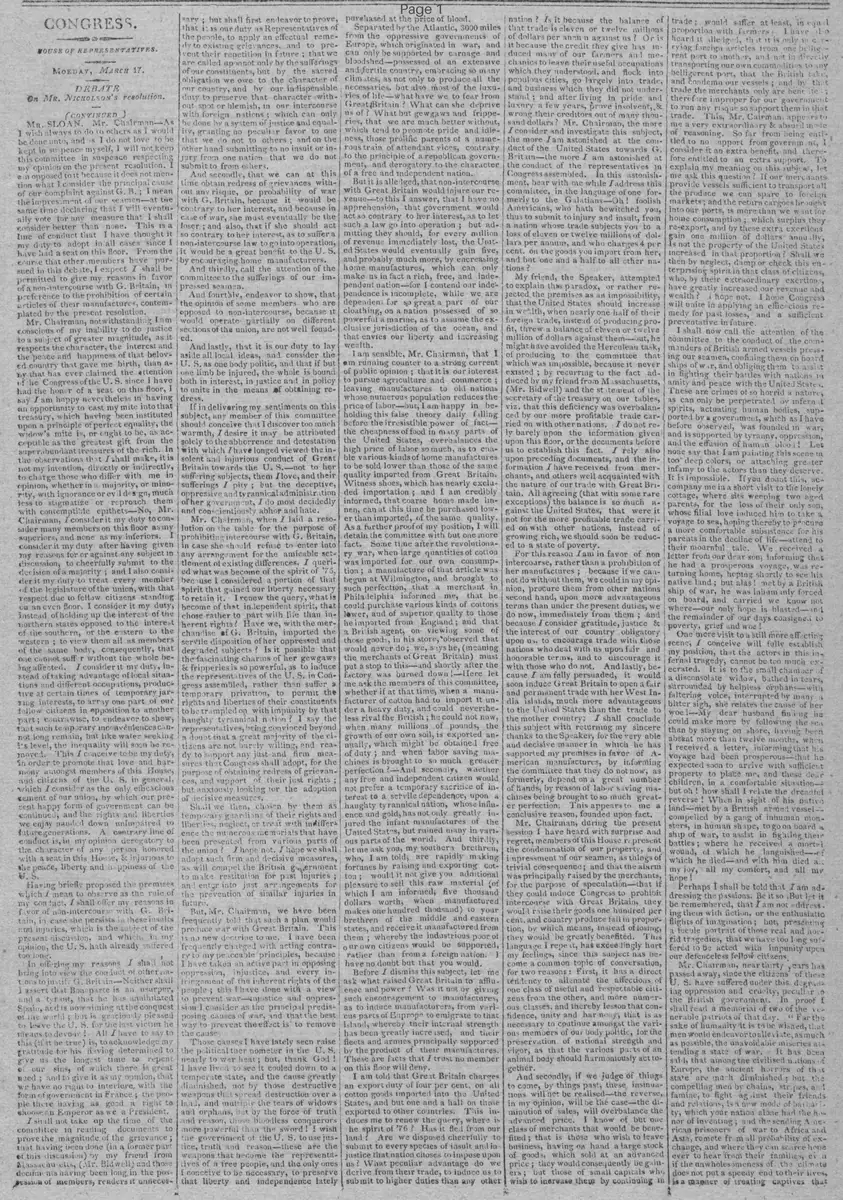
HOUSE OF REPRESENTATIVES.
MONDAY, MARCH 17.
DEBATE
On MR. Nicholson's resolution.
(CONTINUED)
MR. SLOAN. Mr. Chairman—As I wish always to do to others as I would be done unto, and as I do not love to be kept in suspense myself, I will not keep this committee in suspense respecting my opinion on the present resolution. I am opposed to it because it does not mention what I consider the principal cause of our complaint against G. B.; I mean the impressment of our seamen—at the same time declaring that I will eventually vote for any measure that I shall consider better than none. This is a line of conduct that I have thought it my duty to adopt in all cases since I have had a seat on this floor. From the course that other members have pursued in this debate, I expect I shall be permitted to give my reasons in favor of a non-intercourse with G. Britain, in preference to the prohibition of certain articles of their manufactures, contemplated by the present resolution.
Mr. Chairman, notwithstanding I am conscious of my inability to do justice to a subject of greater magnitude, as it respects the character, the interest and the peace and happiness of that beloved country that gave me birth, than any that has ever claimed the attention of the Congress of the U. S. since I have had the honor of a seat on this floor, I say I am happy nevertheless in having an opportunity to cast my mite into that treasury, which having been instituted upon a principle of perfect equality, the widow's mite is, or ought to be, as acceptable as the greatest gift from the superabundant treasures of the rich. In the observations that I shall make, it is not my intention, directly or indirectly, to charge those who differ with me in opinion, whether in a majority, or minority, with ignorance or evil design, much less to stigmatize or reproach them with contemptible epithets—No, Mr. Chairman, I consider it my duty to consider many members on this floor as my superiors, and none as my inferiors. I consider it my duty after having given my reasons for or against any subject in discussion, to cheerfully submit to the decision of a majority; and I also consider it my duty to treat every member of the legislature of the union, with that respect due to fellow citizens standing on an even floor. I consider it my duty, instead of holding up the interest of the northern states opposed to the interest of the southern, or the eastern to the western; to view them all as members of the same body, consequently, that one cannot suffer without the whole being affected. I consider it my duty, instead of taking advantage of local situations and different occupations, productive at certain times of temporary jarring interests, to array one part of our fellow citizens in opposition to another part; contrariwise, to endeavor to show, that such temporary inconveniences cannot long remain, but like water seeking its level, the inequality will soon be removed. This I conceive to be my duty, in order to promote that love and harmony amongst members of this House, and citizens of the U. S. in general, which I consider as the only efficacious cement of our union, by which our present happy form of government can be continued, and the rights and liberties we enjoy handed down unimpaired to future generations. A contrary line of conduct is, in my opinion derogatory to the character of any person honored with a seat in this House, & injurious to the peace, liberty and happiness of the U. S.
Having briefly proposed the premises which I mean to observe as the rule of my conduct, I shall offer my reasons in favor of non-intercourse with G. Britain, in case she persists in these insults and injuries, which is the subject of the present discussion, and which, in my opinion, the U. S. hath already suffered too long.
In offering my reasons I shall not bring into view the conduct of other nations to justify G. Britain—Neither shall I assert that Bonaparte is an usurper, and a tyrant, that he has annihilated Spain, and is now aiming at the conquest of the world; but is graciously pleased to leave the U. S. for the last victim he means to devour! All I have to say to this (if it be true) is, to acknowledge my gratitude for his having determined to give us the longest time to repent of our sins, of which there is great need; and to give it as my opinion, that we have no right to interfere, with the form of government in France; the people there having as good a right to choose an Emperor as we a President.
I shall not take up the time of the committee in reading documents to prove the magnitude of the grievance; that having been done (in a former part of this discussion) by my friend from Massachusetts, (Mr. Bidwell) and those documents having been long, in the possession of members, renders it unnecessary: but shall first endeavor to prove, that it is our duty as Representatives of the people, to apply an effectual remedy to existing grievances, and to prevent their repetition in future; that we are called upon not only by the sufferings of our constituents, but by the sacred obligation we owe to the character of our country, and by our indispensable duty to preserve that character without spot or blemish, in our intercourse with foreign nations; which can only be done by a system of justice and equality, granting no peculiar favor to one that we do not to others; and on the other hand submitting to no insult or injury from one nation that we do not submit to from others.
And secondly, that we can at this time obtain redress of grievances without any risque, or probability of war with G. Britain, because it would be contrary to her interest, and because in case of war, she must eventually be the loser; and also, that if she should act so contrary to her interest, as to suffer a non-intercourse law to go into operation, it would be a great benefit to the U. S. by encouraging home manufacturers.
And thirdly, call the attention of the committee to the sufferings of our impressed seamen.
And fourthly, endeavor to show, that the opinion of some members who are opposed to non-intercourse, because it would operate partially on different sections of the union, are not well founded.
And lastly, that it is our duty to lay aside all local ideas, and consider the U. S. as one body politic, and that if but one limb be injured, the whole is bound both in interest, in justice and in policy to unite in the means of obtaining redress.
If in delivering my sentiments on this subject, any member of this committee should conceive that I discover too much warmth, I desire it may be attributed solely to the abhorrence and detestation with which I have long viewed the insolent and injurious conduct of Great Britain towards the U. S.—not to her suffering subjects, them I love, and their sufferings I pity: but the deceptive, oppressive and tyrannical administration of her government, I do most decidedly and conscientiously abhor and hate.
Mr. Chairman, when I laid a resolution on the table for the purpose of prohibiting intercourse with G. Britain, in case she should refuse to enter into any arrangement for the amicable settlement of existing differences, I queried what was become of the spirit of 76, because I considered a portion of that spirit that gained our liberty necessary to retain it. I renew the query, what is become of that independent spirit, that chose rather to part with life than inherent rights? Have we, with the merchandise of G. Britain, imported the servile disposition of her oppressed and degraded subjects? Is it possible that the fascinating charms of her gewgaws & fripperies is so powerful, as to induce the representatives of the U. S. in Congress assembled, rather than suffer a temporary privation, to permit the rights and liberties of their constituents to be trampled on with impunity by that haughty tyrannical nation? I say the representatives, being convinced beyond a doubt that a great majority of the citizens are not barely willing, and ready to support any just and firm measures that Congress shall adopt, for the purpose of obtaining redress of grievances, and support of their just rights; but anxiously looking for the adoption of decisive measures.
Shall we then, chosen by them as temporary guardians of their rights and liberties, neglect, or treat with indifference the numerous memorials that have been presented from various parts of the union? I hope not. I hope we shall adopt such firm and decisive measures, as will compel the British government to make restitution for past injuries; and enter into just arrangements for the prevention of similar injuries in future.
But, Mr. Chairman, we have been frequently told that such a plan would produce war with Great Britain. This is no new doctrine to me, I have been frequently charged with acting contrary to my peaceable principles, because I have taken an active part in opposing oppression, injustice, and every infringement of the inherent rights of the people; this I have done with a view to prevent war— injustice and oppression I consider as the principal predisposing causes of war, and that the best way to prevent the effect is to remove the cause.
Those causes I have lately seen raise the political thermometer in the U. S. nearly to war heat; but, thank God! I have lived to see it cooled down to a temperate state, and the Cause greatly diminished, not by those destructive weapons that spread destruction over a land, and multiply the tears of widows and orphans, but by the force of truth and reason, those bloodless conquerors more powerful than the sword! I wish the government of the U. S. to use justice, truth and reason—these are the weapons that become the representatives of a free people, and the only ones I conceive to be necessary, to preserve that liberty and independence lately purchased at the price of blood.
Separated by the Atlantic, 3000 miles from the oppressive governments of Europe, which originated in war, and can only be supported by carnage and bloodshed—possessed of an extensive and fertile country, embracing so many climates, as not only to produce all the necessaries, but also most of the luxuries of life—what have we to fear from Great Britain? What can she deprive us of? What but gewgaws and fripperies, that we are much better without, which tend to promote pride and idleness, those prolific parents of a numerous train of attendant vices, contrary to the principle of a republican government, and derogatory to the character of a free and independent nation.
But it is alleged, that non-intercourse with Great Britain would injure our revenue—to this I answer, that I have no apprehension, that government would act so contrary to her interest, as to let such a law go into operation; but admitting they should, for every million of revenue immediately lost, the United States would eventually gain five, and probably much more, by increasing home manufactures, which can only make us in fact a rich, free, and independent nation—for I contend our independence is incomplete, while we are dependent for so great a part of our cloathing, on a nation possessed of so powerful a marine, as to assume the exclusive jurisdiction of the ocean, and that envies our liberty and increasing wealth.
I am sensible, Mr. Chairman, that I am running counter to a strong current of public opinion; that it is our interest to pursue agriculture and commerce; leaving manufactures to old nations whose numerous population reduces the price of labor—but, I am happy in beholding this false theory daily falling before the irresistible power of fact—the cheapness of food in many parts of the United States, overbalances the high price of labor so much, as to enable various kinds of home manufactures to be sold lower than those of the same quality imported from Great Britain. Witness shoes, which has nearly excluded importation; and I am credibly informed, that coarse home made linen, can at this time be purchased lower than imported, of the same quality.
As a further proof of my position, I will detain the committee with but one more fact. Some time after the revolutionary war, when large quantities of cotton was imported for our own consumption; a manufacture of that article was begun at Wilmington, and brought to such perfection, that a merchant in Philadelphia informed me, that he could purchase various kinds of cottons lower, and of superior quality to those he imported from England; and that a British agent, on viewing some of those goods, in his store, observed that would never do; we, says he, (meaning the merchants of Great Britain) must put a stop to this—and shortly after the factory was burned down!—Here let me ask the members of this committee, whether if at that time when a manufacturer of cotton had to import it under a heavy duty, and could nevertheless rival the British; he could not now, when many millions of pounds, the growth of our own soil, is exported annually, which might be obtained free of duty; and when labor saving machines is brought to so much greater perfection?—And secondly, whether any free and independent citizen would not prefer a temporary sacrifice of interest to a servile dependence, upon a haughty tyrannical nation, whose influence and gold, has not only greatly injured the infant manufactures of the United States, but ruined many in various parts of the world. And thirdly, let me ask you, my southern brethren, who, I am told, are rapidly making fortunes by raising and exporting cotton; would it not give you additional pleasure to sell this raw material (of which I am informed, five thousand dollars worth, when manufactured makes one hundred thousand) to your brethren of the middle and eastern states, and receive it manufactured from them; whereby the industrious poor of our own citizens would be supported, rather than from a foreign nation. I have no doubt but that you would.
Before I dismiss this subject, let me ask what raised Great Britain to affluence and power? Was it not by giving such encouragement to manufactures, as to induce manufacturers, from various parts of Europe to emigrate to that island, whereby their internal strength has been greatly increased, and their fleets and armies principally supported by the product of their manufactures.
These are facts that I trust no member on this floor will deny.
I am told that Great Britain charges an export duty of four per cent, on all cotton goods imported into the United States, and but one and a half on those exported to other countries. This induces me to renew the query, where is the spirit of '76? Has it fled from our land? Are we disposed cheerfully to submit to every species of insult and injustice that nation chooses to impose upon us? What peculiar advantage do we derive from their trade, to induce us to submit to higher duties than any other nation? Is it because the balance of that trade is eleven or twelve millions of dollars per annum against us? Or is it because the credit they give has induced many of our farmers and mechanics to leave their useful occupations which they understood, and flock into populous cities, go largely into trade, and business which they did not understand: and after living in pride and luxury a few years, prove insolvent, & wrong their creditors out of many thousand dollars? Mr. Chairman, the more I consider and investigate this subject, the more I am astonished at the conduct of the United States towards G. Britain—the more I am astonished at the conduct of the representatives in Congress assembled. In this astonishment, bear with me while I address this committee, in the language of one formerly to the Galatians—Oh! foolish Americans, who hath bewitched you, thus to submit to injury and insult, from a nation whose trade subjects you to a loss of eleven or twelve millions of dollars per annum, and who charges 4 per cent. on the goods you import from her, and but one and a half to all other nations?
My friend, the Speaker, attempted to explain this paradox, or rather rejected the premises as an impossibility, that the United States should increase in wealth, when nearly one half of their foreign trade, instead of producing profit, threw a balance of eleven or twelve million of dollars against them—but, he might have avoided the Herculean task, of proving to the committee that which was impossible, because it never existed; by recurring to the fact adduced by my friend from Massachusetts, (Mr. Bidwell) and the statement of the secretary of the treasury on our tables, viz. that this deficiency was overbalanced by our more profitable trade carried on with other nations. I do not rely barely upon the information given upon this floor, or the documents before us to establish this fact. I rely also upon preceding documents, and the information I have received from merchants, and others well acquainted with the nature of our trade with Great Britain. All agreeing (that with some rare exceptions) the balance is so much against the United States, that were it not for the more profitable trade carried on with other nations, instead of growing rich, we should soon be reduced to a state of poverty.
For this reason I am in favor of non intercourse, rather than a prohibition of her manufactures; because if we cannot do without them, we could in my opinion, procure them from other nations second hand, upon more advantageous terms than under the present duties, we do now, immediately from them; and because I consider gratitude, justice & the interest of our country obligatory upon us, to encourage trade with those nations who deal with us upon fair and honorable terms, and to discourage it with those who do not. And lastly, because I am fully persuaded, it would soon induce Great Britain to open a fair and permanent trade with her West India islands, much more advantageous to the United States than the trade to the mother country: I shall conclude this subject with returning my sincere thanks to the Speaker, for the very able and decisive manner in which he has supported my premises in favor of American manufactures, by informing the committee that they do not now, as formerly, depend on a great number of hands, by reason of labor saving machines being brought to so much greater perfection. This appears to me a conclusive reason, founded upon fact.
Mr. Chairman, during the present session I have heard with surprise and regret, members of this House represent the condemnation of our property, and impressment of our seamen, as things of trivial consequence; and that the alarm was principally raised by the merchants, for the purpose of speculation—that if they could induce Congress to prohibit intercourse with Great Britain, they would raise their goods one hundred per cent. and country produce fall in proportion, by which means, Instead of losing, they would be greatly benefited. This language I repeat, has exceedingly hurt my feelings, since this subject has become a common topic of conversation, for two reasons: First, it has a direct tendency to alienate the affections of one class of useful and respectable citizens from the other, and more numerous classes, and thereby lessen that confidence, unity and harmony, that is as necessary to continue amongst the various members of our body politic, for the preservation of national strength and vigor, as that the various parts of an animal body should harmoniously act together.
And secondly, if we judge of things to come, by things past, these insinuations will not be realised—the reverse, in my opinion, will be the case—the diminution of sales, will overbalance the advanced price. I know of but one class of merchants that would be benefited; that is those who wish to leave business, having on hand a large stock of goods, which sold at an advanced price; they would consequently be gainers; but those of small capitals who wish to increase them by continuing in trade; would suffer at least, in equal proportion with farmers, I have heard it alleged, that it is only in carrying foreign articles from one belligerent port to another, and not in directly transporting our own commodities to any belligerent port, that the British take, and condemn our vessels; and by that trade the merchants only are benefited; therefore improper for our government to run any risque to support them in that trade. This, Mr. Chairman, appears to me a very extraordinary & absurd mode of reasoning. So far from being entitled to no support from government, I consider it an extra benefit, and therefore entitled to an extra support. To explain my meaning on this subject, let me ask this question? If our merchants provide vessels sufficient to transport all the produce we can spare to foreign markets; and the return cargoes brought into our ports, is more than we want for home consumption; which surplus they re-export, and by these extra exertions gain one million of dollars annually, Is not the property of the United States increased in that proportion? Shall we then by neglect, damp or check this enterprising spirit in that class of citizens, who, by their extraordinary exertion, have greatly increased our revenue and wealth? I hope not. I hope Congress will unite in applying an efficacious remedy for past losses, and a sufficient preventative in future.
I shall now call the attention of the committee to the conduct of the commanders of British armed vessels pressing our seamen, confining them on board ships of war, and obliging them to assist in fighting their battles with nations in amity and peace with the United States. These are crimes of so horrid a nature as can only be perpetrated by infernal spirits, actuating human bodies, supported by a government, which as I have before observed, was founded in war, and is supported by tyranny, oppression, and the effusion of human blood! Let none say that I am painting this scene in too deep colors, or attaching greater infamy to the actors than they deserve. It is impossible. If you doubt this, accompany me in a short visit to the lonely cottage, where sits weeping two aged parents, for the loss of their only son, whose filial love induced him to take a voyage to sea, hoping thereby to procure a more comfortable subsistence for his parents in the decline of life—attend to their mournful tale. We received a letter from our dear son informing that he had a prosperous voyage, was returning home, hoping shortly to see his native land; but alas! met by a British ship of war. he was inhumanly forced on board, and carried we know not where—our only hope is blasted—and the remainder of our days consigned to poverty, grief and woe!
One more visit to a still more affecting scene, I conceive will fully establish my position, that the actors in this infernal tragedy, cannot be too much execrated. It is to the small chamber of a disconsolate widow, bathed in tears, surrounded by helpless orphans—with faltering voice, interrupted by many bitter sigh, she relates the cause of her woe!—My dear husband finding he could make more by following the sea than by staying on shore, having been absent more than twelve months, when I received a letter, informing that his voyage had been prosperous—that he expected soon to arrive with sufficient property to place me, and these dear children, in a comfortable situation—but oh! how shall I relate the dreadful reverse! When in sight of his native land met by a British armed vessel—compelled by a gang of inhuman monsters, in human shape, to go on board a ship of war, to assist in fighting their battles: where he received a mortal wound, of which he languished—and of which he died—and with him died all my joy, all my comfort, and all my hope!
Perhaps I shall be told that I am addressing the passions. Be it so. But let it be remembered, that I am not addressing them with fiction, or the enthusiastic flights of imagination; but, presenting a faithful portrait of those real and horrid tragedies, that we have too long suffered to be acted with impunity upon our defenceless fellow citizens.
Mr. Chairman, near thirty years has passed away, since the citizens of these U. S. have suffered under this degrading oppression and cruelty, peculiar to the British government. In proof I shall read a memorial of two of the venerable patriots of that day. "For the sake of humanity it is to be wished, that men would endeavor to alleviate, as much as possible, the unavoidable miseries attending a state of war. It has been said, that among the civilized nations of Europe, the ancient horrors of that state are much diminished; but the compelling men by chains, stripes, and famine, to fight against their friends and relations, is a new mode of barbarity, which your nation alone had the honor of inventing; and the sending American prisoners of war to Africa and Asia, remote from all probability of exchange, and where they can scarce hope ever to hear from their families, even if the unwholesomeness of the climate does not put a speedy end to their lives, is a manner of treating captives that..."
You can justify I know a her precedent or custom, except that of the black savages of Guinea. We are your lordships most obedient humble servants, B. Franklin, S. Deane.--Lord Viscount Stormont. To the above letter the following reply was made:--The king's ambassador receives no letters from rebels, except when they come to ask mercy. At that time the event of the war was undecided; it was not in the power of Congress to prevent that cruel inhuman practice; not so at this time, it is now in our power--Shall we suffer that nation, after acknowledging our independence to continue the same arbitrary and tyrannical cruelty over our seamen, sailing under protection of our own flag; that they did at that time, when they insolently styled us rebels? I hope we shall not.
(Mr. Sloan's speech to be continued.)
What sub-type of article is it?
What themes does it cover?
What keywords are associated?
What entities or persons were involved?
Where did it happen?
Story Details
Key Persons
Location
House Of Representatives
Event Date
Monday, March 17
Story Details
Mr. Sloan argues for non-intercourse with Great Britain to address impressment of seamen, promotion of domestic manufactures, national unity, and prevention of war through justice, citing economic benefits, historical precedents, and emotional appeals to seamen's sufferings.