Thank you for visiting SNEWPapers!
Sign up free
The New Hampshire Gazette
Portsmouth, Rockingham County, New Hampshire
What is this article about?
Dispatches from US Envoy Elbridge Gerry to Secretary of State detail 1798 negotiations in Paris with French Minister Talleyrand amid the XYZ Affair. Gerry refuses separate talks after colleagues Pinckney and Marshall depart, resists bribe demands, and corresponds on restoring Franco-American friendship. Includes Pickering's 1799 report analyzing French corruption attempts.
Merged-components note: Merged continuation of diplomatic dispatches from France and Secretary Pickering's report on US-France relations spanning pages 1-3 into a single coherent foreign news component.
Clippings
1 of 3
OCR Quality
Full Text
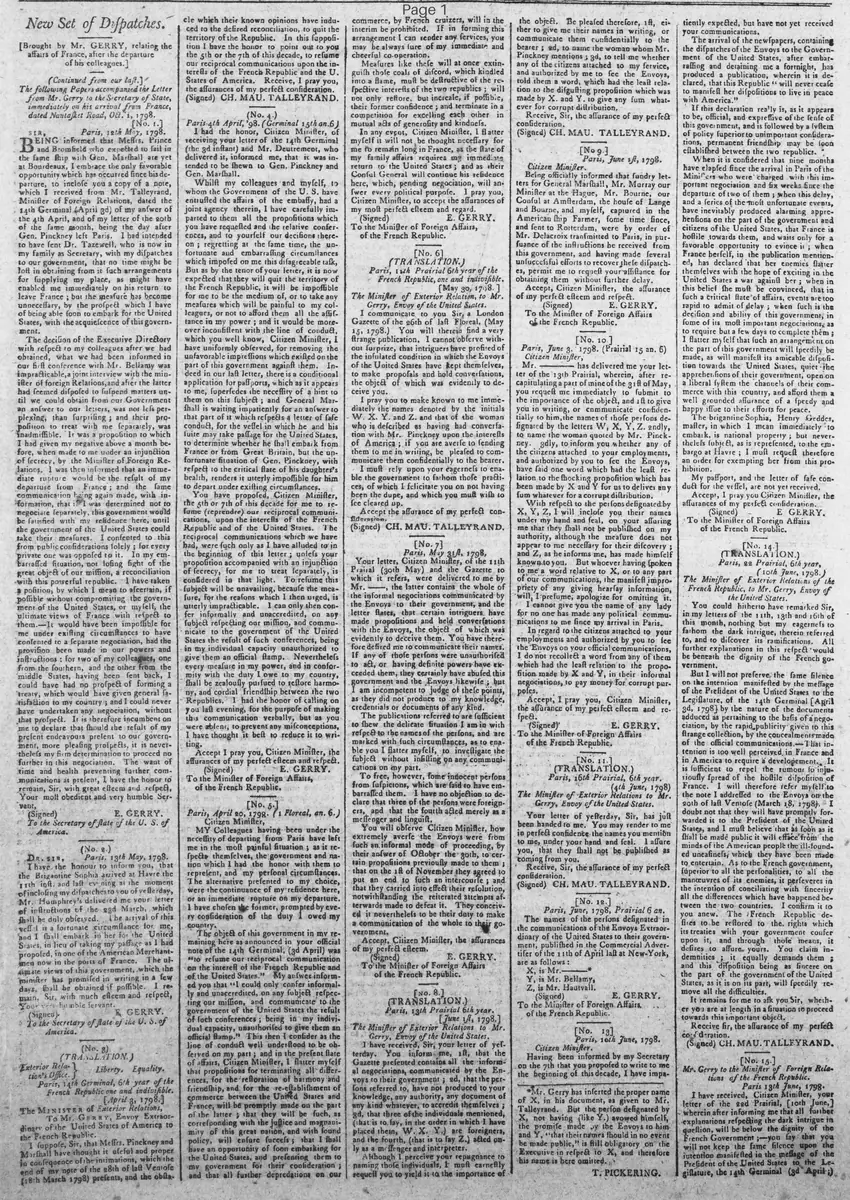
[Brought by Mr. GERRY, relating the affairs of France, after the departure of his colleagues.]
(Continued from our last.)
The following Papers accompanied the Letter from Mr. Gerry to the Secretary of State, immediately on his arrival from France, dated Nantasket Road, Oct. 1, 1798.
[No. 1.]
SIR,
Paris, 12th May, 1798.
BEING informed that Messrs. Pinckney and Marshall who expected to sail in the same ship with Gen. Marshall are yet at Bordeaux, I embrace the only favorable opportunity which has occurred since his departure, to enclose you a copy of a note, which I received from Mr. Talleyrand, Minister of Foreign Relations, dated the 14th Germinal (April 3d) of my answer of the 4th April, and of my letter of the 6th of the same month, being the day after Gen. Pinckney left Paris. I had intended to have sent Dr. Tazewell, who is now in my family as Secretary, with my dispatches to our government, that no time might be lost in obtaining from it such arrangements for supplying my place, as might have enabled me immediately on his return to leave France; but the measure has become unnecessary, by the prospect which I have of being able soon to embark for the United States, with the acquiescence of this government.
The decision of the Executive Directory with respect to my colleagues after we had obtained, what we had been informed in our first conference with Mr. Bellamy was impracticable, a joint interview with the minister of foreign Relations, and after the latter had seemed disposed to suspend matters until we could obtain from our Government an answer to our despatches, was not less perplexing, than surprising; and their proposition to treat with me separately, was inadmissible. It was a proposition to which I had given my negative above a month before, when made to me under an injunction of secrecy, by the Minister of Foreign Relations. I was then informed that an immediate rupture would be the result of my departure from France; and the same communication being again made, with information, that if I was determined not to negotiate separately, this government would be satisfied with my residence there, until the government of the United States could take their measures. I consented to this from public considerations solely; for every private one was opposed to it. In my embarrassed situation, not losing sight of the great object of our mission, a reconciliation with this powerful republic. I have taken a position; by which I mean to ascertain, if possible without compromising the government of the United States, or myself, the ultimate views of France with respect to them. It would have been impossible for me under existing circumstances to have consented to a separate negotiation, had the provision been made in our powers and instructions: for two of my colleagues, one from the southern, and the other from the middle States, having been sent back, I could have had no prospect of forming a treaty, which would have given general satisfaction to my country; and I could never have undertaken any negotiation, without that prospect. It is therefore incumbent on me to declare that should the result of my present endeavours present to our government, more pleasing prospects, it is nevertheless my firm determination to proceed no further in this negotiation. The want of time and health preventing further communications at present, I have the honor to remain, Sir, with great esteem and respect,
Your most obedient and very humble Servant,
(Signed) E. GERRY.
To the Secretary of State of the U. S. of America.
(No. 2.)
SIR,
Paris, 13th May, 1798.
I have the honour to inform you, that the Brigantine Sophia arrived at Havre the 11th inst. and last evening at the moment of enclosing my dispatches to you of yesterday, Mr. Humphreys delivered me your letter of instructions of the 22d March, which shall be duly observed. The arrival of this vessel is a fortunate circumstance for me, and I shall embark in her for the United States, in lieu of taking my passage as I had proposed, in one of the American Merchantmen now in the ports of France. The ultimate views of this government, which the minister has promised in writing in a few days, shall be obtained if possible. I remain, Sir, with much esteem and respect,
Your very humble servant.
(Signed) E. GERRY.
To the Secretary of State of the U. S. of America.
(No. 3)
(TRANSLATION.)
Exterior Relations Office.
Liberty, Equality.
Paris, 19th Germinal, 6th year of the French Republic one and indivisible.
[April 3, 1798.]
The MINISTER of Exterior Relations, To Mr. GERRY, Envoy Extraordinary of the United States of America to the French Republic.
I suppose, Sir, that Messrs. Pinckney and Marshall have thought it as cool and proper in consequence of the intimations, which the end of my note of the 28th of last Ventose (8th March 1798) presents, and the obstacle which their known opinions have induced to the desired reconciliation, to quit the territory of the Republic. In this supposition I have the honor to point out to you the 5th or the 7th of this decade, to resume our reciprocal communications upon the interests of the French Republic and the U. States of America. Receive, I pray you, the assurances of my perfect consideration.
(Signed) CH. MAU. TALLEYRAND.
(No. 4.)
Paris 4th April, '98. (Germinal 15th an.6)
I had the honor, Citizen Minister, of receiving your letter of the 14th Germinal (the 3d instant) and Mr. Deuteremont, who delivered it, informed me, that it was intended to be shown to Gen. Pinckney and Gen. Marshall. Whilst my colleagues and myself, to whom the Government of the U. S. have entrusted the affairs of the embassy, had a joint agency therein, I have carefully imparted to them all the propositions which you have requested and the relative conferences, and to yourself our decisions thereon; regretting at the same time, the unfortunate and embarrassing circumstances which imposed on me this disagreeable task, But as by the tenor of your letter, it is now expected that they will quit the territory of the French Republic, it will be impossible for me to be the medium of, or to take any measures which will be painful to my colleagues, or not to afford them all the assistance in my power; and it would be moreover inconsistent with the line of conduct, which you well know, Citizen Minister, I have uniformly observed, for removing the unfavorable impressions which existed on the part of this government against them. Indeed in our last letter, there is a conditional application for passports, which as it appears to me, supersedes the necessity of a hint to them on this subject; and General Marshall is waiting impatiently for an answer to that part of it which respects a letter of safe conduct, for the vessel in which he and his suite may take passage for the United States, to determine whether he shall embark from France or from Great Britain, but the unfortunate situation of Gen. Pinckney, with respect to the critical state of his daughter's health, renders it utterly impossible for him to depart under existing circumstances.
You have proposed, Citizen Minister, the 5th or 7th of this decade for me to resume (reprendre) our reciprocal communications, upon the interests of the French Republic and of the United States. The reciprocal communications which we have had, were such only as I have alluded to in the beginning of this letter; unless your proposition accompanied with an injunction of secrecy, for me to treat separately, is considered in that light. To resume this subject will be unavailing, because the measure, for the reasons which I then urged, is utterly impracticable. I can only then confer informally and unaccredited, on any subject respecting our mission, and communicate to the government of the United States the result of such conferences, being in my individual capacity unauthorized to give them an official stamp. Nevertheless every measure in my power, and in conformity with the duty I owe to my country, shall be zealously pursued to restore harmony, and cordial friendship between the two Republics. I had the honor of calling on you last evening, for the purpose of making this communication verbally, but as you were absent, to prevent any misconceptions, I have thought it best to reduce it to writing.
Accept I pray you, Citizen Minister, the assurances of my perfect esteem and respect.
(Signed) E. GERRY.
To the Minister of Foreign Affairs of the French Republic.
[No. 5.]
Paris, April 20, 1798. (1 Floreal, an. 6.)
Citizen Minister,
MY Colleagues having been under the necessity of departing from Paris have left me in the most painful situation; as it respects themselves, the government and nation which I had the honor with them to represent, and my personal circumstances. The alternative presented to my choice, were the continuance of my residence here, or an immediate rupture on my departure. I have chosen the former, prompted by every consideration of the duty I owed my country
The object of this government in my remaining here as announced in your official note of the 14th Germinal, (3d April) was "to resume our reciprocal communication on the interests of the French Republic and of the United States." My answer informed you that "I could only confer informally and unaccredited, on any subject respecting our mission, and communicate to the government of the United States the result of such conferences; being in my individual capacity, unauthorized to give them an official stamp." This then I consider as the line of conduct well understood to be observed on my part; and in the present state of affairs, Citizen Minister, I flatter myself that propositions for terminating all differences, for the restoration of harmony and friendship, and for the re-establishment of commerce between the United States and France, will be promptly made on the part of the latter; that they will be such, as corresponding with the justice and magnanimity of this great nation, and with sound policy, will ensure success; that I shall have an opportunity of soon embarking for the United States. and presenting them to my government for their consideration; and that all further depredations on our
commerce, by French cruizers, will in the interim be prohibited. If in forming this arrangement I can render any services, you may be always sure of my immediate and cheerful co-operation.
Measures like these will at once extinguish those coals of discord, which kindled into a flame, must be destructive of the respective interests of the two republics; will not only restore, but increase, if possible, their former confidence; and terminate in a competition for excelling each other in mutual acts of generosity and kindness.
In any event, Citizen Minister, I flatter myself it will not, be thought necessary for me to remain long in France, as the state of my family affairs requires my immediate return to the United States; and as their Consul General will continue his residence here, which, pending negotiation, will answer every political purpose. I pray you, Citizen Minister, to accept the assurances of my most perfect esteem and regard.
(Signed) E. GERRY.
To the Minister of Foreign Affairs, of the French Republic.
[No. 6]
(TRANSLATION.)
Paris, 11th Prairial 6th year of the French Republic, one and indivisible.
[May 30, 1798. ]
The Minister of Exterior Relation, to Mr. Gerry, Envoy of the United States.
I communicate to you Sir, a London Gazette of the 26th of last Floreal, (May 15, 1798.) You will therein find a very strange publication, I cannot observe without surprise, that intriguers have profited of the insulated condition in which the Envoys of the United States have kept themselves, to make proposals and hold conversations, the object of which was evidently to deceive you.
I pray you to make known to me immediately the names denoted by the initials W. X. Y. and Z. and that of the woman who is described as having had conversation with Mr. Pinckney upon the interests of America : if you are averse to sending them to me in writing, be pleased to communicate them confidentially to the bearer.
I must rely upon your eagerness to enable the government to fathom those practices, of which I felicitate you on not having been the dupe, and which you must wish to see cleared up.
Accept the assurance of my perfect consideration.
(Signed) CH. MAU. TALLEYRAND.
[No. 7]
Paris, May 31, 1798.
Your letter, Citizen Minister, of the 11th Prairial (30th May) and the Gazette to which it refers, were delivered to me by Mr. -, the latter contains the whole of the informal negociations communicated by the Envoys to their government, and the letter states, that certain intriguers. have made propositions and held conversations with the Envoys, the object of which was evidently to deceive them. You have therefore desired me to communicate their names.
If any of those persons were unauthorized to act, or having definite powers have exceeded them, they certainly have abused this government and the Envoys likewise : but I am incompetent to judge of these points, as they did not produce to my knowledge, credentials or documents of any kind.
The publications referred to are sufficient to show the delicate situation I am in with respect to the names of the persons, and are marked with such circumstances, as to enable you I flatter myself, to investigate the subject without insisting on any communications on my part.
To free, however, some innocent persons from suspicions, which are said to have embarrassed them. I have no objection to declare that three of the persons were foreigners, and that the fourth acted merely as a messenger and linguist.
You will observe Citizen Minister, how extremely averse the Envoys were from such an, informal mode of proceeding, by their answer of October the 26th, to certain propositions previously made to them ; that on the 1st of November they agreed to put an end to such an intercourse ; and. that they carried into effect their resolution, notwithstanding the reiterated attempts afterwards made to defeat it. They conceived it nevertheless to be their duty to make a communication of the whole to their government.
Accept, Citizen Minister, the assurances of my perfect esteem.
(Signed) E.GERRY.
To the Minister of Foreign Affairs of the French Republic.
[no. 8.]
(TRANSLATION.)
Paris, 13th Prairial 6th year.
[June 1, 1798.]
The Minister of Exterior Relations to Mr. . Gerry, Envoy of the United States.
I have received, Sir, your letter of yesterday. You inform me, it, that the Gazette presented contains all the informal negociations, communicated by the Envoys to their government ; and, that the persons referred to, have not produced to your knowledge, any authority, any document of any kind whatever, to accredit themselves ; and, that three of the individuals mentioned, (that is to say, in the order in which I. have placed them, W. X. Y. are foreigners, and the fourth, (that is to say Z.) acted only as a messenger and interpreter.
Although I perceive your repugnance to naming those individuals, I must earnestly request you to yield it to the importance of the object. Be pleased therefore, 1st. either to give me their names in writing, or communicate them confidentially to the bearer ; 2d, to name the woman whom Mr. Pinckney mentions ; 3d, to tell me whether any of the citizens attached to my service, and authorized by me to see the Envoys, told them a word, which had the least relation to the disgusting proposition which was made by X. and Y. to give any sum whatever for corrupt distribution,
Receive, Sir, the assurance of my perfect consideration.
(Signed) CH. MAU. TALLEYRAND.
[No 9.]
Paris, June 1st, 1798.
Citizen Minister.
Being officially informed that sundry letters for General Marshall, Mr. Murray our Minister at the Hague, Mr. Bourne, our Consul at Amsterdam, the house of Lange and Bourne, and myself, captured in the American ship Farmer, some time since, and sent to Rotterdam, were by order of Mr. Delacroix transmitted to Paris, in pursuance of the instructions he received from this government, and having made several unsuccessful efforts to recover these dispatches, permit me to request your assistance for obtaining them without further delay.
Accept, Citizen Minister, the assurance of my perfect esteem and respect.
(Signed) E.GERRY.
To the Minister of Foreign Affairs of the French Republic.
[No. 10.]
Paris, June 3. 1798. (Prairial 15 an. 6)
Citizen Minister,
Mr. has delivered me your letter of the 13th Prairial, wherein, after recapitulating a part of mine of the 31st of May, you request me immediately to submit to the importance of the object, and 1st to give you in writing, or communicate confidentially to him,the names of those persons designated by the letters W, X, Y. Z. 2dly, to name the woman quoted by Mr. Pinckney. 3dly, to inform you whether any of the citizens attached to your employments, and authorized by you to see the Envoys, have said one word which had the least relation to the shocking proposition which has been made by X and Y for us to deliver any sum whatever for a corrupt distribution.
With respect to the persons designated by X, Y, Z, I will enclose you their names under my hand and seal, on your assuring me that they shall not be published on my authority, although the measure does not appear to me necessary for their discovery ; and Z, as he informs me, has made himself known to you. But whoever having spoken to me a word relative to X, or to any part of our communications, the manifest impropriety of any giving hear-say information, will, I presume, apologize for omitting it.
I cannot give you the name of any lady for no one has made any political communications to me since my arrival in Paris.
In regard to the citizens attached to your employments and authorized by you to see the Envoys on your official communications, I do not recollect a word from any of them which had the least relation to the proposition made by X and Y, in their informal negotiations, to pay money for corrupt purposes.
Accept, I pray you, Citizen Minister, the assurance of my perfect esteem and respect.
(Signed) E. GERRY.
To the Minister of Foreign Affairs of the French Republic.
[No. 11.]
(TRANSLATION.)
Paris, 16th Prairial, 6th year.
(4th June, 1798)
The Minister of Exterior Relations to Mr. Gerry, Envoy of the United States.
Your letter of yesterday, Sir, has just been handed to me. You may render to me in perfect confidence the names you mention to me, under your hand and seal. I assure you, that they shall not be published as coming from you.
Receive, Sir, the assurance of my perfect consideration.
(Signed) CH. MAU. TALLEYRAND.
[No. 12.]
Paris, June, 1798, Prairial 6 an.
The names of the persons designated in the communications of the Envoys Extraordinary of the United States to their government, published in the Commercial Advertiser of the 11th of April last at New-York, are as follows :
X, is Mr.
Y, is Mr. Bellamy
Z, is Mr. Hautevall.
(Signed) E.GERRY.
To the Minister of Foreign Affairs, of the French Republic.
[No. 13]
Paris, 10th June, 1798.
Citizen Minister.
Having been informed by my Secretary on the 7th that you proposed to write to me the beginning of this decade, I have impatiently expected, but have not yet received your communications.
The arrival of the newspapers, containing the dispatches of the Envoys to the Government of the United States, after embarrassing and detaining me a fortnight, has produced a publication, wherein it is declared, that this Republic " will never cease to manifest her dispositions to live in peace with America."
If this declaration really is, as it appears to be, official, and expressive of the sense of this government, and is followed by a system of policy superior to unimportant considerations, permanent friendship may be soon established between the two republics.
When it is considered that nine months have elapsed since the arrival in Paris of the Ministers who were charged with this important negociation and 6 weeks since the departure of two of them ; when this delay, and a series of the most unfortunate events, have inevitably produced alarming apprehensions on the part of the government and citizens of the United States, that France is hostile towards them, and waits only for a favorable opportunity to evince it; when France herself, in the publication mentioned, has declared that her enemies flatter themselves with the hope of exciting in the United States a war against her ; when in this belief she must be convinced, that in such a critical state of affairs, events are too rapid to admit of delay ; when such is the decision and ability of this government, in some of its most important negociations, as to require but a few days to complete them ; I flatter myself that such an arrangement on the part of this government will speedily be made, as will manifest its amicable disposition towards the United States, quiet the apprehensions of their government, open on a liberal system the channels of their commerce with this country, and afford them a well grounded assurance of a speedy and happy issue to their efforts for peace.
The brigantine Sophia, Henry Geddes, master, in which I mean immediately to embark, is national property ; but nevertheless subject, as is represented, to the embargo at Havre ; I must request therefore an order for exempting her from this prohibition.
My passport, and the letter of safe conduct for the vessel, are not yet received.
Accept, I pray you Citizen Minister, the assurances of my perfect consideration.
(Signed) E GERRY.
To the Minister of Foreign Affairs of the French Republic.
[No. 14.]
(TRANSLATION.)
Paris, 22 Prairial, 6th year,
(10th June, 1798.)
The Minister of Exterior Relations of the French Republic, to Mr. Gerry, Envoy of the United States.
You could hitherto have remarked Sir, in my letters of the 11th, 13th and 16th of this month, nothing but my eagerness to fathom the dark intrigue, therein referred to, and to discover its ramifications. All further explanations in this respect would be beneath the dignity of the French government.
But I will not preserve the same silence on the intention manifested by the message of the President of the United States to the Legislature, of the 14th Germinal April 3d, 1798] by the nature of the documents adduced as pertaining to the basis of a negotiation, by the rapid publicity given to this strange collection, by the concealments made of the official communications. This intention is too well perceived in France and in America to require a development. It is sufficient to repel the rumour so injuriously spread of the hostile disposition of France. I will therefore refer myself to the note I addressed to the Envoys on the 20th of last Ventose (March 18, 1798). I doubt not that they will have promptly forwarded it to the President .of the United States, and I must believe that as soon as it shall be made public it will efface from the minds of the American people the ill-founded uneasiness, which they have been made to entertain. As to the French government, superior to all the personalities, to all the manoeuvres of its enemies, it perseveres in the intention of conciliating with sincerity all the differences which have happened between the two countries. I confirm it to you anew. The French Republic desires to be restored to the. rights which its treaties with your government confer upon it, and through those means, it desires to assure. yours. You claim indemnities : it equally demands them ; and this disposition being as sincere on the part of the government of the United States, as it is on its part, will speedily remove all the difficulties.
It remains for me to ask you Sir. whether you are at length in a situation to proceed towards this important object.
Receive ir, the assurance of my perfect consideration.
(Signed) CH.MAU.TALLEYRAND.
[No. 15.]
Mr. Gerry to the Minister of Foreign Relations of the French Republic.
Paris 13th June, 1798.
I have received, Citizen Minister, your letter of the 22d Prairial, 10th June, wherein after informing me that all further explanations respecting the dark intrigue in question, will be below the dignity of the French Government ;-you say that you will not keep the same silence upon the intention manifested in the message of the President of the United States to the Legislature, the 14th Germinal (3d April;)
in the nature of the pieces produced
as forming part of a negociation; in
a rapid publicity given to this strange
collection : and in the concealment of
official communications, by which, in
the subsequent part of your letter, you
allude to your note to the Envoys of
the 28th Ventose (8th March last.
If the wishes and interest of the two
Republics call loudly for an accom-
modation of their differences, (and of
this, the government of France, as well
as that of the United States, appears to
be convinced,) is not a restoration of
friendship between them, one of the
most direct means for accomplishing
that most desirable object ? And is it
not altogether neglected ? The un-
founded prejudices against the Presi-
dent of the United States, in regard
to his message, will be manifest, by
comparing it with his official duty,
designated by the Constitution and
also by referring to the dates of your
note and of his message ; whereby it
will appear that the latter was but
sixteen days later than the former, and
that it was impossible that the Presi-
dent could have received your note,
or concealed it from the public. The
Government of the United States,
pure in its principles, just in its objects,
and wise in its counsels, is also superi-
or to all personalities : and I wish
these may forever cease ; for sure I
am that from such a source, no good
but infinite injuries, may result to the
two republics.' You conceive that
your note, which was duly transmit-
ted by the Envoys to the Govern-
ment, when published will efface from
the minds of the American people
their unfounded inquietude. Of this
I can form no judgment ; but before
you addressed that note to the envoys
the proposition therein contained had
been made to me to treat separately,
and I had stated, that the measure
was in itself impolitic, and as it re-
spected myself, impossible.
I have nevertheless, contrary to my
wishes and interests complied with
your subsequent proposition for re-
maining here to prevent a rupture. I
have been happy, since, by your re-
peated assurances, that this Govern-
ment was sincerely disposed to recon-
cile all differences between the two
countries, and probably would soon
make an arrangement adequate to the
object ; indeed I had great rea-
son to hope, that I should have been
furnished with a copy of it before my
leaving Paris, and I earnestly wished
it, lest the disappointment which
might result from my return to the
United States without it, should pro-
duce unhappy effects : but the vessel
in which I am to embark, being rea-
dy for sea, waits only my arrival at
Havre with the requisite documents
for the voyage.
The sincerity of the disposition of
the Government of the United States,
to meet this Government on the
ground of the existing treaties between
the two countries, and to do justice to
France, as well as to receive it from
her, is too evident to admit for a mo-
ment of the least doubt ; but I again
repeat, that I have no powers to en-
ter on the negociation. Nevertheless.
the proposed arrangement might be
made by this Government, and a Min-
ister be sent to America to complete
it : as it is of little consequence to ei-
ther, in which nation the negociation
is concluded, but of great importance
to both that it should terminate in an
immediate accommodation, and in the
restoration of their friendship. I pre-
sume that in this our wishes are alike
sincere and ardent, and that the mag-
nanimous policy of this Government
to persevere in the intention to recon-
cile with sincerity all the differences
between the two countries, will have
a speedy and happy effect.
Accept, Citizen Minister, the assur-
ances of my perfect respect.
(Signed)
E.GERRY.
(To be continued.)
Secretary Pickering's
REPORT
CONGRESS.
HOUSE OF REPRESENTATIVES.
MONDAY, JAN. 21.
The following message was this
day received from the President
of the United States.
Gentlemen of the Senate, and
Gentlemen of the House of Representatives,
According to an intimation in my
message of Friday last, I now lay be-
fore Congress a report of the Secretary
of State, containing his observations
on some of the documents which at-
tended it.
JOHN ADAMS.
Jan. 21, 1799.
To the PRESIDENT of the U. S.
The Secretary of State respectfully
submits the following report on the
transactions relating to the United
States and France since the last com-
munications to Congress on that sub-
ject.
TIMOTHY PICKERING.
Department
0
REPORT.
Of the Secretary of State, on the Tran-
actions relating to the United States
and France, since the last communica-
tions to Congress on that subject.
The points chiefly meriting atten-
tion, are the attempts of the French
government
I. To exculpate itself from the
charge of corruption, as having de-
manded a douceur of Fifty Thousand
Pounds sterling (222,000 dollars) for
the pockets of the Directors and Mini-
sters, as represented in the dispatches
of our Envoys.
II. To detach Mr. Gerry from his
colleagues, and to inveigle him into a
separate negociation ; and
III. Its design, if the negociation
failed, and a war should take place
between the United States and France,
to throw the blame of the rupture on
the United States.
1. The dispatches of the Envoys
published in the United States, and re-
published in England, reached Paris
towards the last of May ; and on the
30th of that month, the French Minis-
ter, Mr. Talleyrand, affecting an en-
tire ignorance of the persons desig-
nated by the letters W. X. Y. and Z-
calling them intriguers, whose object
was to deceive the Envoys writes to
Mr. Gerry, and " prays him immedi-
ately to make known to him their
names"
Mr. Gerry, in his answer of the 31st,
wishes to evade Mr. Talleyrand's re-
quest ; and with reason; for he and his
colleagues had " promised Messrs. X.
and Y. that their names should in no
event be made public." Mr. Gerry
in his letter of October 1, in noting
the repetition of Mr. Talleyrand's re-
quest for those names, states as an ob-
jection to giving them up " that they
could be otherwise ascertained ;" and
that Mr. Talleyrand's messenger, ad-
mitting the fact that they were already
known, immediately mentioned their
names. Mr. Gerry nevertheless cer-
tified in writing the names of X. Y.
and Z. with the reserve " that they
should not be published on his autho-
rity ;" and besides formally certify-
ing to Mr. Talleyrand the names of
his own private agents, added, that
" they did not produce, to his know-
ledge credentials or documents of any
kind." "Credentials" in writing were
certainly not to be expected to be pro-
duced by agents employed to make
corrupt propositions ; but Mr. Gerry
had Mr. Talleyrand's own assurance
that Mr. Y. was acting by his authori-
ty. It is recited in the Envoys dis-
patches, and upon Mr. Gerry's own
report to his colleagues, that on the
17th of Dec. 1797, Mr. Y. " stated to
him that two measures which Mr.
Talleyrand proposed, being adopted,
a restoration of friendship between the
republics would follow immediately ;
the one was a gratuity of fifty thousand
pounds sterling ; the other a purchase
of thirty-two millions of Dutch re-
criptions," and after conversing on
these topics, Mr. Gerry and Mr. Y.
rode to Mr. Talleyrand's office, where
"Mr. Gerry observed to Mr. Talley.
rand, that Mr. Y. had stated to him
that morning some propositions as
coming from Mr. Talleyrand, respect-
ing which, Mr. Gerry could give no
opinion," and after making some other
observations, Mr. Talleyrand answer-
ed, "that the information Mr. Y. had
given him (Mr. Gerry) was just and
might always be relied on."--This de-
claration stamps with the Minister's au-
thority, all the communications made
by Mr. Y. to the envoys. And Mr.
Y. himself, who is Mr. Bellamy of
Hamburgh, in his public vindication,
declares, that " he had done nothing,
said nothing, written nothing, without
the orders of citizen Talleyrand."
The same may be asserted in regard
to Mr. X. for he first introduced Mr.
Y. to the Envoys ; and his separate
communications were substantially the
same with those of Y. and both together
were present with the Envoys when
the communications were more than
once repeated.
It also deserves notice, that in stating
the preliminary demands of the French
government, the private agents, X.
and Y. and the minister, use a similar
language. The agents declare, that
the Directory are extremely irritated
at the speech of the President, and re-
quire a explanation of some parts of
it, and reparation for others ; that
this must give pain to the Envoys,
but the Directory would not dispense
with it : And that as to the means of
averting the demand concerning the
President's speech, the Envoys must
search for them, and propose them,
themselves. Being asked to suggest
the means, the answer is "money"
the purchase of the Dutch inscriptions,
and "the fifty thousand pounds ster-
ling, as a douceur to the Directory."
The Minister told the envoys that
the directory were wounded by the
President's speech ; and in his conver-
sation with Mr. Gerry on the 28th
of October, said "the directory had
passed an arret, which they offered for
of the envoys an explanation of some
parts, and a reparation for others of
the President's speech to Congress of
the 16th of May, 1797 ; that he was
sensible that difficulties would exist on
the part of the envoys relative to this
demand ; but that by their offering
money, he thought he could prevent
the effect of the arret. Mr. Z. (the
"interpreter") at the request of Mr.
Gerry, having stated that the envoys
have no such power ; Mr. Talley.
rand replied, they can in such case
take a power on themselves, and pro-
posed that they should make a "loan."
But this "loan," as will presently ap-
pear, did not mean the " money"
which would prevent the effect of
the arret." Mr. Gerry then making
some observations on the powers of
the envoys--that they "were adequate
to the discussion and adjustment of all
points of real difference between the
two nations ; that they could alter
and amend the treaty ; or if neces-
sary form a new one, added "that as to
a loan they had no powers whatever
to make one, but that they could send one
of their number for instructions on this
proposition, if deemed expedient."
that as he (Mr. Talleyrand) had ex-
pressed a desire to confer with the en-
voys individually, it was the wish of
Mr. Gerry that such a conference
should take place, and their opinions
thus be ascertained." "Mr. Talley-
rand in answer, said he should be glad
to confer with the other envoys indi-
vidually. but that this matter about the
money must be settled directly, without
sending to America : that he would
not communicate the arret for a week:
that if we could adjust the difficulty
respecting the speech, an application
would nevertheless go to the United
States for a Loan :" Now this mat-
ter of the money must be settled directly
could only refer to the douceur ; for a
loan, in the purchase of millions of
Dutch inscriptions, or in any other
form, could only be the subject of a
stipulation to be afterwards fulfilled by
the United States : but the douceur of
fifty thousand pounds sterling, was a
sum within the immediate reach of
the envoys ; for their credit would
certainly command it : in fact, a mer-
cantile house had offered to answer
their draughts : and this Mr. Talley-
rand unquestionably well knew ; for
it was a member of the same house
who first introduced the minister's a-
gent Mr. X. to General Pinckney, in
the manner stated in the envoys dis-
patches. A collateral evidence that
in "this matter of the money that
must be settled directly." Mr. Tal-
leyrand referred only to the douceur
arises from this circumstance. The
very next day (October 29th) Mr. X.
called on the envoys and said, "Mr.
Talleyrand was extremely anxious to
be of service to them and had requested
that one more effort should be
made to induce us to enable him to
be so." After a great deal of the
same conversation which had passed
at former interviews had been repeat-
ed, the envoys say-"the sum of his
proposition was, that if we would pay
by way of fees (that was his expre-
sion the sum of money demanded for
PRIVATE USE the directory would not
receive us, but would permit us to re-
main in Paris as we now were; and
we should be received by Mr. Talley-
rand, until one of us could go to Ame-
rica and consult our government on the
subject of a Loan."
Although the envoys dispatches, and
the facts and circumstances herein be-
fore stated, cannot leave a doubt that
X. as well as Y. & Z. was well known
to Mr. Talleyrand, it will not be amis
to add, that on the 2d of December X.
Y. and Z. dined together at Mr. Tal-
·leyrand's in company with Mr. Gerry ;
and that after rising from table, the
money propositions, which had before
been made, were repeated, in the room
and in the presence, though perhaps
not in the hearing of Mr. Talleyrand,
Mr. X. put the question to Mr. Gerry
in direct terms, either " whether the
envoys would now give the douceur,"
or whether they had got the money
ready." Mr. Gerry very justly offend-
ed, answered positively in the nega-
tive : and the conversation dropped.
Mr. Z. who has avowed himself to
be Mr. Hauteval. was the person who
first made known to the envoys the min-
ister's desire to confer with them indi-
vidually on the objects of their mi-
sion ; He it was who first introduced
Mr. Gerry to Mr. Talleyrand, and
served as the interpreter of their con-
versations : and in his letter to Mr.
Talleyrand at the close of Mr. Gerry's
documents No. 35, he announces him-
self to be the agent of the minister, to
make communications to the envoys.
. Mr. Hauteval declares " his sensibility must be much affected on finding
himself, under the letter Z. acting a
part in company with certain intri-
guers, whose plan (he says) it doubtless
was to take advantage of the good
faith of the American envoys, and
make them their dupes" ; yet this
person,--the avowed agent of the
French minister, apparently so anx.
ious to screen himself from the su-
picion of an agency in soliciting the
bribe required by Mr. Talleyrand, did
himself urge a compliance with that
corrupt proposition.*
The sensation which these details ir-
resistible excite, is that of astonishment,
at the unparalleled effrontery of Mr.
Talleyrand in demanding of Mr. Ger-
ry the names of X. Y. and Z. after Y.
had accompanied him on a visit to
the minister, with whom the convera-
tion detailed in the printed dispatches
then passed ; and who then assured
Mr. Gerry " that the information
Mr. Y. had given him was just, and
might always be relied on." After
Z. had in the first instance introduced
Mr. Gerry to the minister, and served
as their mutual interpreter, and when
the conversation between them had
also been stated in the dispatches : and
after X. Y. and Z. had all dined to-
gether with Mr. Gerry at Mr. Tal-
leyrand's table, on rising from which
X. and Y. renewed the proposition
about the Money !-The very circum-
stance of Mr. Talleyrand's being con-
tinued in office after the account of
these intrigues had been published to
the world, is a decisive proof that
they were commenced and carried on
with the privity and by the secret or-
ders of the directory. It was to ac-
complish the object of these intrigues
that the American envoys were kept
at Paris unreceived, six months after
their credentials had been laid before
the directory : and it was only because
they were superior to those intrigues,
and that no hopes remained of wheed-
ling or terrifying them into a compli-
ance, that two of them were sent a-
way--and with marks of insult and
contempt.
2. The fact that the French Go-
vernment attempted to inveigle Mr.
Gerry into a separate negociation will
not be questioned : At first it was
made privately, and under an injunc-
tion of secrecy towards his colleagues :
It was afterwards plainly insinuated
by the Minister, in his letter of the
18th of March, 1798, in which he tells
the Envoys that the Executive Direc-
tory was disposed to treat with one
of the three ; and that one he openly
avowed, in his letter of the 3d of A-
pril, to be Mr. Gerry. The pretence
for electing him was that his " opin-
ions presumed to be more impartial,
promised, in the course of the explan-
ations, more of that reciprocal confi-
dence which was indispensable." But
when before, have their " opinions"
been stated as a justifiable ground for
rejecting the ambassadors of peace ?
Ambassadors too, of established pro-
bity, whose characters were of the first
distinction in their own country, and
whose demeanor towards the govern-
ment to which they were deputed,
was decent and respectful? Who had
with a frankness which the candor of
their instructions warranted, commu-
nicated the important points which
they contained ? And who unremit-
tingly, and with the most anxious
solicitude, entreated that the negocia-
tions might be commenced? What
more proper or more honorable qual-
ities ought Ministers deputed to nego-
ciate with a foreign nation to possess ?
But why should a foreign Govern-
ment question the opinions of the Am-
bassadors sent to negociate with it on
subjects of difference between the two
nations ? If wisely chosen, and faith-
ful to the interests of their own coun-
try, they must of course possess differ-
ent opinions from the Government, to
which they were sent, the differing
opinions maintained by the two na-
tions on their respective rights and in-
terests, being the cause and objects of
the negociation. A government really
disposed to treat on fair principles
would never object to the opinions of
foreign ambassadors. It would re-
ceive them, and appoint its own Min-
isters with proper powers to treat with
them, propose its terms, and receive
those offered ; and discuss both, and
if then they could not agree, put an
end to the negociation. The French
Government did not wish to negociate,
it desired to impose a treaty on the
United States. To this practice it
had been accustomed towards the
minor powers in Europe, whom it has
subjected to its will; and it expected
equal submission from the United
States. Hence Mr. Talleyrand's se-
cret declaration to Mr. Gerry " that
if he would negociate, they could soon
finish a treaty; for the Executive Direc-
tory were not in the habit of spending much
time about such matters." Hence the
objections to Gen. Pinckney and Gen.
Marshall : They manifested a discern-
ment superior to the intrigues of the
French Government, and an invinci-
ble determination not to surrender
the honor, the interest or the Independ-
ence of their country. It was neces-
sary then to get rid of them ; and see-
ing that neither despair of negotiating,
nor studied indignities could induce
* Extract of a letter, dated June 15th, 1798,
from Mr. King, minister of the United
States in London to the secretary of state.
" Col. Trumbull who was at Paris, soon
after the arrival there of the commissioners,
has more than once informed me, that Haute-
val told him that both the douceur and the
loan were indispensable; and urged him to
employ his influence with the American com-
missoners to offer the bribe as well as the loan.
them to quit their posts, passports
were sent to them to quit France ; it
was with difficulty that Gen. Pinck-
ey could obtain permission to stay
two or three months for the recovery
of his sick daughter, to whom an im-
mediate voyage would probably prove
fatal. Unembarrassed by the presence
of these Envoys, the French Govern-
ment, if it really desired a treaty on
any terms, hoped to prevail on Mr.
Gerry to negociate separately, al-
though from the first overture he de-
clined, and continued to decline it.
But after the expulsion of his col-
leagues, it hoped by its seductive arts,
to prevail over his scruples, and gain
his consent to terms which, while they
were present, would be rejected ; or at
all events to retain him, with the em-
blance of negotiating, regularly or
informally, and thus keep the United
States in the torpor of indecision,
without preparation for offence or de-
fence.' Unfortunately, Mr. Gerry
was induced, by the threats of imme-
diate war against the United States,
to separate from his colleagues and
stay in Paris : threats, which viewed
with their motives, merited only de-
testation and contempt. Four or five
months before, the threats of immedi-
ate orders to quit France, and the ter-
ors of war in its most dreadful forms,
had been held up to all the Envoys,
to frighten them into a compliance
with the groundless, unjust and cor-
rupt demands of the French Govern-
ment. Those threats had not been ex-
executed, and the unworthy purposes
for which they had been uttered, had
been obvious. Happily for the Uni-
ted States, the character of the French
government as delineated in the offi-
cial dispatches of all the Envoys, and
the knowledge of its conduct towards
other countries whose governments it
had overturned, and whose people in
the names of Liberty and Equality,
it had enslaved, so operated as not to
leave us exposed to all the evils which
supineness was calculated to produce.
Mr. Gerry indeed resisted all the arts
of the French Minister to entice him
into a formal negociation, after that
government had driven his colleagues
from Paris ; a negociation which in
its nature would have been a surren-
der of our independence, by admitting
a foreign government to choose for us
the Minister who should represent our
country, and to treat of our impor-
tant rights and interests, which that
government had itself violated and
deeply injured.
The Directory and their Minister
Mr. Talleyrand hoped and expected
that Gen. Pinckney and Gen. Marshall
would voluntarily have quitted
France, after the Minister's letter of
the 18th of March, in which he made
the offensive distinction between them
and their colleague Mr. Gerry, on
the pretence that his " opinions" were
more " impartial" than theirs. Ac-
cordingly Mr. Talleyrand, in his let-
ter to Mr. Gerry of the third of A-
pril, says--I suppose, Sir, that Messrs.
Pinckney and Marshall have thought
it useful and proper, in consequence
of the intimations which the end of
my note of the 18th of March last pre-
sents, to quit the territory of the
Republic." Yet Mr. Talleyrand had
given them neither passports nor let-
ters of safe conduct ! The fact is, the
French Government wished to avoid
the odium of sending them away and
the blame of a rupture, which Mr.
Talleyrand predicted would be the
consequence ; while it was privately
intimated to them that they must leave
the country. The Minister's conduct
on this occasion towards Gen. Marshall
as detailed in his journal) was par-
ticularly marked with indignities.-
When it was observed to Mr. Talley-
rand that this was not the manner
in which a foreign Minister ought to
be treated, Mr. Talleyrand replied,
that General Marshall was not a
foreign Minister, but was to be con-
sidered as a private American Citizen ;
and must obtain a passport, like
others, through the Consul. To this
it was answered, that General Marshall
was a foreign Minister, * and that the
French government could not deprive
him of that character, which was confer-
red upon him, not by Mr. Talleyrand,
but by the United States ; though the
Directory might refuse to receive or
to treat with them, still his country had
cloathed him with the requisite pow-
ers, which he held independently of
France ; that if he was not accepta-
ble to the French government, and in
consequence thereof it was determin-
ed to send him away, still he ought
to be sent away like a Minister, that
he ought to have his passports, with
letters of safe conduct which would
protect him from the cruifers of
France. Mr. Talleyrand replied, that
if General Marshall wished for a pai-
* On the 9th of Oct. 1797, the day after
the Envoys had delivered to the minister a
copy of their letter of credence, " cards of
hospitality were sent to them and their Secre-
taries, in a style suitable to their official
character." Dispatches p. 17.] And in the
minister's letter to them of the 18th of March,
1798. he calls them " the Commissioners and
Envoys Extraordinary of the United States
of America." Disp. page 96,.
port, he must give in his name, stature, age, complexion, &c. to the American consul, who would obtain a passport for him: that with respect to a letter of safe conduct, it was unnecessary, as no risk from the cruisers would be incurred.
The result of these conversations was, a plain demonstration of the intention of the Minister, that in consequence of his intimation at the close of his letter of the 15th of March, that the "opinions" of two of the envoys were not agreeable to the Government of France. Generals Pinckney and Marshall should appropriate to themselves the character which the Minister had drawn generally; the envoys aware of the snare, in their answer of the third of April to the intimation that "the Directory was disposed to treat with one of the envoys," declare to the Minister, "that no one of the Envoys was authorized to take upon himself a negotiation evidently entrusted to the whole;" and "that no two of them could propose to withdraw themselves from the task committed to them by their government while there remained a possibility of performing it;" but that if it should be the will of the Directory "to order passports for the whole or any number of them," it was desired that such passports might be accompanied with letters of safe conduct, to protect them against the cruisers of France.
[To be continued]
What sub-type of article is it?
What keywords are associated?
What entities or persons were involved?
Where did it happen?
Foreign News Details
Primary Location
Paris
Event Date
March June 1798
Key Persons
Outcome
gerry refuses separate negotiation and formal powers; discloses names of agents x (mr. [redacted]), y (mr. bellamy), z (mr. hautevall) under seal; french government denies corruption and insists on reconciliation via treaties and indemnities; negotiations stall amid mutual accusations.
Event Details
US Envoys Pinckney, Marshall, and Gerry face French demands for bribes (50,000 pounds sterling) and loans via agents X, Y, Z acting for Talleyrand. Pinckney and Marshall depart; Gerry stays to avert rupture, engages in informal talks, resists separate negotiation, and corresponds with Talleyrand on restoring friendship, commerce, and addressing XYZ intrigue. Pickering's report exposes French attempts to corrupt, divide envoys, and blame US for potential war.