Thank you for visiting SNEWPapers!
Sign up free
American Citizen
Canton, Madison County, Mississippi
What is this article about?
An opinion piece from the Memphis Appeal argues for importing Chinese laborers to the post-Civil War South to replace unreliable black labor and unsuitable white labor for agriculture, citing climate similarities, Chinese industriousness in California and elsewhere, and economic necessity for cotton, rice, and sugar production.
Clipping
OCR Quality
Full Text
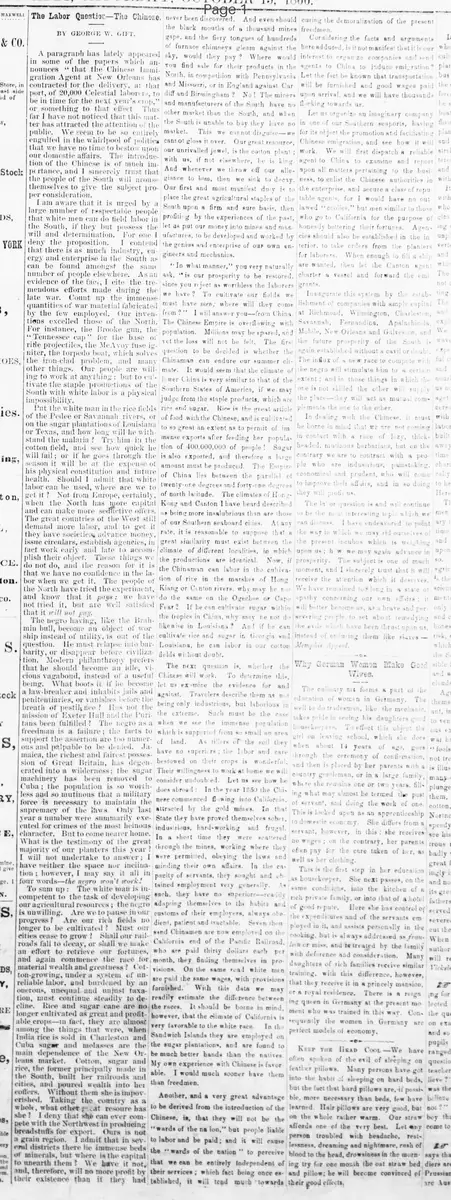
I am aware that it is urged by a large number of respectable people that white men can do field labor in the South, if they but possess the will and determination. For one I deny the proposition. I contend that there is as much industry, energy and enterprise in the South as can be found amongst the same number of people elsewhere. As an evidence of the fact, I cite the tremendous efforts made during the late war. Count up the immense quantities of war material fabricated by the few employed. Our inventions excelled those of the North. For instance, the Brooke gun, the "Tennessee cap" for the base of rifle projectiles, the McAvoy fuse, niter, the torpedo boat, which solves the iron-clad problem, and many other things. Our people are willing to work at anything; but to cultivate the staple productions of the South with white labor is a physical impossibility.
Put the white man in the rice fields of the Pedee or Savannah rivers, or on the sugar plantations of Louisiana or Texas, and how long will he withstand the malaria? Try him in the cotton field, and see how quick he will fail; or if he goes through the season it will be at the expense of his physical constitution and future health. Should I admit that white labor can be used, where are we to get it? Not from Europe, certainly, when the North has more capital and can make more seductive offers. The great countries of the West still demand more labor, and to get it they have societies, advance money, issue circulars, establish agencies, in fact work early and late to accomplish their object. These things we do not do, and the reason for it is that we have no confidence in the labor when we get it. The people of the North have tried the experiment, and know that it pays; we have not tried it, but are well satisfied that it will not pay.
The negro having, like the Brahmin bull, become an object of worship instead of utility, is out of the question. He must relapse into barbarity, or disappear before civilization. Modern philanthropy prefers that he should become an idle, vicious vagabond, instead of a useful being. What boots it if he become a law-breaker and inhabits jails and penitentiaries, or vanishes before the breath of pestilence? Has not the mission of Exeter Hall and the Puritans been fulfilled? The negro as a freedman is a failure; the facts to support the assertion are too numerous and palpable to be denied. Jamaica, the richest and fairest possession of Great Britain, has degenerated into a wilderness; the sugar machinery has been removed to Cuba; the population is so worthless and so mutinous that a military force is necessary to maintain the supremacy of the laws. Only last year a number were summarily executed for crimes of the most heinous character. But to come nearer home. What is the testimony of the great majority of our planters this year? I will not undertake to answer: I have neither the space nor inclination; however, I may say it all in four words—the negro won't work!
To sum up: The white man is incompetent to the task of developing our agricultural resources; the negro is unwilling. Are we to pause in our progress? Are our rich fields no longer to be cultivated? Must our cities cease to grow? Shall our railroads fall to decay, or shall we make an effort to retrieve our fortunes, and again commence the race for material wealth and greatness? Cotton-growing, under a system of unreliable labor, and burdened by an onerous, unequal and unjust taxation, must continue steadily to decline. Rice and sugar cane are no longer cultivated as great and profitable crops—in fact, they are almost among the things that were, when India rice is sold in Charleston and Cuba sugar and molasses are the main dependence of the New Orleans market. Cotton, sugar and rice, the former principally made in the South, built her railroads and cities, and poured wealth into her coffers. Without them she is impoverished. Taking the country as a whole, what other great resource has she? I deny that she can ever compete with the Northwest in producing breadstuffs for export. Ours is not a grain region. I admit that in several districts there lie immense beds of minerals, but where is the capital to unearth them? We have it not, and, therefore, will no more profit by their existence than if they had never been discovered. And even should the black mouths of a thousand mines gape, and the fiery tongues of hundreds of furnace chimneys gleam against the sky, would they pay? Where would you find sale for their products in the North, in competition with Pennsylvania and Missouri, or in England against Cardiff and Birmingham? No! The miners and manufacturers of the South have no other market than the South, and when the South is unable to buy they have no market. This we cannot disguise—we cannot gloss it over. Our great resource, our unrivalled jewel, is the cotton plant: with us, if not elsewhere, he is king. And whenever we throw off our allegiance to him, then we sink to decay. Our first and most manifest duty is to place the great agricultural staples of the South upon a firm and sure basis, then profiting by the experiences of the past, let us put our money into mines and manufactures, to be developed and worked by the genius and enterprise of our own engineers and mechanics.
"In what manner," you very naturally ask, "is our prosperity to be restored, since you reject as worthless the laborers we have? To cultivate our fields we must have men; where will they come from?" I will answer you—from China. The Chinese Empire is overflowing with population. Millions may be spared, and yet the loss will not be felt. The first question to be decided is whether the Chinaman can endure our summer climate. It would seem that the climate of lower China is very similar to that of the Southern States of America, if we may judge from the staple products, which are rice and sugar. Rice is the great article of food with the Chinese, and is cultivated to so great an extent as to permit of immense exports after feeding her population of 400,000,000 of people! Sugar is also exported, and therefore a large amount must be produced. The Empire of China lies between the parallel of twenty-three degrees and forty-one degrees of north latitude. The climates of Hong Kong and Canton I have heard described as being more insalubrious than are those of our Southern seaboard cities. At any rate, it is reasonable to suppose that a great similarity must exist between the climate of different localities, in which the productions are identical. Now, if the Chinaman can labor in the cultivation of rice in the marshes of Hong Kiang or Canton rivers, why may he not do the same on the Ogeechee or Cape Fear? If he can cultivate sugar within the tropics in China, why may he not do likewise in Louisiana? And if he can cultivate rice and sugar in Georgia and Louisiana, he can labor in our cotton fields without doubt.
The next question is, whether the Chinese will work. To determine this, let us examine the evidence for and against. Travelers describe them as not being only industrious, but laborious in the extreme. Such must be the case when we see the immense population which is supported from so small an area of land. As tillers of the soil they have no superiors; the labor and care bestowed on their crops is wonderful. Their willingness to work at home we will consider undoubted. Let us see how he does abroad: In the year 1850 the Chinese commenced flowing into California, attracted by the gold mines. In that State they have proved themselves sober, industrious, hard-working and frugal. In a short time they were scattered through the mines, working where they were permitted, obeying the laws and minding their own affairs. In the capacity of servants, they sought and obtained employment very generally. As such, they have no superiors—readily adapting themselves to the habits and customs of their employers, always obedient, patient and tractable. Seven thousand Chinamen are now employed on the California end of the Pacific Railroad, who are paid thirty dollars each per month, they finding themselves in provisions. On the same road white men are paid the same wages, with provisions furnished. With this data we may readily estimate the difference between the races. It should be borne in mind, however, that the climate of California is very favorable to the white race. In the Sandwich Islands they are employed on the sugar plantations, and are found to be much better hands than the natives. My own experience with Chinese is favorable. I would much sooner have them than freedmen.
Another, and a very great advantage to be derived from the introduction of the Chinese, is, that they will not be the "wards of the nation," but people liable to labor and be paid; and it will cause the "wards of the nation" to perceive that we can be entirely independent of their services; which fact being once established, it will tend much towards
Considering the facts and arguments here adduced, is it not manifest that it is our interest to organize companies and send agents to China to induce emigration? Let the fact be known that transportation will be furnished and good wages paid upon arrival, and we will have thousands flocking towards us. Let us organize an imaginary company in one of our Southern seaports, having for its object the promotion and facilitating Chinese emigration, and see how it will work. We will first dispatch a reliable agent to China to examine and report upon all matters pertaining to the business, to enlist the Chinese authorities in the enterprise, and secure a class of reputable agents, for I would have no outlawed "coolies," but men similar to those who go to California for the purpose of honestly bettering their fortunes. Agencies should also be established in the interior, to take orders from the planters for laborers. When enough to fill a ship are wanted, then let the Canton agent charter a vessel and forward the emigrants. Inaugurate this system by the establishment of companies with ample capital at Richmond, Wilmington, Charleston, Savannah, Fernandina, Apalachicola, Mobile, New Orleans and Galveston, and the future prosperity of the South is again established without a cavil or doubt. The influx of a new race to compete with the negro will stimulate him to a certain extent; and in those things in which the one is not skilled the other will supply the place—they will act as mutual complements the one to the other. In dealing with the Chinese, it must be borne in mind that we are not coming in contact with a race of lazy, thick-headed, mutinous barbarians, but on the contrary we are to contract with a people who are industrious, painstaking, economical and prudent, who will come to improve their affairs, and in so doing they will prosper us. The labor question is and all continue to be the great interesting topic which we can discuss. These endeavored to point the way in which we may rid ourselves of the present incubus which is weighing upon us; how we may again advance in prosperity. The subject is one of much moment, and I sincerely trust that it will receive the attention which it deserves. We have remained too long in a state of apathy concerning our own affairs; it will better become us, as a brave and persevering people, to set about remedying the evils which have been thrust upon us, instead of enduring them like slaves.
Memphis Appeal.
What sub-type of article is it?
What themes does it cover?
What keywords are associated?
Where did it happen?
Story Details
Location
Southern United States, China
Event Date
Post Civil War Era
Story Details
The article argues that post-war Southern agriculture cannot rely on white labor due to climate and health issues or black labor due to unwillingness, proposing Chinese immigrants as industrious workers suited to the climate, based on their success in California and similarities in rice and sugar production.