Thank you for visiting SNEWPapers!
Sign up free
Editorial
April 1, 1853
The Republic
Washington, District Of Columbia
What is this article about?
Critique of rampant office-seeking in Washington, arguing it is deplorable amid economic prosperity, humiliates seekers, and stems from Jackson's spoils system that rewards friends and ignores merit, contrasting with Adams' administration.
Clipping
OCR Quality
95%
Excellent
Full Text
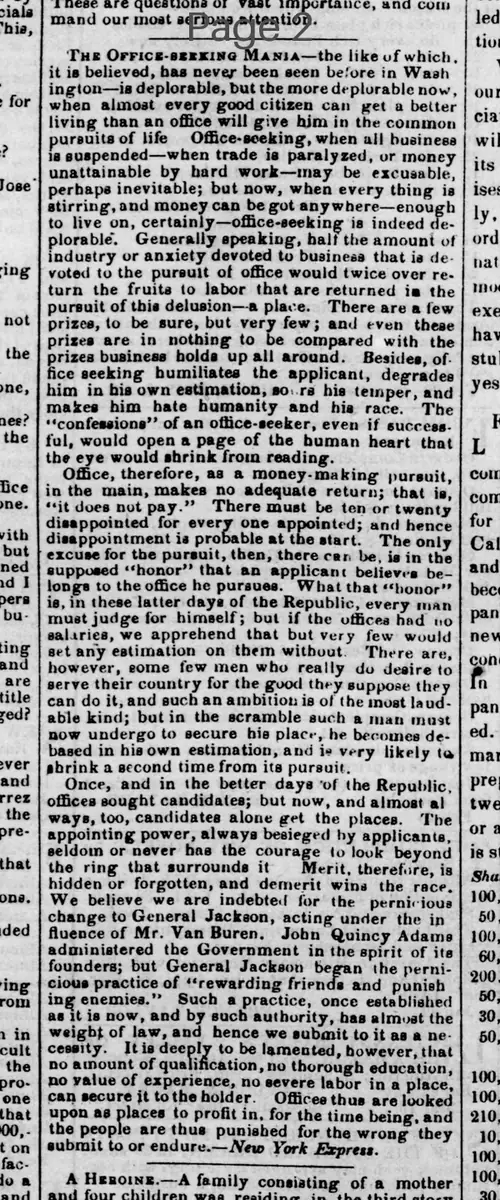
The Office-seeking Mania—the like of which, it is believed, has never been seen before in Washington—is deplorable, but the more deplorable now, when almost every good citizen can get a better living than an office will give him in the common pursuits of life. Office-seeking, when all business is suspended—when trade is paralyzed, or money unattainable by hard work—may be excusable, perhaps inevitable; but now, when every thing is stirring, and money can be got anywhere—enough to live on, certainly—office-seeking is indeed deplorable. Generally speaking, half the amount of industry or anxiety devoted to business that is devoted to the pursuit of office would twice over return the fruits to labor that are returned in the pursuit of this delusion—a place. There are a few prizes, to be sure, but very few; and even these prizes are in nothing to be compared with the prizes business holds up all around. Besides, office seeking humiliates the applicant, degrades him in his own estimation, sours his temper, and makes him hate humanity and his race. The "confessions" of an office-seeker, even if successful, would open a page of the human heart that the eye would shrink from reading.
Office, therefore, as a money-making pursuit, in the main, makes no adequate return; that is, "it does not pay." There must be ten or twenty disappointed for every one appointed; and hence disappointment is probable at the start. The only excuse for the pursuit, then, there can be, is in the supposed "honor" that an applicant believes belongs to the office he pursues. What that "honor" is, in these latter days of the Republic, every man must judge for himself; but if the offices had no salaries, we apprehend that but very few would set any estimation on them without. There are, however, some few men who really do desire to serve their country for the good they suppose they can do it, and such an ambition is of the most laudable kind; but in the scramble such a man must now undergo to secure his place, he becomes degraded in his own estimation, and is very likely to shrink a second time from its pursuit.
Once, and in the better days of the Republic, offices sought candidates; but now, and almost always, too, candidates alone get the places. The appointing power, always besieged by applicants, seldom or never has the courage to look beyond the ring that surrounds it. Merit, therefore, is hidden or forgotten, and demerit wins the race.
We believe we are indebted for the pernicious change to General Jackson, acting under the influence of Mr. Van Buren. John Quincy Adams administered the Government in the spirit of its founders; but General Jackson began the pernicious practice of "rewarding friends and punishing enemies." Such a practice, once established as it is now, and by such authority, has almost the weight of law, and hence we submit to it as a necessity. It is deeply to be lamented, however, that no amount of qualification, no thorough education, no value of experience, no severe labor in a place, can secure it to the holder. Offices thus are looked upon as places to profit in, for the time being, and the people are thus punished for the wrong they submit to or endure.—New York Express.
Office, therefore, as a money-making pursuit, in the main, makes no adequate return; that is, "it does not pay." There must be ten or twenty disappointed for every one appointed; and hence disappointment is probable at the start. The only excuse for the pursuit, then, there can be, is in the supposed "honor" that an applicant believes belongs to the office he pursues. What that "honor" is, in these latter days of the Republic, every man must judge for himself; but if the offices had no salaries, we apprehend that but very few would set any estimation on them without. There are, however, some few men who really do desire to serve their country for the good they suppose they can do it, and such an ambition is of the most laudable kind; but in the scramble such a man must now undergo to secure his place, he becomes degraded in his own estimation, and is very likely to shrink a second time from its pursuit.
Once, and in the better days of the Republic, offices sought candidates; but now, and almost always, too, candidates alone get the places. The appointing power, always besieged by applicants, seldom or never has the courage to look beyond the ring that surrounds it. Merit, therefore, is hidden or forgotten, and demerit wins the race.
We believe we are indebted for the pernicious change to General Jackson, acting under the influence of Mr. Van Buren. John Quincy Adams administered the Government in the spirit of its founders; but General Jackson began the pernicious practice of "rewarding friends and punishing enemies." Such a practice, once established as it is now, and by such authority, has almost the weight of law, and hence we submit to it as a necessity. It is deeply to be lamented, however, that no amount of qualification, no thorough education, no value of experience, no severe labor in a place, can secure it to the holder. Offices thus are looked upon as places to profit in, for the time being, and the people are thus punished for the wrong they submit to or endure.—New York Express.
What sub-type of article is it?
Partisan Politics
Social Reform
What keywords are associated?
Office Seeking
Spoils System
Patronage
Political Appointments
Jackson Administration
Merit Vs Favoritism
Public Service
What entities or persons were involved?
General Jackson
Mr. Van Buren
John Quincy Adams
New York Express
Editorial Details
Primary Topic
Critique Of Office Seeking Mania And Spoils System
Stance / Tone
Deploring And Critical
Key Figures
General Jackson
Mr. Van Buren
John Quincy Adams
New York Express
Key Arguments
Office Seeking Is Deplorable When Economic Opportunities Abound
It Humiliates And Degrades The Seeker
Rarely Pays Adequately With High Disappointment Rate
Honor Of Office Is Questionable Without Salary
True Public Service Is Laudable But Corrupted By The Process
Shift From Merit Based To Patronage Under Jackson
Merit Ignored, Demerit Rewarded
People Punished By Unqualified Officeholders