Thank you for visiting SNEWPapers!
Sign up free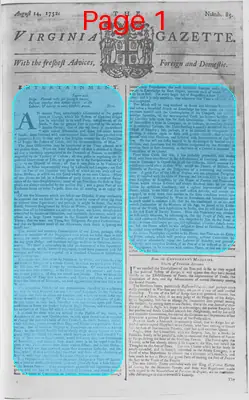
Literary
August 14, 1752
The Virginia Gazette
Richmond, Williamsburg, Richmond County, Virginia
What is this article about?
An essay on the brevity of controllable time in life, urging frugality and diligence in using spare moments for reason, virtue, and learning. It critiques procrastination, references Horace and proverbs, and praises Erasmus's productivity amid wanderings.
Clipping
OCR Quality
95%
Excellent
Full Text
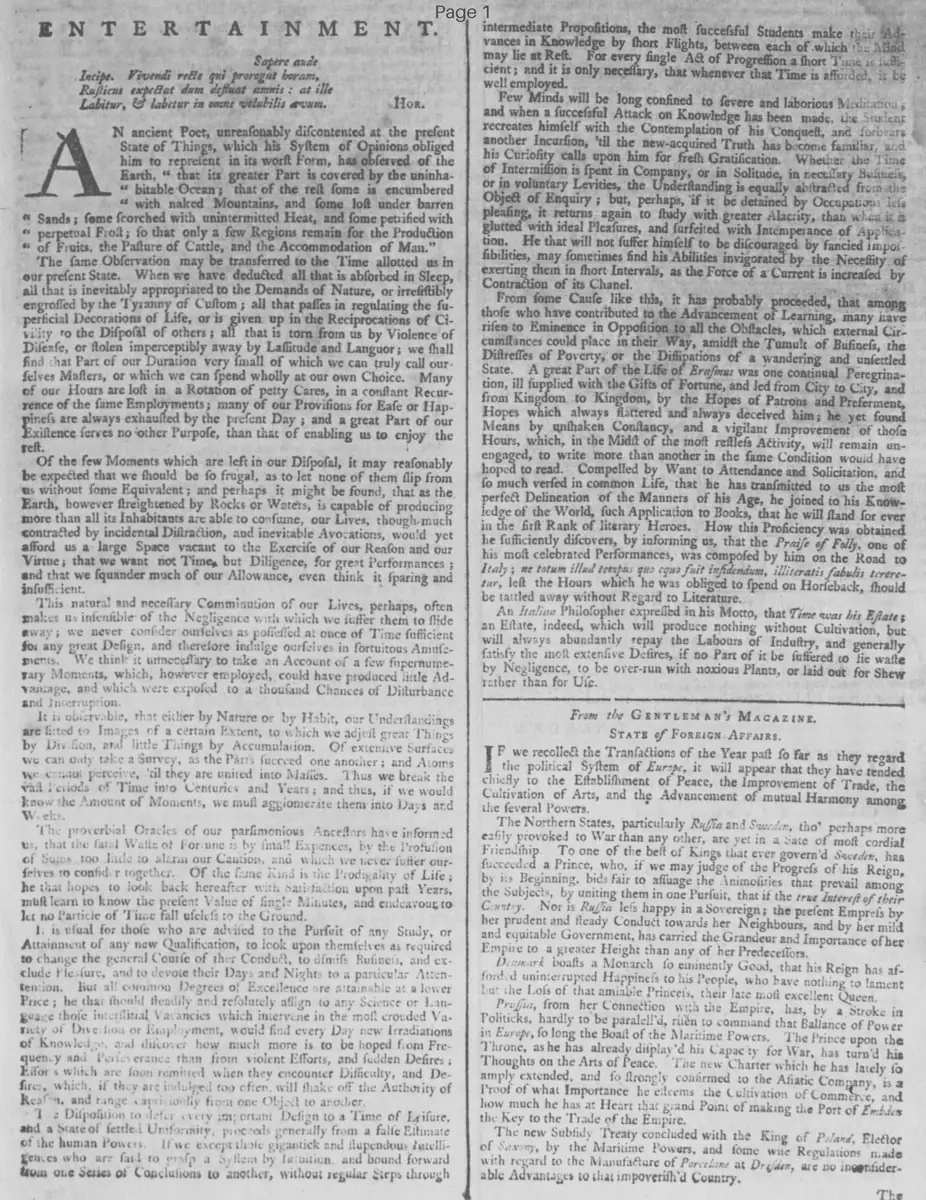
ENTERTAINMENT.
Sapere aude
Incipe.
Vivendi recte qui prorogat horam,
Rusticus expectat dum defuat amnis: at ille
Labitur, & labetur in omne volubilis aevum.
Hor.
An ancient Poet, unreasonably discontented at the present
State of Things, which his System of Opinions obliged
him to represent in its worst Form, has observed of the
Earth, "that its greater Part is covered by the uninhabitable Ocean; that of the rest some is encumbered
with naked Mountains, and some lost under barren
deserts Sands; some scorched with unintermitted Heat, and some petrified with
perpetual Frost; so that only a few Regions remain for the Production
of Fruits, the Pasture of Cattle, and the Accommodation of Man."
The same Observation may be transferred to the Time allotted us in
our present State. When we have deducted all that is absorbed in Sleep,
all that is inevitably appropriated to the Demands of Nature, or irresistibly
engrossed by the Tyranny of Custom; all that passes in regulating the superficial Decorations of Life, or is given up in the Reciprocations of Civility to the Disposal of others; all that is torn from us by Violence of
Disease, or stolen imperceptibly away by Lassitude and Languor; we shall
find that Part of our Duration very small of which we can truly call ourselves Masters, or which we can spend wholly at our own Choice. Many
of our Hours are lost in a Rotation of petty Cares, in a constant Recurrence of the same Employments; many of our Provisions for Ease or Happiness are always exhausted by the present Day; and a great Part of our
Existence serves no other Purpose, than that of enabling us to enjoy the
rest.
Of the few Moments which are left in our Disposal, it may reasonably
be expected that we should be so frugal, as to let none of them slip from
us without some Equivalent; and perhaps it might be found, that as the
Earth, however straitened by Rocks or Waters, is capable of producing
more than all its Inhabitants are able to consume, our Lives, though much
contracted by incidental Distraction, and inevitable Avocations, would yet
afford us a large Space vacant to the Exercise of our Reason and our
Virtue; that we want not Time but Diligence, for great Performances;
and that we squander much of our Allowance, even think it parsimony and
insufficient.
This natural and necessary Comminution of our Lives, perhaps, often
makes us insensible of the Negligence with which we suffer them to slide
away; we never consider ourselves as possessed at once of Time sufficient
for any great Design, and therefore indulge ourselves in fortuitous Amusements.
We think it unnecessary to take an Account of a few supernumerary Moments, which, however employed, could have produced little Advantage, and which were exposed to a thousand Chances of Disturbance
and Interruption.
It is observable, that either by Nature or by Habit, our Understandings
are fitted to Images of a certain Extent, to which we adjust great Things
by Division, and little Things by Accumulation. Of extensive Surfaces
we can only take a Survey, as the Parts succeed one another; and Atoms
we cannot perceive, 'til they are united into Masses.
Thus we break the
vast Idols of Time into Centuries and Years; and thus, if we would
know the Amount of Moments, we must agglomerate them into Days and
Weeks.
The proverbial Oracles of our parsimonious Ancestors have informed
us, that the fatal Waste of Fortune is by small Expenses, by the Profusion
of Sums too little to alarm our Caution, and which we never suffer ourselves to consider together. Of the same Kind is the Prodigality of Life;
he that hopes to look back hereafter with Satisfaction upon past Years,
must learn to know the present Value of single Minutes, and endeavour to
let no Particle of Time fall useless to the Ground.
It is usual for those who are advised to the Pursuit of any Study, or
Attainment of any new Qualification, to look upon themselves as required
to change the general Course of their Conduct, to dismiss Business, and exclude Pleasure, and to devote their Days and Nights to a particular Attention. But all common Degrees of Excellence are attainable at a lower
Price; he that should steadily and resolutely assign to any Science or Language those interstitial Vacancies which intervene in the most crowded Variety of Business or Employment, would find every Day new Irradiations
of Knowledge, and discover how much more is to be hoped from Frequency and Perseverance than from violent Efforts, and sudden Desires;
Efforts which are soon remitted when they encounter Difficulty, and Desires, which, if they are indulged too often, will shake off the Authority of
Reason, and range capriciously from one Object to another.
A Disposition to defer the important Design to a Time of Leisure,
and a State of settled Uniformity, proceeds generally from a false Estimate
of the human Powers. If we except those gigantic and stupendous Intellects who are said to grasp a System by Intuition, and bound forward
from one Series of Conclusions to another, without regular Steps through
intermediate Propositions, the most successful Students make their Advances in Knowledge by short Flights, between each of which the Mind
may lie at Rest. For every single Act of Progression a short Time is sufficient; and it is only necessary, that whenever that Time is afforded, it be
well employed.
Few Minds will be long confined to severe and laborious Meditation,
and when a successful Attack on Knowledge has been made, the Student
recreates himself with the Contemplation of his Conquest, and forbears
another Incursion, 'til the new-acquired Truth has become familiar, and
his Curiosity calls upon him for fresh Gratification. Whether the Time
of Intermission is spent in Company, or in Solitude, in necessary Business,
or in voluntary Levities, the Understanding is equally abstracted from the
Object of Enquiry; but, perhaps, if it be detained by Occupations less
pleasing, it returns again to study with greater Alacrity, than when it is
gluted with ideal Pleasures, and surfeited with Intemperance of Application. He that will not suffer himself to be discouraged by fancied impossibilities, may sometimes find his Abilities invigorated by the Necessity of
exerting them in short Intervals, as the Force of a Current is increased by
Contraction of its Channel.
From some Cause like this, it has probably proceeded, that among
those who have contributed to the Advancement of Learning, many have
risen to Eminence in Opposition to all the Obstacles, which external Circumstances could place in their Way, amidst the Tumult of Business, the
Distresses of Poverty, or the Dissipations of a wandering and unsettled
State. A great Part of the Life of Erasmus was one continual Peregrination, ill supplied with the Gifts of Fortune, and led from City to City, and
from Kingdom to Kingdom, by the Hopes of Patrons and Preferment,
Hopes which always flattered and always deceived him; he yet found
Means by unshaken Constancy, and a vigilant Improvement of those
Hours, which, in the Midst of the most restless Activity, will remain unengaged, to write more than another in the same Condition would have
hoped to read. Compelled by Want to Attendance and Solicitation, and
so much versed in common Life, that he has transmitted to us the most
perfect Delineation of the Manners of his Age, he joined to his Knowledge of the World, such Application to Books, that he will stand for ever
in the first Rank of literary Heroes. How this Proficiency was obtained
he sufficiently discovers, by informing us, that the Praise of Folly, one of
his most celebrated Performances, was composed by him on the Road to
Italy; ne totum illud tempus quo equus fuit insidendum, illiteratis fabulis tererentur, lest the Hours which he was obliged to spend on Horseback, should
be squandered away without Regard to Literature.
An Italian Philosopher expressed in his Motto, that Time was his Estate;
an Estate, indeed, which will produce nothing without Cultivation, but
will always abundantly repay the Labours of Industry, and generally
satisfy the most extensive Desires, if no Part of it be suffered to lie waste
by Negligence, to be over-run with noxious Plants, or laid out for Shew
rather than for Use.
Sapere aude
Incipe.
Vivendi recte qui prorogat horam,
Rusticus expectat dum defuat amnis: at ille
Labitur, & labetur in omne volubilis aevum.
Hor.
An ancient Poet, unreasonably discontented at the present
State of Things, which his System of Opinions obliged
him to represent in its worst Form, has observed of the
Earth, "that its greater Part is covered by the uninhabitable Ocean; that of the rest some is encumbered
with naked Mountains, and some lost under barren
deserts Sands; some scorched with unintermitted Heat, and some petrified with
perpetual Frost; so that only a few Regions remain for the Production
of Fruits, the Pasture of Cattle, and the Accommodation of Man."
The same Observation may be transferred to the Time allotted us in
our present State. When we have deducted all that is absorbed in Sleep,
all that is inevitably appropriated to the Demands of Nature, or irresistibly
engrossed by the Tyranny of Custom; all that passes in regulating the superficial Decorations of Life, or is given up in the Reciprocations of Civility to the Disposal of others; all that is torn from us by Violence of
Disease, or stolen imperceptibly away by Lassitude and Languor; we shall
find that Part of our Duration very small of which we can truly call ourselves Masters, or which we can spend wholly at our own Choice. Many
of our Hours are lost in a Rotation of petty Cares, in a constant Recurrence of the same Employments; many of our Provisions for Ease or Happiness are always exhausted by the present Day; and a great Part of our
Existence serves no other Purpose, than that of enabling us to enjoy the
rest.
Of the few Moments which are left in our Disposal, it may reasonably
be expected that we should be so frugal, as to let none of them slip from
us without some Equivalent; and perhaps it might be found, that as the
Earth, however straitened by Rocks or Waters, is capable of producing
more than all its Inhabitants are able to consume, our Lives, though much
contracted by incidental Distraction, and inevitable Avocations, would yet
afford us a large Space vacant to the Exercise of our Reason and our
Virtue; that we want not Time but Diligence, for great Performances;
and that we squander much of our Allowance, even think it parsimony and
insufficient.
This natural and necessary Comminution of our Lives, perhaps, often
makes us insensible of the Negligence with which we suffer them to slide
away; we never consider ourselves as possessed at once of Time sufficient
for any great Design, and therefore indulge ourselves in fortuitous Amusements.
We think it unnecessary to take an Account of a few supernumerary Moments, which, however employed, could have produced little Advantage, and which were exposed to a thousand Chances of Disturbance
and Interruption.
It is observable, that either by Nature or by Habit, our Understandings
are fitted to Images of a certain Extent, to which we adjust great Things
by Division, and little Things by Accumulation. Of extensive Surfaces
we can only take a Survey, as the Parts succeed one another; and Atoms
we cannot perceive, 'til they are united into Masses.
Thus we break the
vast Idols of Time into Centuries and Years; and thus, if we would
know the Amount of Moments, we must agglomerate them into Days and
Weeks.
The proverbial Oracles of our parsimonious Ancestors have informed
us, that the fatal Waste of Fortune is by small Expenses, by the Profusion
of Sums too little to alarm our Caution, and which we never suffer ourselves to consider together. Of the same Kind is the Prodigality of Life;
he that hopes to look back hereafter with Satisfaction upon past Years,
must learn to know the present Value of single Minutes, and endeavour to
let no Particle of Time fall useless to the Ground.
It is usual for those who are advised to the Pursuit of any Study, or
Attainment of any new Qualification, to look upon themselves as required
to change the general Course of their Conduct, to dismiss Business, and exclude Pleasure, and to devote their Days and Nights to a particular Attention. But all common Degrees of Excellence are attainable at a lower
Price; he that should steadily and resolutely assign to any Science or Language those interstitial Vacancies which intervene in the most crowded Variety of Business or Employment, would find every Day new Irradiations
of Knowledge, and discover how much more is to be hoped from Frequency and Perseverance than from violent Efforts, and sudden Desires;
Efforts which are soon remitted when they encounter Difficulty, and Desires, which, if they are indulged too often, will shake off the Authority of
Reason, and range capriciously from one Object to another.
A Disposition to defer the important Design to a Time of Leisure,
and a State of settled Uniformity, proceeds generally from a false Estimate
of the human Powers. If we except those gigantic and stupendous Intellects who are said to grasp a System by Intuition, and bound forward
from one Series of Conclusions to another, without regular Steps through
intermediate Propositions, the most successful Students make their Advances in Knowledge by short Flights, between each of which the Mind
may lie at Rest. For every single Act of Progression a short Time is sufficient; and it is only necessary, that whenever that Time is afforded, it be
well employed.
Few Minds will be long confined to severe and laborious Meditation,
and when a successful Attack on Knowledge has been made, the Student
recreates himself with the Contemplation of his Conquest, and forbears
another Incursion, 'til the new-acquired Truth has become familiar, and
his Curiosity calls upon him for fresh Gratification. Whether the Time
of Intermission is spent in Company, or in Solitude, in necessary Business,
or in voluntary Levities, the Understanding is equally abstracted from the
Object of Enquiry; but, perhaps, if it be detained by Occupations less
pleasing, it returns again to study with greater Alacrity, than when it is
gluted with ideal Pleasures, and surfeited with Intemperance of Application. He that will not suffer himself to be discouraged by fancied impossibilities, may sometimes find his Abilities invigorated by the Necessity of
exerting them in short Intervals, as the Force of a Current is increased by
Contraction of its Channel.
From some Cause like this, it has probably proceeded, that among
those who have contributed to the Advancement of Learning, many have
risen to Eminence in Opposition to all the Obstacles, which external Circumstances could place in their Way, amidst the Tumult of Business, the
Distresses of Poverty, or the Dissipations of a wandering and unsettled
State. A great Part of the Life of Erasmus was one continual Peregrination, ill supplied with the Gifts of Fortune, and led from City to City, and
from Kingdom to Kingdom, by the Hopes of Patrons and Preferment,
Hopes which always flattered and always deceived him; he yet found
Means by unshaken Constancy, and a vigilant Improvement of those
Hours, which, in the Midst of the most restless Activity, will remain unengaged, to write more than another in the same Condition would have
hoped to read. Compelled by Want to Attendance and Solicitation, and
so much versed in common Life, that he has transmitted to us the most
perfect Delineation of the Manners of his Age, he joined to his Knowledge of the World, such Application to Books, that he will stand for ever
in the first Rank of literary Heroes. How this Proficiency was obtained
he sufficiently discovers, by informing us, that the Praise of Folly, one of
his most celebrated Performances, was composed by him on the Road to
Italy; ne totum illud tempus quo equus fuit insidendum, illiteratis fabulis tererentur, lest the Hours which he was obliged to spend on Horseback, should
be squandered away without Regard to Literature.
An Italian Philosopher expressed in his Motto, that Time was his Estate;
an Estate, indeed, which will produce nothing without Cultivation, but
will always abundantly repay the Labours of Industry, and generally
satisfy the most extensive Desires, if no Part of it be suffered to lie waste
by Negligence, to be over-run with noxious Plants, or laid out for Shew
rather than for Use.
What sub-type of article is it?
Essay
What themes does it cover?
Moral Virtue
What keywords are associated?
Time Value
Diligence
Procrastination
Erasmus
Horace
Learning
Virtue
Proverbs
Literary Details
Form / Style
Philosophical Prose Essay
Key Lines
Vivendi Recte Qui Prorogat Horam, Rusticus Expectat Dum Defuat Amnis: At Ille Labitur, & Labetur In Omne Volubilis Aevum.
We Want Not Time But Diligence, For Great Performances;
He That Hopes To Look Back Hereafter With Satisfaction Upon Past Years, Must Learn To Know The Present Value Of Single Minutes, And Endeavour To Let No Particle Of Time Fall Useless To The Ground.
The Praise Of Folly, One Of His Most Celebrated Performances, Was Composed By Him On The Road To Italy;
Time Was His Estate; An Estate, Indeed, Which Will Produce Nothing Without Cultivation