Thank you for visiting SNEWPapers!
Sign up free
The Enquirer
Richmond, Henrico County, Virginia
What is this article about?
A manuscript in Russian from AD 1066, adorned with Grecian miniatures, is held in Petersburgh, with its owner refusing 20,000 rubles. It may reveal Russia's early enlightenment. Additional insights from M. Bile's Moscow University collection of Czar medals.
Clipping
OCR Quality
Full Text
What sub-type of article is it?
What keywords are associated?
What entities or persons were involved?
Where did it happen?
Foreign News Details
Primary Location
Petersburgh
Key Persons
Outcome
proprietor has refused 20,000 rubles for this valuable relic
Event Details
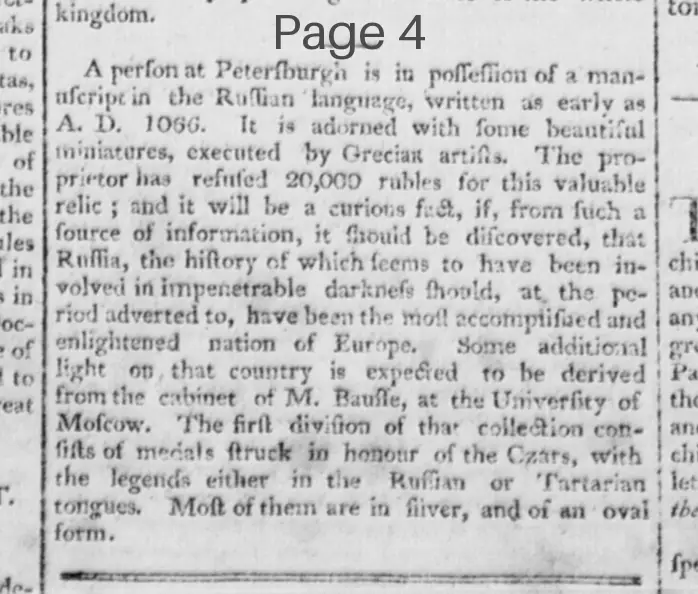
A person at Petersburgh is in possession of a manuscript in the Russian language, written as early as A. D. 1066. It is adorned with some beautiful miniatures, executed by Grecian artists. The proprietor has refused 20,000 rubles for this valuable relic; and it will be a curious fact, if, from such a source of information, it should be discovered, that Russia, the history of which seems to have been involved in impenetrable darkness should, at the period adverted to, have been the most accomplished and enlightened nation of Europe. Some additional light on that country is expected to be derived from the cabinet of M. Bile, at the University of Moscow. The first division of that collection consists of medals struck in honour of the Czars, with the legends either in the Russian or Tartarian tongues. Most of them are in silver, and of an oval form.