Thank you for visiting SNEWPapers!
Sign up free
Virginia Argus
Richmond, Virginia
What is this article about?
Biographical sketch from the Independent Chronicle praising Major-General Henry Dearborn's Revolutionary War service, from enlisting post-Lexington to key battles like Bunker Hill, Quebec, Saratoga, Monmouth, and Yorktown, highlighting his bravery, hardships, and leadership to inspire confidence in the Northern Army amid renewed war threats.
Clipping
OCR Quality
Full Text
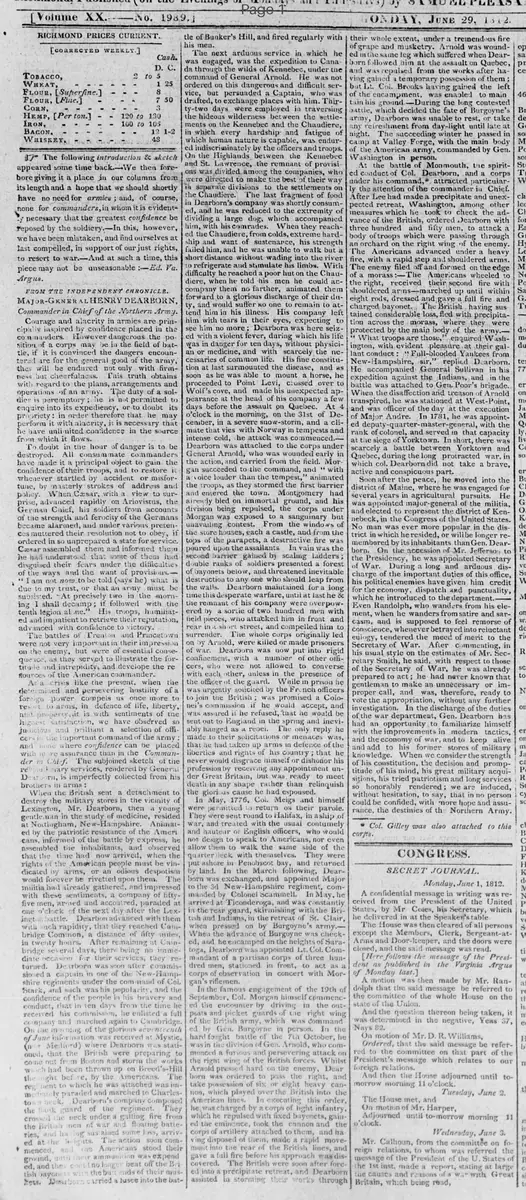
FROM THE INDEPENDENT CHRONICLE.
MAJOR-GENERAL HENRY DEARBORN,
Commander in Chief of the Northern Army.
Courage and alacrity in armies are principally inspired by confidence placed in the commanders. However dangerous the position of a corps may be in the field of battle, if it is convinced the dangers encountered are for the general good of the army, they will be endured not only with firmness but cheerfulness. This truth obtains with regard to the plans, arrangements and operations of an army. The duty of a soldier is peremptory; he is not permitted to enquire into its expediency, or to doubt its propriety: in order therefore that he may perform it with alacrity, it is necessary that he have unlimited confidence in the source from which it flows.
To doubt in the hour of danger is to be destroyed. All consummate commanders have made it a principal object to gain the confidence of their troops, and to restore it whenever startled by accident or misfortune, by masterly strokes of address and policy. When Caesar, with a view to surprise, advanced rapidly on Ariovistus, the German Chief, his soldiers from accounts of the strength and ferocity of the Germans became alarmed, and under various pretences muttered their resolution not to obey, if ordered in so unprepared a state for service. Caesar assembled them and informed them he had understood that some of them had disguised their fears under the difficulties of the ways and the want of provisions. "I am not now to be told (says he) what is due to my trust, or that an army must be subsisted. At precisely two in the morning I shall decamp; if followed with the tenth legion alone." His troops, humiliated and impatient to retrieve their reputation, advanced with confidence to victory.
The battles of Trenton and Princeton were not very important in their impression on the enemy, but were of essential consequence, as they served to illustrate the fortitude and intrepidity, and develope the resources of the American commander.
At a crisis like the present, when the determined and persevering hostility of a foreign power compels us once more to resort to arms, in defence of life, liberty, and property, it is with sentiments of the highest satisfaction, we have observed so judicious and brilliant a selection of officers in the important command of the army: and none where confidence can be placed with more assurance than in the Commander in Chief. The subjoined sketch of the revolutionary services, rendered by General Dearborn, is imperfectly collected from his brothers in arms:
When the British sent a detachment to destroy the military stores in the vicinity of Lexington, Mr. Dearborn, then a young gentleman in the study of medicine, resided at Nottingham, New-Hampshire. Animated by the patriotic resistance of the Americans, informed of the battle by express, he assembled the inhabitants, and observed that the time had now arrived, when the rights of the American people must be vindicated by arms, or an odious despotism would forever be rivetted upon them. The militia had already gathered, and impressed with these sentiments, a Company of fifty-five men, armed and accoutred, paraded at one o'clock of the next day after the Lexington battle. Dearborn advanced with them with such rapidity, that they reached Cambridge Common, a distance of fifty miles, in twenty hours. After remaining at Cambridge several days, there being no immediate occasion for their services, they returned. Dearborn was soon after commissioned a Captain in one of the New-Hampshire regiments under the command of Col. Stark, and such was his popularity, and the confidence of the people in his bravery and conduct, that in ten days from the time he received his Commission, he enlisted a full company and marched again to Cambridge.
On the morning of the glorious seventeenth of June information was received at Mystic, (Medford) where Dearborn was stationed, that the British were preparing to come out from Boston and storm the works which had been thrown up on Breed's-Hill the night before, by the Americans. The regiment to which he was attached was immediately paraded and marched to Charlestown neck. Dearborn's company composed the flank guard of the regiment. They crossed the neck under a galling fire from the British men of war and floating batteries, and having sustained some loss, arrived at the heights. The action soon commenced, and the Americans stood their ground, until their ammunition was expended, and the could no longer beat off the British bayonet with the butts of their muskets. Dearborn carried a loose into the battle of Bunker's Hill, and fired regularly with his men.
The next arduous service in which he was engaged, was the expedition to Canada through the wilds of Kennebec, under the command of General Arnold. He was not ordered on this dangerous and difficult service, but persuaded a Captain, who was drafted, to exchange places with him. Thirty-two days were employed in traversing the hideous wilderness between the settlements on the Kennebec and the Chaudiere, in which every hardship and fatigue of which human nature is capable, was endured indiscriminately by the officers and troops. On the Highlands between the Kennebec and St. Lawrence, the remnant of provisions was divided among the companies, who were directed to make the best of their way in separate divisions to the settlements on the Chaudiere. The last fragment of food in Dearborn's company was shortly consumed, and he was reduced to the extremity of dividing a large dog, which accompanied him, with his comrades. When they reached the Chaudiere, from colds, extreme hardship and want of sustenance, his strength failed him, and he was unable to walk but a short distance without wading into the river to refrigerate and stimulate his limbs. With difficulty he reached a poor hut on the Chaudiere, when he told his men he could accompany them no farther, animated them forward to a glorious discharge of their duty, and would suffer no one to remain to attend him in his illness. His company left him with tears in their eyes, expecting to see him no more; Dearborn was here seized with a violent fever, during which his life was in danger for ten days, without physician or medicine, and with scarcely the necessaries of common life. His fine constitution at last surmounted the disease, and as soon as he was able to mount a horse, he proceeded to Point Levi, crossed over to Wolf's cove, and made his unexpected appearance at the head of his company a few days before the assault on Quebec. At 4 o'clock in the morning, on the 31st of December, in a severe snow-storm, and a climate that vies with Norway in tempests and intense cold, the attack was commenced. Dearborn was attached to the corps under General Arnold, who was wounded early in the action, and carried from the field. Morgan succeeded to the command, and with a voice louder than the tempest, animated the troops, as they stormed the first barrier and entered the town. Montgomery had already bled on immortal ground, and his division being repulsed, the corps under Morgan was exposed to a sanguinary but unavailing contest. From the windows of the store houses, each a castle, and from the tops of the parapets, a destructive fire was poured upon the assailants. In vain was the second barrier gained by scaling ladders; double ranks of soldiers presented a forest of bayonets below, and threatened inevitable destruction to any one who should leap from the walls. Dearborn maintained for a long time this desperate warfare, until at last he & the remnant of his company were overpowered by a sortie of two hundred men with field pieces, who attacked him in front and rear in a short street, and compelled him to surrender. The whole Corps originally led on by Arnold, were killed or made prisoners of war. Dearborn was now put into rigid confinement, with a number of other officers, who were not allowed to converse with each other, unless in the presence of the officer of the guard. While in prison he was urgently solicited by the French officers to join the British; was promised a Colonel's commission if he would accept, and was assured if he refused, that he would be sent out to England in the spring and inevitably hanged as a rebel. The only reply he made to their solicitations or menaces was, that he had taken up arms in defence of the liberties and rights of his Country; that he never would disgrace himself or dishonor his profession by receiving any appointment under Great Britain, but was ready to meet death in any shape rather than relinquish the glorious cause he had espoused.
In May, 1776, Col. Meigs and himself were permitted to return on their parole. They were sent round to Halifax, in a ship of war, and treated with the usual contumely and hauteur of English officers, who would not deign to speak to Americans, nor even allow them to walk the same side of the quarter deck with themselves. They were put ashore in Penobscot bay, and returned by land. In the March following, Dearborn was exchanged, and appointed Major to the 3d New-Hampshire regiment, commanded by Colonel Scammel. In May, he arrived at Ticonderoga, and was constantly in the rear guard, skirmishing with the British and Indians, in the retreat of St. Clair, when pressed on by Burgoyne's army.
When the advance of Burgoyne was checked, and he encamped on the heights of Saratoga, Dearborn was appointed Lt. Col. Commandant of a partisan corps of three hundred men, stationed in front, to act as a corps of observation in concert with Morgan's riflemen.
In the famous engagement of the 19th of September, Col. Morgan himself commenced the encounter by driving in the outposts and picket guards of the right wing of the British army, which was commanded by Gen. Burgoyne in person. In the hard fought battle of the 7th October, he was in the division of Gen. Arnold, who commenced a furious and persevering attack on the right wing of the British forces. Whilst Arnold pressed hard on the enemy, Dearborn was ordered to pass the right, and take possession of six or eight heavy cannon, which played over the British into the American lines. In executing this order, he was charged by a corps of light infantry, which he repulsed with fixed bayonets, gained the eminence, took the cannon and the Corps of artillery attached to them, and having disposed of them, made a rapid movement into the rear of the British lines, and gave a full fire before his approach was discovered. The British were soon after forced into a precipitate retreat, and Dearborn assisted in storming their works through their whole extent, under a tremendous fire of grape and musketry. Arnold was wounded in the same leg which suffered when Dearborn followed him at the assault on Quebec, and was repulsed from the works after having gained a temporary possession of them; but Lt. Col. Brooks having gained the left of the encampment, was enabled to maintain his ground. During the long contested battle, which decided the fate of Burgoyne's army, Dearborn was unable to rest, or take any refreshment from day-light until late at night. The succeeding winter he passed in camp at Valley Forge, with the main body of the American army, commanded by Gen. Washington in person.
At the battle of Monmouth, the spirited conduct of Col. Dearborn, and a corps under his command, * attracted particularly the attention of the commander in Chief. After Lee had made a precipitate and unexpected retreat, Washington, among other measures which he took to check the advance of the British, ordered Dearborn with three hundred and fifty men, to attack a body of troops which were passing through an orchard on the right wing of the enemy. The Americans advanced under a heavy fire, with a rapid step and shouldered arms. The enemy filed off and formed on the edge of a morass:--The Americans wheeled to the right, received their second fire with shouldered arms--marched up until within eight rods, dressed and gave a full fire and charged bayonet. The British, having sustained considerable loss, fled with precipitation across the morass, where they were protected by the main body of the army. "What troops are those," enquired Washington, with evident pleasure at their gallant conduct: "Full-blooded Yankees from New-Hampshire, sir," replied Dearborn.
He accompanied General Sullivan in his expedition against the Indians, and in the battle was attached to Gen. Poor's brigade. When the disaffection and treason of Arnold transpired, he was stationed at West-Point, and was officer of the day at the execution of Major Andre. In 1781, he was appointed deputy-quarter-master-general, with the rank of colonel, and served in that capacity at the siege of Yorktown. In short, there was scarcely a battle between Yorktown and Quebec, during the long protracted war, in which col. Dearborn did not take a brave, active and conspicuous part.
Soon after the peace, he moved into the district of Maine, where he was engaged for several years in agricultural pursuits. He was appointed major-general of the militia, and elected to represent the district of Kennebec, in the Congress of the United States. No man was ever more popular in the district in which he resided, or will be longer remembered by its inhabitants than Gen. Dearborn. On the accession of Mr. Jefferson, to the Presidency, he was appointed Secretary of War. During a long and arduous discharge of the important duties of this office, his political enemies have given him credit for the economy, dispatch and punctuality, which he introduced to the department. Even Randolph, who wanders from his element, when he wanders from satire and sarcasm, and is supposed to feel remorse of conscience, whenever betrayed into reluctant eulogy, tendered the meed of merit to the Secretary of War. After commenting, in his usual style on the estimates of Mr. Secretary Smith, he said, with respect to those of the Secretary of War, he was already prepared to act; he had never known that gentleman to make an unnecessary or improper call, and was, therefore, ready to vote the appropriation, without any further investigation. In the discharge of the duties of the war department, Gen. Dearborn has had an opportunity to familiarize himself with the improvements in modern tactics, and the economy of war, and to keep alive and add to his former stores of military knowledge. When we consider the strength of his constitution, the decision and promptitude of his mind, his great military acquisitions, his tried patriotism and long services so honorably rendered; we are induced, without hesitation, to say, that in no person could be confided, with more hope and assurance, the destinies of the Northern Army.
* Col. Gilley was also attached to this corps.
What sub-type of article is it?
What themes does it cover?
What keywords are associated?
What entities or persons were involved?
Where did it happen?
Story Details
Key Persons
Location
Nottingham New Hampshire, Cambridge, Breed's Hill, Charlestown Neck, Kennebec, Chaudiere, Quebec, Point Levi, Wolf's Cove, Halifax, Penobscot Bay, Ticonderoga, Saratoga, Valley Forge, Monmouth, West Point, Yorktown, Maine, Kennebec District
Event Date
1775 To 1783, With Specific Events On April 19 1775 Lexington, June 17 1775 Bunker Hill, December 31 1775 Quebec, September 19 1777 Saratoga, October 7 1777 Saratoga, June 28 1778 Monmouth, 1781 Yorktown
Story Details
Biographical sketch of Major-General Henry Dearborn's revolutionary services, from enlisting after Lexington, fighting at Bunker Hill, Quebec expedition hardships and capture, parole and exchange, actions at Saratoga, Monmouth, Yorktown, and later roles as Secretary of War, emphasizing his bravery, leadership, and confidence inspiring troops.