Thank you for visiting SNEWPapers!
Sign up free
Domestic News
November 2, 1822
Herald Of The Valley
Fincastle, Botetourt County, Virginia
What is this article about?
Excerpts from Sir Wm. Hope's 'Complete Horseman' (1717), abridged from French, shared via London Farmer's Journal, covering horse eye pits, eyes, age detection, mettle, feeding, appetite, and shoeing practices.
Clipping
OCR Quality
95%
Excellent
Full Text
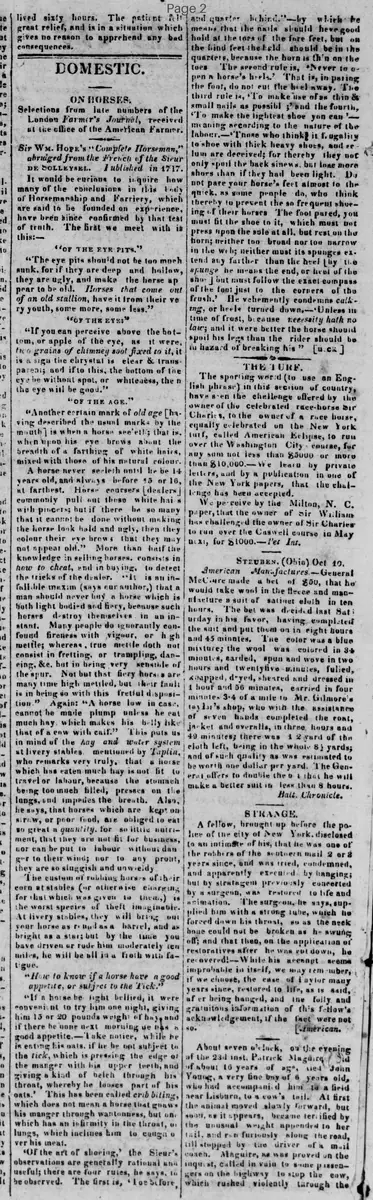
DOMESTIC.
ON HORSES
Selections from June numbers of the London Farmer's Journal, received at the office of the American Farmer.
Sir Wm. Hope's "Complete Horseman," abridged from the French of the Sieur DE Solleysel, published in 1717.
It would be curious to inquire how many of the conclusions in this today of Horsemanship and Farriery, which are said to be founded on experience, have been since confirmed by that test of truth. The first we meet with is this:
"OF THE EYE PITS."
The eye pits should not be too much sunk, for if they are deep and hollow, they are ugly, and make the horse appear to be old. Horses that come out of an old stallion, have it from their very youth, some more, some less.
"OF THE EYE:"
If you can perceive above the bottom, or apple of the eye, as it were, two grains of chimney soot fixed to it, it is a sign the crystal is clear & transparent; and if to this, the bottom of the eye be without spot, or whiteness, the eye will be good.
"OF THE AGE."
Another certain mark of old age having described the usual marks by the mouth is when a horse seels; that is, when upon his eye brows about the breadth of a farthing of white hairs, mixed with those of his natural colour. A horse never seels until he be 14 years old, and always before 15 or 16, at farthest. Horse coursers dealers commonly pull out these white hairs with pincers; but if there be so many that it cannot be done without making the horse look bald and ugly, then they colour their eye brows that they may not appear old. More than half the knowledge in selling horses, consists in how to cheat, and in buying, to detect the tricks of the dealer. It is an infallible maxim (says our author) that a man should never buy a horse which is both light bodied and fiery, because such horses destroy themselves in an instant. Many people do ignorantly confound fieriness with vigour, or high mettle; whereas, true mettle doth not consist in fretting, or trampling, dancing, &c. but in being very sensible of the spur. Not but that fiery horses are many time high metled, but their fault is in being so with this retful disposition. Again: "A horse low in case, cannot be made plump unless he eat much hay, which makes his belly like that of a cow with calf." This puts us in mind of the hay and water system at livery stables, mentioned by Taplin, who remarks very truly, that a horse which has eaten much hay is not fit to travel or labour, because the stomach being too much filled, presses on the lungs, and impedes the breath. Also, he says, that horses which are kept on straw, or poor food, are obliged to eat so great a quantity, for so little nutriment, that they are not fit for business, nor can be put to labour without danger to their wind; nor to any trot, they are so sluggish and unwieldy.
The custom of robbing horses of their corn at stables (or otherwise charging for that which was given to them,) is the worst species of theft imaginable. At livery stables, they will bring on your horse as round as a barrel, and as bright as a star; but by the time you have driven or rode him moderately ten miles, he will be all in a froth with fatigue.
"How to know if a horse have a good appetite, or subject to the Tick."
If a horse be light bellied, it were convenient to try him one night, giving him 15 or 20 pounds weight of hay, and if there be none next morning he has a good appetite. Take notice, while he is eating his oats, if he be not subject to the tick, which is proning the edge of the manger with his upper teeth, and giving a kind of belch through his throat, whereby he looses part of his oats. This has been called crib biting, which does not mean a horse that gnaws his manger through wantonness, but one which has an infirmity in the throat, or lungs, which inclines him to cough over his meat.
Of the art of shoeing, the Sieur's observations are generally rational and useful; there are four rules, he says, to be observed. The first is, 'toe before, and quarter behind.' by which he means that the nails should have good hold at the toes of the fore feet, but on the hind feet the hold should be in the quarters, because the horn is thin on the toes. The second rule is, Never to open a horse's heel. That is, in paring the foot, do not cut the heel away. The third rule is, 'To make use of as thin & small nails as possible; and the fourth, "To make the lightest shoe you can'-- meaning according to the nature of the labour. Those who think it economy to shoe with thick heavy shoes, are deceived; for thereby they not only spoil the back sinews, but lose more shoes than if they had been light. Do not pare your horse's feet almost to the quick, as some people do, who think thereby to prevent the so frequent shoeing of their horses. The foot pared, you must fit the shoe to it, which must not press upon the sole at all, but rest on the horn; neither too broad nor too narrow in the web; neither must its spunges extend any farther than the heel by the spunge he means the end, or brow of the shoe but must follow the exact compass of the foot just to the corners of the frog. He vehemently condemns calking, or heel turned down,--unless in time of frost, because necessity hath no law; and it were better the horse should spoil his legs than the rider should be in hazard of breaking his neck.
ON HORSES
Selections from June numbers of the London Farmer's Journal, received at the office of the American Farmer.
Sir Wm. Hope's "Complete Horseman," abridged from the French of the Sieur DE Solleysel, published in 1717.
It would be curious to inquire how many of the conclusions in this today of Horsemanship and Farriery, which are said to be founded on experience, have been since confirmed by that test of truth. The first we meet with is this:
"OF THE EYE PITS."
The eye pits should not be too much sunk, for if they are deep and hollow, they are ugly, and make the horse appear to be old. Horses that come out of an old stallion, have it from their very youth, some more, some less.
"OF THE EYE:"
If you can perceive above the bottom, or apple of the eye, as it were, two grains of chimney soot fixed to it, it is a sign the crystal is clear & transparent; and if to this, the bottom of the eye be without spot, or whiteness, the eye will be good.
"OF THE AGE."
Another certain mark of old age having described the usual marks by the mouth is when a horse seels; that is, when upon his eye brows about the breadth of a farthing of white hairs, mixed with those of his natural colour. A horse never seels until he be 14 years old, and always before 15 or 16, at farthest. Horse coursers dealers commonly pull out these white hairs with pincers; but if there be so many that it cannot be done without making the horse look bald and ugly, then they colour their eye brows that they may not appear old. More than half the knowledge in selling horses, consists in how to cheat, and in buying, to detect the tricks of the dealer. It is an infallible maxim (says our author) that a man should never buy a horse which is both light bodied and fiery, because such horses destroy themselves in an instant. Many people do ignorantly confound fieriness with vigour, or high mettle; whereas, true mettle doth not consist in fretting, or trampling, dancing, &c. but in being very sensible of the spur. Not but that fiery horses are many time high metled, but their fault is in being so with this retful disposition. Again: "A horse low in case, cannot be made plump unless he eat much hay, which makes his belly like that of a cow with calf." This puts us in mind of the hay and water system at livery stables, mentioned by Taplin, who remarks very truly, that a horse which has eaten much hay is not fit to travel or labour, because the stomach being too much filled, presses on the lungs, and impedes the breath. Also, he says, that horses which are kept on straw, or poor food, are obliged to eat so great a quantity, for so little nutriment, that they are not fit for business, nor can be put to labour without danger to their wind; nor to any trot, they are so sluggish and unwieldy.
The custom of robbing horses of their corn at stables (or otherwise charging for that which was given to them,) is the worst species of theft imaginable. At livery stables, they will bring on your horse as round as a barrel, and as bright as a star; but by the time you have driven or rode him moderately ten miles, he will be all in a froth with fatigue.
"How to know if a horse have a good appetite, or subject to the Tick."
If a horse be light bellied, it were convenient to try him one night, giving him 15 or 20 pounds weight of hay, and if there be none next morning he has a good appetite. Take notice, while he is eating his oats, if he be not subject to the tick, which is proning the edge of the manger with his upper teeth, and giving a kind of belch through his throat, whereby he looses part of his oats. This has been called crib biting, which does not mean a horse that gnaws his manger through wantonness, but one which has an infirmity in the throat, or lungs, which inclines him to cough over his meat.
Of the art of shoeing, the Sieur's observations are generally rational and useful; there are four rules, he says, to be observed. The first is, 'toe before, and quarter behind.' by which he means that the nails should have good hold at the toes of the fore feet, but on the hind feet the hold should be in the quarters, because the horn is thin on the toes. The second rule is, Never to open a horse's heel. That is, in paring the foot, do not cut the heel away. The third rule is, 'To make use of as thin & small nails as possible; and the fourth, "To make the lightest shoe you can'-- meaning according to the nature of the labour. Those who think it economy to shoe with thick heavy shoes, are deceived; for thereby they not only spoil the back sinews, but lose more shoes than if they had been light. Do not pare your horse's feet almost to the quick, as some people do, who think thereby to prevent the so frequent shoeing of their horses. The foot pared, you must fit the shoe to it, which must not press upon the sole at all, but rest on the horn; neither too broad nor too narrow in the web; neither must its spunges extend any farther than the heel by the spunge he means the end, or brow of the shoe but must follow the exact compass of the foot just to the corners of the frog. He vehemently condemns calking, or heel turned down,--unless in time of frost, because necessity hath no law; and it were better the horse should spoil his legs than the rider should be in hazard of breaking his neck.
What sub-type of article is it?
Agriculture
What keywords are associated?
Horse Care
Horsemanship
Farriery
Shoeing
Age Detection
What entities or persons were involved?
Sir Wm. Hope
Sieur De Solleysel
Domestic News Details
Key Persons
Sir Wm. Hope
Sieur De Solleysel
Event Details
Selections from the June numbers of the London Farmer's Journal on horsemanship and farriery, excerpted from Sir Wm. Hope's 1717 book abridged from the French of Sieur de Solleysel, discussing eye pits, eyes, age marks, horse mettle, feeding practices, appetite testing, and shoeing rules.