Thank you for visiting SNEWPapers!
Sign up free
National Gazette
Philadelphia, Philadelphia County, Pennsylvania
What is this article about?
On September 1, 1791, France's new Constitution was presented to King Louis XVI by the National Assembly, with details on revision clauses adopted. A deputation presented it formally on September 2, and the King promised to examine it soon, affirming his stay in Paris.
Clipping
OCR Quality
Full Text
September 3.
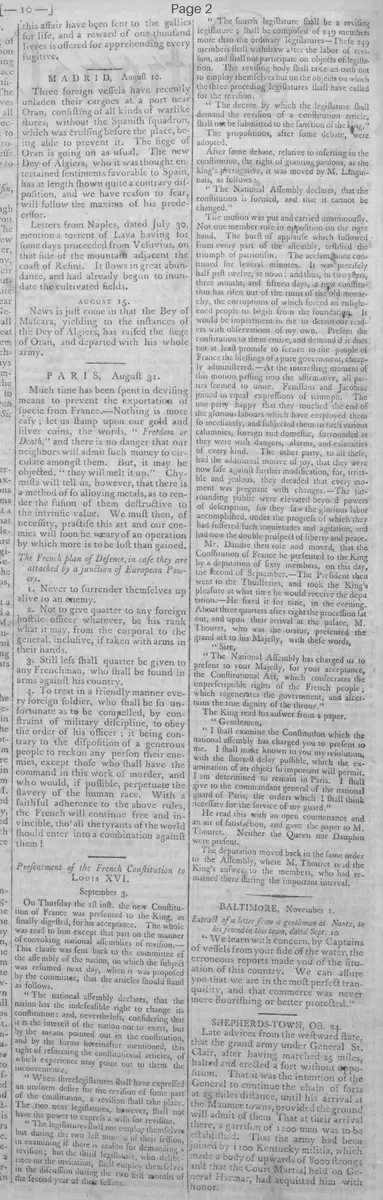
On Thursday the 1st inst. the new Constitution of France was presented to the King, as finally digested, for his acceptance. The whole was read to him except that part on the manner of convoking national assemblies of revision.—This clause was sent back to the committee of the assembly of the nation, on which the subject was resumed next day, when it was proposed by the committee, that the articles should stand as follows.
"The national assembly declares, that the nation has the indefeasible right to change its constitution: and, nevertheless, considering that it is the interest of the nation not to exert, but by the means pointed out in the constitution, and by the forms hereinafter mentioned, this right of reforming the constitutional articles, of which experience may point out to them the inconvenience,
"When three legislatures shall have expressed an uniform desire for the revision of some part of the constitution, a revision shall take place. The two next legislatures, however, shall not have the power to express a wish for revision.
"The legislatures shall not employ themselves but during the two last months of their session, in examining if there is reason for demanding a revision; but the third legislature, who deliberates on the invitation, shall employ themselves in the discussion during the two first months of the second year of their session.
"The fourth legislature shall be a revising legislature; shall be composed of 249 members more than the ordinary legislatures—These 249 members shall withdraw after the labor of revision, and shall not participate on objects of legislation. The revising body shall take an oath not to employ themselves but on the objects on which the three preceding legislatures shall have called for the revision.
"The decree by which the legislature shall demand the revision of a constitution article, shall not be submitted to the sanction of the king."
The propositions, after some debate, were adopted.
After some debate, relative to inserting in the constitution, the right of granting pardons, as the king's prerogative, it was moved by M. Langui-nais, as follows:
"The National Assembly declares, that the constitution is formed, and that it cannot be changed."
The motion was put and carried unanimously. Not one member rose in opposition on the right hand. The burst of applause which followed from every part of the assembly, testified the triumph of patriotism. The acclamations continued for several minutes. It was precisely half past twelve, at noon: and thus, in two years, three months, and fifteen days, a new constitution has risen out of the ruins of the old monarchy, the corruptions of which forced an enlightened people to begin from the foundation. It would be impertinent in me to detain our readers with observations of my own. Present the constitution to them entire, and demand if it does not at least promise to secure to the people of France the blessings of a pure government, cheaply administered.—At the interesting moment of this motion passing into the affirmative, all parties seemed to unite. Feuillans and Jacobins joined in equal expressions of triumph. The one party happy that they touched the end of the glorious labours which have employed them so incessantly, and subjected them to such various calumnies, foreign and domestic, surrounded as they were with dangers, alarms, and calamities of every kind. The other party, to all these, had the additional motive of joy, that they were now safe against further modification, for, irritable and jealous, they dreaded that every moment was pregnant with changes. —The surrounding public were elevated beyond powers of description, for they saw the glorious labor accomplished, under the progress of which they had suffered such inquietudes and agitation, and had now the double prospect of liberty and peace.
Mr. Dandre then rose and moved, that the Constitution of France be presented to the King by a deputation of sixty members, on this day, the second of September.—The President then went to the Thuilleries, and took the King's pleasure at what time he would receive the deputation.—He fixed it for nine, in the evening.
About three quarters after eight the procession set out, and upon their arrival at the palace, M. Thouret, who was the orator, presented the grand act to his Majesty, with these words,
Sire,
"The National Assembly has charged us to present to your Majesty, for your acceptance, the Constitutional Act, which consecrates the imprescriptible rights of the French people; which regenerates the government, and ascertains the true dignity of the throne."
The King read his answer from a paper.
"Gentlemen,
"I shall examine the Constitution which the national assembly has charged you to present to me. I shall make known to you my resolution, with the shortest delay possible, which the examination of an object so important will permit.
I am determined to remain in Paris. I shall give to the commandant general of the national guard of Paris, the orders which I shall think necessary for the service of my guard."
He read this with an open countenance and an air of satisfaction, and gave the paper to M. Thouret. Neither the Queen nor Dauphin were present.
The deputation moved back in the same order to the Assembly, where M. Thouret read the King's answer to the members, who had remained there during the important interval.
What sub-type of article is it?
What keywords are associated?
What entities or persons were involved?
Where did it happen?
Foreign News Details
Primary Location
Paris
Event Date
September 1 2
Key Persons
Outcome
constitution presented to the king for acceptance; king to examine and respond soon; unanimous adoption by national assembly; no further changes.
Event Details
The National Assembly finalized and presented the new French Constitution to King Louis XVI on September 1, including clauses on constitutional revision requiring three legislatures' consent. A motion declared the constitution formed and unchangeable, passed unanimously amid applause. On September 2, a deputation of 60 members presented it at the Tuileries Palace, where the King read a response promising examination and affirming his stay in Paris.