Thank you for visiting SNEWPapers!
Sign up free
Literary
November 24, 1842
Litchfield Enquirer
Litchfield, Litchfield County, Connecticut
What is this article about?
A poor country girl seeks work in London, becomes a servant to a wealthy brewer, rises to marry him and become Lady Aylesbury. Her daughter marries lawyer Edward Hyde, who becomes Earl of Clarendon. Their daughter Anne marries James, Duke of York, making her descendants queens Mary and Anne.
Merged-components note: Multi-part continuation of the same serialized literary story 'The Fortunes of a Country Girl' across sequential reading orders on the same page.
Clipping
OCR Quality
95%
Excellent
Full Text
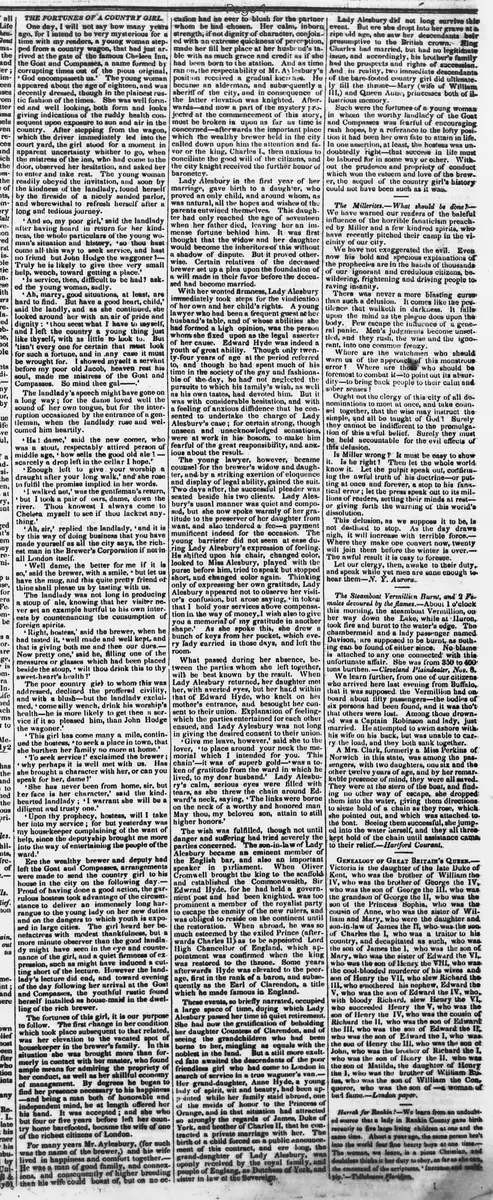
THE FORTUNES OF A COUNTRY GIRL.
One day, I will not say how many years ago, for I intend to be very mysterious for a time with my readers, a young woman stepped from a country wagon, that had just arrived at the gate of the famous Chelsea Inn, the Goat and Compasses, a name formed by corrupting times out of the pious original, "God encompasseth us." The young woman appeared about the age of eighteen, and was decently dressed, though in the plainest rustic fashion of the times. She was well formed and well looking, both form and looks giving indications of the ruddy health consequent upon exposure to sun and air in the country. After stepping from the wagon, which the driver immediately led into the court yard, the girl stood for a moment in apparent uncertainty whither to go, when the mistress of the inn, who had come to the door, observed her hesitation, and asked her to enter and take rest. The young woman readily obeyed the invitation, and soon by the kindness of the landlady, found herself by the fireside of a nicely sanded parlor, and wherewithal to refresh herself after a long and tedious journey.
"And so, my poor girl," said the landlady after having heard in return for her kindness, the whole particulars of the young woman's situation and history, "so thou hast come all this way to seek service, and hast no friend but John Hodge the waggoner?—Truly he is likely to give thee very small help, wench, toward getting a place."
"Is service, then, difficult to be had?" asked the young woman, sadly.
"Ah, marry, good situations, at least, are hard to find." But have a good heart, child," said the landlady, and as she continued, she looked around her with an air of pride and dignity: "thou seest what I have to myself, and I left the country a young thing just like thyself, with as little to look to. But 'tisn't every one for certain that must look for such a fortune, and in any case it must be wrought for. I showed myself a servant before my poor old Jacob, heaven rest his soul, made me mistress of the Goat and Compasses. So mind thee gal—.
The landlady's speech might have gone on a long way; for the dame loved well the sound of her own tongue, but for the interruption occasioned by the entrance of a gentleman, when the landlady rose and welcomed him heartily.
"Ha! dame," said the new comer, who was a stout, respectably attired person of middle age, "how sells the good old ale?—scarcely a drop left in the cellar I hope."
"Enough left to give your worship a draught after your long walk," and she rose to fulfil the promise implied in her words.
"I walked not," was the gentleman's return, "but I took a pair of oars, dame, down the river. Thou knowest I always come to Chelsea myself to see if thou lackest anything."
"Ah, sir," replied the landlady, "and it is by this way of doing business that you have made yourself as all the city says, the richest man in the Brewer's Corporation if not in all London itself."
"Well dame, the better for me if it is so," said the brewer, with a smile, "but let us have the mug, and this quite pretty friend of thine shall please us by tasting with us."
The landlady was not long in producing a stoup of ale, knowing that her visiter never set an example hurtful to his own interests by countenancing the consumption of foreign spirits.
"Right, hostess," said the brewer, when he had tasted it. "Well made and well kept, and that is giving both me and thee our dues.—Now pretty one," said he, filling one of the measures or glasses which had been placed beside the stoup, "wilt thou drink this to thy sweet-heart's health?"
The poor country girl to whom this was addressed, declined the proffered civility, and with a blush—but the landlady exclaimed, "come silly wench, drink his worship's health—he is more likely to get thee a service if it so pleased him, than John Hodge the wagoner."
"This girl has come many a mile, continued the hostess, to seek a place in town, that she burthen her family no more at home."
"To seek service!" exclaimed the brewer: "why perhaps it is well met with us. Has she brought a character with her, or can you speak for her, dame?"
"She has never been from home, sir, but her face is her character," said the kind hearted landlady; "I warrant she will be a diligent and trusty one."
"Upon thy prophecy, hostess, will I take her into my service; for but yesterday was my housekeeper complaining of the want of help, since the deputyship brought me more into the way of entertaining the people of the ward."
Ere the wealthy brewer and deputy had left the Goat and Compasses, arrangements were made to send the country girl to his house in the city on the following day.—Proud of having done a good action, the garrulous hostess took advantage of the circumstance to deliver an immensely long harangue to the young lady on her new duties and on the dangers to which youth is exposed in large cities. The girl heard her benefactress with modest thankfulness, but a more minute observer than the good landlady might have seen in the eye and countenance of the girl, and a quiet firmness of expression, such as might have induced a cutting short of the lecture. However the landlady's lecture did end, and toward evening of the day following her arrival at the Goat and Compasses, the youthful rustic found herself installed as house-maid in the dwelling of the rich brewer.
The fortunes of this girl, it is our purpose to follow. The first change in her condition which took place subsequent to that related, was her elevation to the vacated spot of housekeeper in the brewer's family. In this situation she was brought more than formerly in contact with her master, who found ample means for admiring the propriety of her conduct, as well as her skillful economy of management. By degrees he began to find her presence necessary to his happiness—and being a man both of honorable and independent mind, he at length offered her his hand. It was accepted; and she who but four or five years before left her country home barefooted, became the wife of one of the richest citizens of London.
For many years Mr. Aylesbury, (for such was the name of the brewer,) and his wife lived in happiness and comfort together.—He was a man of good family, and connexions, and consequently of higher breeding than his wife could boast of, but on no occasion had he ever to blush for the partner whom he had chosen. Her calm, inborn strength,—if not dignity of character, conjoined with an extreme quickness of perception, made her fill her place at her husband's table with as much grace and credit as if she had been born to the station. And as time ran on, the respectability of Mr. Aylesbury's position received a gradual increase. He became an alderman, and subsequently a sheriff of the city, and in consequence of the latter elevation was knighted. Afterwards—and now a part of the mystery projected at the commencement of this story, must be broken in upon as far as time is concerned—afterwards the important place which the wealthy brewer held in the city called down upon him the attention and favor of the king, Charles I., then anxious to conciliate the goodwill of the citizens, and the city knight received the further honor of baronetcy.
Lady Aylesbury in the first year of her marriage, gave birth to a daughter, who proved an only child, and around whom, as was natural, all the hopes and wishes of the parents entwined themselves. This daughter had only reached the age of seventeen when her father died, leaving her an immense fortune behind him. It was first thought that the widow and her daughter would become the inheritors of this without a shadow of dispute. But it proved otherwise. Certain relatives of the deceased brewer set up a plea upon the foundation of a will made in their favor before the deceased had become married.
With her wonted firmness, Lady Aylesbury immediately took steps for the vindication of her own and her child's rights. A young lawyer who had been a frequent guest at her husband's table, and of whose abilities she had formed a high opinion, was the person whom she fixed upon as the legal asserter of her cause. Edward Hyde was indeed a youth of great ability. Though only twenty-four years of age at the period referred to, and though he had spent much of his time in the society of the gay and fashionable of the day, he had not neglected the pursuits to which his family's wish, as well as his own tastes, had devoted him. But it was with considerable hesitation, and with a feeling of anxious diffidence that he consented to undertake the charge of Lady Aylesbury's case; for certain strong, though unseen and unacknowledged sensations, were at work in his bosom, to make him fearful of the great responsibility, and anxious about the result.
The young lawyer, however, became counsel for the brewer's widow and daughter, and by a striking exertion of eloquence and display of legal ability, gained the suit.
Two days after, the successful pleader was seated beside his two clients. Lady Aylesbury's usual manner was quiet and composed, but she now spoke warmly of her gratitude to the preserver of her daughter from want, and also tendered a fee—a payment munificent indeed for the occasion. The young barrister did not seem at ease during Lady Aylesbury's expression of feeling. He shifted upon his chair, changed color, looked to Miss Aylesbury, played with the purse before him, tried to speak but stopped short, and changed color again. Thinking only of expressing her own gratitude, Lady Aylesbury appeared not to observe her visitor's confusion, but arose saying, "in token that I hold your services above compensation in the way of money, I wish also to give you a memorial of my gratitude in another shape." As she spoke this, she drew a bunch of keys from her pocket, which every lady carried in those days, and left the room.
What passed during her absence, between the parties whom she left together, will be best known by the result. When Lady Aylesbury returned, her daughter met her, with averted eyes, but her hand within that of Edward Hyde, who knelt on her mother's entrance, and besought her consent to their union. Explanation of feelings which the parties entertained for each other ensued, and Lady Aylesbury was not long in giving the desired consent to their union.
"Give me leave, however," said she to the lover, "to place around your neck the memorial which I intended for you. This chain"—it was of superb gold—"was a token of gratitude from the ward in which he lived, to my dear husband." Lady Aylesbury's calm, serious eyes were filled with tears, as she threw the chain around Edward's neck, saying, "The links were borne on the neck of a worthy and honored man—May thou, my beloved son, attain to still higher honors."
The wish was fulfilled, though not until danger and suffering had tried severely the parties concerned. The son-in-law of Lady Aylesbury became an eminent member of the English bar, and also an important speaker in Parliament.
When Oliver Cromwell brought the king to the scaffold and established the Commonwealth, Sir Edward Hyde, for he had held a government post and had been knighted, was too prominent a member of the royalist party to escape the enmity of the new rulers, and was obliged to reside on the continent until the restoration. When abroad, he was so much esteemed by the exiled Prince (afterwards Charles II) as to be appointed Lord High Chancellor of England, which appointment was confirmed when the king was restored to the throne. Some years afterwards Hyde was elevated to the peerage, first in the rank of a baron, and subsequently as the Earl of Clarendon, a title which he made famous in England.
These events, so briefly narrated, occupied a large space of time, during which Lady Aylesbury passed her time in quiet retirement. She had now the gratification of beholding her daughter Countess of Clarendon, and of seeing the grandchildren who had been borne to her, mingling as equals with the noblest in the land. But a still more exalted fate awaited the descendants of the poor friendless girl who had come to London in search of service in a true wagoner's van.—Her grand-daughter, Anne Hyde, a young lady of spirit, wit and beauty, had been appointed while her family staid abroad, one of the maids of honor to the Princess of Orange, and in that situation had attracted so strongly the regards of James, Duke of York, and brother of Charles II, that he contracted a private marriage with her. The birth of a child forced on a public announcement of this contract, and ere long, the grand-daughter of Lady Aylesbury, was openly received by the royal family, and people of England, as Duchess of York, and sister in law of the Sovereign.
Lady Aylesbury did not long survive this event. But ere she dropt into her grave at a ripe old age, she saw her descendants heir presumptive to the British crown.— King Charles had married, but had no legitimate issue, and accordingly, his brother's family had the prospects and rights of succession.
And in reality, two immediate descendants of the bare-footed country girl did ultimately fill the throne—Mary (wife of William III,) and Queen Anne, princesses both of illustrious memory.
Such were the fortunes of a young woman in whom the worthy landlady of the Goat and Compasses was fearful of encouraging rash hopes, by a reference to the lofty position it had been her own fate to attain in life.
In one assertion, at least, the hostess was undoubtedly right—that success in life must be labored for in some way or other. Without the prudence and propriety of conduct which won the esteem and love of the brewer, the sequel of the country girl's history could not have been such as it was.
One day, I will not say how many years ago, for I intend to be very mysterious for a time with my readers, a young woman stepped from a country wagon, that had just arrived at the gate of the famous Chelsea Inn, the Goat and Compasses, a name formed by corrupting times out of the pious original, "God encompasseth us." The young woman appeared about the age of eighteen, and was decently dressed, though in the plainest rustic fashion of the times. She was well formed and well looking, both form and looks giving indications of the ruddy health consequent upon exposure to sun and air in the country. After stepping from the wagon, which the driver immediately led into the court yard, the girl stood for a moment in apparent uncertainty whither to go, when the mistress of the inn, who had come to the door, observed her hesitation, and asked her to enter and take rest. The young woman readily obeyed the invitation, and soon by the kindness of the landlady, found herself by the fireside of a nicely sanded parlor, and wherewithal to refresh herself after a long and tedious journey.
"And so, my poor girl," said the landlady after having heard in return for her kindness, the whole particulars of the young woman's situation and history, "so thou hast come all this way to seek service, and hast no friend but John Hodge the waggoner?—Truly he is likely to give thee very small help, wench, toward getting a place."
"Is service, then, difficult to be had?" asked the young woman, sadly.
"Ah, marry, good situations, at least, are hard to find." But have a good heart, child," said the landlady, and as she continued, she looked around her with an air of pride and dignity: "thou seest what I have to myself, and I left the country a young thing just like thyself, with as little to look to. But 'tisn't every one for certain that must look for such a fortune, and in any case it must be wrought for. I showed myself a servant before my poor old Jacob, heaven rest his soul, made me mistress of the Goat and Compasses. So mind thee gal—.
The landlady's speech might have gone on a long way; for the dame loved well the sound of her own tongue, but for the interruption occasioned by the entrance of a gentleman, when the landlady rose and welcomed him heartily.
"Ha! dame," said the new comer, who was a stout, respectably attired person of middle age, "how sells the good old ale?—scarcely a drop left in the cellar I hope."
"Enough left to give your worship a draught after your long walk," and she rose to fulfil the promise implied in her words.
"I walked not," was the gentleman's return, "but I took a pair of oars, dame, down the river. Thou knowest I always come to Chelsea myself to see if thou lackest anything."
"Ah, sir," replied the landlady, "and it is by this way of doing business that you have made yourself as all the city says, the richest man in the Brewer's Corporation if not in all London itself."
"Well dame, the better for me if it is so," said the brewer, with a smile, "but let us have the mug, and this quite pretty friend of thine shall please us by tasting with us."
The landlady was not long in producing a stoup of ale, knowing that her visiter never set an example hurtful to his own interests by countenancing the consumption of foreign spirits.
"Right, hostess," said the brewer, when he had tasted it. "Well made and well kept, and that is giving both me and thee our dues.—Now pretty one," said he, filling one of the measures or glasses which had been placed beside the stoup, "wilt thou drink this to thy sweet-heart's health?"
The poor country girl to whom this was addressed, declined the proffered civility, and with a blush—but the landlady exclaimed, "come silly wench, drink his worship's health—he is more likely to get thee a service if it so pleased him, than John Hodge the wagoner."
"This girl has come many a mile, continued the hostess, to seek a place in town, that she burthen her family no more at home."
"To seek service!" exclaimed the brewer: "why perhaps it is well met with us. Has she brought a character with her, or can you speak for her, dame?"
"She has never been from home, sir, but her face is her character," said the kind hearted landlady; "I warrant she will be a diligent and trusty one."
"Upon thy prophecy, hostess, will I take her into my service; for but yesterday was my housekeeper complaining of the want of help, since the deputyship brought me more into the way of entertaining the people of the ward."
Ere the wealthy brewer and deputy had left the Goat and Compasses, arrangements were made to send the country girl to his house in the city on the following day.—Proud of having done a good action, the garrulous hostess took advantage of the circumstance to deliver an immensely long harangue to the young lady on her new duties and on the dangers to which youth is exposed in large cities. The girl heard her benefactress with modest thankfulness, but a more minute observer than the good landlady might have seen in the eye and countenance of the girl, and a quiet firmness of expression, such as might have induced a cutting short of the lecture. However the landlady's lecture did end, and toward evening of the day following her arrival at the Goat and Compasses, the youthful rustic found herself installed as house-maid in the dwelling of the rich brewer.
The fortunes of this girl, it is our purpose to follow. The first change in her condition which took place subsequent to that related, was her elevation to the vacated spot of housekeeper in the brewer's family. In this situation she was brought more than formerly in contact with her master, who found ample means for admiring the propriety of her conduct, as well as her skillful economy of management. By degrees he began to find her presence necessary to his happiness—and being a man both of honorable and independent mind, he at length offered her his hand. It was accepted; and she who but four or five years before left her country home barefooted, became the wife of one of the richest citizens of London.
For many years Mr. Aylesbury, (for such was the name of the brewer,) and his wife lived in happiness and comfort together.—He was a man of good family, and connexions, and consequently of higher breeding than his wife could boast of, but on no occasion had he ever to blush for the partner whom he had chosen. Her calm, inborn strength,—if not dignity of character, conjoined with an extreme quickness of perception, made her fill her place at her husband's table with as much grace and credit as if she had been born to the station. And as time ran on, the respectability of Mr. Aylesbury's position received a gradual increase. He became an alderman, and subsequently a sheriff of the city, and in consequence of the latter elevation was knighted. Afterwards—and now a part of the mystery projected at the commencement of this story, must be broken in upon as far as time is concerned—afterwards the important place which the wealthy brewer held in the city called down upon him the attention and favor of the king, Charles I., then anxious to conciliate the goodwill of the citizens, and the city knight received the further honor of baronetcy.
Lady Aylesbury in the first year of her marriage, gave birth to a daughter, who proved an only child, and around whom, as was natural, all the hopes and wishes of the parents entwined themselves. This daughter had only reached the age of seventeen when her father died, leaving her an immense fortune behind him. It was first thought that the widow and her daughter would become the inheritors of this without a shadow of dispute. But it proved otherwise. Certain relatives of the deceased brewer set up a plea upon the foundation of a will made in their favor before the deceased had become married.
With her wonted firmness, Lady Aylesbury immediately took steps for the vindication of her own and her child's rights. A young lawyer who had been a frequent guest at her husband's table, and of whose abilities she had formed a high opinion, was the person whom she fixed upon as the legal asserter of her cause. Edward Hyde was indeed a youth of great ability. Though only twenty-four years of age at the period referred to, and though he had spent much of his time in the society of the gay and fashionable of the day, he had not neglected the pursuits to which his family's wish, as well as his own tastes, had devoted him. But it was with considerable hesitation, and with a feeling of anxious diffidence that he consented to undertake the charge of Lady Aylesbury's case; for certain strong, though unseen and unacknowledged sensations, were at work in his bosom, to make him fearful of the great responsibility, and anxious about the result.
The young lawyer, however, became counsel for the brewer's widow and daughter, and by a striking exertion of eloquence and display of legal ability, gained the suit.
Two days after, the successful pleader was seated beside his two clients. Lady Aylesbury's usual manner was quiet and composed, but she now spoke warmly of her gratitude to the preserver of her daughter from want, and also tendered a fee—a payment munificent indeed for the occasion. The young barrister did not seem at ease during Lady Aylesbury's expression of feeling. He shifted upon his chair, changed color, looked to Miss Aylesbury, played with the purse before him, tried to speak but stopped short, and changed color again. Thinking only of expressing her own gratitude, Lady Aylesbury appeared not to observe her visitor's confusion, but arose saying, "in token that I hold your services above compensation in the way of money, I wish also to give you a memorial of my gratitude in another shape." As she spoke this, she drew a bunch of keys from her pocket, which every lady carried in those days, and left the room.
What passed during her absence, between the parties whom she left together, will be best known by the result. When Lady Aylesbury returned, her daughter met her, with averted eyes, but her hand within that of Edward Hyde, who knelt on her mother's entrance, and besought her consent to their union. Explanation of feelings which the parties entertained for each other ensued, and Lady Aylesbury was not long in giving the desired consent to their union.
"Give me leave, however," said she to the lover, "to place around your neck the memorial which I intended for you. This chain"—it was of superb gold—"was a token of gratitude from the ward in which he lived, to my dear husband." Lady Aylesbury's calm, serious eyes were filled with tears, as she threw the chain around Edward's neck, saying, "The links were borne on the neck of a worthy and honored man—May thou, my beloved son, attain to still higher honors."
The wish was fulfilled, though not until danger and suffering had tried severely the parties concerned. The son-in-law of Lady Aylesbury became an eminent member of the English bar, and also an important speaker in Parliament.
When Oliver Cromwell brought the king to the scaffold and established the Commonwealth, Sir Edward Hyde, for he had held a government post and had been knighted, was too prominent a member of the royalist party to escape the enmity of the new rulers, and was obliged to reside on the continent until the restoration. When abroad, he was so much esteemed by the exiled Prince (afterwards Charles II) as to be appointed Lord High Chancellor of England, which appointment was confirmed when the king was restored to the throne. Some years afterwards Hyde was elevated to the peerage, first in the rank of a baron, and subsequently as the Earl of Clarendon, a title which he made famous in England.
These events, so briefly narrated, occupied a large space of time, during which Lady Aylesbury passed her time in quiet retirement. She had now the gratification of beholding her daughter Countess of Clarendon, and of seeing the grandchildren who had been borne to her, mingling as equals with the noblest in the land. But a still more exalted fate awaited the descendants of the poor friendless girl who had come to London in search of service in a true wagoner's van.—Her grand-daughter, Anne Hyde, a young lady of spirit, wit and beauty, had been appointed while her family staid abroad, one of the maids of honor to the Princess of Orange, and in that situation had attracted so strongly the regards of James, Duke of York, and brother of Charles II, that he contracted a private marriage with her. The birth of a child forced on a public announcement of this contract, and ere long, the grand-daughter of Lady Aylesbury, was openly received by the royal family, and people of England, as Duchess of York, and sister in law of the Sovereign.
Lady Aylesbury did not long survive this event. But ere she dropt into her grave at a ripe old age, she saw her descendants heir presumptive to the British crown.— King Charles had married, but had no legitimate issue, and accordingly, his brother's family had the prospects and rights of succession.
And in reality, two immediate descendants of the bare-footed country girl did ultimately fill the throne—Mary (wife of William III,) and Queen Anne, princesses both of illustrious memory.
Such were the fortunes of a young woman in whom the worthy landlady of the Goat and Compasses was fearful of encouraging rash hopes, by a reference to the lofty position it had been her own fate to attain in life.
In one assertion, at least, the hostess was undoubtedly right—that success in life must be labored for in some way or other. Without the prudence and propriety of conduct which won the esteem and love of the brewer, the sequel of the country girl's history could not have been such as it was.
What sub-type of article is it?
Prose Fiction
What themes does it cover?
Moral Virtue
Social Manners
What keywords are associated?
Country Girl
Social Rise
Marriage
Royalty
Moral Tale
Historical Fiction
Virtue Rewarded
Literary Details
Title
The Fortunes Of A Country Girl.
Key Lines
One Day, I Will Not Say How Many Years Ago, For I Intend To Be Very Mysterious For A Time With My Readers, A Young Woman Stepped From A Country Wagon...
Without The Prudence And Propriety Of Conduct Which Won The Esteem And Love Of The Brewer, The Sequel Of The Country Girl's History Could Not Have Been Such As It Was.
And In Reality, Two Immediate Descendants Of The Bare Footed Country Girl Did Ultimately Fill The Throne—Mary (Wife Of William Iii,) And Queen Anne, Princesses Both Of Illustrious Memory.